GB/T 1515-2002 PDF English
Price & Delivery
US$120.00 · In stock · Download in 9 secondsGB/T 1515-2002: Manganese ores -- Determination of phosphorus content -- Phosphomolybdenum blue spectrophotometric method
Delivery: 9 seconds. True-PDF full-copy in English & invoice will be downloaded + auto-delivered via email. See step-by-step procedure
Status: Valid
GB/T 1515: Historical versions
| Standard ID | USD | BUY PDF | Delivery | Standard Title (Description) | Status |
| GB/T 1515-2002 | 120 | Add to Cart | Auto, 9 seconds. | Manganese ores -- Determination of phosphorus content -- Phosphomolybdenum blue spectrophotometric method | Valid |
| GB/T 1515-1979 | 199 | Add to Cart | 2 days | Method for determination of phosphorus content in manganese ores | Obsolete |
Click to Preview this PDF
GB/T 1515-2002: Manganese ores -- Determination of phosphorus content -- Phosphomolybdenum blue spectrophotometric method
---This is an excerpt. Full copy of true-PDF in English version (including equations, symbols, images, flow-chart, tables, and figures etc.), auto-downloaded/delivered in 9 seconds, can be purchased online: https://www.ChineseStandard.net/PDF.aspx/GBT1515-2002
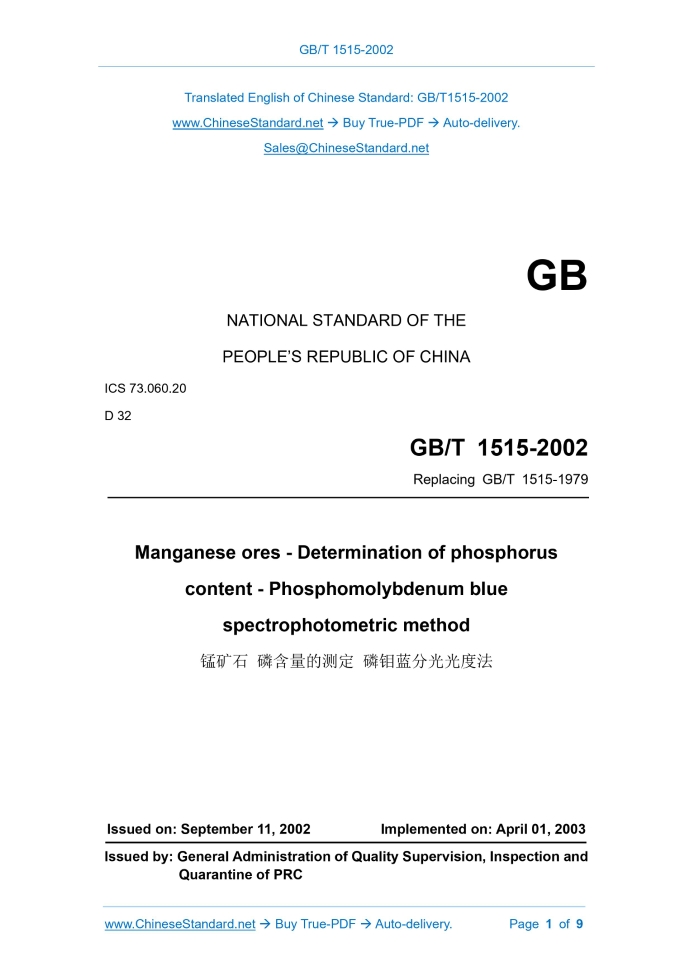
GB NATIONAL STANDARD OF THE PEOPLE’S REPUBLIC OF CHINA ICS 73.060.20 D 32 Replacing GB/T 1515-1979 Manganese ores - Determination of phosphorus content - Phosphomolybdenum blue spectrophotometric method ISSUED ON: SEPTEMBER 11, 2002 IMPLEMENTED ON: APRIL 01, 2003 Issued by: General Administration of Quality Supervision, Inspection and Quarantine of PRC
Table of Contents
Foreword ... 3 1 Scope ... 4 2 Normative references ... 4 3 Principles ... 4 4 Reagents and materials ... 5 5 Instruments ... 5 6 Sampling and specimen preparation ... 6 7 Analytical procedures ... 6 8 Result calculation ... 8 9 Tolerance ... 8 10 Test report ... 8 Manganese ores - Determination of phosphorus content - Phosphomolybdenum blue spectrophotometric method WARNING: Persons using this Part shall have practical experience in formal laboratory work. This Part does not address all possible security issues. It is the user's responsibility, to take appropriate safety and health measures AND to ensure compliance with the conditions stipulated by relevant national regulations.1 Scope
This Part specifies the principles, reagents and materials, instruments, sampling and specimen preparation, analytical procedures, calculation of results, etc., for the determination of phosphorus content, through the phosphomolybdenum blue spectrophotometric method. This Part applies to the determination of phosphorus content in manganese ore and aluminum concentrate; the determination range (mass fraction) is: 0.010% ~ 1.00%.2 Normative references
The provisions in following documents become the provisions of this Part through reference in this Part. For the dated references, the subsequent amendments (excluding corrections) or revisions do not apply to this Part; however, parties who reach an agreement based on this Part are encouraged to study if the latest versions of these documents are applicable. For undated references, the latest edition of the referenced document applies. GB/T 2011 Method of sampling and sample preparation of manganese ores in bulk GB/T 14949.8-1994 Manganese ores - Determination of hygroscopic moisture content in analytical samples3 Principles
The sample is decomposed by hydrochloric acid, hydrofluoric acid, sulfuric acid; the residue is melted; the pentavalent arsenic is reduced by sodium carbonate to trivalent arsenic. Phosphorus (V) and ammonium molybdate form molybdophosphoric heteropoly acid. After reduced by ascorbic acid, it forms phosphomolybdenum blue. Then the absorbance is measured, the phosphorus content is calculated.4 Reagents and materials
Unless otherwise stated, only reagents confirmed to be analytically pure and distilled water or water of equivalent purity are used in the analysis. 4.1 Anhydrous sodium carbonate. 4.2 Hydrofluoric acid (ρ1.14 gm/L). 4.3 Hydrochloric acid (ρ1.19 gm/L). 4.4 Hydrochloric acid (1 + 50). 4.5 Sulfuric acid (1 + 1). 4.6 Sulfuric acid (1 + 3). 4.7 Potassium iodide solution (200 g/L). 4.8 Ascorbic acid solution (10 g/L), which is prepared at the time of use. 4.9 Ammonium molybdate solution (40 g/L). 4.10 Phosphorus standard solution 4.10.1 Weigh 0.4394 g of the reference potassium dihydrogen phosphate, that was pre-dried at 105 °C ~ 110 °C for 2 hours AND cooled to room temperature in a desiccator. Dissolve it in water. Transfer it into a 1000 mL volumetric flask. Use water to dilute it to the mark. Mix well. 1 mL of this solution contains 100 µg of phosphorus. 4.10.2 Pipette 100.00 mL of phosphorus standard solution (4.10.1), into a 1000 mL volumetric flask. Use water to dilute it the mark. Mix well. 1 mL of this solution contains 10 µg of phosphorus.5 Instruments
The usual laboratory instruments are used in the analysis. water to wash the crucible. Add 1.5 mL of sulfuric acid (4.5). Concentrate the solution to 10 mL ~ 15 mL. 7.3.1.3 Add 5 mL of potassium iodide solution (4.7). Heat it to a slight boil. After cooling, transfer the solution into a 100 mL volumetric flask. Use water to dilute it to the mark. Mix well. Use fast filter paper to make dry-filtration (the filtrate should not be placed for a long time, to prevent trivalent arsenic from being re- oxidized to pentavalent arsenic). 7.3.2 Color development and measurement 7.3.2.1 Divide the filtrate into a 50 mL volumetric flask, according to Table 2. Add 5.5 mL of sulfuric acid (4.6). Add 5 mL of ascorbic acid solution (4.8). Mix well. Add water along the bottle wall, to about 40 mL. Add 4.0 mL of ammonium molybdate solution (4.9), whilst shaking it. Use water to rinse the bottle neck. Mix well. Heat in a boiling water bath, for 5 min. Remove it. Use running water to cool it to room temperature. Use water to dilute it to the mark. Mix well. Put in a spectrophotometer. Use a 1 cm absorbing dish, to measure the absorbance. Find out the corresponding amount of phosphorus from the calibration curve. 7.3.2.2 Selection of measurement wavelength: When the phosphorus content (mass fraction) is ≤ 0.04%, use 825 nm; when the phosphorus content (mass fraction) > 0.04%, use 700 nm. 7.3.3 Plotting the calibration curve 7.3.3.1 Pipette 0 mL, 2.00 mL, 4.00 mL, 6.00 mL, 8.00 mL, 10.00 mL of phosphorus standard solution (4.10.2), respectively, into a group of 50 mL volumetric flasks. Add 6.5 mL of sulfuric acid (4.6). Then carry out color development, according to 7.3.2.1, from "Add 5 mL of ascorbic acid solution". Measure the absorbance at 700 nm AND draw a calibration curve. 7.3.3.2 Pipette 0 mL, 0.50 mL, 1.00 mL, 2.00 mL, 3.00 mL, 4.00 mL of phosphorus standard solution (4.10.2), respectively, into a group of 50 mL volumetric flasks. Add 6.5 mL of sulfuric acid (4.6). Then carry out color development, according to 7.3.2.1, from "Add 5 mL of ascorbic acid solution". Measure the absorbance at 825 nm AND draw a calibration curve. ......Source: Above contents are excerpted from the full-copy PDF -- translated/reviewed by: www.ChineseStandard.net / Wayne Zheng et al.