GB/T 14517-1993 PDF English
Price & Delivery
US$205.00 · In stock · Download in 9 secondsGB/T 14517-1993: Test method for dielectric strength of insulating adhesive tape at power frequency
Delivery: 9 seconds. True-PDF full-copy in English & invoice will be downloaded + auto-delivered via email. See step-by-step procedure
Status: Obsolete
| Standard ID | USD | BUY PDF | Delivery | Standard Title (Description) | Status |
| GB/T 14517-1993 | 205 | Add to Cart | Auto, 9 seconds. | Test method for dielectric strength of insulating adhesive tape at power frequency | Obsolete |
Click to Preview this PDF
Similar standards
GB/T 14517-1993: Test method for dielectric strength of insulating adhesive tape at power frequency
---This is an excerpt. Full copy of true-PDF in English version (including equations, symbols, images, flow-chart, tables, and figures etc.), auto-downloaded/delivered in 9 seconds, can be purchased online: https://www.ChineseStandard.net/PDF.aspx/GBT14517-1993
GB NATIONAL STANDARD OF THE PEOPLE’S REPUBLIC OF CHINA UDC 621.315.611 G 38 GB/T 14517-93 Test method for dielectric strength of insulating adhesive tape at power frequency Issued on: JUNE 15, 1993 Implemented on: APRIL 1, 1994 Issued by. State Bureau of Technical Supervision
Table of Contents
1 Subject content and application scope ... 3 2 Definitions ... 3 3 Test equipment ... 3 4 Test conditions ... 5 5 Sample ... 5 6 Test steps ... 6 7 Test report ... 6 Additional information... 7 Test method for dielectric strength of insulating adhesive tape at power frequency This Standard referred to International Electrotechnical Commission (IEC) publication 243-1-1988 “Methods of test for electric strength of solid insulating materials, Part 1. Tests at power frequencies”.1 Subject content and application scope
This Standard specifies the sample preparation, test equipment and test steps for test of dielectric strength of insulating adhesive tape at power frequency. This Standard is applicable to the determination of dielectric strength of insulating adhesive tape at power frequency.2 Definitions
Dielectric strength -- The sample is not broken down within a specified time under the action of a certain power frequency voltage, expressed in kilovolts and minutes. Breakdown -- The sample has traces of through holes, cracks, burns, etc. along the direction of the applied voltage.3 Test equipment
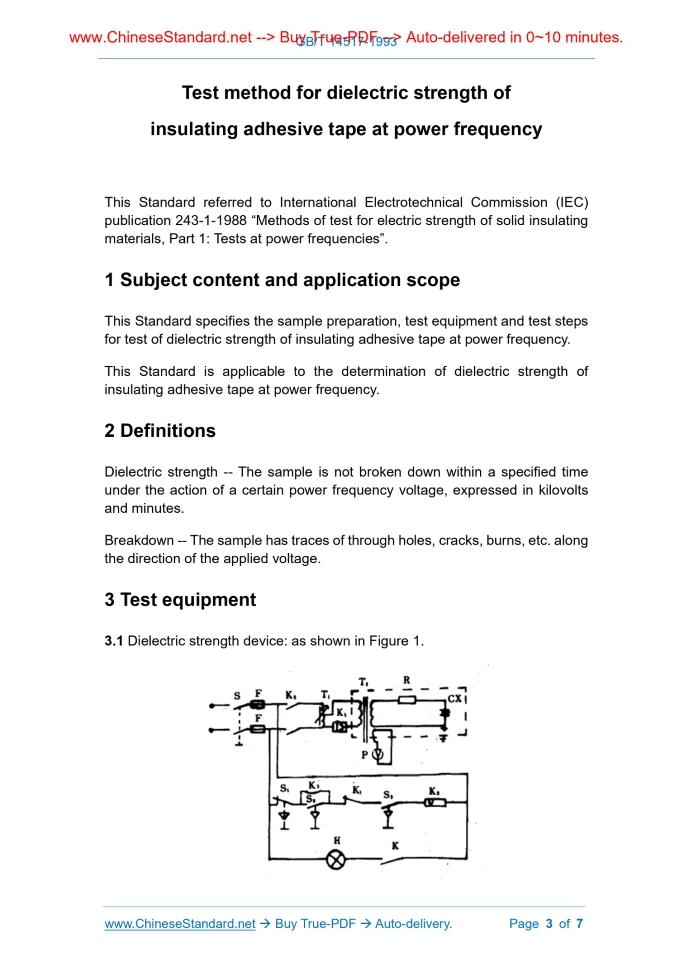
3.1 Dielectric strength device. as shown in Figure 1. The sample shall be clean, dry, free of impurities and bubbles, and the adhesive layer has no significant uneven areas.6 Test steps
6.1 Check the grounding wire of the dielectric strength device to ensure good grounding. 6.2 Loosen the wing nut on the top of the electrode assembly, take out the upper cover of the electrode device, and install the sample as shown in Figure 2. In order to prevent arcing at the edge of the sample, an insulating adhesive tape can be used to overlap the sample at the edge of the sample. Install the upper cover and tighten the wing nut. 6.3 Connect one end of the high voltage cable to the AC high voltage output of the dielectric strength device AND the other end to an upper electrode of the electrode device. 6.4 Connect one end of the test cable to the test end of the dielectric strength device and the other end to the lower electrode of the electrode assembly. 6.5 Select the voltage range on the dielectric strength device according to the specified test voltage. 6.6 Select the time range on the dielectric strength device according to the specified dielectric strength time. 6.7 Turn on the power, turn on the power switch of the dielectric strength device, and warm up the device for a few minutes. 6.8 The tester stands on the insulating rubber plate, press the voltage-rise switch to continuously and evenly rise to the test voltage within 10~20 s. At the same time, press the stopwatch to start timing. 6.9 When the dielectric strength time is over, press the return switch to lower the voltage to zero and remove the sample. 6.10 If the sample is broken during the voltage-rise process or during the dielectric strength, the test voltage is automatically reduced to zero. Remove the sample and observe the part where the sample is in contact with the electrode. Record the form in which the sample is broken down, such as small holes, cracking, charring, etc.7 Test report
The test report shall contain the following information. ......Source: Above contents are excerpted from the full-copy PDF -- translated/reviewed by: www.ChineseStandard.net / Wayne Zheng et al.