GB/T 14454.1-2008 PDF English
Price & Delivery
US$85.00 · In stock · Download in 9 secondsGB/T 14454.1-2008: Fragrance/Flavor substances -- Preparation of test samples
Delivery: 9 seconds. True-PDF full-copy in English & invoice will be downloaded + auto-delivered via email. See step-by-step procedure
Status: Valid
GB/T 14454.1: Historical versions
| Standard ID | USD | BUY PDF | Delivery | Standard Title (Description) | Status |
| GB/T 14454.1-2008 | 85 | Add to Cart | Auto, 9 seconds. | Fragrance/Flavor substances -- Preparation of test samples | Valid |
| GB/T 14454.1-1993 | 199 | Add to Cart | 2 days | Aromatics. Preparation of test sample | Obsolete |
Click to Preview this PDF
Similar standards
GB/T 14454.1-2008: Fragrance/Flavor substances -- Preparation of test samples
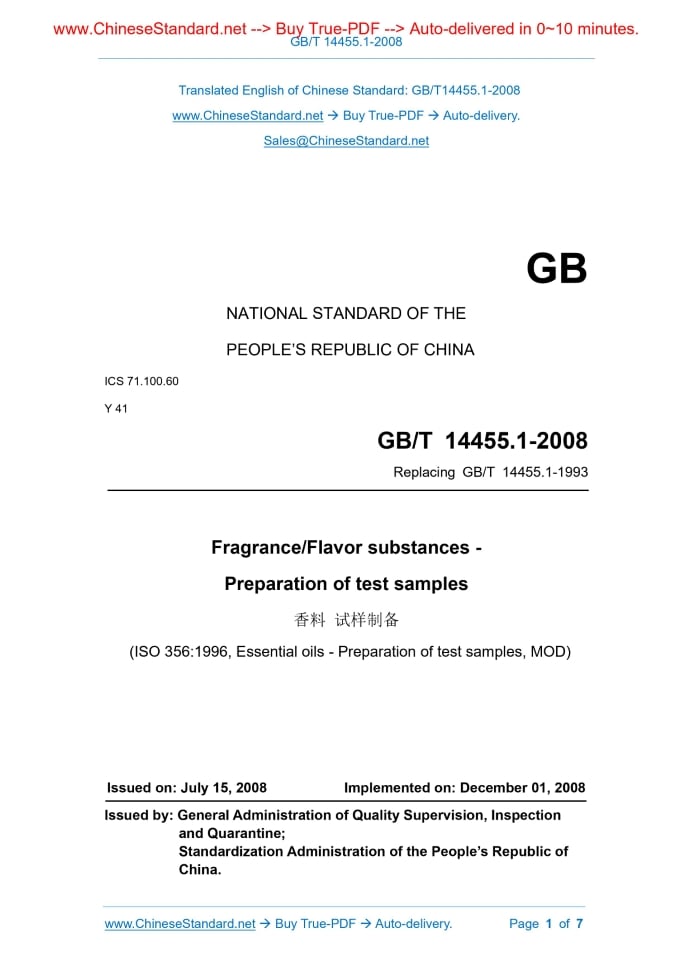
---This is an excerpt. Full copy of true-PDF in English version (including equations, symbols, images, flow-chart, tables, and figures etc.), auto-downloaded/delivered in 9 seconds, can be purchased online: https://www.ChineseStandard.net/PDF.aspx/GBT14454.1-2008NATIONAL STANDARD OF THE PEOPLE’S REPUBLIC OF CHINA ICS 71.100.60 Y 41 Replacing GB/T 14455.1-1993 Fragrance/Flavor substances - Preparation of test samples (ISO 356:1996, Essential oils - Preparation of test samples, MOD) ISSUED ON: JULY 15, 2008 IMPLEMENTED ON: DECEMBER 01, 2008 Issued by: General Administration of Quality Supervision, Inspection and Quarantine; Standardization Administration of the People’s Republic of China.
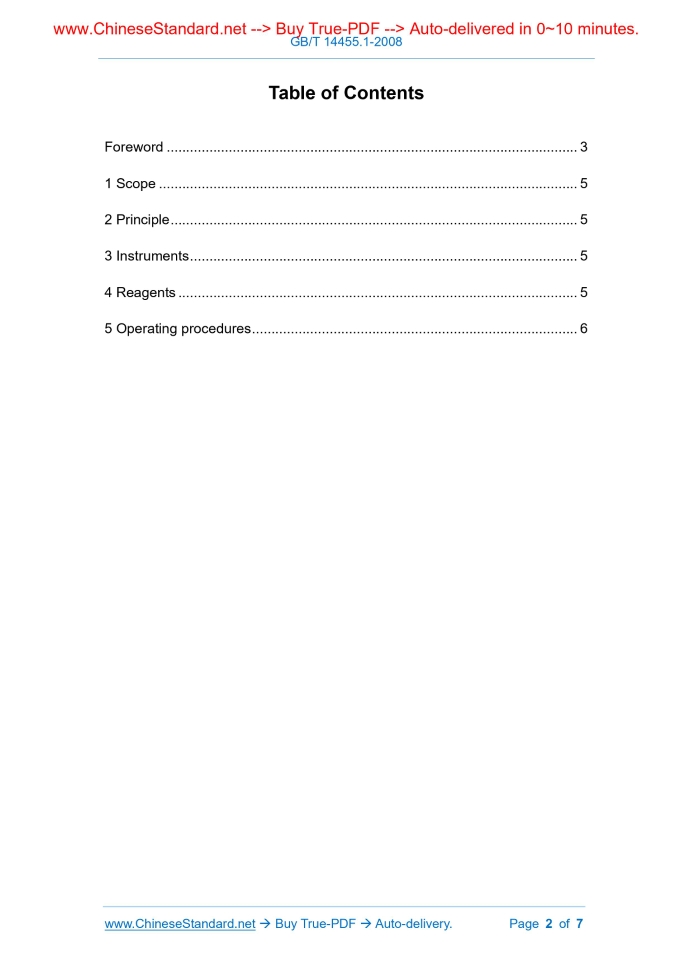
Table of Contents
Foreword ... 3 1 Scope ... 5 2 Principle ... 5 3 Instruments ... 5 4 Reagents ... 5 5 Operating procedures ... 6Foreword
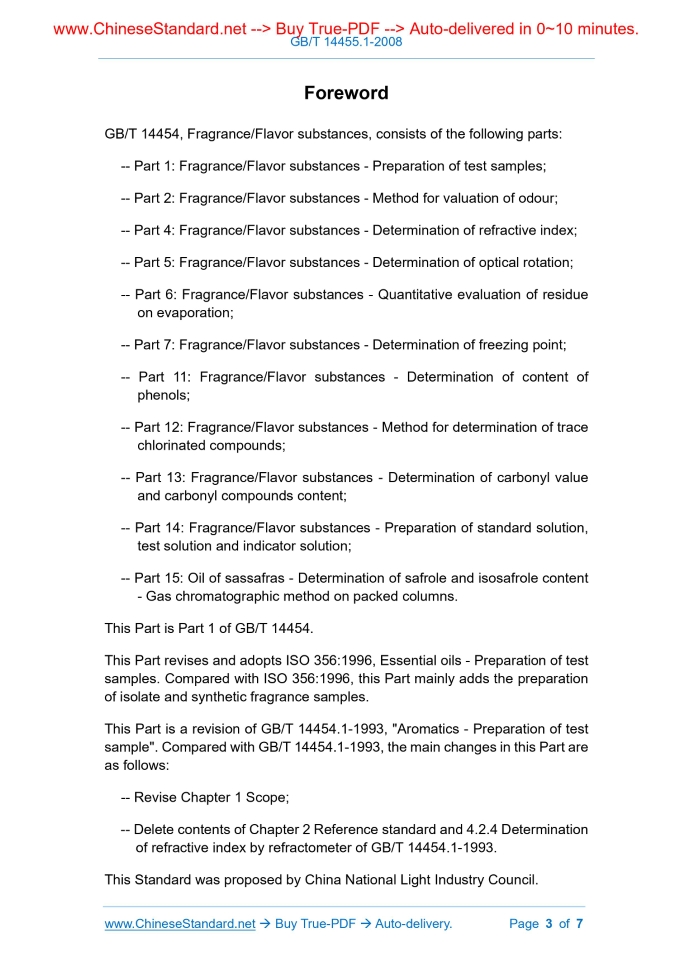
GB/T 14454, Fragrance/Flavor substances, consists of the following parts: -- Part 1: Fragrance/Flavor substances - Preparation of test samples; -- Part 2: Fragrance/Flavor substances - Method for valuation of odour; -- Part 4: Fragrance/Flavor substances - Determination of refractive index; -- Part 5: Fragrance/Flavor substances - Determination of optical rotation; -- Part 6: Fragrance/Flavor substances - Quantitative evaluation of residue on evaporation; -- Part 7: Fragrance/Flavor substances - Determination of freezing point; -- Part 11: Fragrance/Flavor substances - Determination of content of phenols; -- Part 12: Fragrance/Flavor substances - Method for determination of trace chlorinated compounds; -- Part 13: Fragrance/Flavor substances - Determination of carbonyl value and carbonyl compounds content; -- Part 14: Fragrance/Flavor substances - Preparation of standard solution, test solution and indicator solution; -- Part 15: Oil of sassafras - Determination of safrole and isosafrole content - Gas chromatographic method on packed columns. This Part is Part 1 of GB/T 14454. This Part revises and adopts ISO 356:1996, Essential oils - Preparation of test samples. Compared with ISO 356:1996, this Part mainly adds the preparation of isolate and synthetic fragrance samples. This Part is a revision of GB/T 14454.1-1993, "Aromatics - Preparation of test sample". Compared with GB/T 14454.1-1993, the main changes in this Part are as follows: -- Revise Chapter 1 Scope; -- Delete contents of Chapter 2 Reference standard and 4.2.4 Determination of refractive index by refractometer of GB/T 14454.1-1993. This Standard was proposed by China National Light Industry Council. Fragrance/Flavor substances - Preparation of test samples1 Scope
This part of GB/T 14454 stipulates the preparation principle, instruments, reagents and operating procedures of fragrance samples for laboratory analysis. This Part applies to the preparation of essential oil, isolate and synthetic fragrance samples. This Part is particularly applicable to fragrances that cannot be directly analyzed, that is, fragrances that are solid or semi-solid at room temperature or those that are cloudy due to containing of water or suspended particles. This Part does not apply to samples for moisture determination.2 Principle
Add magnesium sulfate or sodium sulfate to the fragrance that is liquid at room temperature or that needs to be heated to an appropriate temperature to be liquid; then, filter to remove moisture and insoluble substances in the sample.3 Instruments
Commonly used instruments in the laboratory, especially the following instruments: 3.1 Oven. 3.2 Conical flask. 3.3 Appropriate filtering device.4 Reagents
4.1 All the used reagents are analytical reagents. 4.2 Freshly dried, neutral magnesium sulfate or freshly dried sodium sulfate: heat magnesium sulfate or sodium sulfate at 180 °C ~ 200 °C (read the temperature from the continuously stirred material); dry to constant weight (it ......Source: Above contents are excerpted from the full-copy PDF -- translated/reviewed by: www.ChineseStandard.net / Wayne Zheng et al.