GB/T 13083-2018 PDF English
Price & Delivery
US$85.00 · In stock · Download in 9 secondsGB/T 13083-2018: Determination of fluorine in feeds -- Ion selective electrode method
Delivery: 9 seconds. True-PDF full-copy in English & invoice will be downloaded + auto-delivered via email. See step-by-step procedure
Status: Valid
GB/T 13083: Historical versions
| Standard ID | USD | BUY PDF | Delivery | Standard Title (Description) | Status |
| GB/T 13083-2018 | 85 | Add to Cart | Auto, 9 seconds. | Determination of fluorine in feeds -- Ion selective electrode method | Valid |
| GB/T 13083-2002 | 239 | Add to Cart | 3 days | Determination of fluorine in feed -- Ion selective electrode method | Obsolete |
| GB/T 13083-1991 | 199 | Add to Cart | 2 days | Method for determination of fluorine in feeds | Obsolete |
Click to Preview this PDF
Similar standards
GB/T 13083-2018: Determination of fluorine in feeds -- Ion selective electrode method
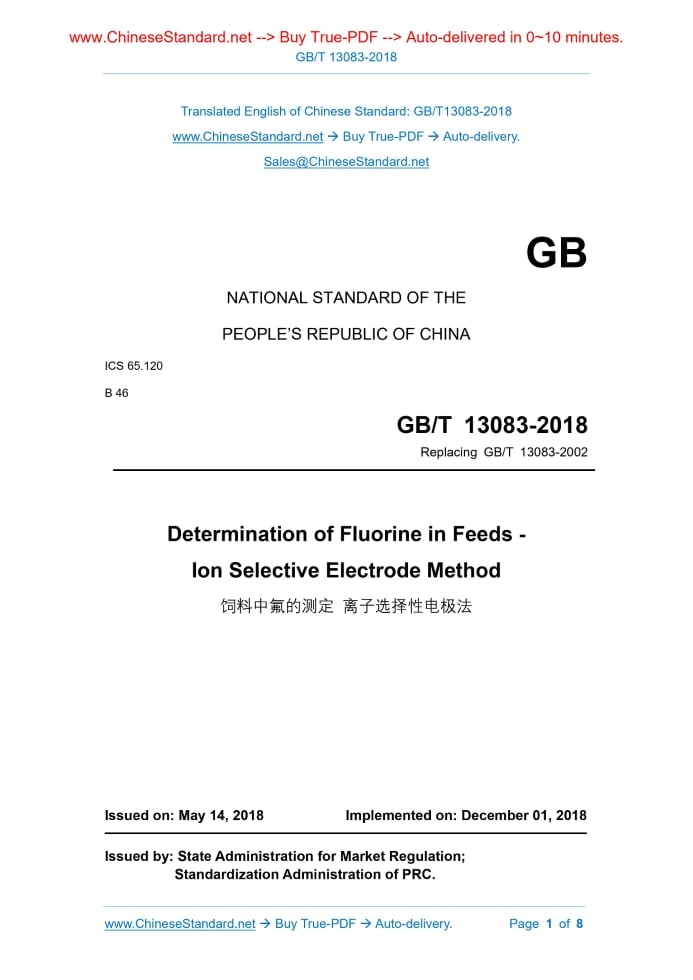
---This is an excerpt. Full copy of true-PDF in English version (including equations, symbols, images, flow-chart, tables, and figures etc.), auto-downloaded/delivered in 9 seconds, can be purchased online: https://www.ChineseStandard.net/PDF.aspx/GBT13083-2018GB NATIONAL STANDARD OF THE PEOPLE’S REPUBLIC OF CHINA ICS 65.120 B 46 Replacing GB/T 13083-2002 Determination of Fluorine in Feeds - Ion Selective Electrode Method Issued on. MAY 14, 2018 Implemented on. DECEMBER 01, 2018 Issued by. State Administration for Market Regulation; Standardization Administration of PRC.
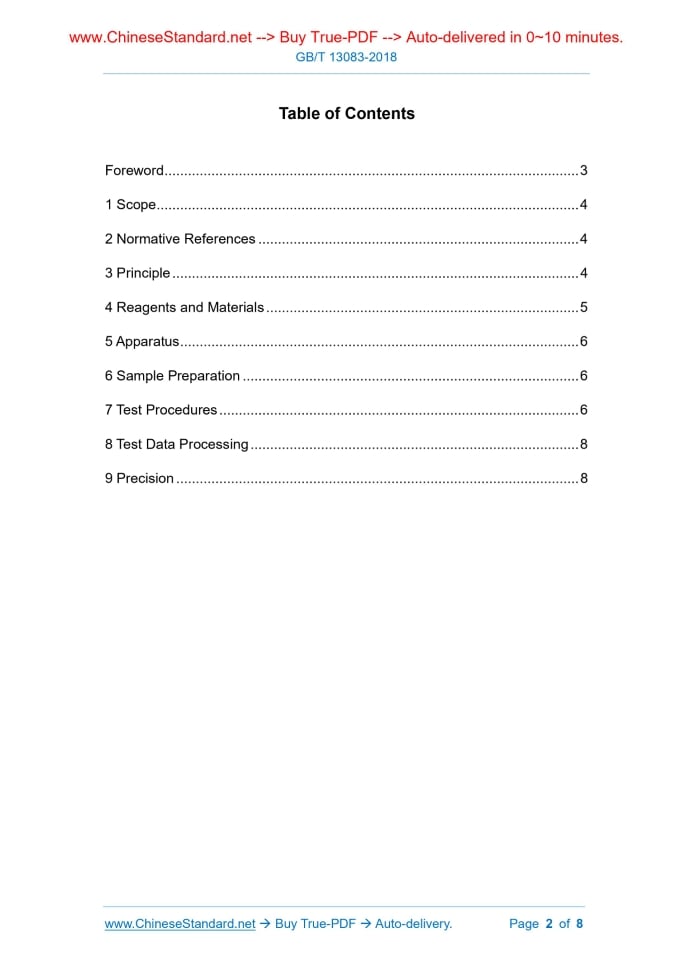
Table of Contents
Foreword... 3 1 Scope... 4 2 Normative References... 4 3 Principle... 4 4 Reagents and Materials... 5 5 Apparatus... 6 6 Sample Preparation... 6 7 Test Procedures... 6 8 Test Data Processing... 8 9 Precision... 8Foreword
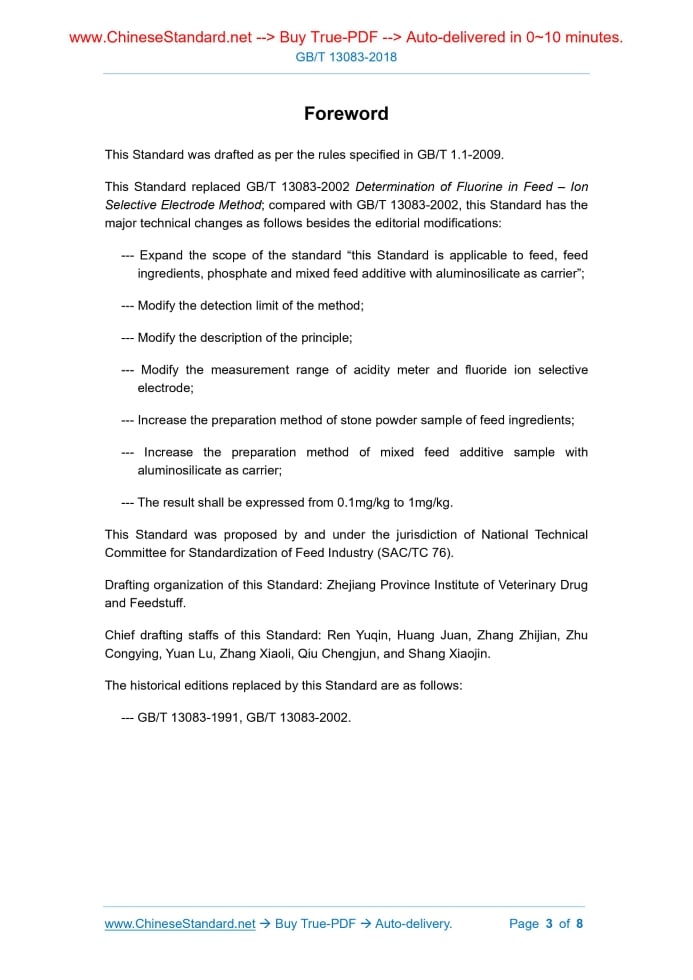
This Standard was drafted as per the rules specified in GB/T 1.1-2009. This Standard replaced GB/T 13083-2002 Determination of Fluorine in Feed – Ion Selective Electrode Method; compared with GB/T 13083-2002, this Standard has the major technical changes as follows besides the editorial modifications. --- Expand the scope of the standard “this Standard is applicable to feed, feed ingredients, phosphate and mixed feed additive with aluminosilicate as carrier”; --- Modify the detection limit of the method; --- Modify the description of the principle; --- Modify the measurement range of acidity meter and fluoride ion selective electrode; --- Increase the preparation method of stone powder sample of feed ingredients; --- Increase the preparation method of mixed feed additive sample with aluminosilicate as carrier; --- The result shall be expressed from 0.1mg/kg to 1mg/kg. This Standard was proposed by and under the jurisdiction of National Technical Committee for Standardization of Feed Industry (SAC/TC 76). Drafting organization of this Standard. Zhejiang Province Institute of Veterinary Drug and Feedstuff. Chief drafting staffs of this Standard. Ren Yuqin, Huang Juan, Zhang Zhijian, Zhu Congying, Yuan Lu, Zhang Xiaoli, Qiu Chengjun, and Shang Xiaojin. The historical editions replaced by this Standard are as follows. --- GB/T 13083-1991, GB/T 13083-2002. Determination of Fluorine in Feeds - Ion Selective Electrode Method1 Scope
This Standard specifies using ion selective electrode method to determine the fluorine in the feeds. This Standard is applicable to the feed, feed ingredients, phosphate and mixed feed additive with aluminosilicate as carrier. The detection limit of this method is 3mg/kg (take 1g of sample, make constant volume to 50mL).2 Normative References
The following documents are essential to the application of this document. For the dated documents, only the versions with the dates indicated are applicable to this document; for the undated documents, only the latest version (including all the amendments) are applicable to this document. GB/T 6682 Water for Analytical Laboratory Use – Specification and Test Methods GB/T 14699.1 Feeding Stuffs – Sampling GB/T 20195 Animal Feeding Stuffs – Preparation of Test Samples3 Principle
The sample is extracted by hydrochloric acid solution; use total ionic strength buffer solution to adjust the pH to be 5~6; eliminate the acidity and the ion interference such as Al3+, Fe3+, Ca2+, Mg2+, and SiO32- that can form complexes with fluoride ion; then use ion meter to measure the potential difference between the fluoride ion selective electrode and the saturated calomel electrode; such potential difference is linear with the logarithm of the fluoride ion activity (concentration) in the solution;4 Reagents and Materials
Unless otherwise stated, the reagents used in this method shall be analytical reagent; water shall be Class-III water specified in GB/T 6682. 4.1 Hydrochloric acid. 4.2 Sodium acetate solution (3mol/L). take 204g of sodium acetate trihydrate; add about 300mL of water; adjust the pH to be 7.0 by acetic acid solution (1→10); transfer into a 500mL volumetric flask; add water to the scale. 4.6 NaOH solution (15mol/L). take 60g of sodium hydroxide; add water to dissolve into 100mL. 4.7 Fluorine standard solution.5 Apparatus
5.1 Analytical balance. sensitivity of 0.0001g. 5.2 Ion meter. measuring range of 0.0mV~±1800mV; or its equivalent pH meter or potentiometer. 5.3 Fluoride ion electrode. measuring range of 10-1 mol/L ~ 10-6 mol/L; pF-1 type or its equivalent composite electrode. 5.7 Magnetic stirrer. 5.8 Ultrasonic extractor. 5.9 Nickel crucible or platinum crucible.6 Sample Preparation
Take representative sample according to the provisions of GB/T 14699.1; take about 250g of reduced sample by quadruple method; prepare the sample as per the provision of GB/T 20195;7 Test Procedures
7.1 Preparation of fluorine standard series Accurately pipette 0.5mL, 1.00mL, 2.00mL, 5.00mL, 10.00mL of fluorine standard working solution II [4.7c)] and 2.00mL, 5.00mL of fluorine standard working solution I [4.7b)]; separately place them into 50mL volumetric flasks; separately add 5.0mL of hydrochloric acid solution (4.5), 25mL of total ionic strength buffer solution (4.4); add water to the scale; mix evenly. The concentrations of the above standard series are 0.1µg/mL, 0.2µg/mL, 0.4µg/mL, 1.0µg/mL, 2.0µg/mL, 4.0µg/mL, 10.0µg/mL. 7.2 Preparation of sample solution 7.2.1 Preparation of feeds and feed ingredients (except for the three types listed in 7.2.2, 7.2.3 and 7.2.4) sample solutions 7.2.3 Preparation of stone powder sample solution Take about 0.5g~1g (accurate to 0.0001) of sample; place into a 50mL volumetric flask; slowly add 20mL (prevent the reaction is too violent and spill) of hydrochloric acid solution (4.5); extract for 1h (slightly shake the volumetric flask from time to time to avoid the sample sticking to the flask wall); or perform ultrasonic extraction for 20min; after extraction, add 25mL of total ionic strength buffer solution (4.4); add water to the scale; mix evenly; filter by filter paper. 7.2.4 Preparation of mixed feed additive sample solution with aluminosilicate as carrier 7.3 Measurement Connect the fluoride ion selective electrode and saturated calomel electrode with the negative and positive ends of the ion meter. Insert the electrode into a polyethylene plastic cup containing 50mL of water; preheat the instrument; stir at a constant speed on the magnetic stirring function; replace the water for twice or three times; after the potential is stable, the potential can be measured.8 Test Data Processing
The fluorine content in the sample, X, shall be calculated as per the Formula (1), in mg/kg.9 Precision
In the same laboratory, two independent test results are obtained by the same operator using the same equipment and the same measurement method against the same test object within a short time. when the fluorine content in the sample is less than or equal to 50mg/kg, the absolute difference shall be no more than 20% of the arithmetic mean of the two measured values; when the fluorine content in the sample is greater than 50mg/kg, the absolute difference shall be no more than 10% of the arithmetic mean of the two measured values. ......Source: Above contents are excerpted from the full-copy PDF -- translated/reviewed by: www.ChineseStandard.net / Wayne Zheng et al.