GB/T 12914-2018 PDF English
Price & Delivery
US$170.00 · In stock · Download in 9 secondsGB/T 12914-2018: Paper and board -- Determination of tensile properties -- Constant rate of elongation method (20mm/min)
Delivery: 9 seconds. True-PDF full-copy in English & invoice will be downloaded + auto-delivered via email. See step-by-step procedure
Status: Valid
GB/T 12914: Historical versions
| Standard ID | USD | BUY PDF | Delivery | Standard Title (Description) | Status |
| GB/T 12914-2018 | 170 | Add to Cart | Auto, 9 seconds. | Paper and board -- Determination of tensile properties -- Constant rate of elongation method (20mm/min) | Valid |
| GB/T 12914-2008 | 140 | Add to Cart | Auto, 9 seconds. | Paper and board -- Determination of tensile properties | Obsolete |
| GB/T 12914-1991 | 279 | Add to Cart | 3 days | Paper and board--Determination of tensile properties--Constant rate of elongation method | Obsolete |
Click to Preview this PDF
Similar standards
GB/T 12914-2018: Paper and board -- Determination of tensile properties -- Constant rate of elongation method (20mm/min)
---This is an excerpt. Full copy of true-PDF in English version (including equations, symbols, images, flow-chart, tables, and figures etc.), auto-downloaded/delivered in 9 seconds, can be purchased online: https://www.ChineseStandard.net/PDF.aspx/GBT12914-2018
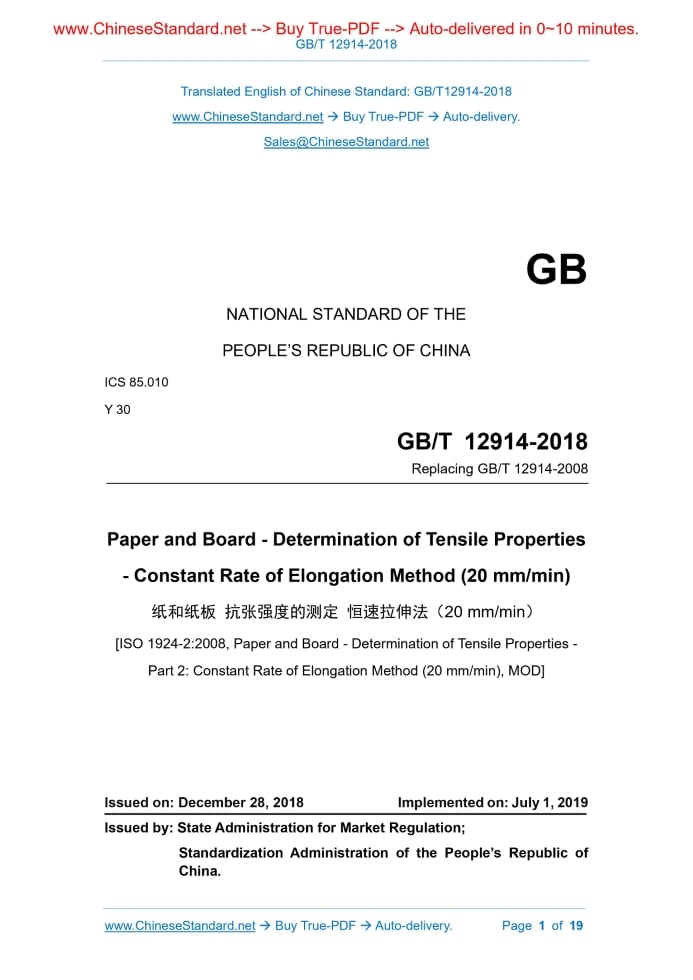
NATIONAL STANDARD OF THE PEOPLE’S REPUBLIC OF CHINA ICS 85.010 Y 30 Replacing GB/T 12914-2008 Paper and Board - Determination of Tensile Properties - Constant Rate of Elongation Method (20 mm/min) [ISO 1924-2.2008, Paper and Board - Determination of Tensile Properties - Part 2.Constant Rate of Elongation Method (20 mm/min), MOD] Issued on. DECEMBER 28, 2018 Implemented on. JULY 1, 2019 Issued by. State Administration for Market Regulation; Standardization Administration of the People’s Republic of China.
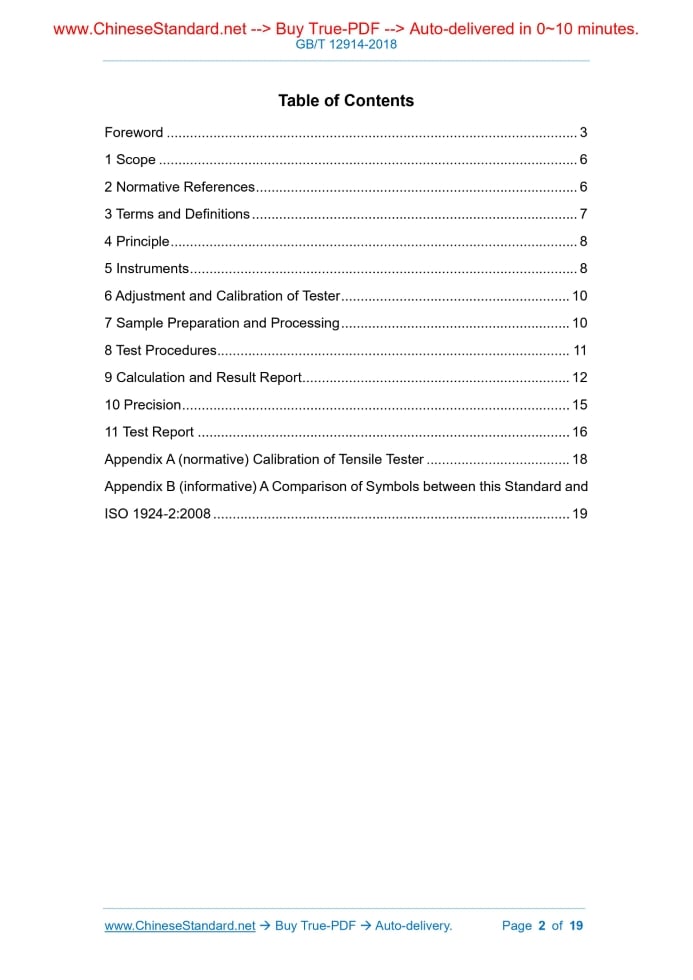
Table of Contents
Foreword... 3 1 Scope... 6 2 Normative References... 6 3 Terms and Definitions... 7 4 Principle... 8 5 Instruments... 8 6 Adjustment and Calibration of Tester... 10 7 Sample Preparation and Processing... 10 8 Test Procedures... 11 9 Calculation and Result Report... 12 10 Precision... 15 11 Test Report... 16 Appendix A (normative) Calibration of Tensile Tester... 18 Appendix B (informative) A Comparison of Symbols between this Standard and ISO 1924-2.2008... 19Foreword
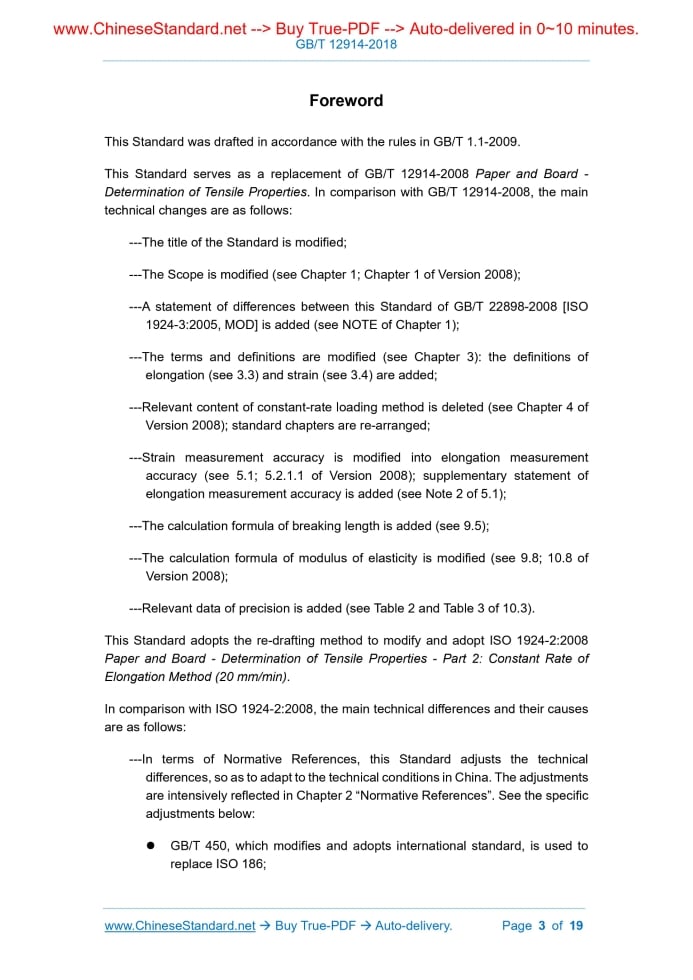
This Standard was drafted in accordance with the rules in GB/T 1.1-2009. This Standard serves as a replacement of GB/T 12914-2008 Paper and Board - Determination of Tensile Properties. In comparison with GB/T 12914-2008, the main technical changes are as follows. ---The title of the Standard is modified; ---The Scope is modified (see Chapter 1; Chapter 1 of Version 2008); ---A statement of differences between this Standard of GB/T 22898-2008 [ISO 1924-3.2005, MOD] is added (see NOTE of Chapter 1); ---The terms and definitions are modified (see Chapter 3). the definitions of elongation (see 3.3) and strain (see 3.4) are added; ---Relevant content of constant-rate loading method is deleted (see Chapter 4 of Version 2008); standard chapters are re-arranged; ---Strain measurement accuracy is modified into elongation measurement accuracy (see 5.1; 5.2.1.1 of Version 2008); supplementary statement of elongation measurement accuracy is added (see Note 2 of 5.1); ---The calculation formula of breaking length is added (see 9.5); ---The calculation formula of modulus of elasticity is modified (see 9.8; 10.8 of Version 2008); ---Relevant data of precision is added (see Table 2 and Table 3 of 10.3). This Standard adopts the re-drafting method to modify and adopt ISO 1924-2.2008 Paper and Board - Determination of Tensile Properties - Part 2.Constant Rate of Elongation Method (20 mm/min). In comparison with ISO 1924-2.2008, the main technical differences and their causes are as follows. ---In terms of Normative References, this Standard adjusts the technical differences, so as to adapt to the technical conditions in China. The adjustments are intensively reflected in Chapter 2 “Normative References”. See the specific adjustments below. GB/T 450, which modifies and adopts international standard, is used to replace ISO 186; GB/T 451.2, which equivalently adopts international standard, is used to replace ISO 536; GB/T 451.3, which identically adopts international standard, is used to replace ISO 534; GB/T 10739, which equivalently adopts international standard, is used to replace ISO 187; ---In view of the fact that breaking length index is still extensively used in China, the definition and calculation formula of breaking length are added (see 3.6 and 9.5); This Standard makes the following editorial modifications. ---With reference to ISO 1924-3, a supplementary statement of elongation measurement accuracy is provided (see NOTE 2 of 5.1.2), so as to distinguish different test items’ different requirements for elongation measurement accuracy; ---The letter codes of various tensile property indexes are modified (see Chapter 9), so as to facilitate instrument display, printing, and maintain consistency with relevant standards; ---The unit of tensile property is modified (see 9.3), the numerical value remains the same, so as to maintain consistency with relevant product standards and the existing instruments; ---Appendix B (informative) is added, which is a comparison of symbols between this Standard and ISO 1924-2.2008. Please be noted that certain content of this document might involve patents. The issuing institution of this document does not undertake the responsibility of identifying these patents. This Standard was proposed by China Light Industry Council. This Standard shall be under the jurisdiction of National Technical Committee 141 on Paper Industry of Standardization Administration of China (SAC/TC 141). The drafting organizations of this Standard. Sichuan Changjiang Papermaking Instrument Co., Ltd.; Shandong Century Sunshine Paper Group Co., Ltd.; China National Pulp and Paper Research Institute Co., Ltd.; National Paper Product Quality Supervision & Inspection Center. The main drafters of this Standard. Yin Baochun, Li Defei, Wen Jianyu, Sheng Yongzhong, Wang Dongxing. The issuing of the previous versions is as follows. ---GB/T 453-1989, GB/T 453-2002; ---GB/T 12914-1991, GB/T 12914-2008. Paper and Board - Determination of Tensile Properties - Constant Rate of Elongation Method (20 mm/min)1 Scope
This Standard stipulates the method of using test instrument with a constant rate of elongation (20 mm/min) to determine tensile strength, strain at break, breaking length and tensile energy absorption of paper and board. It also stipulates the calculation2 Normative References
The following documents are indispensable to the application of this document. In terms of references with a specified date, only versions with a specified date are applicable to this document. In terms of references without a specified date, the latest version (including all the modifications) is applicable to this document.3 Terms and Definitions
The following terms and definitions are applicable to this document. Strain at break refers to the ratio of the elongation at the moment of breaking to the initial test length under the specified test conditions.4 Principle
Use a tensile tester, at a constant rate of elongation, stretch a sample of the specified size to break; record its tensile force. If necessary, record its elongation. If the tensile force and elongation can be continuously recorded, then, strain at break, tensile energy absorption and modulus of elasticity can be determined.5 Instruments
It is only needed when the modulus of elasticity needs to be determined. NOTE. some tensile testers are equipped with the function of drawing the tensile force- elongation curve and calculating the modulus of elasticity without external connection with the above-mentioned devices.6 Adjustment and Calibration of Tester
In the chuck, clamp a thin aluminum foil; measure the distance between the two clamping indentations; check whether the test length is accurate.7 Sample Preparation and Processing
In accordance with GB/T 450, take samples. If tensile index or tensile energy absorption index needs to be determined, then, in accordance with the stipulations of GB/T 451.2, determine the quantification of the samples.8 Test Procedures
Start the test, till the sample breaks. Then, record the applied maximum tensile force. If necessary, record the elongation (expressed in mm), or directly read strain at break (%) from the instrument.9 Calculation and Result Report
Determine the maximum tensile force of each sample; calculate the average value of the maximum tensile force. In accordance with Formula (1), calculate tensile strength S, expressed in (kN/m).10 Precision
The results of the repeatability test in the same laboratory are listed in Table 1 with the coefficient of variation CV (within the laboratory); listed in Table 2 and Table 3 with the standard deviation of repeatability sr and the limit of repeatability r. ......Source: Above contents are excerpted from the full-copy PDF -- translated/reviewed by: www.ChineseStandard.net / Wayne Zheng et al.