GB/T 12428-2023 PDF English
Price & Delivery
US$170.00 · In stock · Download in 9 secondsGB/T 12428-2023: Laden mass calculating method for bus
Delivery: 9 seconds. True-PDF full-copy in English & invoice will be downloaded + auto-delivered via email. See step-by-step procedure
Status: Valid
GB/T 12428: Historical versions
| Standard ID | USD | BUY PDF | Delivery | Standard Title (Description) | Status |
| GB/T 12428-2023 | 170 | Add to Cart | Auto, 9 seconds. | Laden mass calculating method for bus | Valid |
| GB/T 12428-2005 | 70 | Add to Cart | Auto, 9 seconds. | Laden mass calculating method for buses | Obsolete |
| GB/T 12428-1990 | 199 | Add to Cart | 2 days | laden mass calculation of buses | Obsolete |
Click to Preview this PDF
Similar standards
GB/T 12428-2023: Laden mass calculating method for bus
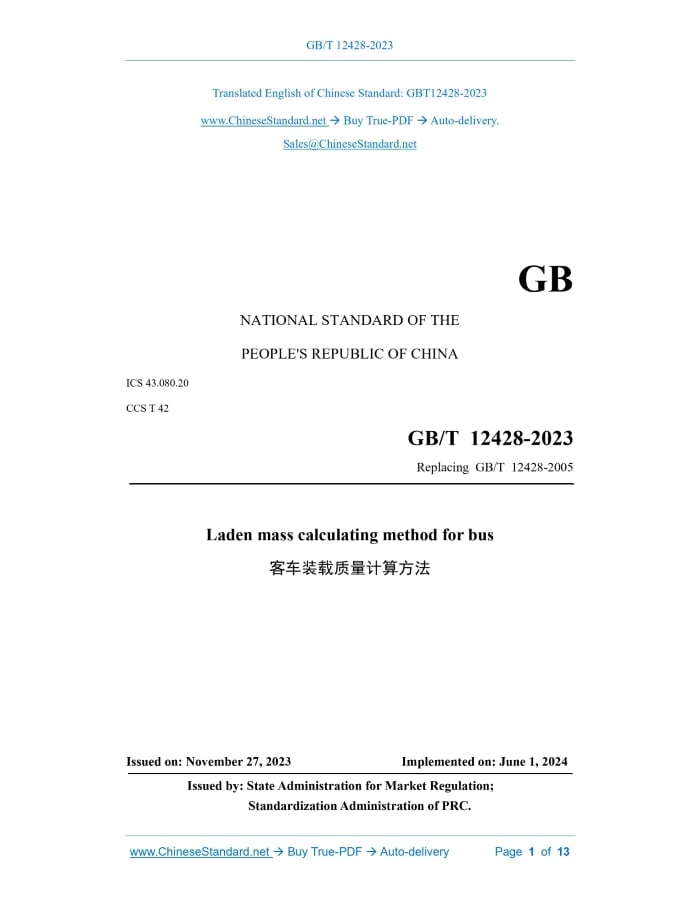
---This is an excerpt. Full copy of true-PDF in English version (including equations, symbols, images, flow-chart, tables, and figures etc.), auto-downloaded/delivered in 9 seconds, can be purchased online: https://www.ChineseStandard.net/PDF.aspx/GBT12428-2023GB NATIONAL STANDARD OF THE PEOPLE'S REPUBLIC OF CHINA ICS 43.080.20 CCS T 42 Replacing GB/T 12428-2005 Laden mass calculating method for bus Issued on. NOVEMBER 27, 2023 Implemented on. JUNE 1, 2024 Issued by. State Administration for Market Regulation; Standardization Administration of PRC.
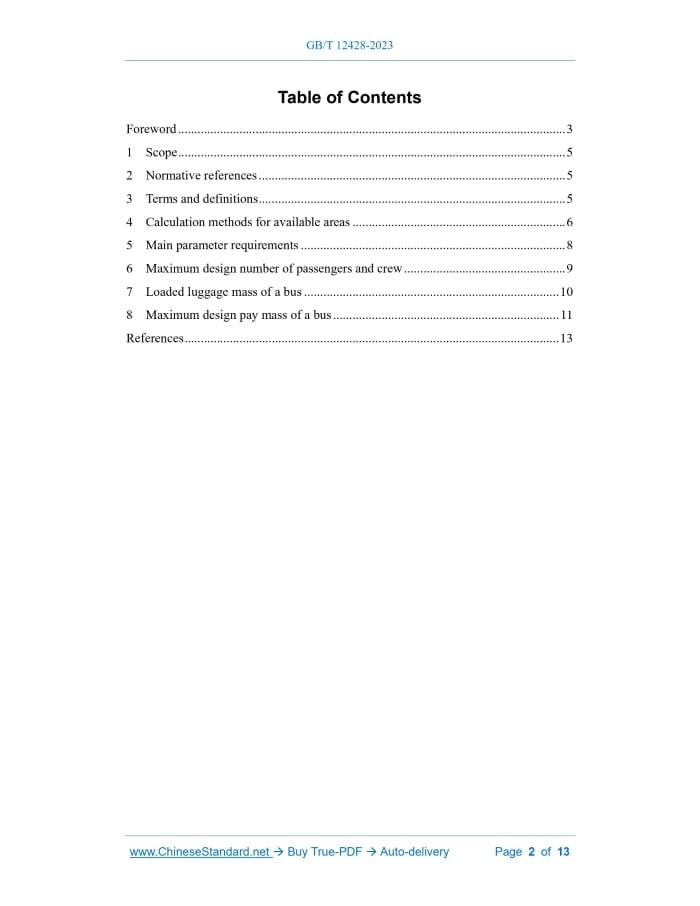
Table of Contents
Foreword... 3 1 Scope... 5 2 Normative references... 5 3 Terms and definitions... 5 4 Calculation methods for available areas... 6 5 Main parameter requirements... 8 6 Maximum design number of passengers and crew... 9 7 Loaded luggage mass of a bus... 10 8 Maximum design pay mass of a bus... 11 References... 13Foreword
This document was drafted in accordance with the provisions of GB/T1.1-2020 Directives for standardization - Part 1.Rules for the structure and drafting of standardizing documents. This document replaces GB/T 12428-2005 Laden mass calculating method for buses. Compared with GB/T 12428-2005, in addition to structural adjustments and editorial changes, the main technical changes are as follows. a) The term "passengers" is deleted (see 3.2 of the 2005 edition); b) The terms "crew" and "volume of luggage compartment" are added (see 3.2 and 3.8); c) The definitions of the terms "surface area available for passenger compartment" and "surface area available for standing passenger" are changed (see 3.4 and 3.5; see 3.4 and 3.5 of the 2005 edition); d) The calculation method of the available surface area is added (see Chapter 4); e) The average passenger mass is changed (see Table 1; see Table 1 of the 2005 edition); f) The method for calculating the number of passengers and crew is changed (see Chapter 6; see Chapter 7 of the 2005 edition); g) The method for calculating the loaded luggage mass of a bus is changed (see Chapter 7; see Chapter 8 of the 2005 edition); h) The calculation method for the maximum design pay mass of a bus is changed (see Chapter 8; see Chapter 9 of the 2005 edition). Please note that some content in this document may be subject to patents. The publisher of this document assumes no responsibility for identifying patents. This document is proposed by the Ministry of Industry and Information Technology of the People's Republic of China. This document is under the jurisdiction of the National Technical Committee of Auto Standardization (SAC/TC114). Drafting organizations of this document. China Highway Vehicle & Machinery Co., Ltd., Chang'an University, Yutong Bus Co., Ltd., Xiamen Golden Dragon Bus Co., Ltd., CRRC Times Electric Vehicle Co., Ltd., Zhongtong Bus Holding Co., Ltd., BYD Auto Industry Co., Ltd., Higer Bus Co., Ltd., China Automotive Engineering Research Institute Co., Ltd., China Merchants Testing Vehicle Technology Research Institute Co., Ltd. Main drafters of this document. Yu Yali, Shen Fulin, Song Jiangquan, Guo Jingang, Kang Tuanjie, Chen Yan, Liang Bo, Liu Houlin, Shi Hong, Cai Pengfei, Li Wei, Chu Guanyao, Li Zhaokai. This document was first published in 1990, and revised for the first time in 2005; this is the second revision. Laden mass calculating method for bus1 Scope
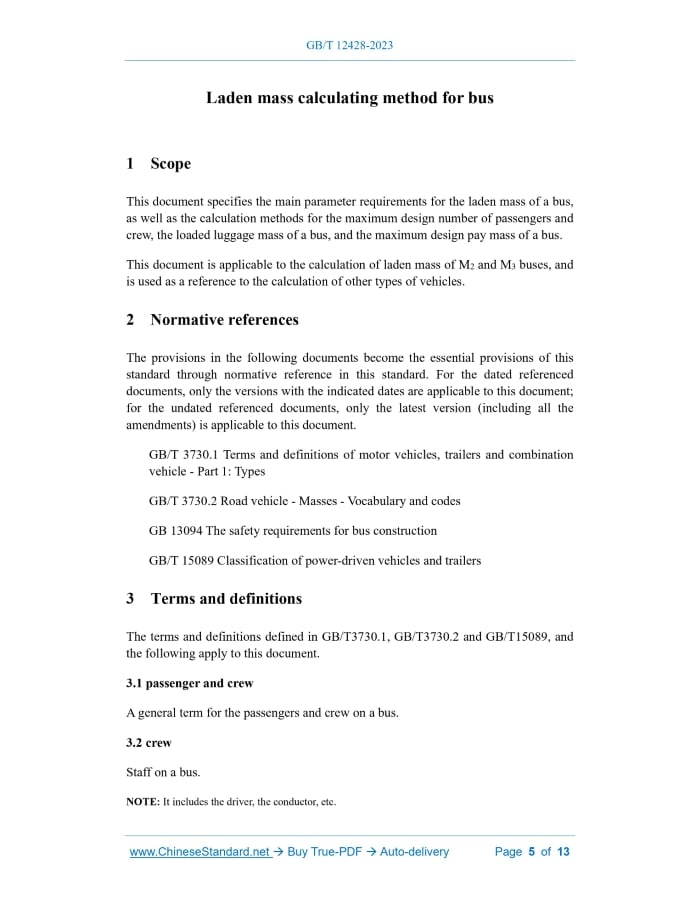
This document specifies the main parameter requirements for the laden mass of a bus, as well as the calculation methods for the maximum design number of passengers and crew, the loaded luggage mass of a bus, and the maximum design pay mass of a bus. This document is applicable to the calculation of laden mass of M2 and M3 buses, and is used as a reference to the calculation of other types of vehicles.2 Normative references
The provisions in the following documents become the essential provisions of this standard through normative reference in this standard. For the dated referenced documents, only the versions with the indicated dates are applicable to this document; for the undated referenced documents, only the latest version (including all the amendments) is applicable to this document. GB/T 3730.1 Terms and definitions of motor vehicles, trailers and combination vehicle - Part 1.Types GB/T 3730.2 Road vehicle - Masses - Vocabulary and codes GB 13094 The safety requirements for bus construction GB/T 15089 Classification of power-driven vehicles and trailers3 Terms and definitions
The terms and definitions defined in GB/T3730.1, GB/T3730.2 and GB/T15089, and the following apply to this document. 3.1 passenger and crew A general term for the passengers and crew on a bus. 3.2 crew Staff on a bus. NOTE. It includes the driver, the conductor, etc. 3.3 passenger compartment A space on a bus dedicated to passengers. 3.7 bulky luggage Other luggage carried by passengers and placed in the luggage compartment except for hand luggage. 3.8 volume of luggage compartment The available volume for bulky luggage when the bus is in operation.4 Calculation methods for available areas
4.1 Calculation of surface area available for passenger compartment The surface area available for passenger compartment shall be calculated by subtracting the following areas from the total horizontal projected area inside the bus (no double calculations). 4.2 Calculation of surface area available for standing passengers The surface area available for standing passengers shall be calculated by subtracting the following areas from the surface area available for passenger compartment (no double calculation).5 Main parameter requirements
5.1 Per capita mass of (passenger and crew) 5.1.1 The per capita mass of (passengers and crew) includes the average mass per passenger and the per capita mass of the crew. The values shall comply with the provisions of Table 1. 5.2 Surface area available per standing passenger The surface area available per standing passenger (Ssp) shall comply with the provisions of Table 2.6 Maximum design number of passengers and crew
The maximum design number of passengers and crew of a bus is calculated according to formula (1) and formula (2), and the minimum value is taken as the result. where.7 Loaded luggage mass of a bus
The loaded luggage mass of a bus is calculated according to formula (3) ~ formula (5), and the minimum value is taken as the result.8 Maximum design pay mass of a bus
The maximum design pay mass of a bus is calculated according to formula (6) and formula (7), and the maximum value is taken. ......Source: Above contents are excerpted from the full-copy PDF -- translated/reviewed by: www.ChineseStandard.net / Wayne Zheng et al.