GB 5009.276-2016 PDF English
Price & Delivery
US$110.00 · In stock · Download in 9 secondsGB 5009.276-2016: National food safety standard - Determination of Glucono Delta-Lactone in Foods
Delivery: 9 seconds. True-PDF full-copy in English & invoice will be downloaded + auto-delivered via email. See step-by-step procedure
Status: Valid
| Standard ID | USD | BUY PDF | Delivery | Standard Title (Description) | Status |
| GB 5009.276-2016 | 110 | Add to Cart | Auto, 9 seconds. | National food safety standard - Determination of Glucono Delta-Lactone in Foods | Valid |
Click to Preview this PDF
Similar standards
GB 5009.276-2016: National food safety standard - Determination of Glucono Delta-Lactone in Foods
---This is an excerpt. Full copy of true-PDF in English version (including equations, symbols, images, flow-chart, tables, and figures etc.), auto-downloaded/delivered in 9 seconds, can be purchased online: https://www.ChineseStandard.net/PDF.aspx/GB5009.276-2016GB NATIONAL STANDARD OF THE PEOPLE’S REPUBLIC OF CHINA National Food Safety Standard - Determination of Glucono Delta-Lactone in Foods ISSUED ON: DECEMBER 23, 2016 IMPLEMENTED ON: JUNE 23, 2017 Issued by: National Health and Family Planning Commission of the PRC; China Food and Drug Administration.
Table of Contents
Foreword ... 3 1 Application Scope ... 4 2 Principle ... 4 3 Reagents and Materials ... 4 4 Instruments and Apparatuses ... 5 5 Analysis Steps ... 6 6 Description of the Analysis Result ... 7 7 Precision ... 8 8 Others ... 8 9 Principle ... 8 10 Reagents and Materials ... 8 11 Instruments and Apparatuses ... 9 12 Analysis Steps ... 9 13 Description of the Analysis Result ... 10 14 Precision ... 11 15 Others ... 11 Appendix A Chromatogram of Glucono Delta-Lactone Standard Solution ... 12 National Food Safety Standard - Determination of Glucono Delta-Lactone in Foods1 Application Scope
This Standard specifies methods for the determination of glucono delta-lactone in foods. Method 1 of this standard is applicable to the determination of glucono delta-lactone content in meat, meat products, soy products and beverages; method 2 of this standard is applicable to the determination of glucono delta-lactone content in foods. Method 1 -- Spectrophotometry2 Principle
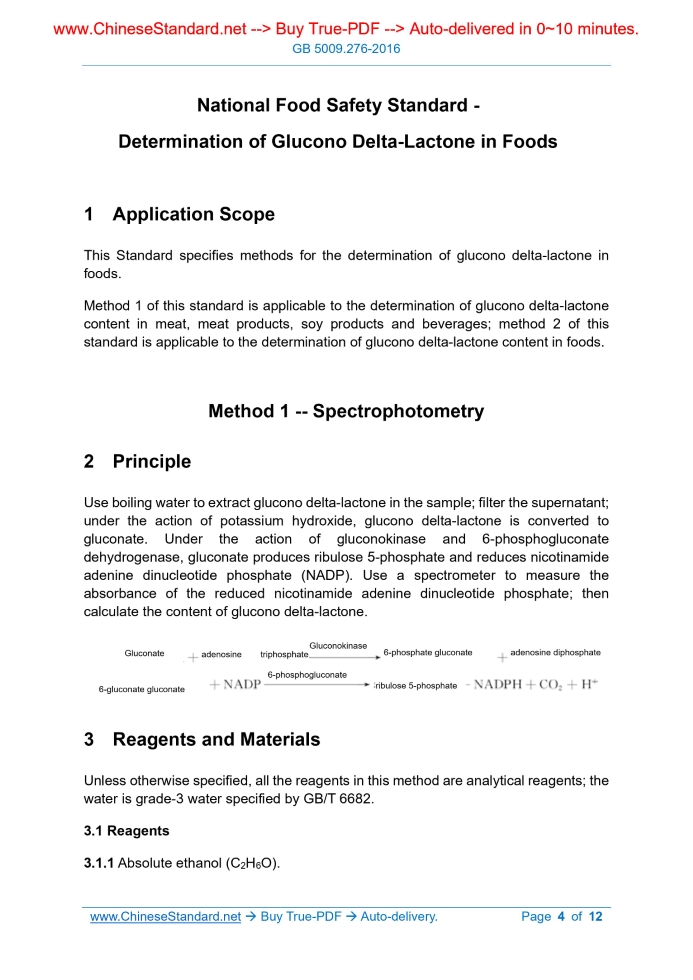
Use boiling water to extract glucono delta-lactone in the sample; filter the supernatant; under the action of potassium hydroxide, glucono delta-lactone is converted to gluconate. Under the action of gluconokinase and 6-phosphogluconate dehydrogenase, gluconate produces ribulose 5-phosphate and reduces nicotinamide adenine dinucleotide phosphate (NADP). Use a spectrometer to measure the absorbance of the reduced nicotinamide adenine dinucleotide phosphate; then calculate the content of glucono delta-lactone.3 Reagents and Materials
Unless otherwise specified, all the reagents in this method are analytical reagents; the water is grade-3 water specified by GB/T 6682. 3.1 Reagents 3.1.1 Absolute ethanol (C2H6O). 6-gluconate gluconate Gluconate adenosine triphosphate 6-phosphogluconate ribulose 5-phosphate adenosine diphosphate 6-phosphate gluconate Gluconokinase 4.2 Analytical balance: the sensitivity is 1 mg and 0.1 mg. 4.3 Homogenizer.5 Analysis Steps
5.1 Sample preparation 5.1.1 Solid samples such as meat, meat products and soy products Take no less than 200 g of representative samples; then use homogenizer to make them into homogenate. Analyze the finished sample as soon as possible, or seal and freeze the sample if it is not analyzed immediately. The stored sample should be remixed when activated. 5.1.2 Liquid samples such as beverage Shake up and take samples directly. 5.2 Extraction Meat products: weigh 2 g ~ 10 g of sample (accurate to 0.001g) into a 50 mL beaker; add 10 mL of petroleum ether to wash; use glass rod to stir evenly; let stand for 15 min; then use dry filter paper to filter; repeat washing three times. Then use 10 mL of absolute ethanol to wash for three times. Then, transfer the residue on the filter paper to the original small beaker; add 30 mL of water to boil. After cooling, use potassium hydroxide solution (2 mol/L) to adjust the solution pH to 10; use water to fix-volume to a 100 mL volumetric flask. Filter; put the filtrate as standby for the machine. Soy products: weigh 2 g ~ 10 g of sample (accurate to 0.001 g) into a 50 mL beaker; add 30 mL of water to extract; after boiling and cooling, use potassium hydroxide solution (2 mol/L) to adjust the solution pH to 10.0; use water to fix-volume to a 100 mL volumetric flask. Filter; put the filtrate as standby for the machine. Beverage: filter, accurately draw 30 mL of filtrate; use potassium hydroxide solution (2 mol/L) to adjust solution pH to 10; use water to fix-volume to a 100 mL volumetric flask; put as standby for the machine. 5.3 Determination Take two 1 cm cuvettes; one of them is test cuvette and the other one is blank cuvette. Add 2.50 mL of buffer (3.2.2), 0.1 mL of NADP solution (10 mg/mL) and 0.1 mL of ATP solution (50 mg/mL) respectively and orderly; cover and mix; add 0.2 mL of extract to the test cuvette and 0.2 mL of water to the blank cuvette respectively; then cover and mix. Then add 0.05 mL of 6-PGDH solution (2.0 mg/mL); cover and mix; then put aside for 5 min; with reference to the blank, measure the absorbance at the wavelength of m -- sample quality; the unit is g. The calculation result shall keep three significant figures.7 Precision
The absolute difference of two independent test results under repeatability cannot exceed 10% of the arithmetic mean value.8 Others
When the sample weight is 10 g, the method detection-limit is 0.007 5%; the quantitation-limit is 0.025%. Method 2 -- High Performance Liquid Chromatography9 Principle
Glucono delta-lactone slowly hydrolyzes in water to form gluconic acid and a small amount of glucono-γ-lactone and achieves hydrolysis equilibrium. After the sample is boiled, extracted, fix-volume and filtered, use high performance liquid chromatography to separate it. By comparing the peak area of gluconic acid in the test solution with the peak area of glucono delta-lactone standard-hydrolysis into gluconic acid, use external standard method to fix-volume and calculate the content of glucono delta-lactone in the sample.10 Reagents and Materials
Unless otherwise specified, all the reagents in this method are analytical reagents; the water is grade-1 water specified by GB/T 6682. 10.1 Reagents 10.1.1 Monopotassium phosphate (KH2PO4). 10.1.2 Phosphoric acid (H3PO4). 10.2 Reagent preparation Monopotassium phosphate-phosphoric acid buffer: weigh 1.36 g of monopotassium phosphate and 0.5 mL of phosphoric acid; use water to dissolve them; then fix-volume 12.3 Apparatus reference conditions 12.3.1 Chromatographic column: organic acid column with a column length of 4.6 mm, an inner diameter of 250 mm and a film thickness of 5 μm, or other silica gel bonding column with equivalent separation effect. 12.3.2 Column temperature: 30°C. 12.3.3 Differential detector detection cell temperature: 35°C. 12.3.4 Mobile phase: monopotassium phosphate-phosphoric acid buffer. 12.3.5 Flow velocity: 0.8 mL/min. 12.3.6 Injection volume: 1 μL. 12.4 Preparation of the standard curve Respectively inject standard series working solution into the high performance liquid chromatography to test the corresponding peak area of gluconic acid; use the concentration of standard working solution as the vertical ordinate, the peak area as the abscissa; draw the standard curve. See Figure A.1 for the chromatogram of glucono delta-lactone standard. 12.5 Test of sample solution Inject the sample solution into the high performance liquid chromatography to obtain the peak area of gluconic acid; compare with the peak area from glucono delta-lactone standard-hydrolysis into gluconic acid; obtain the content of glucono delta-lactone in the to-be-test solution according to the standard curve.13 Description of the Analysis Result
Calculate content of glucono delta-lactone in the sample according to Equation (2): Where: X -- content of glucono delta-lactone in the sample, % ρ -- concentration of glucono delta-lactone in the sample solution; the unit is mg/mL. V -- fix-volume of the extract; the unit is mL; ......Source: Above contents are excerpted from the full-copy PDF -- translated/reviewed by: www.ChineseStandard.net / Wayne Zheng et al.