GB 31650.1-2022 PDF English
Price & Delivery
US$260.00 · In stock · Download in 9 secondsGB 31650.1-2022: National food safety standard - Maximum Residue Limits for 41 Veterinary Drugs in Foods
Delivery: 9 seconds. True-PDF full-copy in English & invoice will be downloaded + auto-delivered via email. See step-by-step procedure
Status: Valid
GB 31650.1: Historical versions
| Standard ID | USD | BUY PDF | Delivery | Standard Title (Description) | Status |
| GB 31650.1-2022 | 260 | Add to Cart | Auto, 9 seconds. | National food safety standard - Maximum Residue Limits for 41 Veterinary Drugs in Foods | Valid |
| GB 31650-2019 | 535 | Add to Cart | Auto, 9 seconds. | National food safety standard - Maximum Residue Limits for Veterinary Drugs in Food | Valid |
Click to Preview this PDF
Similar standards
GB 31650.1-2022: National food safety standard - Maximum Residue Limits for 41 Veterinary Drugs in Foods
---This is an excerpt. Full copy of true-PDF in English version (including equations, symbols, images, flow-chart, tables, and figures etc.), auto-downloaded/delivered in 9 seconds, can be purchased online: https://www.ChineseStandard.net/PDF.aspx/GB31650.1-2022
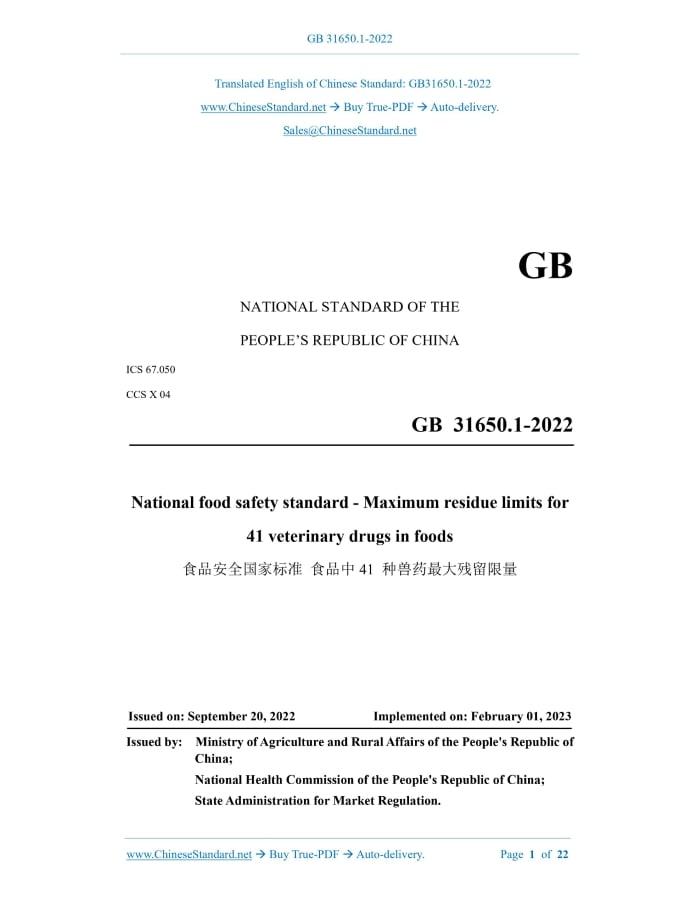
GB NATIONAL STANDARD OF THE PEOPLE’S REPUBLIC OF CHINA ICS 67.050 CCS X 04 National food safety standard - Maximum residue limits for 41 veterinary drugs in foods Issued on. SEPTEMBER 20, 2022 Implemented on. FEBRUARY 01, 2023 Issued by. Ministry of Agriculture and Rural Affairs of the People's Republic of China; National Health Commission of the People's Republic of China; State Administration for Market Regulation.
Table of Contents
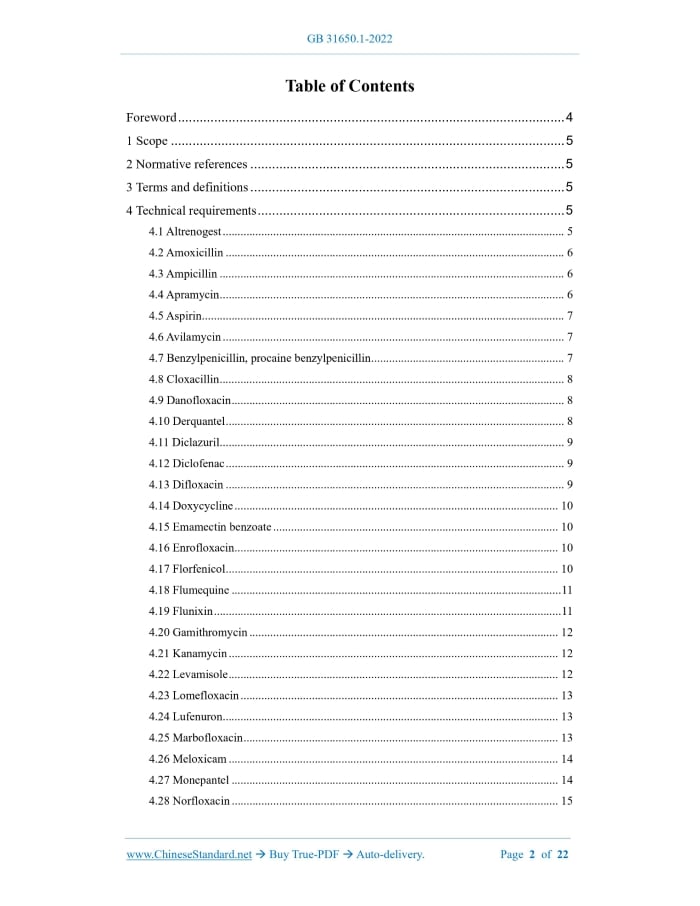
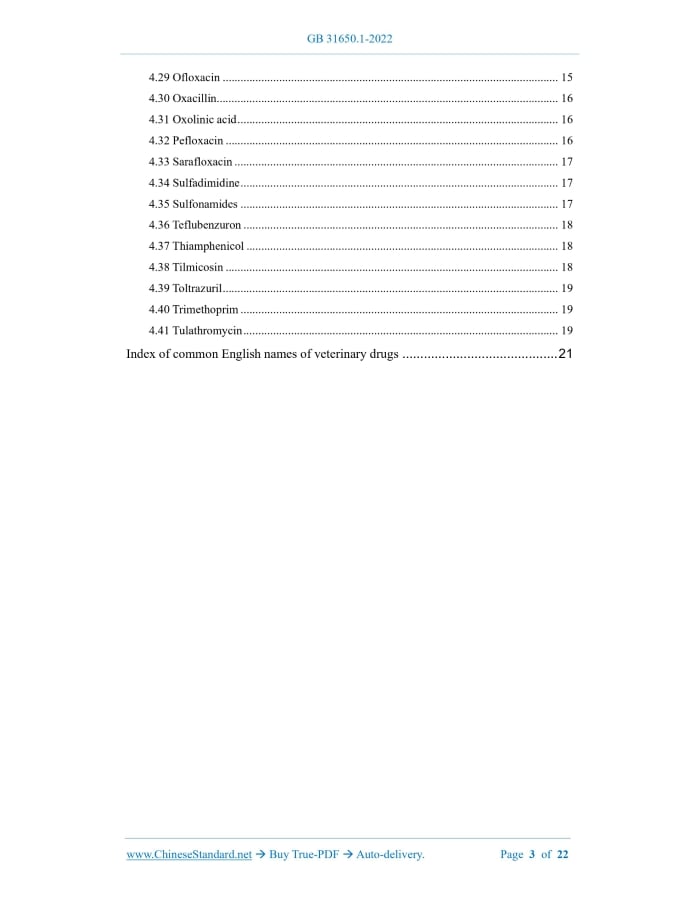
Foreword... 4 1 Scope... 5 2 Normative references... 5 3 Terms and definitions... 5 4 Technical requirements... 5 4.1 Altrenogest... 5 4.2 Amoxicillin... 6 4.3 Ampicillin... 6 4.4 Apramycin... 6 4.5 Aspirin... 7 4.6 Avilamycin... 7 4.7 Benzylpenicillin, procaine benzylpenicillin... 7 4.8 Cloxacillin... 8 4.9 Danofloxacin... 8 4.10 Derquantel... 8 4.11 Diclazuril... 9 4.12 Diclofenac... 9 4.13 Difloxacin... 9 4.14 Doxycycline... 10 4.15 Emamectin benzoate... 10 4.16 Enrofloxacin... 10 4.17 Florfenicol... 10 4.18 Flumequine... 11 4.19 Flunixin... 11 4.20 Gamithromycin... 12 4.21 Kanamycin... 12 4.22 Levamisole... 12 4.23 Lomefloxacin... 13 4.24 Lufenuron... 13 4.25 Marbofloxacin... 13 4.26 Meloxicam... 14 4.27 Monepantel... 14 4.28 Norfloxacin... 15 4.29 Ofloxacin... 15 4.30 Oxacillin... 16 4.31 Oxolinic acid... 16 4.32 Pefloxacin... 16 4.33 Sarafloxacin... 17 4.34 Sulfadimidine... 17 4.35 Sulfonamides... 17 4.36 Teflubenzuron... 18 4.37 Thiamphenicol... 18 4.38 Tilmicosin... 18 4.39 Toltrazuril... 19 4.40 Trimethoprim... 19 4.41 Tulathromycin... 19 Index of common English names of veterinary drugs... 21Foreword
This document was drafted in accordance with the rules given in GB/T 1.1-2020 "Directives for standardization - Part 1.Rules for the structure and drafting of standardizing documents". This document is a supplement to GB 31650-2019 "National Food Safety Standard - Maximum Residue Limits for Veterinary Drugs in Food". It is used together with GB 31650-2019 "National Food Safety Standard - Maximum Residue Limits for Veterinary Drugs in Food". National food safety standard - Maximum residue limits for 41 veterinary drugs in foods1 Scope
This document specifies the maximum residue limits for 41 kinds of veterinary drugs such as derquantel in foods of animal origin. This document applies to foods of animal origin related to maximum residue limits.2 Normative references
The following referenced documents are indispensable for the application of this document. For dated references, only the edition cited applies. For undated references, the latest edition of the referenced document (including any amendments) applies. GB/T 31650-2019, National Food Safety Standard - Maximum Residue Limits for Veterinary Drugs in Food3 Terms and definitions
For the purposes of this document, the terms and definitions defined in GB/T 31650- 2019 as well as the followings apply. 3.1 marker residue Residues that have a clear correlation with total residues in target tissues after drug administration in animals.4 Technical requirements
4.1 Altrenogest 4.2 Amoxicillin 4.3 Ampicillin 4.4 Apramycin 4.5 Aspirin 4.5.1 Veterinary drug classification. antipyretic, analgesic and anti-inflammatory drugs. 4.6 Avilamycin 4.6.1 Veterinary drug classification. oligosaccharide antibiotics. 4.7 Benzylpenicillin, procaine benzylpenicillin 4.7.1 Veterinary drug classification. β-lactam antibiotics. 4.7.2 ADI. 0μg penicillin/(person · d) ~ 30μg penicillin/(person · d). 4.8 Cloxacillin 4.8.1 Veterinary drug classification. β-lactam antibiotics. 4.8.2 ADI. 0μg/kg bw ~ 200μg/kg bw. 4.9 Danofloxacin 4.9.1 Veterinary drug classification. quinolones synthetic antibacterial drugs. 4.10 Derquantel 4.11 Diclazuril 4.12 Diclofenac 4.12.1 Veterinary drug classification. antipyretic, analgesic and anti-inflammatory drugs. 4.13 Difloxacin 4.13.1 Veterinary drug classification. quinolone synthetic antibacterial drugs. 4.14 Doxycycline 4.15 Emamectin benzoate 4.15.1 Veterinary drug classification. insecticides. 4.16 Enrofloxacin 4.17 Florfenicol 4.18 Flumequine 4.19 Flunixin 4.20 Gamithromycin 4.20.1 Veterinary drug classification. macrolide antibiotics. 4.20.2 ADI. 0μg/kg bw ~ 10μg/kg bw. 4.20.3 Marker residue. gamithromycin. 4.20.4 Maximum residue limit. shall meet the requirements in Table 20. 4.21 Kanamycin 4.21.1 Veterinary drug classification. aminoglycoside antibiotics. 4.21.2 ADI. 0μg/kg bw ~ 8μg/kg bw, microbiology ADI. 4.21.3 Marker residue. kanamycin A. 4.21.4 Maximum residue limit. shall meet the requirements in Table 21. Table 21 Animal species Target tissue Maximum residue limit, μg/kg Poultry Egg 10 4.22 Levamisole 4.22.1 Veterinary drug classification. anti-nematode drugs. 4.22.2 ADI. 0μg/kg bw ~ 6μg/kg bw. 4.22.3 Marker residue. levamisole. 4.23 Lomefloxacin 4.24 Lufenuron 4.25 Marbofloxacin 4.26 Meloxicam 4.26.1 Veterinary drug classification. antipyretic, analgesic and anti-inflammatory drugs. 4.27 Monepantel 4.28 Norfloxacin 4.28.1 Veterinary drug classification. quinolone synthetic antibacterial drugs. 4.28.2 ADI. 0μg/kg bw ~ 14μg/kg bw. 4.28.3 Marker residue. norfloxacin. 4.29 Ofloxacin 4.29.1 Veterinary drug classification. quinolone synthetic antibacterial drugs. 4.29.2 ADI. 0μg/kg bw ~ 5μg/kg bw. 4.29.3 Marker residue. ofloxacin. 4.30 Oxacillin 4.30.1 Veterinary drug classification. β-lactam antibiotics. 4.30.2 Marker residue. oxacillin. 4.30.3 Maximum residue limit. shall meet the requirements in Table 30. Table 30 Animal species Target tissue Maximum residue limit, μg/kg Poultry Egg 4 4.31 Oxolinic acid 4.31.1 Veterinary drug classification. quinolone synthetic antibacterial drugs. 4.31.2 ADI. 0μg/kg bw ~ 2.5μg/kg bw. 4.31.3 Marker residue. oxolinic acid. 4.31.4 Maximum residue limit. shall meet the requirements in Table 31. Table 31 Animal species Target tissue Maximum residue limit, μg/kg Chicken Egg 10 4.32 Pefloxacin 4.32.1 Veterinary drug classification. quinolone synthetic antibacterial drugs. 4.33 Sarafloxacin 4.33.1 Veterinary drug classification. quinolone synthetic antibacterial drugs. 4.35 Sulfonamides 4.35.1 Veterinary drug classification. sulfa synthetic antibacterial drugs. 4.35.2 ADI. 0μg/kg bw ~ 50μg/kg bw. 4.36 Teflubenzuron 4.36.1 Veterinary drug classification. insecticides. 4.36.2 ADI. 0μg/kg bw ~ 5μg/kg bw. 4.36.3 Marker residue. teflubenzuron. 4.36.4 Maximum residue limit. shall meet the requirements in Table 36. 4.37 Thiamphenicol 4.39 Toltrazuril 4.40 Trimethoprim 4.41 Tulathromycin ......Source: Above contents are excerpted from the full-copy PDF -- translated/reviewed by: www.ChineseStandard.net / Wayne Zheng et al.