GB 24155-2020 PDF English
Price & Delivery
US$185.00 · In stock · Download in 9 secondsGB 24155-2020: Safety specifications for electric motorcycles and electric mopeds
Delivery: 9 seconds. True-PDF full-copy in English & invoice will be downloaded + auto-delivered via email. See step-by-step procedure
Status: Valid
GB 24155: Historical versions
| Standard ID | USD | BUY PDF | Delivery | Standard Title (Description) | Status |
| GB 24155-2020 | 185 | Add to Cart | Auto, 9 seconds. | Safety specifications for electric motorcycles and electric mopeds | Valid |
| GB 24155-2009 | 319 | Add to Cart | 3 days | Electric motorcycles and electric mopeds -- Safety specifications | Obsolete |
Click to Preview this PDF
Similar standards
GB 24155-2020: Safety specifications for electric motorcycles and electric mopeds
---This is an excerpt. Full copy of true-PDF in English version (including equations, symbols, images, flow-chart, tables, and figures etc.), auto-downloaded/delivered in 9 seconds, can be purchased online: https://www.ChineseStandard.net/PDF.aspx/GB24155-2020GB NATIONAL STANDARD OF THE PEOPLE’S REPUBLIC OF CHINA ICS 43.140 T 80 Replacing GB 24155-2009 Safety specifications for electric motorcycles and electric mopeds Issued on. MAY 29, 2020 Implemented on. OCTOBER 01, 2021 Issued by. State Administration for Market Regulation; Standardization Administration of the People’s Republic of China.
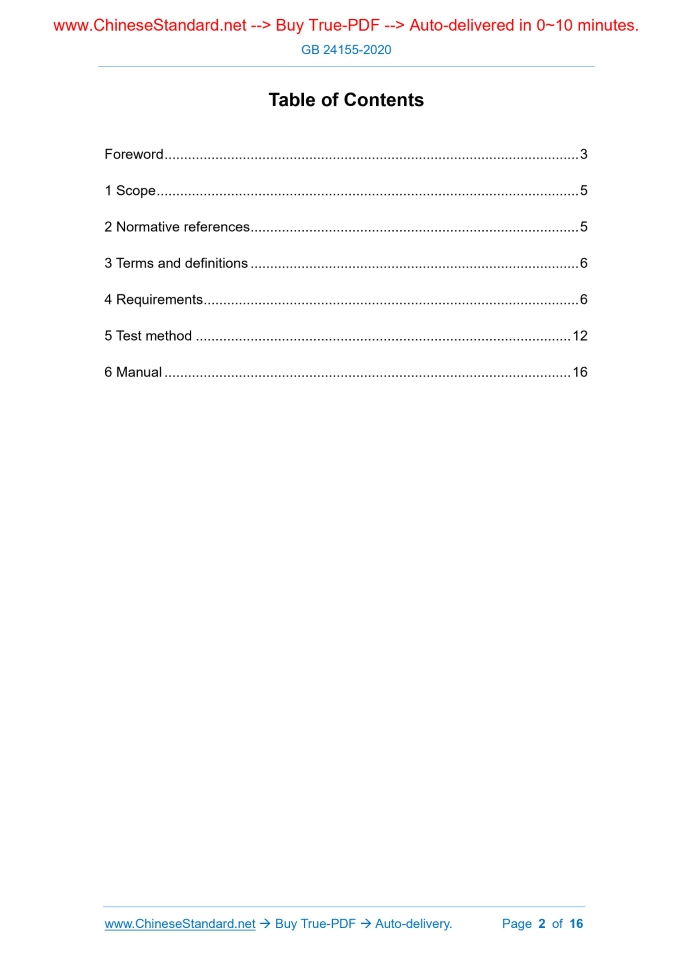
Table of Contents
Foreword... 3 1 Scope... 5 2 Normative references... 5 3 Terms and definitions... 6 4 Requirements... 6 5 Test method... 12 6 Manual... 161 Scope
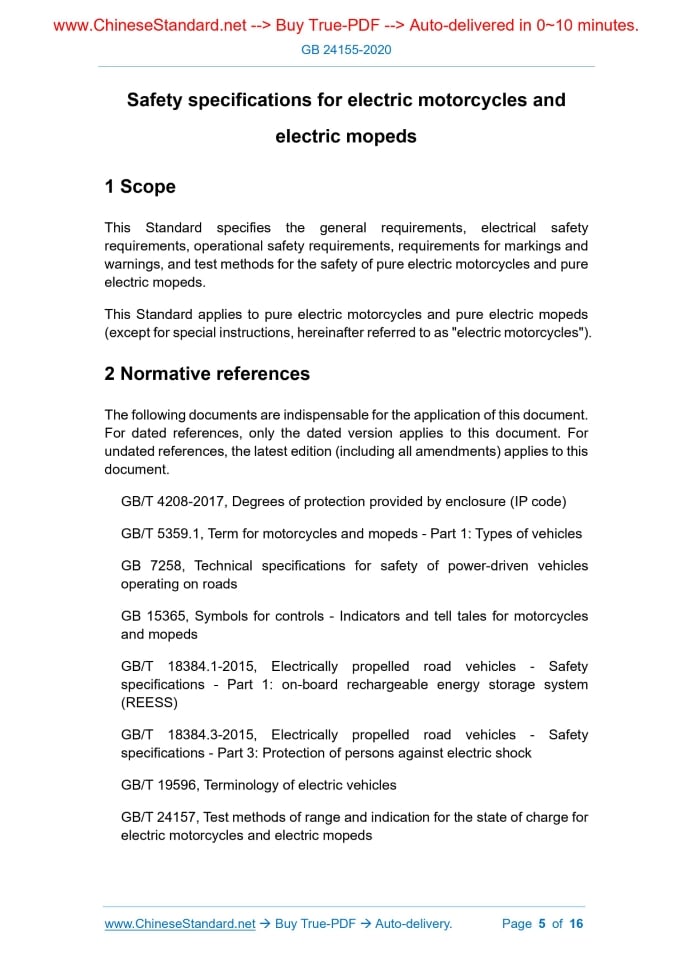
This Standard specifies the general requirements, electrical safety requirements, operational safety requirements, requirements for markings and warnings, and test methods for the safety of pure electric motorcycles and pure electric mopeds. This Standard applies to pure electric motorcycles and pure electric mopeds (except for special instructions, hereinafter referred to as "electric motorcycles").2 Normative references
The following documents are indispensable for the application of this document. For dated references, only the dated version applies to this document. For undated references, the latest edition (including all amendments) applies to this document. GB/T 4208-2017, Degrees of protection provided by enclosure (IP code) GB/T 5359.1, Term for motorcycles and mopeds - Part 1.Types of vehicles GB 7258, Technical specifications for safety of power-driven vehicles operating on roads GB 15365, Symbols for controls - Indicators and tell tales for motorcycles and mopeds GB/T 18384.1-2015, Electrically propelled road vehicles - Safety specifications - Part 1.on-board rechargeable energy storage system (REESS)3 Terms and definitions
Terms and definitions determined by GB/T 5359.1, GB/T 18384.3-2015 and GB/T 19596, and the following ones are applicable to this document. 3.2 On-board charger A device that is fixedly installed on the electric motorcycle and converts the electric energy of the public grid into direct current to charge the on-board energy storage device.4 Requirements
4.1 General requirements 4.1.1 The heat that is generated by electrical components shall be avoided to cause burning or personal burns. 4.1.2 The design of the electronic speed regulation unit shall avoid the risk of fire or electric shock which is caused by abnormal operation or non-operation. 4.2 Electrical safety requirements 4.2.1 Power battery 4.2.2 Electric shock protection of live parts 4.2.2.1 Unless otherwise specified, the live parts whose nominal voltage is not higher than 36 V (d.c.) and 12 V (a.c.) (rms) are not required by this Standard. 4.2.2.2 The live parts whose nominal voltage is higher than 36 V (d.c.) and 12 V (a.c.) (rms) shall be covered with insulation, that is, basic insulation or isolation and sealing to prevent direct contact. 4.2.2.5 It shall not contain exposed wires, terminals and connection units. The wiring on the vehicle shall be protected and not touch burrs, heat sinks, so as not to damage the wiring insulation; the surface of the metal hole through the insulated wire shall be smooth, round and equipped with a sleeve. 4.2.2.6 The connecting wires between the electrical components shall not be subjected to excessive tension; the connection between the steering handle and the frame shall not damage the insulation of the wires due to normal rotation, and shall effectively prevent the wires from contacting moving parts. 4.2.2.10 After various waterproof tests that are carried out in accordance with 5.4, immediately measure the insulation resistance of the circuit according to 5.2 (the electric motorcycle is still wet); the insulation resistance value shall be greater than 500 Ω/V; after standing for 24 h, the second test shall be greater than 1 000 Ω/V. 4.2.3 Electric shock protection of exposed conductive parts 4.2.3.1 The exposed conductive parts of grade-A voltage are not required by this Standard. 4.2.5 Overcurrent protection device If the design function of the electric motorcycle cannot control the current that flows from the battery to the device when the auxiliary device (such as the charger, the power converter) is damaged, an overcurrent protection device shall be installed at either end of the circuit. 4.3 Operational safety requirements 4.3.1 Start 4.3.2 Driving and stopping 4.3.2.1 The electric motorcycle shall remind the driver that the electric motorcycle can start driving through the "operation preparation" symbol in GB 15365. 4.4 Requirements for markings and warnings 4.4.1 The protective cover of the power battery and the easily accessible grade- B voltage components shall be marked with the markings that are specified in Figure 2 in an easy-to-see position; the markings shall be clear and firm. Note. the background color is yellow; the frame and the symbol are black. 4.4.2 The chemical type, nominal voltage and rated capacity shall be clearly marked on the power battery for identification. 4.4.3 The split-type power battery charger shall be marked with the warning word of "Beware of rain!”5 Test method
5.1 General requirements for the test 5.1.1 Unless otherwise specified, the tests shall be carried out on the same vehicle as far as possible in the factory state; the sample vehicle shall be able to withstand all relevant tests. 5.1.2 For the test of any movable part, it shall be placed in the most unfavorable position that may occur in normal use. 5.1.3 The accuracy of all test instruments shall meet the requirements of Table 1. 5.2 Measurement of insulation resistance 5.2.1 The electric motorcycle shall be placed in the following environment for 8 h before insulation resistance measurement. 5.2.2 The insulation resistance measurement method of the power battery is carried out according to 5.1.3 of GB/T 18384.1-2015. 5.2.3 When measuring the insulation resistance of the power system circuit, the power battery shall be disconnected. Apply the test voltage that is shown in Table 2 between the power system bus and the metal frame for a period of time until a stable reading is obtained; If a stable reading cannot be obtained within 60 s, select the minimum reading within 60 s. >330 1 000 5.3 Withstand voltage test 5.3.1 Apply an AC voltage of 50 Hz ~ 60 Hz, 2(U0 + 1 200) V between the input terminal of the on-board charger and the electric chassis for 1 min; record the leakage current value of the test; U0 is the maximum effective voltage value of the input terminal of the on-board charger. 5.4 Waterproof test 5.4.1 Vehicle wash test Use the hose nozzle of IPX5 in GB/T 4208-2017, as shown in Figure 3.Use clean water; spray water along the joints of the body at a flow rate of 12.5 L/min; the distance between the nozzle and the joint of the body is 2.5 m ~ 3 m; try to ensure that it moves at a speed of nearly 0.1 m/s; flush one cycle. 5.4.2 Rain test Use the nozzle of IPX3 in GB/T 4208-2017, as shown in Figure 4.Use clean water to spray from distance in the figure at a flow rate of 10 L/min; move the nozzle as regularly as possible; spray the electric motorcycle for 5 minutes. 5.5 Potential equalization test Use a current of more than 0.2 A to pass through any two exposed conductive parts for at least 5 s; measure the voltage drop. The resistance value that is calculated from the current and voltage drop shall not exceed 0.1 Ω. 5.6 Remaining battery warning test 5.6.1 The test conditions shall meet the requirements for test conditions in GB/T 24157. 5.6.2 The test is carried out according to the following steps.6 Manual
Each vehicle shall be accompanied by a user manual. The manual shall specify special requirements for the use and maintenance of electric motorcycles, including at least. ......Source: Above contents are excerpted from the full-copy PDF -- translated/reviewed by: www.ChineseStandard.net / Wayne Zheng et al.