GB 1903.9-2015 PDF English
Price & Delivery
US$70.00 · In stock · Download in 9 secondsGB 1903.9-2015: National food safety standard - Food nutrition enhancer - Sodium selenite
Delivery: 9 seconds. True-PDF full-copy in English & invoice will be downloaded + auto-delivered via email. See step-by-step procedure
Status: Valid
| Standard ID | USD | BUY PDF | Delivery | Standard Title (Description) | Status |
| GB 1903.9-2015 | 70 | Add to Cart | Auto, 9 seconds. | National food safety standard - Food nutrition enhancer - Sodium selenite | Valid |
Click to Preview this PDF
Similar standards
GB 1903.9-2015: National food safety standard - Food nutrition enhancer - Sodium selenite
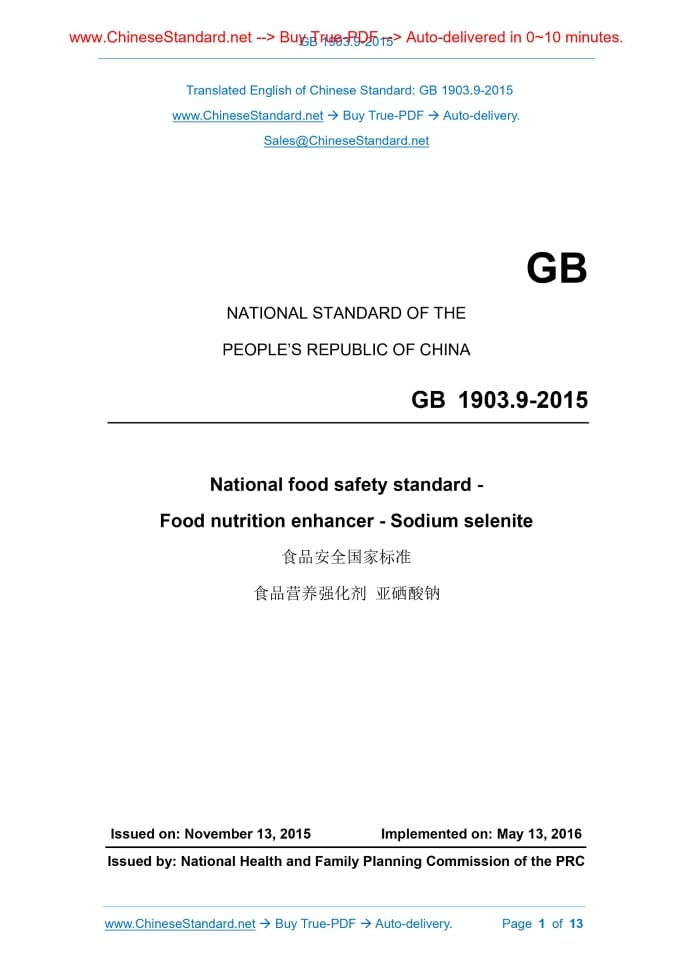
---This is an excerpt. Full copy of true-PDF in English version (including equations, symbols, images, flow-chart, tables, and figures etc.), auto-downloaded/delivered in 9 seconds, can be purchased online: https://www.ChineseStandard.net/PDF.aspx/GB1903.9-2015GB NATIONAL STANDARD OF THE PEOPLE’S REPUBLIC OF CHINA National food safety standard - Food nutrition enhancer - Sodium selenite Issued on. NOVEMBER 13, 2015 Implemented on. MAY 13, 2016 Issued by. National Health and Family Planning Commission of the PRC
Table of Contents
1 Scope... 3 2 Chemical formula, structural formula and relative molecular mass... 3 3 Technical requirements... 3 Appendix A Testing method... 5 National food safety standard - Food nutrition enhancer - Sodium selenite1 Scope
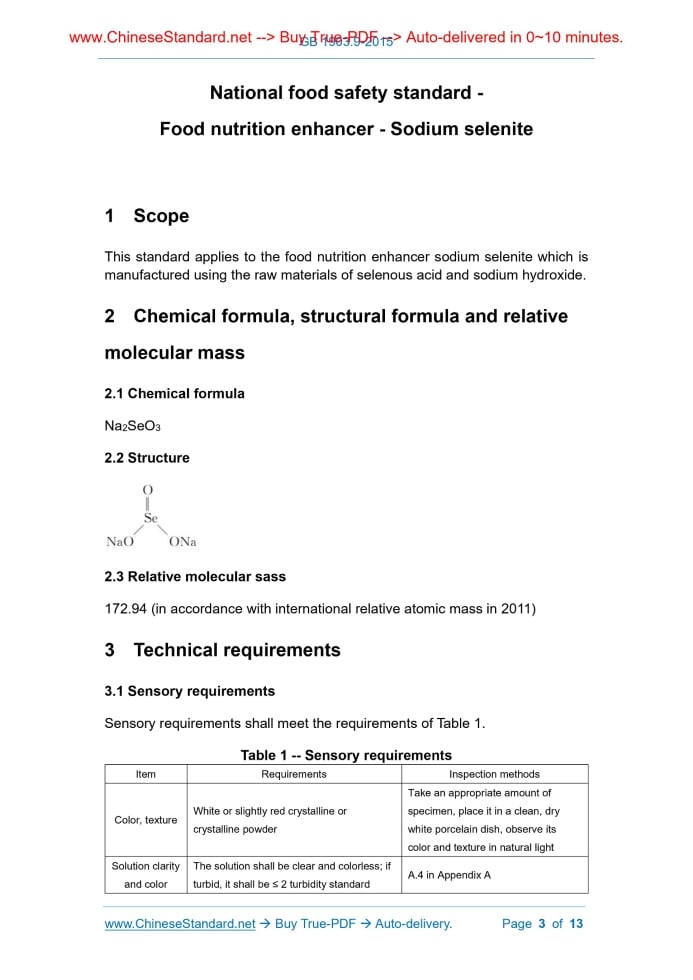
This standard applies to the food nutrition enhancer sodium selenite which is manufactured using the raw materials of selenous acid and sodium hydroxide.2 Chemical formula, structural formula and relative
molecular mass 2.1 Chemical formula Na2SeO3 2.2 Structure 2.3 Relative molecular sass 172.94 (in accordance with international relative atomic mass in 2011)3 Technical requirements
3.1 Sensory requirements Sensory requirements shall meet the requirements of Table 1.Appendix A
Testing method A.1 Warning Some of the reagents used in the test methods of this standard are toxic or corrosive. It shall be used in accordance with the relevant national regulations. Care must be taken when using it. If splashed on the skin, it shall be rinsed immediately with water, and seek doctors immediately in severe cases. When using volatile acids, it shall be done in a fume hood. A.3 Identification test A.3.1 Reagents and materials A.3.1.1 Concentrated hydrochloric acid. A.3.1.2 Ammonium thiocyanate solution. 80 g/L. A.3.2.2 Selenite ion identification (select one method) A.3.2.2.1 TAKE about 0.1 g of specimen, DISSOLVE it in 5 mL of water, ADD 1 mL of ammonium thiocyanate solution, then ADD a few drops of concentrated hydrochloric acid to make it acidic, that is, it produces red turbidity. A.3.2.2.2 TAKE about 0.1 g of specimen, DISSOLVE it in 5 mL of water, ADD 1 mL of copper sulfate solution, which produces a blue-green precipitate, the precipitate is dissolved in acetic acid solution. A.3.2.2.3 TAKE about 0.05 g of specimen, ADD 5 mL of hydrochloric acid solution, SHAKE to dissolve it, ADD 2 mL of sodium thiosulfate solution, HEAT it, the solution is in orange red. A.4 Determination of solution clarity and color A.4.1 Determination of solution color A.4.1.1 Reagents and materials A.4.1.1.6 Xylenol orange indicator solution. WEIGH 0.2 g of xylenol orange, DISSOLVE it in 100 mL of water. A.4.1.1.7 Disodium ethylenediaminetetraacetic acid titrant. c(Na2EDTA) = 0.05 mol/L. A.4.1.2 Analytical procedures A.4.1.2.1 Preparation of standard stock solutions of various colors A.4.1.2.1.1 Potassium dichromate solution. Accurately WEIGH 400 mg of potassium dichromate which has been dried to constant weight at 120 °C, USE water to dilute it to 500 mL (1 mL of solution contains 0.800 mg of K2Cr2O7). A.4.1.2.1.4 Preparation of standard stock solution of various colors. In accordance with Table A.1, accurately MEASURE the colorimetric cobalt chloride solution, the colorimetric potassium dichromate solution, the colorimetric copper sulfate solution and water, SHAKE it uniformly, to obtain it. A.4.1.2.2 Preparation of standard colorimetric solutions of various color numbers A.4.2 Determination of solution clarity A.4.2.1 Reagents and materials 10% urotropine solution. WEIGH 10 g of urotropin, DISSOLVE it in 100 mL of water. A.4.2.2 Analytical procedures A.4.2.2.1 Preparation of turbidity standard stock solution WEIGH 1.00 g of barium sulphate which has been dried to constant weight at 105°C, ADD water to dissolve it to make its volume reach to 100 mL, if necessary, warmly DISSOLVE it in water bath at 40 °C, SHAKE it uniformly, PLACE it for 4 h ~ 6 h. TAKE this solution, MIX it with the same volume of 10% urotropine solution, SHAKE it uniformly, LET it be standing at 25 °C for 24 hours in the dark before use. The solution can be stored in the refrigerator to protect it from light for 2 months. A.4.2.2.4 Determination WEIGH 1.0 g of specimen, PLACE it in a 10 mL Nessler colorimetric tube, USE 10 mL of newly boiled cold water to dissolve it, the solution shall be clear. If there is turbidity, if it is compared with the orange red No.2 turbidity standard solution of the same volume, it shall not be deeper. A.5 Determination of sodium selenite content (dry basis) A.5.1 Reagents and materials A.5.1.1 Potassium iodide solution. WEIGH 16.5 g of potassium iodide, ADD water to 100 mL, PREPARE it before use. A.7 Determination of alkalinity A.7.1 Reagents and Materials A.7.1.1 0.1% thymolphthalein indicator. WEIGH 0.1 g of thymolphthalein, DISSOLVE it in 100 mL of absolute ethanol. A.7.1.2 Hydrochloric acid standard titration solution. c (HCl) = 1 mol/L. A.7.2 Analytical procedures WEIGH 2.0 g of specimen, accurate to 0.0001 g, USE the newly boiled cold water to dissolve it to make its volume reach to 100 mL, PIPETTE 50 mL of test solution, ADD 0.2 mL of thymolphthalein indicator, USE 1 mol/L hydrochloric acid standard solution to titrate the solution until it becomes from deep blue to light blue, which is maintained for at least 30 seconds. A.8 Determination of chloride A.8.1 Reagents and materials A.8.1.1 Sodium chloride standard solution. WEIGH 0.165 g of sodium chloride, USE water to dilute it to 1000 mL (equivalent to 100 μg/mL Cl). A.8.1.2 Nitric acid solution. PIPETTE 105 mL of nitric acid, USE water to dilute it to 1000 mL. A.8.1.3 Silver nitrate solution (0.1 mol/L). WEIGH 17.5 g of silver nitrate, USE water to dilute it to 1000 mL. A.10 Determination of water insoluble A.10.1 Instruments and equipment A.10.1.1 No.4 glass sand core crucible. The pore size of the filter plate is 5 μm ~ 15 μm. A.10.1.2 Electric thermostatic oven. The temperature can be controlled at 105 °C ± 2 °C. A.10.2 Analytical procedures WEIGH 5.0 g of specimen, accurate to 0.0001 g, PLACE it in a 250 mL beaker, ADD 100 mL of boiling water to dissolve it, COVER the watch glass, MAINTAINE the temperature in boiling water bath for 1 h, TAKE it out, COOL it to room temperature, USE the glass sand core crucible which has been dried to the constant mass at 105 °C ± 2 °C to filter it, USE hot water to wash it to neutral, PLACE it into an electric constant temperature drying oven, DRY it to constant mass at a temperature of 105 °C ± 2 °C. ......Source: Above contents are excerpted from the full-copy PDF -- translated/reviewed by: www.ChineseStandard.net / Wayne Zheng et al.