GB 1886.27-2015 PDF English
Price & Delivery
US$70.00 · In stock · Download in 9 secondsGB 1886.27-2015: National food safety standard - Food additives - Sucrose esters of fatty acid
Delivery: 9 seconds. True-PDF full-copy in English & invoice will be downloaded + auto-delivered via email. See step-by-step procedure
Status: Valid
| Standard ID | USD | BUY PDF | Delivery | Standard Title (Description) | Status |
| GB 1886.27-2015 | 70 | Add to Cart | Auto, 9 seconds. | National food safety standard - Food additives - Sucrose esters of fatty acid | Valid |
Click to Preview this PDF
Similar standards
GB 1886.27-2015: National food safety standard - Food additives - Sucrose esters of fatty acid
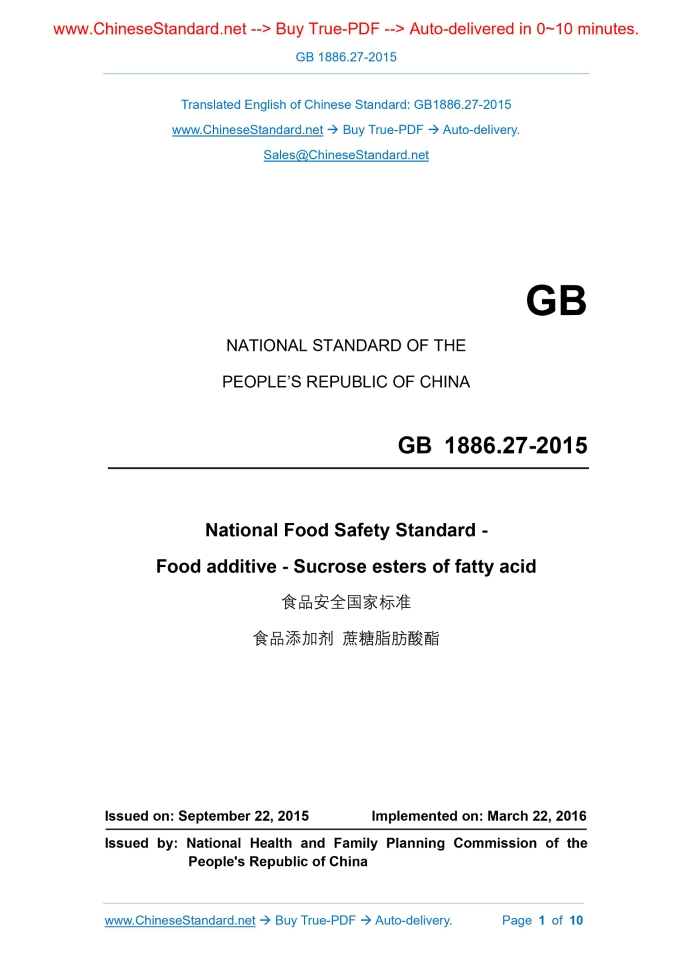
---This is an excerpt. Full copy of true-PDF in English version (including equations, symbols, images, flow-chart, tables, and figures etc.), auto-downloaded/delivered in 9 seconds, can be purchased online: https://www.ChineseStandard.net/PDF.aspx/GB1886.27-2015NATIONAL STANDARD OF THE PEOPLE’S REPUBLIC OF CHINA National Food Safety Standard - Food additive - Sucrose esters of fatty acid ISSUED ON: SEPTEMBER 22, 2015 IMPLEMENTED ON: MARCH 22, 2016 Issued by: National Health and Family Planning Commission of the People's Republic of China
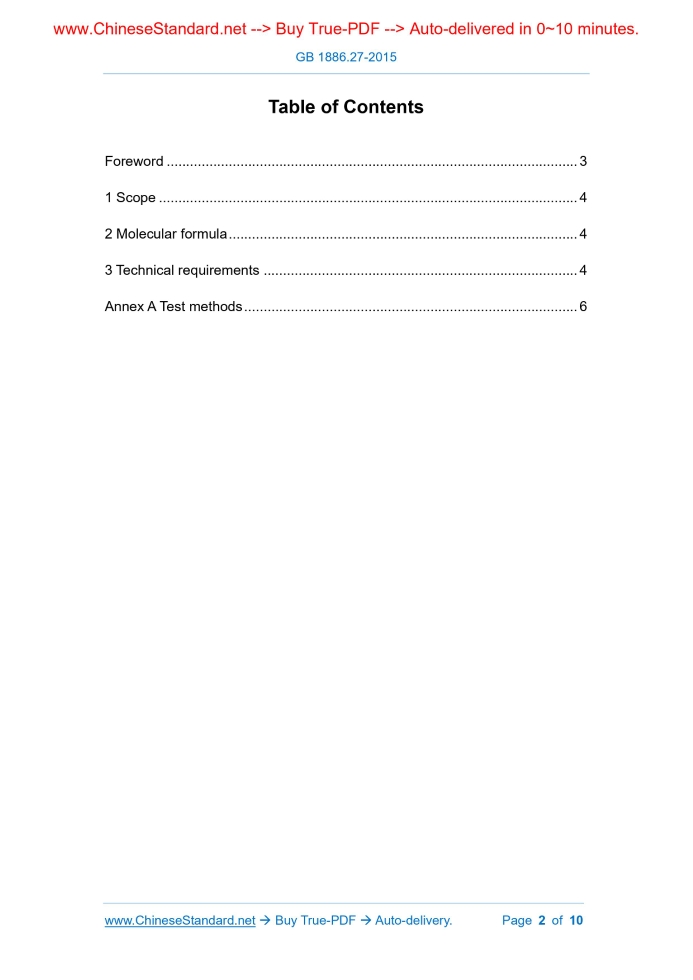
Table of Contents
Foreword ... 3 1 Scope ... 4 2 Molecular formula ... 4 3 Technical requirements ... 4 Annex A Test methods ... 6 National Food Safety Standard - Food additive - Sucrose esters of fatty acid1 Scope
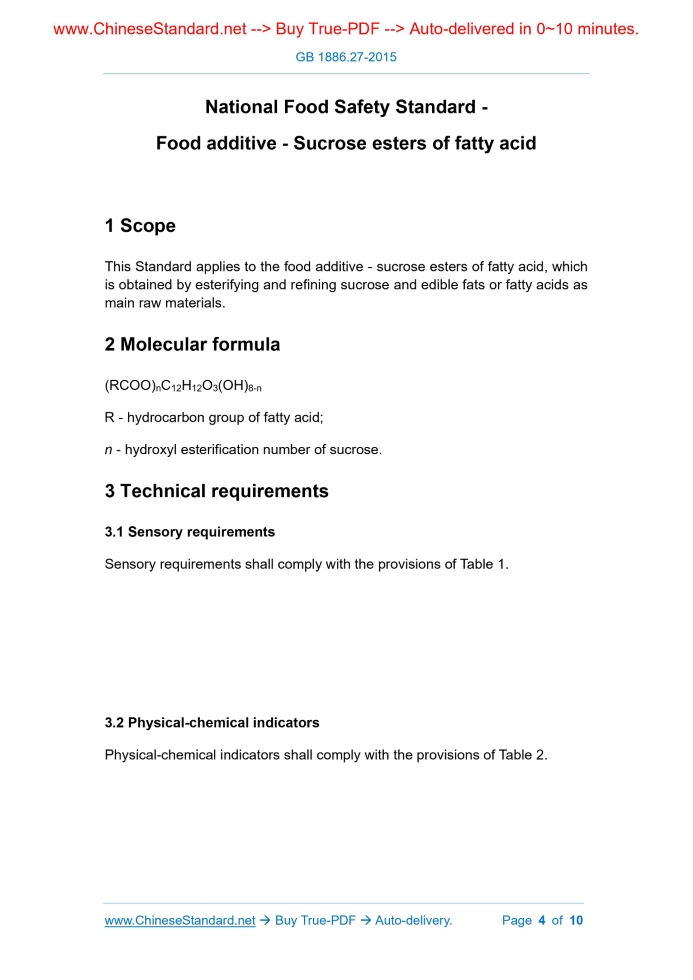
This Standard applies to the food additive - sucrose esters of fatty acid, which is obtained by esterifying and refining sucrose and edible fats or fatty acids as main raw materials.2 Molecular formula
(RCOO)nC12H12O3(OH)8-n R - hydrocarbon group of fatty acid; n - hydroxyl esterification number of sucrose.3 Technical requirements
3.1 Sensory requirements Sensory requirements shall comply with the provisions of Table 1. 3.2 Physical-chemical indicators Physical-chemical indicators shall comply with the provisions of Table 2.Annex A
Test methods A.1 General Unless otherwise specified, the reagents and water used in this Standard refer to analytical reagents and grade 3 water specified in GB/T 6682. Unless otherwise specified, the standard titration solutions used in the test, the standard solutions, preparations and products used in the determination of impurities are prepared according to the provisions of GB/T 601, GB/T 602 and GB/T 603. When the solution used in the test does not indicate which solvent is used for preparation, it refers to aqueous solution. A.2 Identification test A.2.1 Reagents and materials A.2.1.1 Sodium chloride. A.2.1.2 Anhydrous sodium sulfate. A.2.1.3 Ether. A.2.1.4 Hydrochloric acid solution: 1 + 3. A.2.1.5 Potassium hydroxide-ethanol solution. A.2.1.6 Anthrone sulfuric acid solution: 2 g/L. A.2.2 Analysis steps A.2.2.1 Sample processing WEIGH 1 g of sample in a 250 mL Erlenmeyer flask; ADD 25 mL of potassium hydroxide-ethanol solution; INSTALL a reflux condenser; HEAT on a water bath and slightly BOIL for 1 h; REMOVE after a little cooling; ADD 50 mL of water; HEAT to concentrate to about 30 mL; ADD 10 mL of hydrochloric acid solution; SHAKE thoroughly; ADD sodium chloride to make it a saturated solution; SHAKE well; TRANSFER to a separatory funnel; EXTRACT twice with 30 mL of diethyl ether each time; SEPARATE the ether layer and the water layer, for test. A.2.2.2 Identification After the ether layer is washed with 20 mL of saturated sodium chloride solution, moles per liter (mol/L); M - the molar mass of potassium hydroxide, in grams per mole (g/mol), [M(KOH) = 56.1]; m1 - the mass of the sample, in grams (g). The test result is based on the arithmetic mean of the two parallel determination results (retain one decimal place). The absolute difference between two independent determination results obtained under repeatability conditions shall not exceed 5 % of the arithmetic mean. A.4 Determination of free sugar (calculated as sucrose) A.4.1 Reagents and materials A.4.1.1 n-butanol. A.4.1.2 Sodium chloride solution: 50 g/L. A.4.1.3 Hydrochloric acid solution: 6 mol/L. TAKE 540 mL of hydrochloric acid; DILUTE to 1000 mL with water; SHAKE well. A.4.1.4 Sodium hydroxide solution: 200 g/L. A.4.1.5 Glucose standard solution: WEIGH 1.000 g, to the nearest 0.0001 g, of pure glucose that has been dried to constant weight at 98 °C ~ 100 °C; after adding water to dissolve, ADD 5 mL of hydrochloric acid; DILUTE to 200 mL with water. A.4.1.6 Fehling's solution A. A.4.1.7 Fehling's solution B. A.4.1.8 Methyl red indicator solution: 1 g/L. A.4.1.9 Methylene blue indicator solution: 0.05 g/L. A.4.2 Analysis steps A.4.2.1 Sample processing WEIGH about 2 g of sample (to the nearest 0.01 g); PLACE it in an Erlenmeyer flask; ADD 40 mL of n-butanol; HEAT to dissolve in a water bath. TRANSFER to a 125 mL separatory funnel; EXTRACT twice with 10 mL of sodium chloride solution at 60 °C to 70 °C each time; SEPARATE (centrifuge if necessary); COMBINE the extracts. ADD 2.0 mL of 6 mol/L hydrochloric acid solution; HEAT in a water bath at 68 °C ~ 70 °C for 15 min; ADD methyl red indicator solution ......Source: Above contents are excerpted from the full-copy PDF -- translated/reviewed by: www.ChineseStandard.net / Wayne Zheng et al.