GB 1886.233-2016 PDF English
Price & Delivery
US$85.00 · In stock · Download in 9 secondsGB 1886.233-2016: National food safety standard - Food additives - Vitamin E
Delivery: 9 seconds. True-PDF full-copy in English & invoice will be downloaded + auto-delivered via email. See step-by-step procedure
Status: Valid
| Standard ID | USD | BUY PDF | Delivery | Standard Title (Description) | Status |
| GB 1886.233-2016 | 85 | Add to Cart | Auto, 9 seconds. | National food safety standard - Food additives - Vitamin E | Valid |
Click to Preview this PDF
Similar standards
GB 1886.233-2016: National food safety standard - Food additives - Vitamin E
---This is an excerpt. Full copy of true-PDF in English version (including equations, symbols, images, flow-chart, tables, and figures etc.), auto-downloaded/delivered in 9 seconds, can be purchased online: https://www.ChineseStandard.net/PDF.aspx/GB1886.233-2016NATIONAL STANDARD OF THE PEOPLE’S REPUBLIC OF CHINA National Food Safety Standard - Food Additive - Vitamin E Issued on. AUGUST 31, 2016 Implemented on. JANUARY 1, 2017 Issued by. National Health and Family Planning Commission of the PRC
Table of Contents
Foreword... 3 1 Application Scope... 4 2 Chemical Name, Molecular Formula, Structural Formula and Relative Molecular Mass... 4 3 Technical Requirements... 6 Appendix A Test Method... 8Foreword
This Standard replaces GB 19191-2003, Food Additive. Natural Vitamin E. Compared with GB 19191-2003, the major changes of this Standard are as follows. -- Change the standard name into “National Food Safety Standard - Food Additive. Vitamin E”; -- Modify the tocopherol species contained in vitamin E; -- Add refractive index requirements; -- Add absorption coefficient indicator requirements. National Food Safety Standard - Food Additive - Vitamin E1 Application Scope
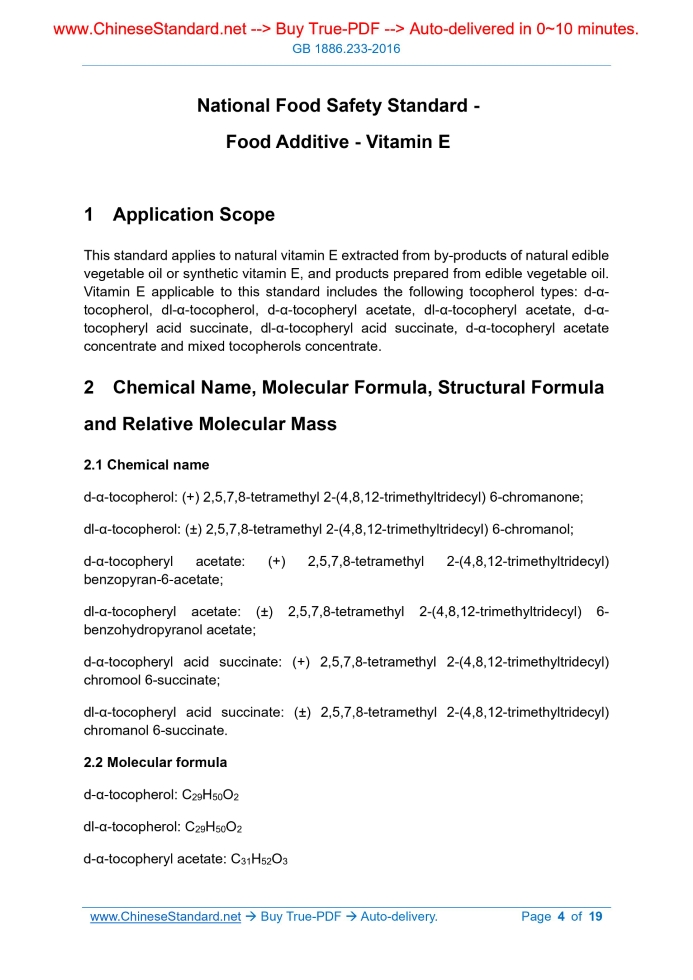
This standard applies to natural vitamin E extracted from by-products of natural edible vegetable oil or synthetic vitamin E, and products prepared from edible vegetable oil. Vitamin E applicable to this standard includes the following tocopherol types. d-α- tocopherol, dl-α-tocopherol, d-α-tocopheryl acetate, dl-α-tocopheryl acetate, d-α- tocopheryl acid succinate, dl-α-tocopheryl acid succinate, d-α-tocopheryl acetate concentrate and mixed tocopherols concentrate.2 Chemical Name, Molecular Formula, Structural Formula
and Relative Molecular Mass 2.1 Chemical name 2.2 Molecular formula 2.3 structural formula For d-α-tocopherol, dl-α-tocopherol, d-α-tocopheryl acetate, dl-α-tocopheryl acetate, d-α-tocopheryl acid succinate, dl-α-tocopheryl acid succinate, d-α-tocopheryl acetate concentrate and mixed tocopherols concentrate, the R1 group, R2 group, R3 group and R4 group corresponding to their structural formula are shown as Table 1. 2.4 Relative molecular mass d-α-tocopherol. 430.71 (according to the international relative atomic mass in 2013); dl-α-tocopherol. 430.71 (according to the international relative atomic mass in 2013); d-α-tocopheryl acetate. 472.75 (according to the international relative atomic mass in 2013);3 Technical Requirements
3.1 Sensory requirements Sensory requirements should be in accordance with Table 2.Appendix A
Test Method A.1 General provisions Unless otherwise specified in this standard, the purity of reagents used shall be above the grade of analytical reagent; the used standard titration solutions, the standard solutions for the determination of impurities, the preparations and products shall be prepared in accordance with the provisions of GB/T 601, GB/T 602 and GB/T 603; the test water should meet the requirements of grade-3 water specified by GB/T 6682. The solution used in the test, if not indicated which solvent is used, refers to aqueous solution. A.2 Identification test A.2.1 Reagents and materials A.2.1.1 Absolute ethanol. A.2.1.2 Nitric acid. A.2.2 Identification method A.3 Content determination A.3.1 Reagents and materials A.3.1.1 Cetyl palmitate. A.3.1.2 α-tocopherol reference substance. A.3.1.3 α-tocopheryl acetate reference substance. A.3.1.4 α-tocopheryl acid succinate reference substance. A.3.1.5 n-hexane. A.3.2 Instruments and apparatuses Gas chromatography. A.3.3 Analysis steps A.3.3.1 Determination of d-α-tocopherol content A.3.3.1.2 Reference chromatographic conditions SE-30 capillary column; hydrogen flame ion detector; keep the oven temperature at 250°C; the vaporization temperature and detection temperature are 300°C; the carrier gas is nitrogen; adjust the carrier gas flow rate to make the internal standard peak retention time at 18 min ~ 20 min. Inject 1 μL of the reference solution into the chromatograph; record the chromatogram. A.3.3.1.3 Correction factor determination Inject 1 μL of reference solution into the gas chromatograph; record the chromatogram; measure Aref1, the peak area of the α-tocopherol, and Aint1, the peak area of the internal standard peak; calculate the correction factor f1 according to Formula (A.1). A.3.3.1.4 Determination Inject 1 μL of the sample solution into the gas chromatograph; record the chromatogram; calculate the peak area of α-tocopherol, β- and γ-tocopherol, and δ- tocopherol (Aα2, Aβ,γ2, Aδ2); calculate the sum of the first three items (At2) and the internal standard peak area Aint2; calculate the content according to Formula (A.2) and Formula (A.3). A.3.3.2.1 Solution preparation The internal standard solution and the reference solution are the same as A.3.3.1.1. Sample solution. weigh an appropriate amount of sample; accurate to 0.02 mg; place it in a brown volumetric flask; add internal standard solution to dilute to 10.0 mL; shake to dissolve to gain a solution containing d-β-+d-γ-tocopherol of about 1.5 mg/mL. A.3.3.2.2 Reference chromatographic conditions Same as A.3.3.1.2. A.3.3.2.3 Correction factor determination Same as A.3.3.1.3. A.3.3.3.4 Determination Inject 1 μL of sample solution into the gas chromatograph; record the chromatogram. Calculate Asample7, the peak area of the α-tocopheryl acetate, and Aint7, the peak area of the internal standard; calculate the content according to Formula (A.7). A.6 Determination of absorbance coefficient A.6.1 Reagents and materials Absolute ethanol. A.6.2 Instruments and apparatuses Spectrophotometry. A.6.3 Analysis steps Weigh about 0.02 g of sample; accurate to 0.002 g; add absolute ethanol and dilute to 200 mL; shake well to obtain the sample solution. Take the sample solution in a 1 cm cuvette; use absolute ethanol as a blank control; use spectrometer to measure the absorbance at 284 nm (control the absorbance between 0.2 and 0.8, otherwise adjust the concentration of the sample solution to re-measure the absorbance). A.6.4 Result calculation For the absorbance coefficient E1% 1cm (284nm), calculate in accordance with Formula (A.13). ......Source: Above contents are excerpted from the full-copy PDF -- translated/reviewed by: www.ChineseStandard.net / Wayne Zheng et al.