GB 18279-2023 PDF English
Price & Delivery
US$905.00 · In stock · Download in 9 secondsGB 18279-2023: Sterilization of health-care products - Ethylene oxide - Requirements for the development, validation and routine control of a sterilization process for medical devices
Delivery: 9 seconds. True-PDF full-copy in English & invoice will be downloaded + auto-delivered via email. See step-by-step procedure
Status: Valid
GB 18279: Historical versions
| Standard ID | USD | BUY PDF | Delivery | Standard Title (Description) | Status |
| GB 18279-2023 | 905 | Add to Cart | Auto, 9 seconds. | Sterilization of health-care products - Ethylene oxide - Requirements for the development, validation and routine control of a sterilization process for medical devices | Valid |
| GB 18279.1-2015 | 555 | Add to Cart | Auto, 9 seconds. | Sterilization of health care products -- Ethylene oxide -- Part 1: Requirements for development, validation and routine control of a sterilization process for medical devices | Valid |
| GB 18279-2000 | RFQ | ASK | 4 days | Medical devices. Validation and routine control of ethylene oxide sterilization | Obsolete |
Click to Preview this PDF
Similar standards
GB 18279-2023: Sterilization of health-care products - Ethylene oxide - Requirements for the development, validation and routine control of a sterilization process for medical devices
---This is an excerpt. Full copy of true-PDF in English version (including equations, symbols, images, flow-chart, tables, and figures etc.), auto-downloaded/delivered in 9 seconds, can be purchased online: https://www.ChineseStandard.net/PDF.aspx/GB18279-2023
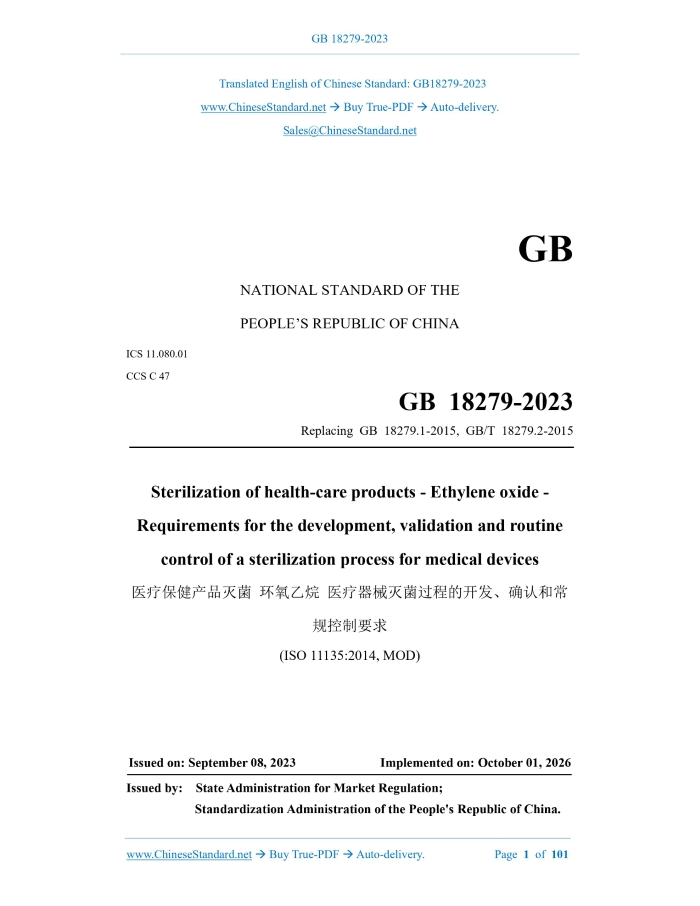
GB NATIONAL STANDARD OF THE PEOPLE’S REPUBLIC OF CHINA ICS 11.080.01 CCS C 47 Replacing GB 18279.1-2015, GB/T 18279.2-2015 Sterilization of health-care products - Ethylene oxide - Requirements for the development, validation and routine control of a sterilization process for medical devices (ISO 11135.2014, MOD) Issued on. SEPTEMBER 08, 2023 Implemented on. OCTOBER 01, 2026 Issued by. State Administration for Market Regulation; Standardization Administration of the People's Republic of China.
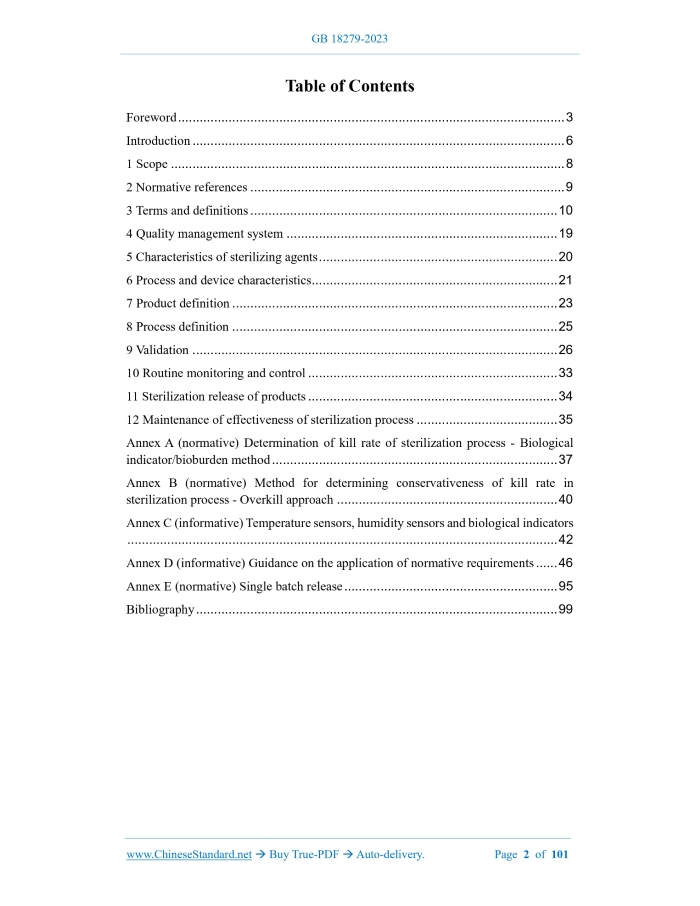
Table of Contents
Foreword... 3 Introduction... 6 1 Scope... 8 2 Normative references... 9 3 Terms and definitions... 10 4 Quality management system... 19 5 Characteristics of sterilizing agents... 20 6 Process and device characteristics... 21 7 Product definition... 23 8 Process definition... 25 9 Validation... 26 10 Routine monitoring and control... 33 11 Sterilization release of products... 34 12 Maintenance of effectiveness of sterilization process... 35 Annex A (normative) Determination of kill rate of sterilization process - Biological indicator/bioburden method... 37 Annex B (normative) Method for determining conservativeness of kill rate in sterilization process - Overkill approach... 40 Annex C (informative) Temperature sensors, humidity sensors and biological indicators ... 42 Annex D (informative) Guidance on the application of normative requirements... 46 Annex E (normative) Single batch release... 95 Bibliography... 99Foreword
This document was drafted in accordance with the rules given in GB/T 1.1-2020 "Directives for standardization - Part 1.Rules for the structure and drafting of standardizing documents". This document replaces GB 18279.1-2015 "Sterilization of health care products - Ethylene oxide - Part 1.Requirements for development, validation and routine control of a sterilization process for medical devices" and GB/T 18279.2-2015 "Sterilization of health care products - Part 2.Guidance on the application of GB 18279.1". In addition to structural adjustments and editorial changes, the main technical changes are as follows. - Added instructions for the application of this document in health care facility (see 1.1 of this Edition); - Added some terms (see 3.10, 3.38, 3.43, 3.57 of this Edition); - Deleted some terms (see 3.19 of GB 18279.1-2015 and 3.1 of GB/T 18279.2-2015); - Modified the requirements for the quality management system (see 4.1, 4.2, 4.3 of this Edition; 4.1, 4.2, 4.3 of GB 18279.1-2015); - Modified the requirements for sterilizing agent (see 5.1, 5.2, 5.5 of this Edition; 5.1, 5.4 of GB 18279.1-2015); - Added an overview of process and equipment characteristics (see 6.1 of this Edition); - Modified the requirements for process characteristics (see 6.2 of this Edition; 6.1 of GB 18279.1-2015); - Added the purpose and content of product definition (see 7.1.1, 7.1.5 of this Edition); - Deleted the requirements for the most difficult to sterilize location (see 7.1.3 of GB 18279.1-2015); - Added the purpose of process definition (see 8.1 of this Edition); - Added general rules for confirmation (see 9.1 of this Edition); - Added the requirements for installation qualification (see 9.2.1.3, 9.2.2.3, 9.2.2.4, 9.2.2.6 of this Edition); - Added performance qualification requirements (see 9.4.1.1, 9.4.1.5, 9.4.1.6 of this Edition); - Changed the requirements for performance qualification (see 9.4.1.8 of this Edition; 9.3 of GB 18279.1-2015); - Added requirements for microbial performance qualification (see 9.4.2.5, 9.4.2.6, 9.4.3.2 of this Edition); - Added parameters that shall be specified in the validation report (see 9.5.4 of this Edition); - Added the objectives and requirements of routine monitoring (see 10.1, 10.2, 10.3 of this Edition); - Changed the requirements for product release (see 11.2, 11.3, 11.4 of this Edition; Chapter 11 of GB 18279.1-2015); - Changed the requalification requirements (see 12.3.1, 12.3.3 of this Edition; 12.3 of GB 18279.1-2015); - Added requirements for change assessment (see 12.4.2, 12.4.6 of this Edition); - Added the content of equivalence evaluation (see 12.5 of this Edition); - Deleted the description of the procedures and calculation methods for the biological indicator/bioburden method (see A.2 and A.3 of GB 18279.1-2015); - Changed the procedure of the overkill approach (see B.2 of this Edition; B.2 of GB 18279.1-2015); - Changed the number of sensors and biological indicators (see Table C.1 and Table C.3 of this Edition; Table C.1 and Table C.3 of GB 18279.1-2015); - Added content related to single batch release (see Annex E of this Edition). The modification of this document adopted ISO 11135.2014 "Sterilization of health- care products - Ethylene oxide - Requirements for the development, validation and routine control of a sterilization process for medical devices". The technical differences between this document and ISO 11135.2014 and their reasons are as follows. - Changed the description of the requirements for health care facility in the scope (see 1.1) to avoid conflicts between the mandatory requirements of the standard and the requirements of the regulations; - Deleted the term "medical device" (see 3.21 of ISO 11135.2014) to avoid conflict with Chinese regulations; - Changed the terminology of "spore-log-reduction" (see 3.41 of this Edition) to make it easier to understand; - Deleted the exception for analytical (if used) process variable control (see 6.2.5 of ISO 11135.2014) to standardize the process control requirements; - Deleted the specification of the method for proving that the bioburden resistance is less than the resistance of the biological indicator in the overkill approach (see B.1.4 of ISO 11135.2014) to avoid limiting the application of the standard; - Changed the references to other international standards in 4.1.2, 4.3.1, 4.3.2, 4.3.3, 4.4, 7.3.2, 8.9, 11.3, 11.4, and E.1 to notes to suit China's national conditions. The following editorial changes were made to this document. - The amendments to ISO 11135.2014/Amd.1.2018 were incorporated. The outer margins of the clauses involved are marked with a double vertical line (ǁ); - Deleted the note in 1.2.2 to adapt to China's national conditions; - Used YY/T 0287-2017 to replace ISO 13485.2016 to adapt to China's national conditions; - Moved the note referring to Annex E in 11.4 into the main text to be consistent with the normative Annex E; - Simplified the description of A.2 to make the standard terms clearer; - Added management standards for health care institutions for reference in applicable guidelines (see note to D.4.2.2). - Added two notes in D.5.5.1 to better describe the combustion and explosion of ethylene oxide; - Changed the interpretation of D.12.5 to refer to YY/T 1268 to make the standard content easier to understand. Attention is drawn to the possibility that some of the elements of this document may be the subject of patent rights. The issuing authority shall not be held responsible for identifying any or all such patent rights. This document was proposed by and shall be under the jurisdiction of State Administration for Market Regulation. Versions of standard substituted by this document are. - It was first published in 2000 as GB 18279-2000; - It was first revised in 2015 as GB 18279.1-2015 and GB/T 18279.2-2015; This is the second revision.1 Scope
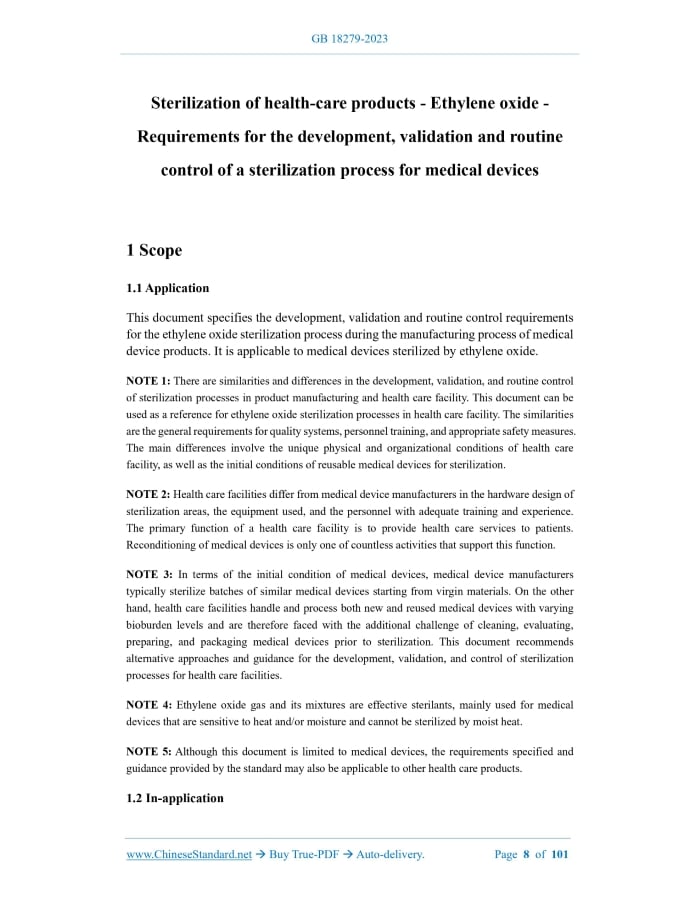
This document specifies the development, validation and routine control requirements for the ethylene oxide sterilization process during the manufacturing process of medical device products. It is applicable to medical devices sterilized by ethylene oxide.2 Normative references
The following referenced documents are indispensable for the application of this document. For dated references, only the edition cited applies. For undated references, the latest edition of the referenced document (including any amendments) applies. GB 18281.1-2015, Sterilization of health care products - Biological indicators - Part 1.General requirements (ISO 11138-1.2006, IDT) GB 18281.2-2015, Sterilization of health care products - Biological indicators - Part 2.Biological indicators for ethylene oxide sterilization processes (ISO 11138- 2.2006, IDT)3 Terms and definitions
For the purposes of this document, the following terms and definitions apply. A test system containing live microorganisms that has a specific resistance to a specified sterilization process. A test system that exhibits changes in one or more predetermined process variables based on chemical or physical changes caused by exposure to a sterilization process.4 Quality management system
The responsibilities and authorities for implementing and meeting the requirements of this document shall be specified. The responsibilities may be assigned to competent personnel in accordance with the applicable provisions of YY/T 0287- 2017. Where the requirements of this document are undertaken by more than one organization with separate quality management systems, the responsibilities and authorities of each party shall be specified. Calibration procedures for all equipment (including test instruments) used to meet the requirements of this document shall be specified.5 Characteristics of sterilizing agents
If ethylene oxide outside the recognized composition range is used or a new diluent is used, data on microbiological effectiveness shall be developed. The effects of ethylene oxide on most materials used to manufacture medical devices have been thoroughly documented. This documentation is valuable in the design and development of medical devices that are sterilized using ethylene oxide. This document does not require specific studies on the effects of ethylene oxide on materials, but does require studies on the effects of ethylene oxide on products (see Chapter 7).6 Process and device characteristics
a) identification of the necessary stages of the ethylene oxide sterilization process; b) identification of the process variables at each stage; c) documentation of the process variables.7 Product definition
The sterilization process shall be defined using the process parameters and tolerances that have been identified as having the greatest impact on the product/package. Confirm that the product and its packaging meet the specified safety, quality and performance requirements. The medical device manufacturer shall document the results of the product definition.8 Process definition
The suitability of process challenge devices for process definition, validation, and routine monitoring and control shall be determined. The challenge to the sterilization process from the process challenge device shall be greater than or equal to the challenge of the natural bioburden at the most difficult location to sterilize in the product.9 Validation
For the equipment used in sterilization process, only one installation qualification and one operational qualification may be carried out for the designated equipment. qualification to prove that the sterilization process meets the specified acceptance criteria and can achieve the sterility assurance level required by the product. At least three consecutive, planned qualification runs shall be included. These runs shall meet all specified acceptance criteria. ......Source: Above contents are excerpted from the full-copy PDF -- translated/reviewed by: www.ChineseStandard.net / Wayne Zheng et al.