GB/T 15981-2021 PDF English
Price & Delivery
US$230.00 · In stock · Download in 9 secondsGB/T 15981-2021: Evaluating method for the efficacy of sterilization for disinfection equipment
Delivery: 9 seconds. True-PDF full-copy in English & invoice will be downloaded + auto-delivered via email. See step-by-step procedure
Status: Valid
GB/T 15981: Historical versions
| Standard ID | USD | BUY PDF | Delivery | Standard Title (Description) | Status |
| GB/T 15981-2021 | 230 | Add to Cart | Auto, 9 seconds. | Evaluating method for the efficacy of sterilization for disinfection equipment | Valid |
| GB 15981-1995 | 155 | Add to Cart | Auto, 9 seconds. | Evaluating method and standard for the efficacy of disinfection and sterilization | Obsolete |
Click to Preview this PDF
Similar standards
GB/T 15981-2021: Evaluating method for the efficacy of sterilization for disinfection equipment
---This is an excerpt. Full copy of true-PDF in English version (including equations, symbols, images, flow-chart, tables, and figures etc.), auto-downloaded/delivered in 9 seconds, can be purchased online: https://www.ChineseStandard.net/PDF.aspx/GBT15981-2021NATIONAL STANDARD OF THE PEOPLE’S REPUBLIC OF CHINA ICS 11.080 CCS C 59 Replacing GB 15981-1995 Evaluating method for the efficacy of sterilization for disinfection equipment Issued on. DECEMBER 31, 2021 Implemented on. JULY 01, 2022 Issued by. State Administration for Market Regulation; Standardization Administration of the People's Republic of China.
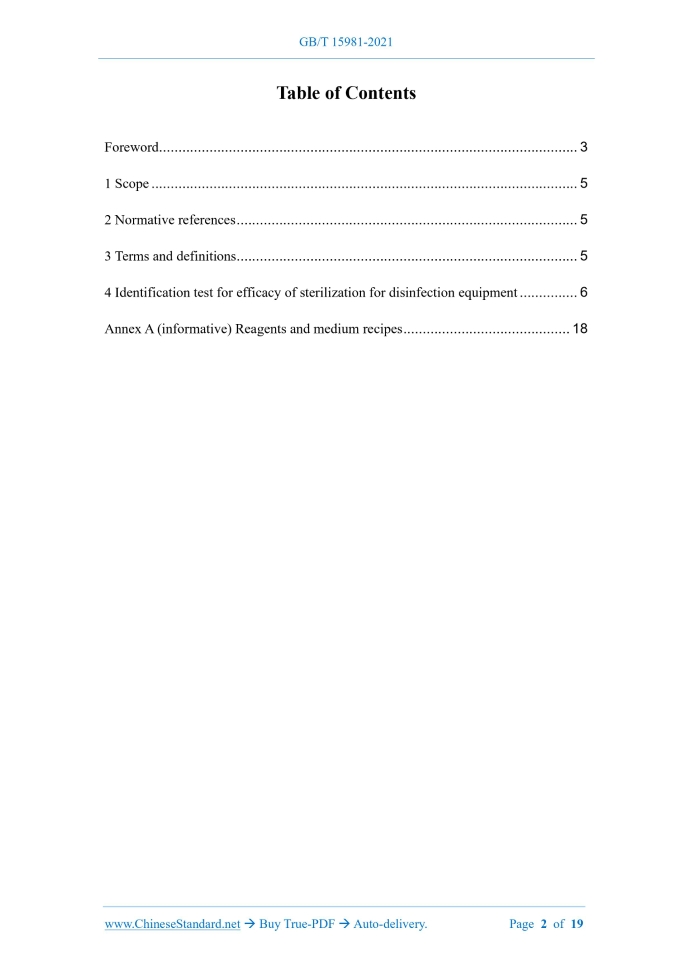
Table of Contents
Foreword... 3 1 Scope... 5 2 Normative references... 5 3 Terms and definitions... 5 4 Identification test for efficacy of sterilization for disinfection equipment... 6 Annex A (informative) Reagents and medium recipes... 181 Scope
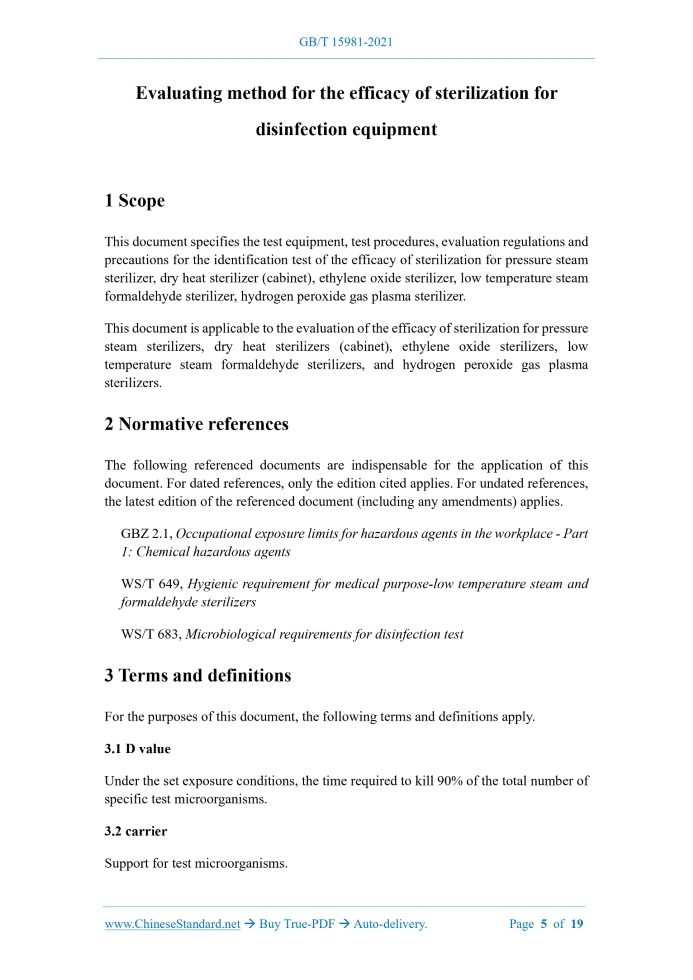
This document specifies the test equipment, test procedures, evaluation regulations and precautions for the identification test of the efficacy of sterilization for pressure steam sterilizer, dry heat sterilizer (cabinet), ethylene oxide sterilizer, low temperature steam formaldehyde sterilizer, hydrogen peroxide gas plasma sterilizer. This document is applicable to the evaluation of the efficacy of sterilization for pressure steam sterilizers, dry heat sterilizers (cabinet), ethylene oxide sterilizers, low temperature steam formaldehyde sterilizers, and hydrogen peroxide gas plasma sterilizers.2 Normative references
The following referenced documents are indispensable for the application of this document. For dated references, only the edition cited applies. For undated references, the latest edition of the referenced document (including any amendments) applies. GBZ 2.1, Occupational exposure limits for hazardous agents in the workplace - Part 1.Chemical hazardous agents WS/T 649, Hygienic requirement for medical purpose-low temperature steam and formaldehyde sterilizers WS/T 683, Microbiological requirements for disinfection test3 Terms and definitions
For the purposes of this document, the following terms and definitions apply. 3.1 D value Under the set exposure conditions, the time required to kill 90% of the total number of specific test microorganisms. 3.2 carrier Support for test microorganisms. 3.4 process challenge device; PCD A specially designed device to simulate the sterilization of articles, resistant to a specific sterilization process, and used to evaluate the effectiveness of the sterilization process.4 Identification test for efficacy of sterilization for disinfection equipment
4.1 Identification test for efficacy of sterilization for pressure steam sterilizer 4.1.1 Test equipment 4.1.2 Test steps The test steps are as follows. 4.1.3 Evaluation regulations 4.1.3.1 To determine that the efficacy of sterilization of the sterilizer is qualified, it must meet the requirements at the same time. The color of the positive control medium turns yellow for each test. The negative control medium color does not change. The recovered bacteria volume of the control bacteria tablets is ≥1×10⁵ CFU/tablet. The color of the test group remained unchanged. 4.1.3.2 When self-contained biological indicators are used for evaluation, the results are determined according to the instruction manual. 4.1.4 Precautions 4.2 Identification test for efficacy of sterilization for dry heat sterilizer (cabinet) 4.2.1 Test equipment 4.2.2 Test steps The test steps are as follows. 4.2.3 Evaluation regulations 4.2.4 Precautions 4.2.4.1 Strictly abide by aseptic technique regulations. 4.2.4.2 The test shall be carried out under full load conditions. 4.3 Identification test for efficacy of sterilization for ethylene oxide sterilizer 4.3.1 Test equipment 4.3.2 Test steps The test steps are as follows. 4.3.3 Evaluation regulations 4.3.3.1 To determine the sterilization effect of the sterilizer is qualified, it must meet the following requirements. The amount of recovered bacteria in the control group shall be greater than or equal to 1×10⁶ CFU/tablet. There is bacterial growth in the positive control group. There is aseptic growth in the negative control group. All the test groups are aseptically grown. 4.3.4 Precautions 4.3.4.1 Ethylene oxide is flammable, explosive and toxic. To ensure the safety of the test, the operators and test personnel shall be familiar with the performance of ethylene oxide and the operating procedures of the equipment. 4.3.4.2 The working environment shall be well ventilated. The maximum allowable concentration of ethylene oxide in the air at the work site is 2mg/m3.If a person inhales too much ethylene oxide gas, it will cause poisoning symptoms. Severe cases can cause pulmonary edema. If symptoms of poisoning appear, leave the scene immediately and rest in a well-ventilated place. Mild cases breathe fresh air until symptoms clear up. Severe cases shall be sent to hospital for treatment in time. 4.4 Identification test for efficacy of sterilization for low temperature steam formaldehyde sterilizer 4.4.1 Test equipment 4.4.2 Test steps The test steps are as follows. 4.4.3 Evaluation regulations 4.4.3.1 To determine that the sterilization effect of the sterilizer is qualified, it must meet the requirements at the same time. The amount of testing recovered bacteria of the bacterial count control group in each test is 1×10⁶ CFU/tablet~5×106 CFU/tablet. There is bacterial growth in the positive control group. There is aseptic growth in the negative control group. There is aseptic growth in the test group. 4.5 Identification test for efficacy of sterilization for hydrogen peroxide gas plasma sterilizer 4.5.1 Test equipment 4.5.1.1 Test contamination carrier. Bacillus stearothermophilus (ATCC 7953 or SSI K31) spores, with qualified resistance identification. The contamination carrier is a stainless-steel needle with a diameter of ≤0.4mm. 4.5.1.2 Reagents. Phosphate buffered saline (PBS, see A.1); tryptone soy agar medium (TSA, see A.3); bromocresol purple peptone medium (see A.4). 4.5.1.3 Simulated medical device lumen 4.5.1.4 Fully loaded items. The items specified in the instruction manual. 4.5.2 Test steps The test steps are as follows. 4.5.4 Precautions 4.5.4.1 Items must be placed in compliance with the regulations. Sterilized items shall be clean and dry. 4.5.4.2 If the hydrogen peroxide gas plasma sterilizer has multiple sterilization programs, each sterilization program shall be verified separately. 4.5.4.3 The identification of the efficacy of sterilization of the hydrogen peroxide gas sterilizer is carried out with reference to the test method in 4.5. ......Source: Above contents are excerpted from the full-copy PDF -- translated/reviewed by: www.ChineseStandard.net / Wayne Zheng et al.