DL/T 911-2016 PDF English
Price & Delivery
US$215.00 · In stock · Download in 9 secondsDL/T 911-2016: Frequency response analysis on winding deformation of power transformers
Delivery: 9 seconds. True-PDF full-copy in English & invoice will be downloaded + auto-delivered via email. See step-by-step procedure
Status: Valid
DL/T 911: Historical versions
| Standard ID | USD | BUY PDF | Delivery | Standard Title (Description) | Status |
| DL/T 911-2016 | 215 | Add to Cart | Auto, 9 seconds. | Frequency response analysis on winding deformation of power transformers | Valid |
| DL/T 911-2004 | 70 | Add to Cart | Auto, 9 seconds. | Frequency response analysis on winding deformation of power transformers | Obsolete |
Click to Preview this PDF
Similar standards
DL/T 911-2016: Frequency response analysis on winding deformation of power transformers
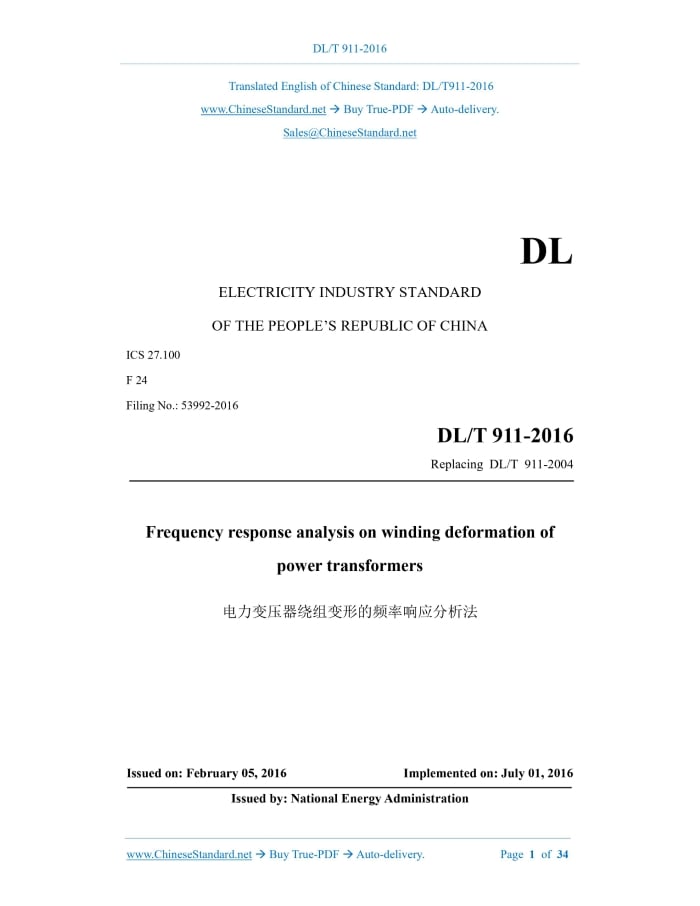
---This is an excerpt. Full copy of true-PDF in English version (including equations, symbols, images, flow-chart, tables, and figures etc.), auto-downloaded/delivered in 9 seconds, can be purchased online: https://www.ChineseStandard.net/PDF.aspx/DLT911-2016DL ELECTRICITY INDUSTRY STANDARD ICS 27.100 F 24 Filing No.. 53992-2016 Replacing DL/T 911-2004 Frequency response analysis on winding deformation of power transformers Issued on. FEBRUARY 05, 2016 Implemented on. JULY 01, 2016 Issued by. National Energy Administration
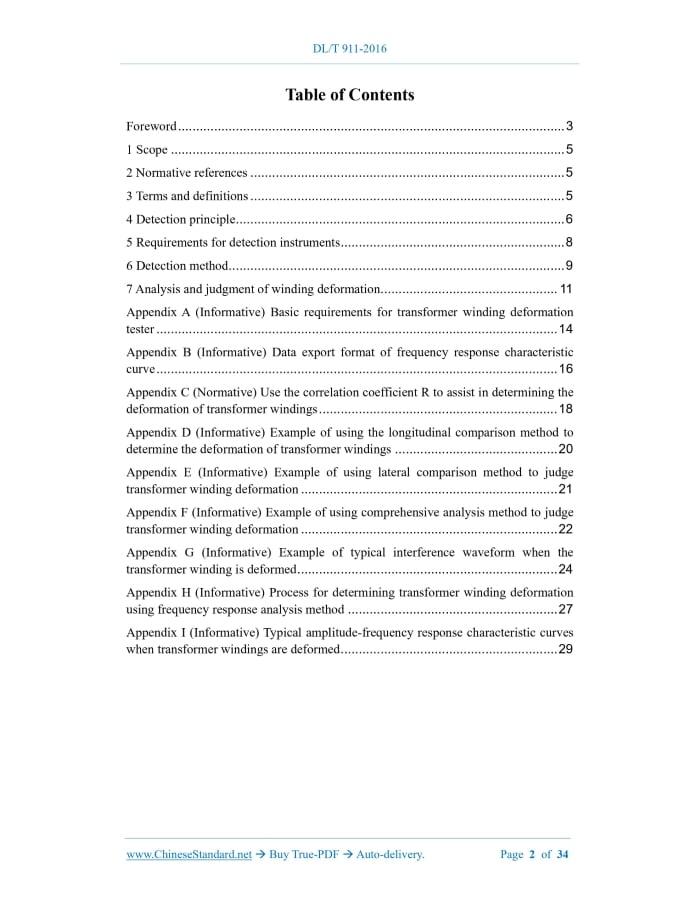
Table of Contents
Foreword... 3 1 Scope... 5 2 Normative references... 5 3 Terms and definitions... 5 4 Detection principle... 6 5 Requirements for detection instruments... 8 6 Detection method... 9 7 Analysis and judgment of winding deformation... 11 Appendix A (Informative) Basic requirements for transformer winding deformation tester... 14 Appendix B (Informative) Data export format of frequency response characteristic curve... 16 Appendix C (Normative) Use the correlation coefficient R to assist in determining the deformation of transformer windings... 18 Appendix D (Informative) Example of using the longitudinal comparison method to determine the deformation of transformer windings... 20 Appendix E (Informative) Example of using lateral comparison method to judge transformer winding deformation... 21 Appendix F (Informative) Example of using comprehensive analysis method to judge transformer winding deformation... 22 Appendix G (Informative) Example of typical interference waveform when the transformer winding is deformed... 24 Appendix H (Informative) Process for determining transformer winding deformation using frequency response analysis method... 27 Appendix I (Informative) Typical amplitude-frequency response characteristic curves when transformer windings are deformed... 291 Scope
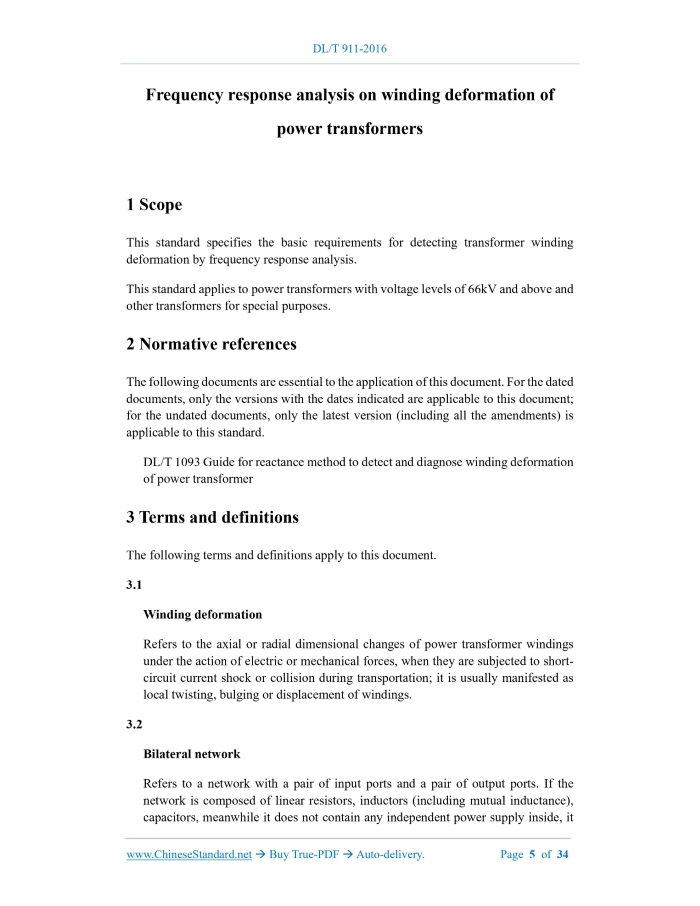
This standard specifies the basic requirements for detecting transformer winding deformation by frequency response analysis. This standard applies to power transformers with voltage levels of 66kV and above and other transformers for special purposes.2 Normative references
The following documents are essential to the application of this document. For the dated documents, only the versions with the dates indicated are applicable to this document; for the undated documents, only the latest version (including all the amendments) is applicable to this standard. DL/T 1093 Guide for reactance method to detect and diagnose winding deformation of power transformer3 Terms and definitions
The following terms and definitions apply to this document. 3.1 Winding deformation Refers to the axial or radial dimensional changes of power transformer windings under the action of electric or mechanical forces, when they are subjected to short- circuit current shock or collision during transportation; it is usually manifested as local twisting, bulging or displacement of windings. 3.2 Bilateral network Refers to a network with a pair of input ports and a pair of output ports. If the network is composed of linear resistors, inductors (including mutual inductance), capacitors, meanwhile it does not contain any independent power supply inside, it is called a passive linear bilateral network. 3.3 Transfer function The ratio of the output to the input of a passive bilateral network, which is expressed in Laplace transform form. The distribution of the poles and zeros of the transfer function is closely related to the internal component parameters, connection method, port connection impedance of the bilateral network. 3.4 Frequency response Refers to the relationship between the transfer function H(jω) of the network and the angular frequency ω in the sinusoidal steady state. The relationship between the amplitude of H(jω) and the frequency ω is usually called the amplitude-frequency response; the relationship between the phase of H(jω) and the frequency ω is called the phase-frequency response.4 Detection principle
Under the action of a high frequency voltage, each winding of the transformer can be regarded as a passive linear bilateral network, which is composed of distributed parameters such as linear resistance, inductance (mutual inductance), capacitance.5 Requirements for detection instruments
5.1 Basic requirements for detection instruments For the basic requirements of transformer winding deformation tester, please refer to Appendix A. 5.2 Sweep frequency detection range The sweep frequency detection range shall include the frequency band of 1kHz ~ 1000kHz. 5.4 Sweep frequency accuracy The frequency accuracy of the sine wave signal output by the signal source shall not exceed 0.01%. 5.5 Scanning frequency interval The scanning frequency interval should be 1kHz. 5.6 Impedance matching method The output impedance RS of the sine wave signal output source US of the detection instrument shall be 50Ω; the input impedance of the two signal detection terminals U1 and U2 shall not be lower than 1MΩ; a 50Ω matching resistor R shall be installed between the signal response terminal and the common terminal (see Figure 1). 5.7 Detection accuracy The detection instrument shall have a dynamic detection range of -100dB ~ 20dB; the absolute error of detection within the range of -80dB ~ 20dB shall be less than 1dB. 5.10 Data query function The search function can be used to query the historical data of the same model, the same manufacturer and the transformer.6 Detection method
6.1 Detection condition requirements 6.1.1 Detection shall not be carried out in thunderstorms, rain, snow and other weather. The detection shall strictly implement the requirements of the power safety work regulations; it shall strictly implement the organizational and technical measures to ensure safety. The test personnel shall be trained and have the ability to conduct on-site tests. 6.1.3 Before testing, all leads connected to the end of the transformer bushing shall be removed; the removed leads shall be as far away from the tested transformer bushing as possible. 6.2 Wiring requirements 6.2.1 All wiring shall be stable and reliable. Special wiring clamps shall be used to reduce contact resistance. 6.2.2 The same wiring method shall be used for the same transformer or the same model. The test cable and ground lead on the excitation end and the response end can be led down along the porcelain sleeve of the bushing. The ground wire cannot be entangled and shall be electrically connected to the metal box of the transformer nearby, to maintain good high-frequency grounding performance. 6.3 Wiring method 6.3.1 According to the connection structure of the transformer winding, select the excitation end (input end) and response end (measurement end) of the winding to be tested according to Figure 2; the ends of other windings are suspended.7 Analysis and judgment of winding deformation
7.1 Analysis and judgment principle The frequency response analysis method is used to judge the deformation of transformer windings. The frequency response data curves of three-phase windings of the same voltage level are mainly compared longitudinally, laterally, comprehensively; the changes in the amplitude-frequency characteristics of the transformer windings are judged by the correlation coefficient. 7.2 Longitudinal comparison method The longitudinal comparison method refers to comparing the amplitude-frequency response characteristics of the same transformer, the same winding, the same tap position, the different periods; 7.3 Lateral comparison method The lateral comparison method refers to comparing the amplitude-frequency response characteristics of three-phase windings of the same voltage level of the transformer. If necessary, the amplitude-frequency response characteristics of the same model transformer manufactured by the same manufacturer at the same time are used to judge whether the transformer winding is deformed. This method does not require the original amplitude-frequency response characteristics of the transformer; 7.4 Comprehensive analysis method The comprehensive analysis method mainly compares the three-phase frequency response fingerprints of the transformer laterally and longitudinally; makes a judgment based on the differences in the three-phase frequency response fingerprints. See Appendix F for an example of using the comprehensive comparison method to judge the deformation of the transformer winding. 7.5 Analysis process 7.6 Winding deformation analysis 7.6.1 The typical amplitude-frequency response characteristic curve of transformer winding usually contains multiple obvious peaks and troughs. The changes in the distribution position and number of peaks or troughs are important bases for analyzing transformer winding deformation. See Appendix I for the typical amplitude-frequency response characteristic curve of transformer winding deformation. DL/T 911-2016 DL ELECTRICITY INDUSTRY STANDARD ICS 27.100 F 24 Filing No.. 53992-2016 Replacing DL/T 911-2004 Frequency response analysis on winding deformation of power transformers Issued on. FEBRUARY 05, 2016 Implemented on. JULY 01, 2016 Issued by. National Energy AdministrationTable of Contents
Foreword... 3 1 Scope... 5 2 Normative references... 5 3 Terms and definitions... 5 4 Detection principle... 6 5 Requirements for detection instruments... 8 6 Detection method... 9 7 Analysis and judgment of winding deformation... 11 Appendix A (Informative) Basic requirements for transformer winding deformation tester... 14 Appendix B (Informative) Data export format of frequency response characteristic curve... 16 Appendix C (Normative) Use the correlation coefficient R to assist in determining the deformation of transformer windings... 18 Appendix D (Informative) Example of using the longitudinal comparison method to determine the deformation of transformer windings... 20 Appendix E (Informative) Example of using lateral comparison method to judge transformer winding deformation... 21 Appendix F (Informative) Example of using comprehensive analysis method to judge transformer winding deformation... 22 Appendix G (Informative) Example of typical interference waveform when the transformer winding is deformed... 24 Appendix H (Informative) Process for determining transformer winding deformation using frequency response analysis method... 27 Appendix I (Informative) Typical amplitude-frequency response characteristic curves when transformer windings are deformed... 291 Scope
This standard specifies the basic requirements for detecting transformer winding deformation by frequency response analysis. This standard applies to power transformers with voltage levels of 66kV and above and other transformers for special purposes.2 Normative references
The following documents are essential to the application of this document. For the dated documents, only the versions with the dates indicated are applicable to this document; for the undated documents, only the latest version (including all the amendments) is applicable to this standard. DL/T 1093 Guide for reactance method to detect and diagnose winding deformation of power transformer3 Terms and definitions
The following terms and definitions apply to this document. 3.1 Winding deformation Refers to the axial or radial dimensional changes of power transformer windings under the action of electric or mechanical forces, when they are subjected to short- circuit current shock or collision during transportation; it is usually manifested as local twisting, bulging or displacement of windings. 3.2 Bilateral network Refers to a network with a pair of input ports and a pair of output ports. If the network is composed of linear resistors, inductors (including mutual inductance), capacitors, meanwhile it does not contain any independent power supply inside, it is called a passive linear bilateral network. 3.3 Transfer function The ratio of the output to the input of a passive bilateral network, which is expressed in Laplace transform form. The distribution of the poles and zeros of the transfer function is closely related to the internal component parameters, connection method, port connection impedance of the bilateral network. 3.4 Frequency response Refers to the relationship between the transfer function H(jω) of the network and the angular frequency ω in the sinusoidal steady state. The relationship between the amplitude of H(jω) and the frequency ω is usually called the amplitude-frequency response; the relationship between the phase of H(jω) and the frequency ω is called the phase-frequency response.4 Detection principle
Under the action of a high frequency voltage, each winding of the transformer can be regarded as a passive linear bilateral network, which is composed of distributed parameters such as linear resistance, inductance (mutual inductance), capacitance.5 Requirements for detection instruments
5.1 Basic requirements for detection instruments For the basic requirements of transformer winding deformation tester, please refer to Appendix A. 5.2 Sweep frequency detection range The sweep frequency detection range shall include the frequency band of 1kHz ~ 1000kHz. 5.4 Sweep frequency accuracy The frequency accuracy of the sine wave signal output by the signal source shall not exceed 0.01%. 5.5 Scanning frequency interval The scanning frequency interval should be 1kHz. 5.6 Impedance matching method The output impedance RS of the sine wave signal output source US of the detection instrument shall be 50Ω; the input impedance of the two signal detection terminals U1 and U2 shall not be lower than 1MΩ; a 50Ω matching resistor R shall be installed between the signal response terminal and the common terminal (see Figure 1). 5.7 Detection accuracy The detection instrument shall have a dynamic detection range of -100dB ~ 20dB; the absolute error of detection within the range of -80dB ~ 20dB shall be less than 1dB. 5.10 Data query function The search function can be used to query the historical data of the same model, the same manufacturer and the transformer.6 Detection method
6.1 Detection condition requirements 6.1.1 Detection shall not be carried out in thunderstorms, rain, snow and other weather. The detection shall strictly implement the requirements of the power safety work regulations; it shall strictly implement the organizational and technical measures to ensure safety. The test personnel shall be trained and have the ability to conduct on-site tests. 6.1.3 Before testing, all leads connected to the end of the transformer bushing shall be removed; the removed leads shall be as far away from the tested transformer bushing as possible. 6.2 Wiring requirements 6.2.1 All wiring shall be stable and reliable. Special wiring clamps shall be used to reduce contact resistance. 6.2.2 The same wiring method shall be used for the same transformer or the same model. The test cable and ground lead on the excitation end and the response end can be led down along the porcelain sleeve of the bushing. The ground wire cannot be entangled and shall be electrically connected to the metal box of the transformer nearby, to maintain good high-frequency grounding performance. 6.3 Wiring method 6.3.1 According to the connection structure of the transformer winding, select the excitation end (input end) and response end (measurement end) of the winding to be tested according to Figure 2; the ends of other windings are suspended.7 Analysis and judgment of winding deformation
7.1 Analysis and judgment principle The frequency response analysis method is used to judge the deformation of transformer windings. The frequency response data curves of three-phase windings of the same voltage level are mainly compared longitudinally, laterally, comprehensively; the changes in the amplitude-frequency characteristics of the transformer windings are judged by the correlation coefficient. 7.2 Longitudinal comparison method The longitudinal comparison method refers to comparing the amplitude-frequency response characteristics of the same transformer, the same winding, the same tap position, the different periods; 7.3 Lateral comparison method The lateral comparison method refers to comparing the amplitude-frequency response characteristics of three-phase windings of the same voltage level of the transformer. If necessary, the amplitude-frequency response characteristics of the same model transformer manufactured by the same manufacturer at the same time are used to judge whether the transformer winding is deformed. This method does not require the original amplitude-frequency response characteristics of the transformer; 7.4 Comprehensive analysis method The comprehensive analysis method mainly compares the three-phase frequency response fingerprints of the transformer laterally and longitudinally; makes a judgment based on the differences in the three-phase frequency response fingerprints. See Appendix F for an example of using the comprehensive comparison method to judge the deformation of the transformer winding. 7.5 Analysis process 7.6 Winding deformation analysis 7.6.1 The typical amplitude-frequency response characteristic curve of transformer winding usually contains multiple obvious peaks and troughs. The changes in the distribution position and number of peaks or troughs are important bases for analyzing transformer winding deformation. See Appendix I for the typical amplitude-frequency response characteristic curve of transformer winding deformation. ......Source: Above contents are excerpted from the full-copy PDF -- translated/reviewed by: www.ChineseStandard.net / Wayne Zheng et al.