YY/T 1142-2013 PDF English
Price & Delivery
US$175.00 · In stock · Download in 9 secondsYY/T 1142-2013: Methods of measuring the frequency of medical ultrasonic equipment and probe
Delivery: 9 seconds. True-PDF full-copy in English & invoice will be downloaded + auto-delivered via email. See step-by-step procedure
Status: Valid
YY/T 1142: Historical versions
| Standard ID | USD | BUY PDF | Delivery | Standard Title (Description) | Status |
| YY/T 1142-2013 | 175 | Add to Cart | Auto, 9 seconds. | Methods of measuring the frequency of medical ultrasonic equipment and probe | Valid |
| YY/T 1142-2003 | 239 | Add to Cart | 2 days | Methods of measuring the frequency of medical diagnostic and monitoring ultrasonic equipment | Obsolete |
Click to Preview this PDF
YY/T 1142-2013: Methods of measuring the frequency of medical ultrasonic equipment and probe
---This is an excerpt. Full copy of true-PDF in English version (including equations, symbols, images, flow-chart, tables, and figures etc.), auto-downloaded/delivered in 9 seconds, can be purchased online: https://www.ChineseStandard.net/PDF.aspx/YYT1142-2013YY PHARMACEUTICAL INDUSTRY STANDARD OF THE PEOPLE'S REPUBLIC OF CHINA ICS 11.040.50 C 41 Replacing YY/T 1142-2003 Methods of measuring the frequency of medical ultrasonic equipment and probe ISSUED ON: OCTOBER 21, 2013 IMPLEMENTED ON: OCTOBER 1, 2014 Issued by: China Food and Drug Administration
Table of Contents
Foreword ... 3 1 Scope ... 4 2 Normative references ... 4 3 Terms and definitions ... 4 4 Test conditions ... 6 5 Test methods ... 8 Methods of measuring the frequency of medical ultrasonic equipment and probe1 Scope
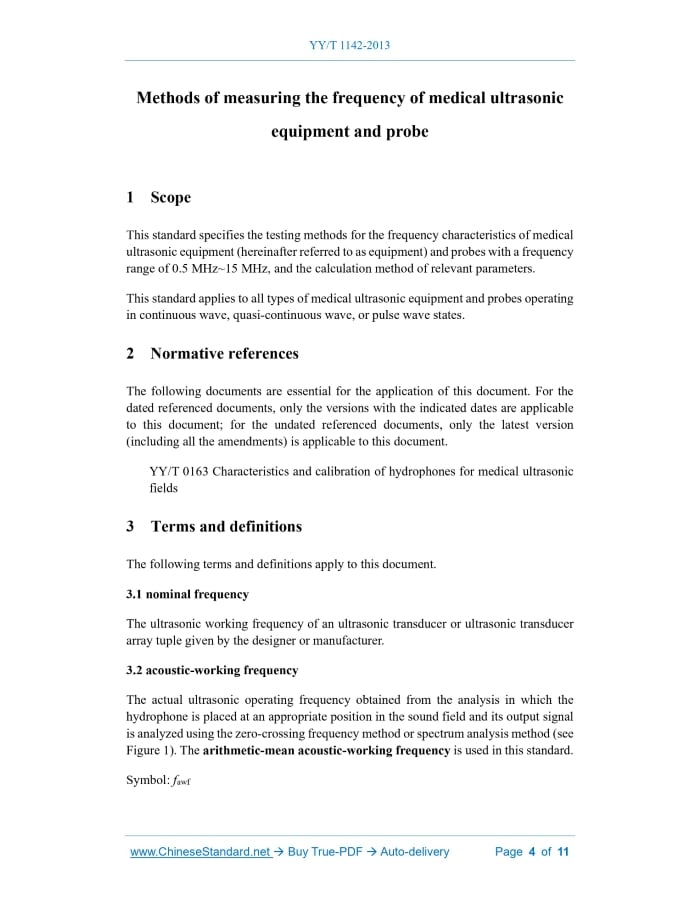
This standard specifies the testing methods for the frequency characteristics of medical ultrasonic equipment (hereinafter referred to as equipment) and probes with a frequency range of 0.5 MHz~15 MHz, and the calculation method of relevant parameters. This standard applies to all types of medical ultrasonic equipment and probes operating in continuous wave, quasi-continuous wave, or pulse wave states.2 Normative references
The following documents are essential for the application of this document. For the dated referenced documents, only the versions with the indicated dates are applicable to this document; for the undated referenced documents, only the latest version (including all the amendments) is applicable to this document. YY/T 0163 Characteristics and calibration of hydrophones for medical ultrasonic fields3 Terms and definitions
The following terms and definitions apply to this document. 3.1 nominal frequency The ultrasonic working frequency of an ultrasonic transducer or ultrasonic transducer array tuple given by the designer or manufacturer. 3.2 acoustic-working frequency The actual ultrasonic operating frequency obtained from the analysis in which the hydrophone is placed at an appropriate position in the sound field and its output signal is analyzed using the zero-crossing frequency method or spectrum analysis method (see Figure 1). The arithmetic-mean acoustic-working frequency is used in this standard. Symbol: fawf a) ambient temperature; b) supply voltage; c) Driving power setting (if any). 4.2 Test equipment 4.2.1 Hydrophone It shall meet the requirements of Class A or Class B needle-shaped (Z-type) or membrane-type (M-type) hydrophones specified in YY/T 0163. The size of the sensitive element is ≤1 mm, the frequency response is 0.5 MHz~15 MHz, and the flatness is ±3 dB. For some equipment that cannot provide the synchronized trigger signal required for measurement, an auxiliary hydrophone (Class A or B) may be required to trigger the oscilloscope. 4.2.2 Oscilloscope The frequency range is not narrower than 0~100 MHz, and the sensitivity is not lower than 5 mV/div. 4.2.3 Spectrum analyzer The frequency range is not narrower than 0.1 MHz~30 MHz, and the dynamic range is not less than 60 dB. 4.2.4 Hydrophone amplifier The frequency range is not narrower than 0~15 MHz, and there is an appropriate amplification factor. 4.2.5 Pulse generator/receiver Pulse generator: the external pulse leading edge (10%~90%) is < 10 ns, the amplitude is >50 V, the trailing edge is < 50 ns, the repetition frequency is 0~10 kHz, and the internal pulse repetition frequency is 100 Hz~10 kHz. Pulse receiver: the bandwidth is not narrower than 1 kHz~35 MHz(-3 dB). 4.2.6 Water tank and positioning device The size of the tank shall be such that boundary sound reflection does not have a major impact on the test. If necessary, sound-absorbing materials can be laid at appropriate locations in the tank. A positioning adjustment device equipped with a fixed probe and hydrophone can change the relative position and direction of the probe and hydrophone in three dimensions. The minimum adjustment displacement shall be less than half the wavelength of the sound wave. b) The ultrasonic output power is controlled at an appropriate position. c) The scanning angle shall be as small as possible. 5.2.3 After turning on the ultrasonic output, adjust the orientation and angle of the transducer to maximize the signal received by the hydrophone. If necessary, use a hydrophone amplifier to amplify the signal. 5.2.4 If the equipment under test operates in continuous wave or quasi-continuous wave mode, the frequency measurement function of an oscilloscope and a digital frequency meter can be used directly to measure the acoustic-working frequency without using a spectrum analyzer. 5.2.5 If the equipment under test operates in pulse scanning mode, an additional trigger signal synchronized with each sound repetition period shall be provided. If this cannot be provided, an auxiliary hydrophone can be used to provide an oscilloscope synchronization signal. 5.2.6 Calculation of the arithmetic-mean acoustic-working frequency: Measure f1 and f2 on the sound pressure waveform diagram or sound pressure spectrum diagram (as shown in Figure 1), then the arithmetic-mean acoustic-working frequency is calculated according to formula (1). where: f1 and f2 -- f1 and f2 respectively measured on the sound pressure spectrum diagram (as shown in Figure 1), the unit is megahertz (MHz). 5.2.7 The acoustic-working frequency bandwidth is calculated according to formula (3). where: f1 and f2 -- f1 and f2 respectively measured on the sound pressure spectrum diagram (Figure 1), the unit is megahertz (MHz). 5.2.8 If the equipment has multiple nominal frequencies, the above measurements shall be made separately for each nominal frequency value and the corresponding results shall be given. 5.2.9 The spectrum analysis diagram of the signal at the actual working frequency shall be given. In particular, the component sizes of its second harmonic and other specified ......Source: Above contents are excerpted from the full-copy PDF -- translated/reviewed by: www.ChineseStandard.net / Wayne Zheng et al.