YY/T 0664-2020 PDF English
Price & Delivery
US$980.00 · In stock · Download in 9 secondsYY/T 0664-2020: Medical device software - Software life cycle processes
Delivery: 9 seconds. True-PDF full-copy in English & invoice will be downloaded + auto-delivered via email. See step-by-step procedure
Status: Valid
YY/T 0664: Historical versions
| Standard ID | USD | BUY PDF | Delivery | Standard Title (Description) | Status |
| YY/T 0664-2020 | 980 | Add to Cart | Auto, 9 seconds. | Medical device software - Software life cycle processes | Valid |
| YY/T 0664-2008 | 500 | Add to Cart | Auto, 9 seconds. | Medical device software - Software life cycle processes | Obsolete |
Click to Preview this PDF
YY/T 0664-2020: Medical device software - Software life cycle processes
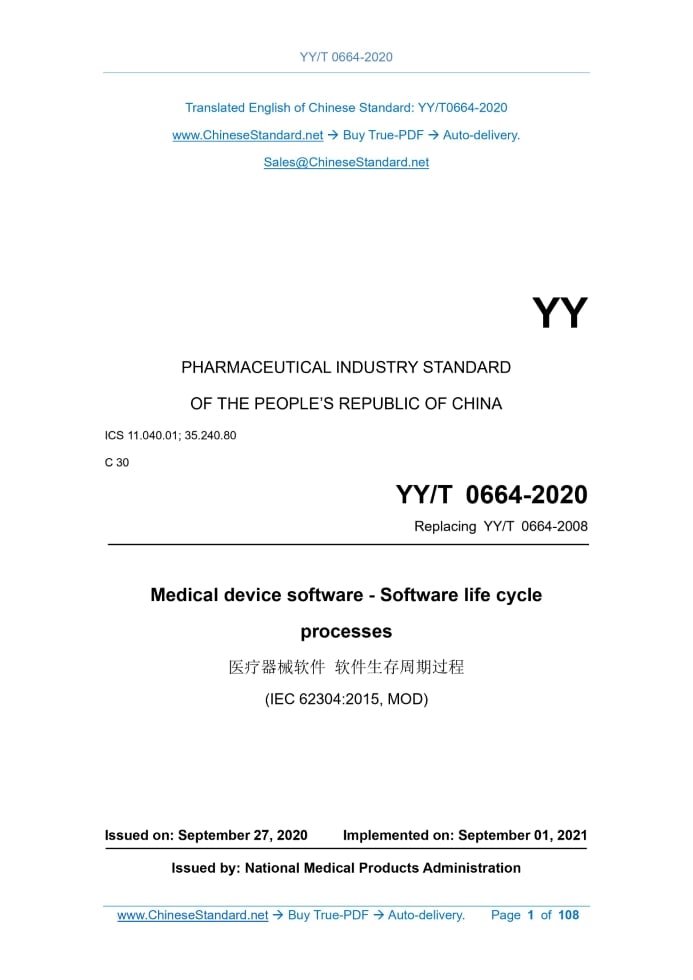
---This is an excerpt. Full copy of true-PDF in English version (including equations, symbols, images, flow-chart, tables, and figures etc.), auto-downloaded/delivered in 9 seconds, can be purchased online: https://www.ChineseStandard.net/PDF.aspx/YYT0664-2020YY PHARMACEUTICAL INDUSTRY STANDARD ICS 11.040.01; 35.240.80 C 30 Replacing YY/T 0664-2008 Medical device software - Software life cycle processes (IEC 62304.2015, MOD) Issued on. SEPTEMBER 27, 2020 Implemented on. SEPTEMBER 01, 2021 Issued by. National Medical Products Administration
Table of Contents
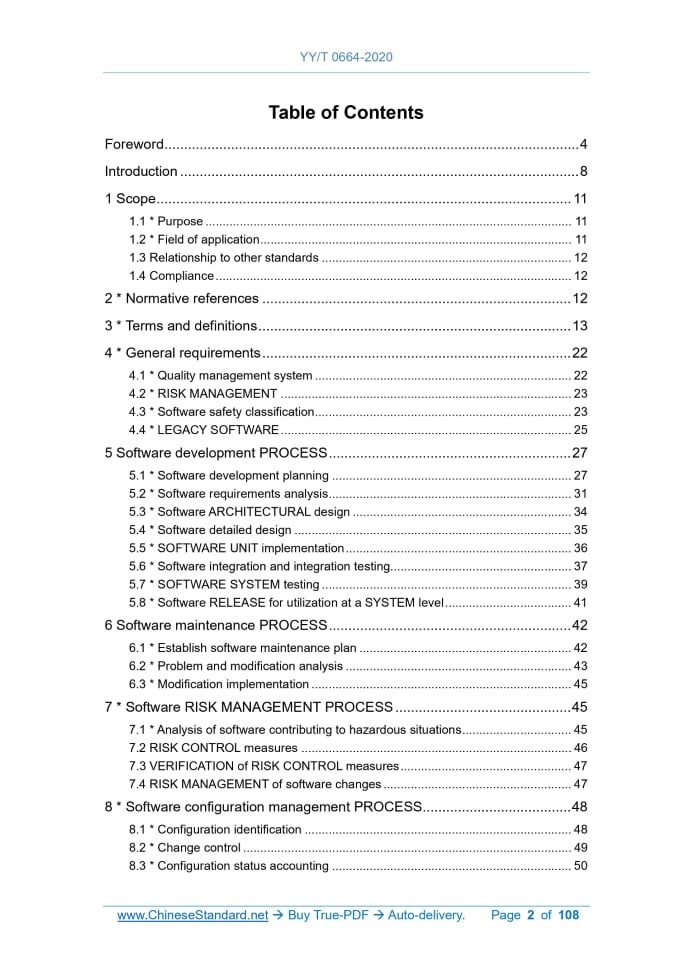
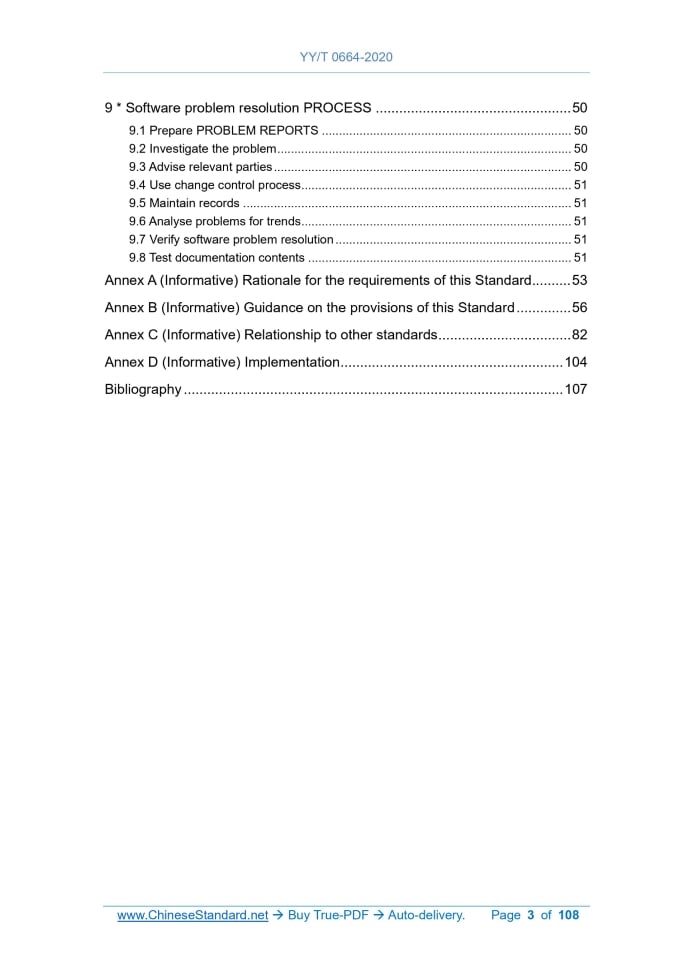
Foreword... 4 Introduction... 8 1 Scope... 11 1.1 * Purpose... 11 1.2 * Field of application... 11 1.3 Relationship to other standards... 12 1.4 Compliance... 12 2 * Normative references... 12 3 * Terms and definitions... 13 4 * General requirements... 22 4.1 * Quality management system... 22 4.2 * RISK MANAGEMENT... 23 4.3 * Software safety classification... 23 4.4 * LEGACY SOFTWARE... 25 5 Software development PROCESS... 27 5.1 * Software development planning... 27 5.2 * Software requirements analysis... 31 5.3 * Software ARCHITECTURAL design... 34 5.4 * Software detailed design... 35 5.5 * SOFTWARE UNIT implementation... 36 5.6 * Software integration and integration testing... 37 5.7 * SOFTWARE SYSTEM testing... 39 5.8 * Software RELEASE for utilization at a SYSTEM level... 41 6 Software maintenance PROCESS... 42 6.1 * Establish software maintenance plan... 42 6.2 * Problem and modification analysis... 43 6.3 * Modification implementation... 45 7 * Software RISK MANAGEMENT PROCESS... 45 7.1 * Analysis of software contributing to hazardous situations... 45 7.2 RISK CONTROL measures... 46 7.3 VERIFICATION of RISK CONTROL measures... 47 7.4 RISK MANAGEMENT of software changes... 47 8 * Software configuration management PROCESS... 48 8.1 * Configuration identification... 48 8.2 * Change control... 49 8.3 * Configuration status accounting... 50 9 * Software problem resolution PROCESS... 50 9.1 Prepare PROBLEM REPORTS... 50 9.2 Investigate the problem... 50 9.3 Advise relevant parties... 50 9.4 Use change control process... 51 9.5 Maintain records... 51 9.6 Analyse problems for trends... 51 9.7 Verify software problem resolution... 51 9.8 Test documentation contents... 51 Annex A (Informative) Rationale for the requirements of this Standard... 53 Annex B (Informative) Guidance on the provisions of this Standard... 56 Annex C (Informative) Relationship to other standards... 82 Annex D (Informative) Implementation... 104 Bibliography... 107Foreword
This Standard is drafted in accordance with the rules given in GB/T 1.1-2009. This Standard replaces YY/T 0664-2008 "Medical device software - Software life cycle processes". Compared with YY/T 0664-2008, in addition to editorial changes, the main technical changes are as follows. - Incorporate the amendments of the international standard IEC 62304.2006/AMD1.2015.The clauses and subclauses involved in these amendments have been marked by a vertical double line (||) on the outer margins. The main amendments include. Delete the term "software product" (3.26 of the 2008 edition); replace "software product" with "medical device software" (see 3.11); ADD the terms and definitions of "hazardous situation" (see 3.33), "legacy software" (see 3.34), "release" (see 3.35), "residual risk" (see 3.36), "risk estimation" (see 3.37), and "risk evaluation" (see 3.38); Modify the requirements of "Software safety classification" (see 4.3; 4.3 of the 2008 edition); ADD "Figure 3 Assigning software safety classification" (see 4.3); ADD the requirements of "LEGACY SOFTWARE" (see 4.4); ADD the requirements of "Identification and avoidance of common software defects" (see 5.1.12); Modify the requirements of "Verify software integration" (see 5.6.2; 5.6.2 of the 2008 edition); Modify the software safety class to which the provisions apply (see 5.7.1, 5.7.2, 5.7.3, 5.8.1, 5.8.2, 5.8.7, 5.8.8; 5.7.1, 5.7.2, 5.7.3, 5.8.1, 5.8.2, 5.8.7, 5.8.8 of the 2008 edition); Modify the requirements of "Evaluate SOFTWARE SYSTEM testing" (see 5.7.4; 5.7.4 of the 2008 edition); Modify "SOFTWARE SYSTEM test record contents" (see 5.7.5; 5.7.5 of the 2008 edition); Delete the requirements of "Document the sequence of events" (7.1.5 of the 2008 edition); Delete the requirements of "Document any new sequence of events" (7.3.2 of the 2008 edition); Modify the requirements of "Prepare PROBLEM REPORTS" (see 9.1; 9.1 of the 2008 edition); Modify the guidance on "Software safety classification" (see Annex B.4.3; Annex B.4.3 of the 2008 edition); ADD the guidance on "LEGACY SOFTWARE" (see Annex B.4.4). - Modify the Chinese expression of the term "anomaly" (see 3.2; 3.2 of the 2008 edition). - Modify the Chinese expression of the term "hazard" (see 3.9; 3.9 of the 2008 edition). - Modify the Chinese expression of the term "safety" (see 3.20; 3.21 of the 2008 edition); USE the changed expression throughout the text instead. - Modify the Chinese expression of the term "serious injury" (see 3.22; 3.23 of the 2008 edition). - Modifications to part of the content due to translation. This Standard uses the redraft law to modify and adopt IEC 62304.2015 "Medical device software - Software life cycle processes". There are technical differences between this Standard and IEC 62304.2015. The provisions involved in these differences have been marked by a single vertical line (|) on the outer margins. The main technical differences and reasons are as follows. - As for the normative references, this Standard has adjusted the technical differences, to adapt to the technical conditions of China. The adjustments are mainly reflected in Clause 2 “Normative references”. The specific adjustments are as follows. Replace ISO 14971 with YY/T 0316 which is identical to the international standard. - For deleted terms, clauses, or items that involve "not used", change the corresponding serial numbers (including table serial numbers), to comply with the provisions of GB/T 1.1, to ensure the determination of technical content and the harmonization of the text structure; - Modify the definition of the term "manufacturer (see 3.10)", to be consistent with the YY/T 0287-2017 standard; - Delete the term "medical device". Because medical device regulations and YY/T 0287-2017 both have a definition of "medical device", this Standard does not repeat it; - Modify the definitions of the terms "process (see 3.13)" and "verification (see 3.31)", to be consistent with GB/T 19000-2016; - Modify the definition of the term "regression testing" (see 3.14), to be consistent with ISO/IEC/IEEE 90003.2018; - Modify the Chinese expression of the term "harm" (see 3.8; 3.8 of the 2008 edition); and modify the definition to be consistent with YY/T 0316-2016; - Modify the Chinese expression of the term "security" (see 3.21; 3.22 of the 2008 edition); and modify the definition to be consistent with ISO/IEC/IEEE 12207.2017; - Uniformly modify "RISK CONTROL measures external to the software", "RISK CONTROL measures external to the software system", "RISK CONTROL measures not implemented within (external to) the software system", and "RISK CONTROL measures external to the (software system)" TO "external RISK CONTROL measures” (see 4.3 and Figure 3), in order to be consistent with regulations; - CHANGE the 8.2.2 note/8.2.3 note "5.1.1 e)" to "5.1.1 d)". Based on the standard context, editorial errors are corrected; - ADD Annex B.4.5 Regulatory perspective, in order to understand standards’ and regulatory requirements; - Delete the IEC mark in Figure 3.The content in the figure has technical changes with IEC 62304.2015; - Modify Table C.1 and Table C.2 in Annex C, to be consistent with YY/T 0287-2017 and YY/T 0316-2016 respectively; - Delete Annex C.4.7, because IEC 60601-1-4 has been abolished; - Delete the index of the terms defined in Clause 3, which is not used. Attention is drawn to the possibility that some of the elements of this document may be the subject of patent rights. The issuing authority of this document shall not be held responsible for identifying any or all such patent rights. This Standard was proposed by National Medical Products Administration. This Standard shall be under the jurisdiction of National Technical Committee 221 on Quality Systems and Corresponding General Aspects for Medical Devices of Standardization Administration of China (SAC/TC 221). Drafting organizations of this Standard. Beijing Hua Guang Certification of Medical Devices Co., Ltd.; National Institutes for Food and Drug Control; Center for Medical Device Evaluation, NMPA; BMC Medical Co., Ltd.; Neusoft Medical Systems Co., Ltd.; Shanghai MicroPort Medical (Group) Co., Ltd.; Shenzhen Mindray Bio-Medical Electronics Co., Ltd.; Siemens Shanghai Medical Equipment Ltd.; Contec Medical Systems Co., Ltd.; Infervision Medical Technology Co., Ltd. Main drafters of this Standard. Liu Rongmin, Lv Jianying, Zheng Jia, Peng Liang, Chen Xingwen, Wang Zhiqiang, Li Yong, Yin Jun, Gao Yunqiong, Li Xueyong, Chen Kuan, Li Zhaohui, Wang Meiying, Xu Huiwen, Chen Bei, Yan Jialing, Yang Zhiming, Wang Shaokang, Shao Yubo, Wei Xiaojie. The previous editions of the standard replaced by this Standard were released as follows. - YY/T 0664-2008.1 Scope
This Standard describes PROCESSES that are intended to be applied to software which executes on a processor or which is executed by other software (for example an interpreter) which executes on a processor. Compliance with this Standard is defined as implementing all of the PROCESSES, ACTIVITIES, and TASKS identified in this Standard in accordance with the software safety class. 2 Normative references The following documents are indispensable for the application of this document. For the dated references, only the editions with the dates indicated are applicable to this document. For the undated references, the latest edition (including all the amendments) are applicable to this document. YY/T 0316 Medical devices - Application of risk management to medical devices (YY/T 0316-2016, ISO 14971.2007 revised edition, IDT) 3 Terms and definitions For the purposes of this document, the following terms and definitions apply. 4 General requirements As an alternative to applying Clauses 5 through 9, compliance of LEGACY SOFTWARE may be demonstrated as indicated in 4.4.2 to 4.4.5. Based on the software safety class of the LEGACY SOFTWARE (see 4.3), the MANUFACTURER shall perform a gap analysis of available DELIVERABLES against those required according to 5.2, 5.3, 5.7, and Clause 7.5 Software development PROCESS
The MANUFACTURER shall include or reference in the software development plan information about the documents to be produced during the software development life cycle. For each identified document or type of document the following information shall be included or referenced.6 Software maintenance PROCESS
The MANUFACTURER shall EVALUATE and approve CHANGE REQUESTS which modify released MEDICAL DEVICE SOFTWARE. The MANUFACTURER shall identify the approved CHANGE REQUESTS that affect released MEDICAL DEVICE SOFTWARE. 7 Software RISK MANAGEMENT PROCESS For each case documented in the RISK MANAGEMENT FILE where a SOFTWARE ITEM could contribute to a HAZARDOUS SITUATION, the MANUFACTURER shall define and document RISK CONTROL measures in accordance with YY/T 0316. 8 Software configuration management PROCESS The MANUFACTURER shall document the set of CONFIGURATION ITEMS and their VERSIONS that comprise the SOFTWARE SYSTEM configuration. The MANUFACTURER shall implement the change as specified in the CHANGE REQUEST. 9 Software problem resolution PROCESS The MANUFACTURER shall advise relevant parties of the existence of the problem, as appropriate. The MANUFACTURER shall approve and implement all CHANGE REQUESTS, observing the requirements of the change control PROCESS (see 8.2). ......Source: Above contents are excerpted from the full-copy PDF -- translated/reviewed by: www.ChineseStandard.net / Wayne Zheng et al.