JJF 1951-2021 PDF English
| Standard ID | USD | BUY PDF | Delivery | Standard Title (Description) | Status |
| JJF 1951-2021 | 230 | Add to Cart | Auto, 9 seconds. | Calibration Specification for Optical 3D Measuring Systems Based on Structured Light Scanning | Valid |
JJF 1951-2021: Calibration Specification for Optical 3D Measuring Systems Based on Structured Light Scanning
---This is an excerpt. Full copy of true-PDF in English version (including equations, symbols, images, flow-chart, tables, and figures etc.), auto-downloaded/delivered in 9 seconds, can be purchased online: https://www.ChineseStandard.net/PDF.aspx/JJF1951-2021
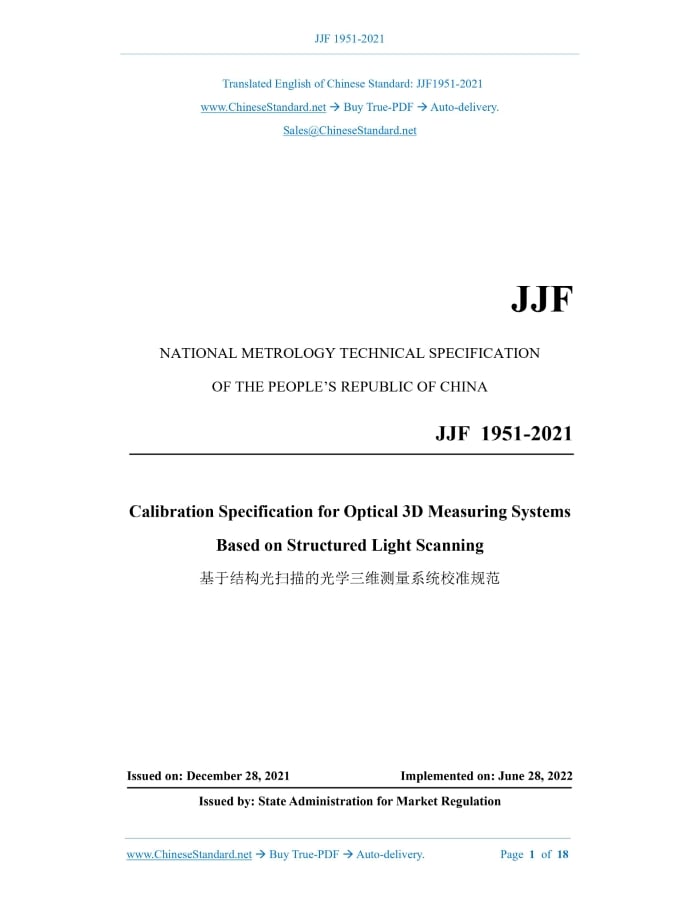
JJF NATIONAL METROLOGY TECHNICAL SPECIFICATION Calibration Specification for Optical 3D Measuring Systems Based on Structured Light Scanning Issued on. DECEMBER 28, 2021 Implemented on. JUNE 28, 2022 Issued by. State Administration for Market Regulation Administrative organization. National Technical Committee on Geometry and Length Measurement Main drafting organizations. Aviation Industry Beijing Great Wall Metrology and Testing Technology Research Institute China Institute of Metrology Beijing Institute of Aerospace Metrology and Testing Technology Participating drafting organizations. Zhejiang Institute of Metrology Aviation Industry Shenyang Aircraft Industry (Group) Co., Ltd. Beijing Tianyuan 3D Technology Co., Ltd. Gaomu Optical Measurement Technology (Shanghai) Co., Ltd. (GOM GmbH) Hexagon Measurement Technology (Qingdao) Co., Ltd. Baoli Machinery Co., Ltd. This Specification shall be interpreted by National Technical Committee on Geometry and Length Measurement. Calibration Specification for Optical 3D Measuring Systems Based on Structured Light Scanning Main drafters of this Specification. Wang Jihu (Aviation Industry Beijing Great Wall Metrology and Testing Technology Research Institute) Wang Weinong (China Institute of Metrology) Gan Xiaochuan (Aviation Industry Beijing Great Wall Metrology and Testing Technology Research Institute) Liu Ke (Beijing Institute of Aerospace Metrology and Testing Technology) Participating drafters. Mao Zhenhua (Zhejiang Institute of Metrology) Liu Hongxia [Aviation Industry Shenyang Aircraft Industry (Group) Co., Ltd.] Li Renju (Beijing Tianyuan 3D Technology Co., Ltd.) Zhao Liang [GOMG Optical Measurement Technology (Shanghai) Co., Ltd. (GOM GmbH)] Wang Jin [Hexagon Measurement Technology (Qingdao) Co., Ltd.] Gu Qingbai (Poly Machinery Co., Ltd.)
Table of Contents
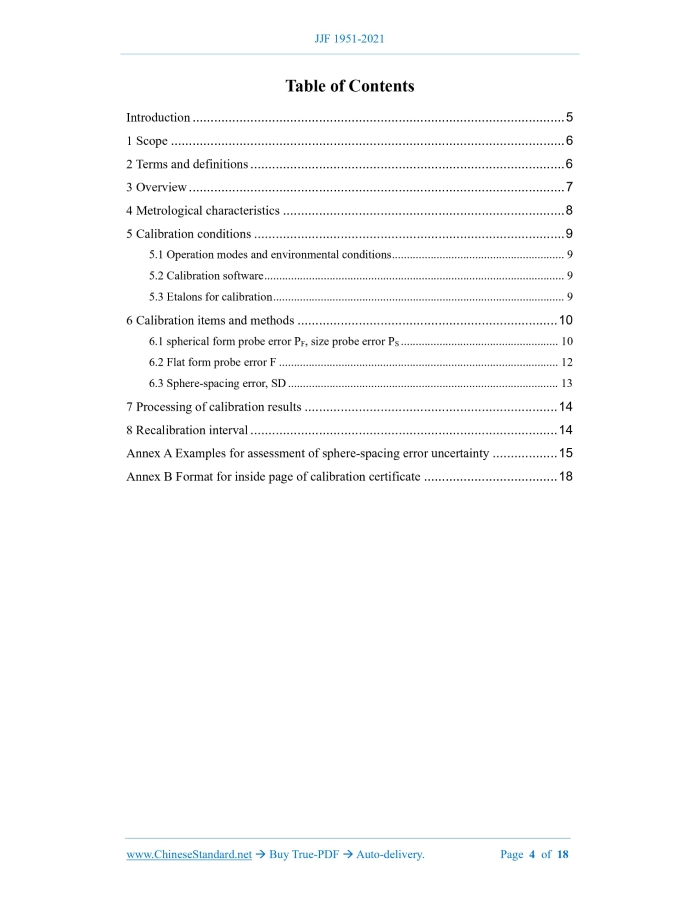
Introduction... 5 1 Scope... 6 2 Terms and definitions... 6 3 Overview... 7 4 Metrological characteristics... 8 5 Calibration conditions... 9 5.1 Operation modes and environmental conditions... 9 5.2 Calibration software... 9 5.3 Etalons for calibration... 9 6 Calibration items and methods... 10 6.1 spherical form probe error PF, size probe error PS... 10 6.2 Flat form probe error F... 12 6.3 Sphere-spacing error, SD... 13 7 Processing of calibration results... 14 8 Recalibration interval... 14 Annex A Examples for assessment of sphere-spacing error uncertainty... 15 Annex B Format for inside page of calibration certificate... 181 Scope
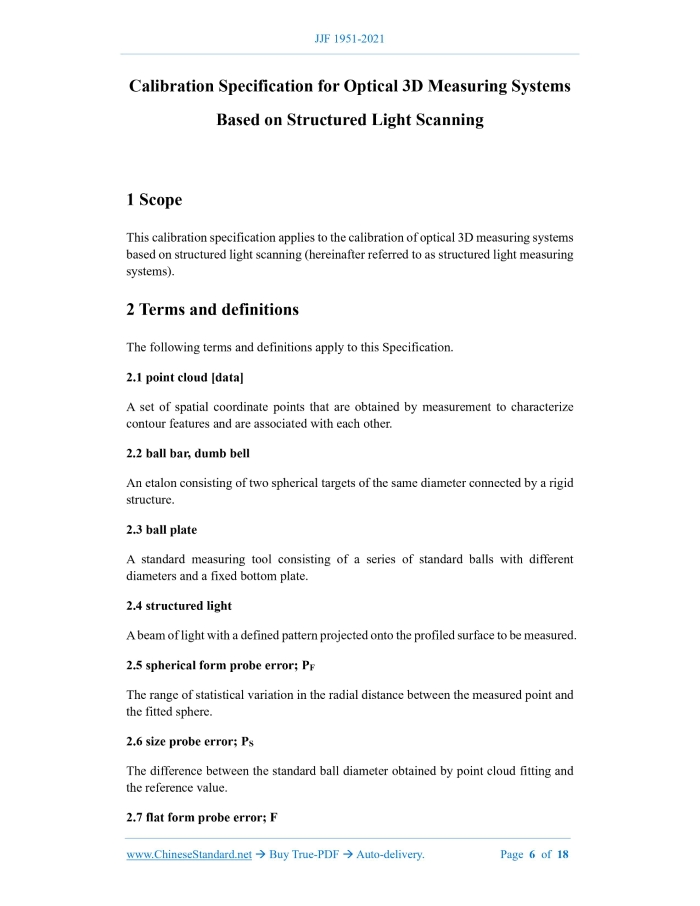
This calibration specification applies to the calibration of optical 3D measuring systems based on structured light scanning (hereinafter referred to as structured light measuring systems).2 Terms and definitions
The following terms and definitions apply to this Specification. 2.1 point cloud [data] A set of spatial coordinate points that are obtained by measurement to characterize contour features and are associated with each other. 2.2 ball bar, dumb bell An etalon consisting of two spherical targets of the same diameter connected by a rigid structure. 2.3 ball plate A standard measuring tool consisting of a series of standard balls with different diameters and a fixed bottom plate. 2.8 sphere-spacing error; SD The difference between the measured value and the reference value of the center distance between two balls.3 Overview
The structured light measuring system is a non-contact measurement device. By projecting the structured light onto the surface of the measured object, and by collecting the point cloud of the structured light pattern on the surface of the measured object, the surface contour features of the measured object are calculated and obtained.4 Metrological characteristics
The metrological characteristics are shown in Table 1.5 Calibration conditions
5.1 Operation modes and environmental conditions Before calibration, the operation mode needs to be set, including the type and brightness of lighting, the measurement range, the type, quantity and distribution of sensors used in the system. 5.2 Calibration software 5.3 Etalons for calibration Etalons for calibration shall be made of ceramic, steel, aluminum or other rigid material. It shall have a diffuse surface (non-volumetric scattering). The etalons used to calibrate different metrological characteristics are shown in Table 1.6 Calibration items and methods
6.1 spherical form probe error PF, size probe error PS Select the appropriate diameter standard ball according to Table 1. Standard balls shall be fixed in an appropriate way. Avoid introducing measurement errors due to instability. 6.1.2 Multi-view system The standard ball shall be located in at least n=3 positions within the measurement range. The standard ball shall be measured from no less than 5 different directions at each position, see Figure 3, so that the point cloud shall cover the surface of the standard ball as completely as possible. Figure 3 -- Schematic diagram of 5 measuring directions 6.2 Flat form probe error F Select a standard plane of appropriate size according to Table 1. 6.3 Sphere-spacing error, SD 6.3.1 Single-view system Choose the appropriate length ball bar according to Table 1. The sphere-spacing error SD shall be measured at 7 different positions in the entire measurement range. It is recommended to arrange and measure the etalon as shown in Figure 5.7 Processing of calibration results
Calibration certificate is issued to the calibrated structured light measuring system. The calibration certificate shall meet the requirements of 5.12 in JJF 1071-2010.Calibration results and their uncertainties list the calibration items and data.8 Recalibration interval
The user decides the recalibration interval according to the actual usage. It is recommended that the interval between recalibration shall not exceed 1 year. JJF NATIONAL METROLOGY TECHNICAL SPECIFICATION Calibration Specification for Optical 3D Measuring Systems Based on Structured Light Scanning Issued on. DECEMBER 28, 2021 Implemented on. JUNE 28, 2022 Issued by. State Administration for Market Regulation Administrative organization. National Technical Committee on Geometry and Length Measurement Main drafting organizations. Aviation Industry Beijing Great Wall Metrology and Testing Technology Research Institute China Institute of Metrology Beijing Institute of Aerospace Metrology and Testing Technology Participating drafting organizations. Zhejiang Institute of Metrology Aviation Industry Shenyang Aircraft Industry (Group) Co., Ltd. Beijing Tianyuan 3D Technology Co., Ltd. Gaomu Optical Measurement Technology (Shanghai) Co., Ltd. (GOM GmbH) Hexagon Measurement Technology (Qingdao) Co., Ltd. Baoli Machinery Co., Ltd. This Specification shall be interpreted by National Technical Committee on Geometry and Length Measurement. Calibration Specification for Optical 3D Measuring Systems Based on Structured Light Scanning Main drafters of this Specification. Wang Jihu (Aviation Industry Beijing Great Wall Metrology and Testing Technology Research Institute) Wang Weinong (China Institute of Metrology) Gan Xiaochuan (Aviation Industry Beijing Great Wall Metrology and Testing Technology Research Institute) Liu Ke (Beijing Institute of Aerospace Metrology and Testing Technology) Participating drafters. Mao Zhenhua (Zhejiang Institute of Metrology) Liu Hongxia [Aviation Industry Shenyang Aircraft Industry (Group) Co., Ltd.] Li Renju (Beijing Tianyuan 3D Technology Co., Ltd.) Zhao Liang [GOMG Optical Measurement Technology (Shanghai) Co., Ltd. (GOM GmbH)] Wang Jin [Hexagon Measurement Technology (Qingdao) Co., Ltd.] Gu Qingbai (Poly Machinery Co., Ltd.)Table of Contents
Introduction... 5 1 Scope... 6 2 Terms and definitions... 6 3 Overview... 7 4 Metrological characteristics... 8 5 Calibration conditions... 9 5.1 Operation modes and environmental conditions... 9 5.2 Calibration software... 9 5.3 Etalons for calibration... 9 6 Calibration items and methods... 10 6.1 spherical form probe error PF, size probe error PS... 10 6.2 Flat form probe error F... 12 6.3 Sphere-spacing error, SD... 13 7 Processing of calibration results... 14 8 Recalibration interval... 14 Annex A Examples for assessment of sphere-spacing error uncertainty... 15 Annex B Format for inside page of calibration certificate... 181 Scope
This calibration specification applies to the calibration of optical 3D measuring systems based on structured light scanning (hereinafter referred to as structured light measuring systems).2 Terms and definitions
The following terms and definitions apply to this Specification. 2.1 point cloud [data] A set of spatial coordinate points that are obtained by measurement to characterize contour features and are associated with each other. 2.2 ball bar, dumb bell An etalon consisting of two spherical targets of the same diameter connected by a rigid structure. 2.3 ball plate A standard measuring tool consisting of a series of standard balls with different diameters and a fixed bottom plate. 2.8 sphere-spacing error; SD The difference between the measured value and the reference value of the center distance between two balls.3 Overview
The structured light measuring system is a non-contact measurement device. By projecting the structured light onto the surface of the measured object, and by collecting the point cloud of the structured light pattern on the surface of the measured object, the surface contour features of the measured object are calculated and obtained.4 Metrological characteristics
The metrological characteristics are shown in Table 1.5 Calibration conditions
5.1 Operation modes and environmental conditions Before calibration, the operation mode needs to be set, including the type and brightness of lighting, the measurement range, the type, quantity and distribution of sensors used in the system. 5.2 Calibration software 5.3 Etalons for calibration Etalons for calibration shall be made of ceramic, steel, aluminum or other rigid material. It shall have a diffuse surface (non-volumetric scattering). The etalons used to calibrate different metrological characteristics are shown in Table 1.6 Calibration items and methods
6.1 spherical form probe error PF, size probe error PS Select the appropriate diameter standard ball according to Table 1. Standard balls shall be fixed in an appropriate way. Avoid introducing measurement errors due to instability. 6.1.2 Multi-view system The standard ball shall be located in at least n=3 positions within the measurement range. The standard ball shall be measured from no less than 5 different directions at each position, see Figure 3, so that the point cloud shall cover the surface of the standard ball as completely as possible. Figure 3 -- Schematic diagram of 5 measuring directions 6.2 Flat form probe error F Select a standard plane of appropriate size according to Table 1. 6.3 Sphere-spacing error, SD 6.3.1 Single-view system Choose the appropriate length ball bar according to Table 1. The sphere-spacing error SD shall be measured at 7 different positions in the entire measurement range. It is recommended to arrange and measure the etalon as shown in Figure 5.7 Processing of calibration results
Calibration certificate is issued to the calibrated structured light measuring system. The calibration certificate shall meet the requirements of 5.12 in JJF 1071-2010.Calibration results and their uncertainties list the calibration items and data.8 Recalibration interval
The user decides the recalibration interval according to the actual usage. It is recommended that the interval between recalibration shall not exceed 1 year. ......Source: Above contents are excerpted from the full-copy PDF -- translated/reviewed by: www.ChineseStandard.net / Wayne Zheng et al.