GB/T 3049-2006 PDF English
Price & Delivery
US$105.00 · In stock · Download in 9 secondsGB/T 3049-2006: Chemical products for industrial use - General method for determination of iron content. 1, 10-Phenanthroline spectrophotometric method
Delivery: 9 seconds. True-PDF full-copy in English & invoice will be downloaded + auto-delivered via email. See step-by-step procedure
Status: Valid
GB/T 3049: Historical versions
| Standard ID | USD | BUY PDF | Delivery | Standard Title (Description) | Status |
| GB/T 3049-2006 | 105 | Add to Cart | Auto, 9 seconds. | Chemical products for industrial use - General method for determination of iron content. 1, 10-Phenanthroline spectrophotometric method | Valid |
| GB/T 3049-1986 | 479 | Add to Cart | 4 days | Chemical products for industrial use--General method for determination of iron content--0-phenanthroline spectrophotometric method | Obsolete |
Click to Preview this PDF
GB/T 3049-2006: Chemical products for industrial use - General method for determination of iron content. 1, 10-Phenanthroline spectrophotometric method
---This is an excerpt. Full copy of true-PDF in English version (including equations, symbols, images, flow-chart, tables, and figures etc.), auto-downloaded/delivered in 9 seconds, can be purchased online: https://www.ChineseStandard.net/PDF.aspx/GBT3049-2006
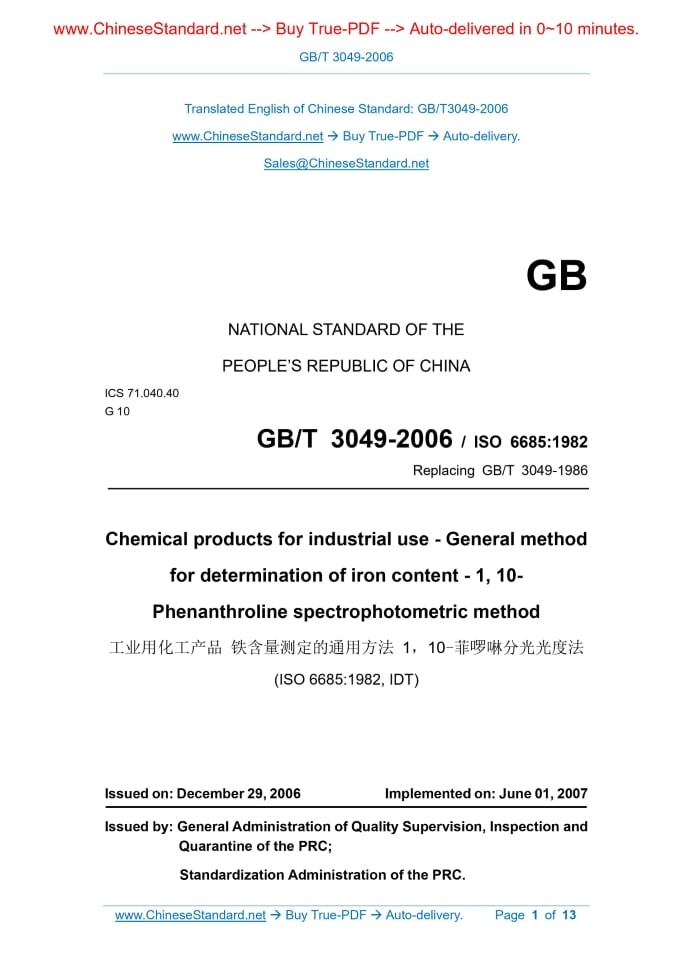
NATIONAL STANDARD OF THE PEOPLE’S REPUBLIC OF CHINA ICS 71.040.40 G 10 GB/T 3049-2006 / ISO 6685:1982 Replacing GB/T 3049-1986 Chemical products for industrial use - General method for determination of iron content - 1, 10- Phenanthroline spectrophotometric method (ISO 6685:1982, IDT) ISSUED ON: DECEMBER 29, 2006 IMPLEMENTED ON: JUNE 01, 2007 Issued by: General Administration of Quality Supervision, Inspection and Quarantine of the PRC; Standardization Administration of the PRC.
Table of Contents
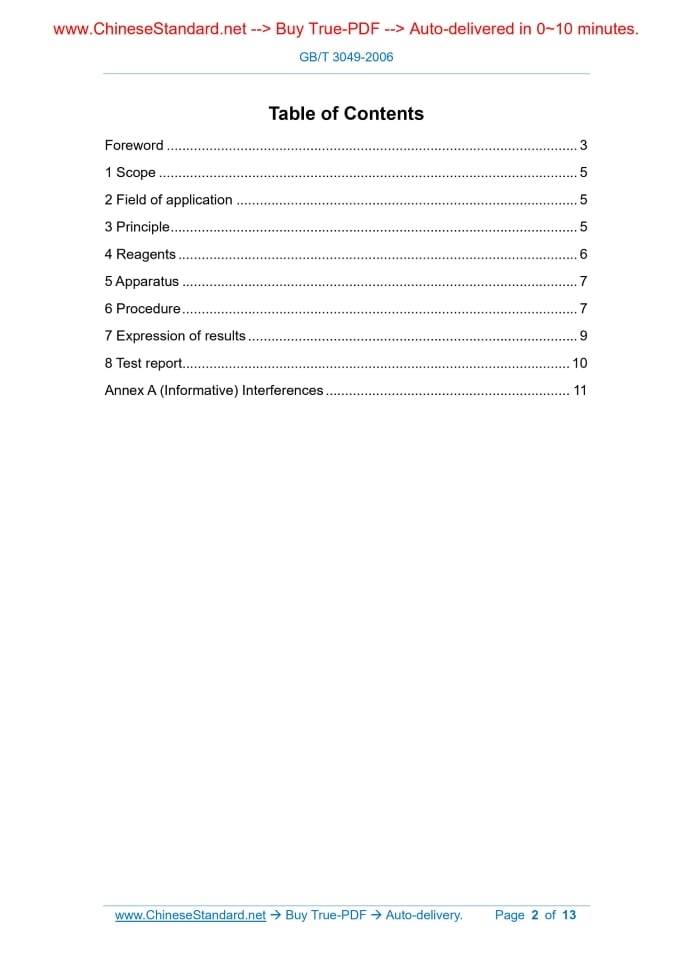
Foreword ... 3 1 Scope ... 5 2 Field of application ... 5 3 Principle ... 5 4 Reagents ... 6 5 Apparatus ... 7 6 Procedure ... 7 7 Expression of results ... 9 8 Test report ... 10 Annex A (Informative) Interferences ... 11Foreword
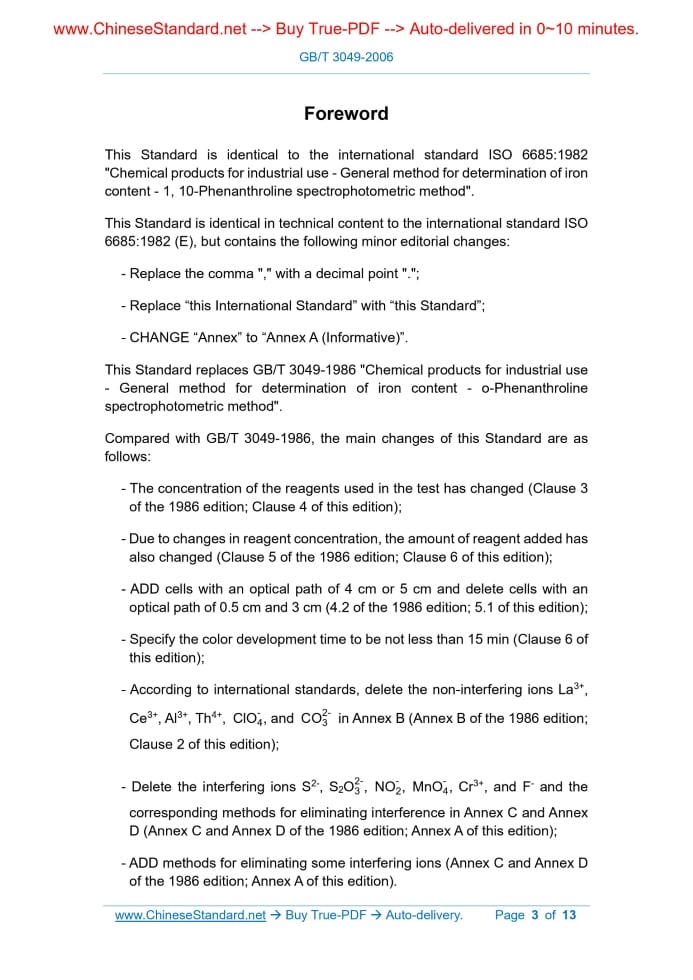
This Standard is identical to the international standard ISO 6685:1982 "Chemical products for industrial use - General method for determination of iron content - 1, 10-Phenanthroline spectrophotometric method". This Standard is identical in technical content to the international standard ISO 6685:1982 (E), but contains the following minor editorial changes: - Replace the comma "," with a decimal point "."; - Replace “this International Standard” with “this Standard”; - CHANGE “Annex” to “Annex A (Informative)”. This Standard replaces GB/T 3049-1986 "Chemical products for industrial use - General method for determination of iron content - o-Phenanthroline spectrophotometric method". Compared with GB/T 3049-1986, the main changes of this Standard are as follows: - The concentration of the reagents used in the test has changed (Clause 3 of the 1986 edition; Clause 4 of this edition); - Due to changes in reagent concentration, the amount of reagent added has also changed (Clause 5 of the 1986 edition; Clause 6 of this edition); - ADD cells with an optical path of 4 cm or 5 cm and delete cells with an optical path of 0.5 cm and 3 cm (4.2 of the 1986 edition; 5.1 of this edition); - Specify the color development time to be not less than 15 min (Clause 6 of this edition); - According to international standards, delete the non-interfering ions La3+, Ce3+, Al3+, Th4+, ClO4- , and CO32- in Annex B (Annex B of the 1986 edition; Clause 2 of this edition); - Delete the interfering ions S2-, S2O32-, NO2- , MnO4- , Cr3+, and F- and the corresponding methods for eliminating interference in Annex C and Annex D (Annex C and Annex D of the 1986 edition; Annex A of this edition); - ADD methods for eliminating some interfering ions (Annex C and Annex D of the 1986 edition; Annex A of this edition). Annex A of this Standard is an informative annex. This Standard was proposed by China Petroleum and Chemical Industry Federation. This Standard shall be under the jurisdiction of Subcommittee 1 on Inorganic Chemical Industry, National Standardization Technical Committee of Chemical (SAC/TC 63/SC 1). Main drafting organizations of this Standard: Tianjin Entry-Exit Inspection and Quarantine Bureau, Shandong Entry-Exit Inspection and Quarantine Bureau, Tianjin Chemical Research and Design Institute. Main drafters of this Standard: Liu Shaocong, Zhao Zuliang, Liu Youruo, Sun Shujun, Lu Siwei. The previous editions of the standard replaced by this Standard were released as follows: GB/T 3049-1986. Chemical products for industrial use - General method for determination of iron content - 1, 10- Phenanthroline spectrophotometric method1 Scope
This Standard specifies a general 1, 10-phenanthroline spectrophotometric method for the determination of the iron content of chemical products. This Standard describes a technique for the determination of the content of iron in a solution. Reference should be made, for the preparation of the test solution, to the standard relating to the product to be analysed, which should indicate the modifications necessary to make the method applicable to that product.2 Field of application
This Standard is applicable to test solutions from which an aliquot portion can be taken containing between 10 and 500 μg of Fe in a volume of not more than 60 ml. Large amounts of alkali metals, calcium, strontium, barium, magnesium, manganese (II), arsenic (III), arsenic (V), uranium (VI), lead, chloride, bromide, iodide, thiocyanate, acetate, chlorate, nitrate, sulphate, sulphide, metaborate, selenate, citrate, tartrate, phosphate and up to 100 mg of germanium (IV), in the test solution, do not interfere. In the presence of tartrate, citrate, arsenate or more than 100 mg of phosphate, colour development is, however, liable to be slower. Details of certain interferences and means by which they can be overcome are given in Annex A.3 Principle
Reduction of all the iron (lll) present in the test solution to iron (ll) with ascorbic acid. Formation of the orange-red complex between iron (ll) and 1, 10- phenanthroline at a pH between 2 and 9, and spectrophotometric measurement of the absorbance of the complex at the wavelength of maximum absorption (510 nm). ......Source: Above contents are excerpted from the full-copy PDF -- translated/reviewed by: www.ChineseStandard.net / Wayne Zheng et al.