GB/T 30126-2013 English PDF
Price & Delivery
US$140.00 · In stock · Download in 9 secondsGB/T 30126-2013: Textiles - Testing and evaluation for anti-mosquitoes properties
Delivery: 9 seconds. True-PDF full-copy in English & invoice will be downloaded + auto-delivered via email. See step-by-step procedure
Status: Valid
| Standard ID | USD | BUY PDF | Delivery | Standard Title (Description) | Status |
| GB/T 30126-2013 | 140 | Add to Cart | Auto, 9 seconds. | Textiles - Testing and evaluation for anti-mosquitoes properties | Valid |
Click to Preview this PDF
Similar standards
GB/T 30126-2013: Textiles - Testing and evaluation for anti-mosquitoes properties
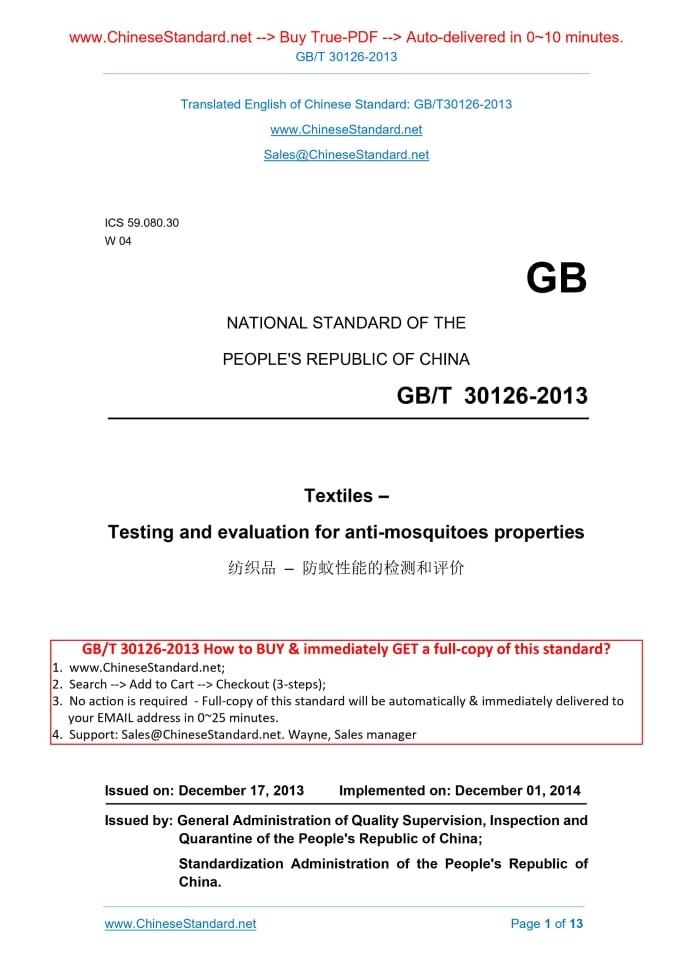
---This is an excerpt. Full copy of true-PDF in English version (including equations, symbols, images, flow-chart, tables, and figures etc.), auto-downloaded/delivered in 9 seconds, can be purchased online: https://www.ChineseStandard.net/PDF.aspx/GBT30126-2013ICS 59.080.30 W 04 GB NATIONAL STANDARD OF THE PEOPLE'S REPUBLIC OF CHINA Textiles – Testing and evaluation for anti-mosquitoes properties Issued on. DECEMBER 17, 2013 Implemented on. DECEMBER 01, 2014 Issued by. General Administration of Quality Supervision, Inspection and Quarantine of the People's Republic of China; Standardization Administration of the People's Republic of China.
Table of Contents
Foreword... 3 1 Scope... 4 2 Normative references... 4 3 Terms and definitions... 4 4 Safety precautions... 5 5 Principles... 5 6 Equipment and materials... 5 7 Test mosquitoes... 8 8 Sample preparation... 9 9 Test conditions... 9 10 Test procedures... 10 11 Result calculation and evaluation... 11Foreword
This Standard was drafted in accordance with the rules specified in GB/T 1.1-2009. This standard was proposed by China Textile Industry Association. This standard shall be under the jurisdiction of the Basic Standard Technical Committee of National Textile Standardization Technical Committee (SAC/TC 209/SC 1). The drafting organizations of this Standard. Shenzhen Kang Yi health Supplies Co., Textile Industry Standardization Institute, Shanghai Juhua Textile Technology Institute, Beijing JLsun high-tech Co., Ltd. The main drafters of this Standard. Shang Chengjie, Zheng Yuying, Zhu Dan, Zhang Hongjie, Zhang Jintong, Wang Xingfu. Textiles – Testing and evaluation for anti-mosquitoes properties1 Scope
This standard specifies the method of using repellent method AND forced contact method to measure the textile’s anti-mosquitoes properties, AND provides the anti-mosquitoes properties evaluation. This standard applies to the woven fabrics, knitted fabrics, non-woven fabrics and other textiles.2 Normative references
The following documents are essential to the application of this document. For the dated documents, only the versions with the dates indicated are applicable to this document; for the undated documents, only the latest version (including all the amendments) are applicable to this Standard. GB/T 12490-2007 Textiles – Tests for color fastness – Color fastness to domestic and commercial laundering3 Terms and definitions
The following terms and definitions apply to this document. 3.1 Anti-mosquitoes properties It refers to the product features of knocking down, killing, and repelling mosquitoes, etc. 3.2 Control fabric It refers to the fabrics used to compare the anti-mosquitoes properties with the samples to be tested.4 Safety precautions
When using this method, it is required to contact with mosquitoes, and has the mosquito breeding conditions, so it shall, under the specified test conditions, ARRANGE the trained personnel to conduct test.5 Principles
Repellent method. PLACE the mosquitoes which has certain offensive power into the space containing the sample, which is attached to the human body OR blood providing device;6 Equipment and materials
6.1 Constant temperature and humidity laboratory It can maintain a certain test temperature and relative humidity; the temperature accuracy is ± 1 °C AND the relative humidity accuracy is ± 10%. 6.3 Repellent tester 6.3.1 The repellent tester is rectangular, 18 cm (length) x 5cm (width) x 4 cm (height); its top is fabricated by the gauze the mesh of which is 20 mesh ± 10 mesh; whilst its side surface, end plate, and bottom surface are fabricated by transparent materials; REFER to Figure 2. Figure 2 Repellent tester 6.5 Forced contactor Forced contactor complying with GB/T 13917.1-2009.it is used to knock down AND kill test. 6.6 Other 6.6.1 Mosquito suction tube. 6.6.2 Commonly used laboratory equipment such as measuring cylinder AND flask, etc. 6.6.3 Stopwatch, counter. 6.6.4 Scissors. 6.6.5 5% sucrose solution.7 Test mosquitoes
7.1 Mosquito species Aedes albopictus, the female adult mosquito which is 4 d ~ 7 d after emergence AND does not suck blood; 7.2 Indicated information The mosquitoes used for test purposes shall be indicated of the following information.8 Sample preparation
8.1 Sample size and quantity 8.1.1 Repellent tester method SELECT representative samples from each sample; CUT a 4 cm x 4 cm square as a sample. Respectively TAKE 8 anti-mosquitoes fabric samples to be tested AND 8 control fabrics. 8.2 Sample pretreatment After placing the sample at 26 °C ± 1 °C for 10 min, CONDUCT test. 8.3 Treatment of anti-mosquito effect washability sample If evaluating the fabric’s anti-mosquito washable performance, WASH the sample to be tested in accordance with the sample conditions A1M of GB/T 12490-2007;9 Test conditions
Temperature 26 °C ± 1 °C; relative humidity 65% ± 10%.10 Test procedures
10.1 Repellent method 10.1.1 Repellent tester method 10.1.2 Blood-sucking insect feeding device method In the 2 blood feeding boxes of the blood-sucking insects feeding device (6.4), respectively ADD 10 mL of blood; USE artificial membrane to seal the blood; respectively COVER the sample to be tested AND the control fabric over the artificial membrane of the blood feeding box. 10.2 Forced contact method USE the forced contactor to conduct test in accordance with the steps as specified in 4.3.3.1 of GB/T 13917.1-2009.The test mosquitoes are Culex pipiens pallens, and USE the sample to substitute the reagent contact surface.11 Result calculation and evaluation
11.1 Result calculation Based on the selected test, USE the equation (1) to calculate the sample’s repellent ratio against mosquitoes; USE the equation (2) and (3) to calculate the sample’s knock-down ratio and kill ratio against mosquitoes; KEEP one decimal place. ......Source: Above contents are excerpted from the full-copy PDF -- translated/reviewed by: www.ChineseStandard.net / Wayne Zheng et al.