GB/T 1410-2006 PDF English
Price & Delivery
US$140.00 · In stock · Download in 9 secondsGB/T 1410-2006: [Replaced by GB/T 31838.2-2019] Methods of test for volume resistivity and surface resistivity of solid electrical insulating materials
Delivery: 9 seconds. True-PDF full-copy in English & invoice will be downloaded + auto-delivered via email. See step-by-step procedure
Status: Obsolete
GB/T 1410: Historical versions
| Standard ID | USD | BUY PDF | Delivery | Standard Title (Description) | Status |
| GB/T 1410-2006 | 140 | Add to Cart | Auto, 9 seconds. | [Replaced by GB/T 31838.2-2019] Methods of test for volume resistivity and surface resistivity of solid electrical insulating materials | Obsolete |
| GB/T 1410-1989 | 519 | Add to Cart | 4 days | Methods of test for volume resistivity and surface resistivity of solid insulating materials | Obsolete |
Click to Preview this PDF
Similar standards
GB/T 1410-2006: [Replaced by GB/T 31838.2-2019] Methods of test for volume resistivity and surface resistivity of solid electrical insulating materials
---This is an excerpt. Full copy of true-PDF in English version (including equations, symbols, images, flow-chart, tables, and figures etc.), auto-downloaded/delivered in 9 seconds, can be purchased online: https://www.ChineseStandard.net/PDF.aspx/GBT1410-2006
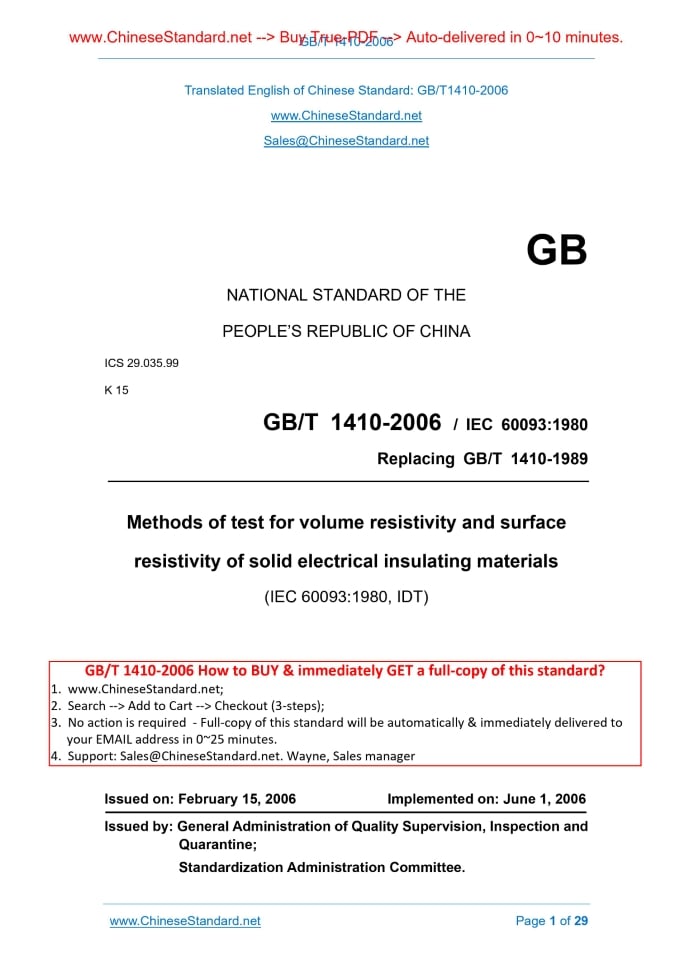
GB NATIONAL STANDARD OF THE PEOPLE’S REPUBLIC OF CHINA ICS 29.035.99 K 15 GB/T 1410-2006 / IEC 60093.1980 Replacing GB/T 1410-1989 Methods of test for volume resistivity and surface resistivity of solid electrical insulating materials (IEC 60093.1980, IDT) Issued on: FEBRUARY 15, 2006 Implemented on: JUNE 1, 2006 Issued by. General Administration of Quality Supervision, Inspection and Quarantine; Standardization Administration Committee.
Table of Contents
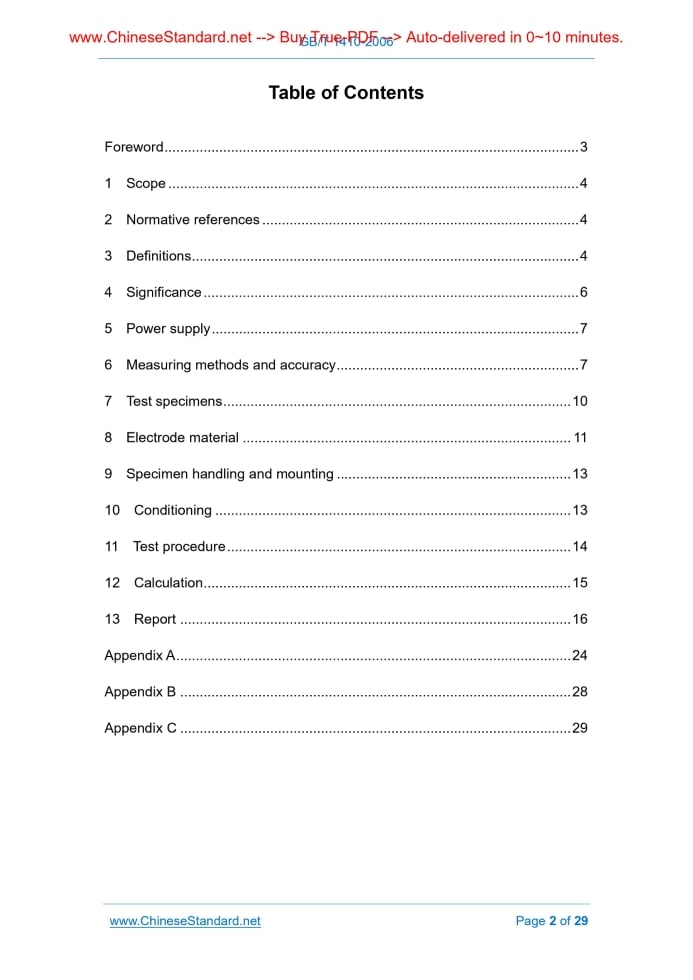
Foreword ... 3 1 Scope ... 4 2 Normative references ... 4 3 Definitions ... 4 4 Significance ... 6 5 Power supply ... 7 6 Measuring methods and accuracy ... 7 7 Test specimens ... 10 8 Electrode material ... 11 9 Specimen handling and mounting ... 13 10 Conditioning ... 13 11 Test procedure ... 14 12 Calculation ... 15 13 Report ... 16 Appendix A ... 24 Appendix B ... 28 Appendix C ... 29Foreword
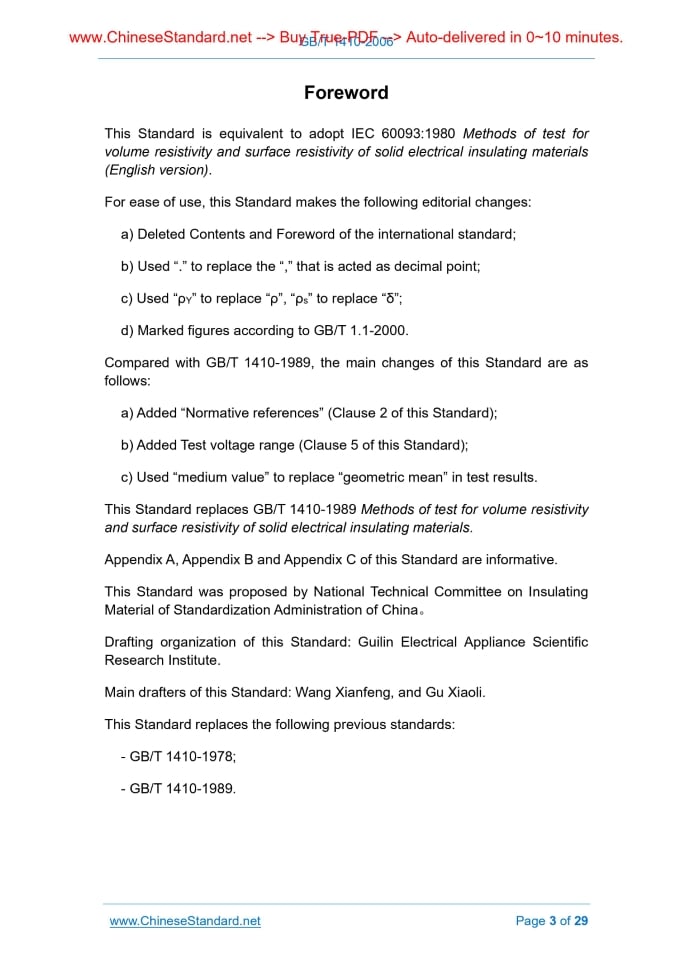
This Standard is equivalent to adopt IEC 60093.1980 Methods of test for volume resistivity and surface resistivity of solid electrical insulating materials (English version). For ease of use, this Standard makes the following editorial changes. a) Deleted Contents and Foreword of the international standard; b) Used “.” to replace the “,” that is acted as decimal point; c) Used “ρY” to replace “ρ”, “ρs” to replace “δ”; d) Marked figures according to GB/T 1.1-2000. Compared with GB/T 1410-1989, the main changes of this Standard are as follows. a) Added “Normative references” (Clause 2 of this Standard); b) Added Test voltage range (Clause 5 of this Standard); c) Used “medium value” to replace “geometric mean” in test results. This Standard replaces GB/T 1410-1989 Methods of test for volume resistivity and surface resistivity of solid electrical insulating materials. Appendix A, Appendix B and Appendix C of this Standard are informative. This Standard was proposed by National Technical Committee on Insulating Material of Standardization Administration of China. Drafting organization of this Standard. Guilin Electrical Appliance Scientific Research Institute. Main drafters of this Standard. Wang Xianfeng, and Gu Xiaoli. This Standard replaces the following previous standards. - GB/T 1410-1978; - GB/T 1410-1989. Methods of test for volume resistivity and surface resistivity of solid electrical insulating materials1 Scope
This Standard specifies methods of test for volume resistivity and surface resistivity of solid electrical insulating materials. These methods of test cover procedures for the determination of volume and surface resistance and calculations for the determination of volume and surface resistivity of solid electrical insulating materials. Both volume resistance and surface resistance tests are affected by the following factors. the magnitude and time of voltage application, the nature and geometry of the electrodes, and the temperature and humidity of the ambient atmosphere and of the specimens during conditioning and measurement.2 Normative references
The following standards contain the provisions which, through reference in this Standard, constitute the provisions of this Standard. For dated references, the subsequent amendments (excluding corrections) or revisions do not apply to this Standard. However, the parties who enter into agreement based on this Standard are encouraged to investigate whether the latest versions of these documents are applicable. For undated reference documents, the latest versions apply to this Standard. GB/T 10064-2006 Methods of test for the determination of the insulation resistance of solid insulating materials GB/T 10580-2003 Standard conditions for use prior to and during the testing of solid insulating materials IEC 60260.1968 Test enclosures of non-injection type for constant relative humidity3 Definitions
The following definitions apply to this document. 3.1 volume resistance the quotient of a direct voltage applied between two electrodes placed on two faces (opposite) of a specimen, and the steady-state current between the electrodes, excluding current along the surface, and neglecting possible polarization phenomena at the electrodes NOTE Unless otherwise specified, the volume resistance is determined after 1 min of electrification. 3.2 volume resistivity the quotient of a d.c. electric field strength and the steady-state current density within an insulating material. In practice it is taken as the volume resistance reduced to a cubical unit volume NOTE The SI unit of volume resistivity is Ω·m. In practice the unit Ω·cm is also used. 3.3 surface resistance the quotient of a direct voltage applied between two electrodes on a surface of a specimen, and the current between the electrodes at a given time of electrification, neglecting possible polarization phenomena at the electrodes NOTE 1 Unless otherwise specified, the surface resistance is determined after 1 min of electrification. NOTE 2 The current generally passes mainly through a surface layer of the specimen and any associated moisture and surface contaminant, but it also includes a component through the volume of the specimen. 3.4 surface resistivity the quotient of a d.c. electric field strength, and the linear current density in a surface layer of an insulating material. In practice it is taken as the surface resistance reduced to a square area. The size of the square is immaterial NOTE The SI unit of surface resistivity is Ω. In practice this is sometimes referred to as “ohms per square”. 3.5 electrodes measuring electrodes are conductors of defined shape, size and configuration in contact with the specimen being measured NOTE Insulation resistance is the quotient of a direct voltage applied between two electrodes in contact with a specimen and the total current between the electrodes. The insulation resistance depends on both volume and surface resistivity of the specimen (see GB/T 10064- 2006). characteristics. The surface resistance, especially when high, often changes in an erratic manner, and in general depends strongly on the time of electrification; for measurements, 1 min of electrification is usually specified.5 Power supply
A source of very steady direct voltage is required. This may be provided either by batteries or by a rectified and stabilized power supply. The degree of stability required is such that the change in current due to any change in voltage is negligible compared with the current to be measured. Commonly specified test voltages to be applied to the complete specimen are 100 V, 250 V, 500 V, 1 000 V, 2 500 V, 5 000 V, 10 000 V and 15 000 V. Of these the most frequently used are 100 V, 500 V and 1 000 V. In some cases, the specimen resistance depends upon the polarity of the applied voltage. If the resistance is polarity dependent, this should be indicated. The geometric (arithmetic mean of the logarithmic exponents) mean of the two resistance values is taken as the result. Since the specimen resistance may be voltage dependent, the test voltage should be stated.6 Measuring methods and accuracy
6.1 Methods The methods commonly in use for measuring high resistances are either direct methods or comparison methods. The direct methods depend upon simultaneous measurement of the direct voltage applied to the unknown resistance and the current through it (voltmeter- ammeter method). The comparison methods establish the ratio of the unknown resistance to the resistance of a known resistor, either in a bridge circuit, or by comparison of currents through the resistances at fixed voltage. Examples illustrating the principles are described in Appendix A. The voltmeter-ammeter method requires a reasonably accurate voltmeter, but the sensitivity and accuracy of the method depend mainly on the properties of the current measuring device, which may be a galvanometer, an electronic used to test the operation of the equipment.7 Test specimens
7.1 Volume resistivity For the determination of volume resistivity the test specimen may have any practicable form that allows the use of a third electrode to guard against error from surface effect. For specimens that have negligible surface leakage, the guard may be omitted when m... ......Source: Above contents are excerpted from the full-copy PDF -- translated/reviewed by: www.ChineseStandard.net / Wayne Zheng et al.