GB 1886.326-2021 English PDF
Price & Delivery
US$80.00 · In stock · Download in 9 secondsGB 1886.326-2021: National food safety standard - Food additives - Calcium acid pyrophosphat
Delivery: 9 seconds. True-PDF full-copy in English & invoice will be downloaded + auto-delivered via email. See step-by-step procedure
Status: Valid
| Standard ID | USD | BUY PDF | Delivery | Standard Title (Description) | Status |
| GB 1886.326-2021 | 80 | Add to Cart | Auto, 9 seconds. | National food safety standard - Food additives - Calcium acid pyrophosphat | Valid |
Click to Preview this PDF
Similar standards
GB 1886.326-2021: National food safety standard - Food additives - Calcium acid pyrophosphat
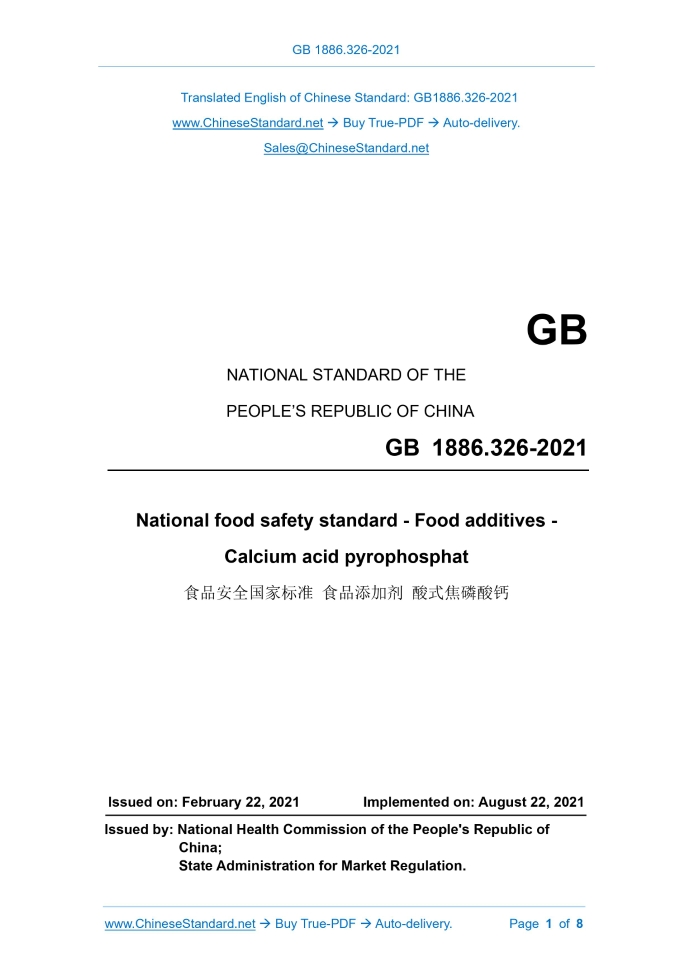
---This is an excerpt. Full copy of true-PDF in English version (including equations, symbols, images, flow-chart, tables, and figures etc.), auto-downloaded/delivered in 9 seconds, can be purchased online: https://www.ChineseStandard.net/PDF.aspx/GB1886.326-2021GB NATIONAL STANDARD OF THE PEOPLE’S REPUBLIC OF CHINA National food safety standard - Food additives - Calcium acid pyrophosphat ISSUED ON: FEBRUARY 22, 2021 IMPLEMENTED ON: AUGUST 22, 2021 Issued by: National Health Commission of the People's Republic of China; State Administration for Market Regulation.
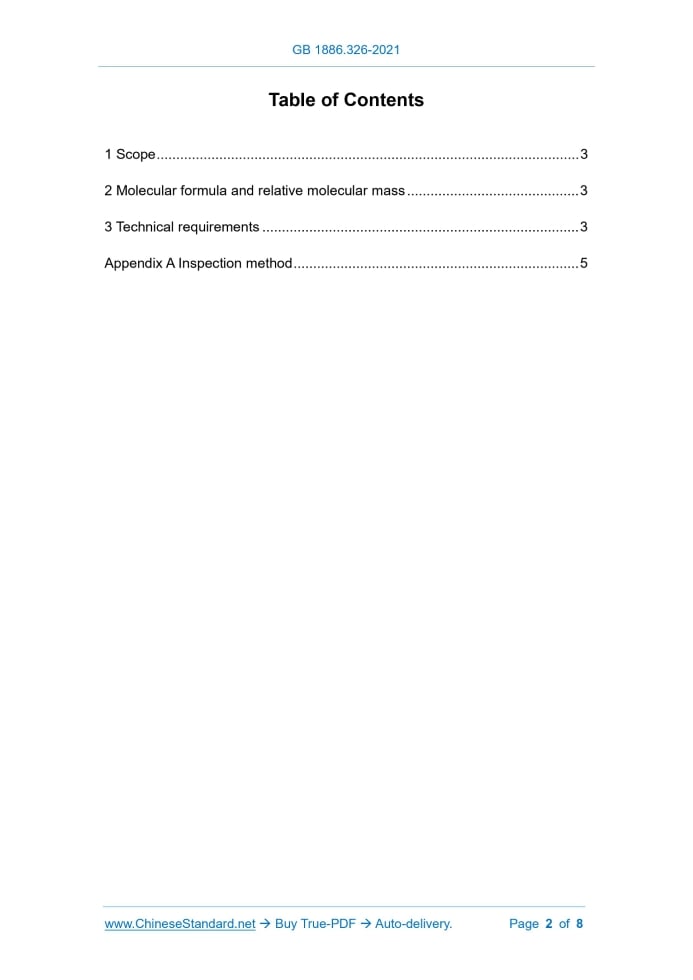
Table of Contents
1 Scope ... 3 2 Molecular formula and relative molecular mass ... 3 3 Technical requirements ... 3 Appendix A Inspection method ... 5 National food safety standard - Food additives - Calcium acid pyrophosphat1 Scope
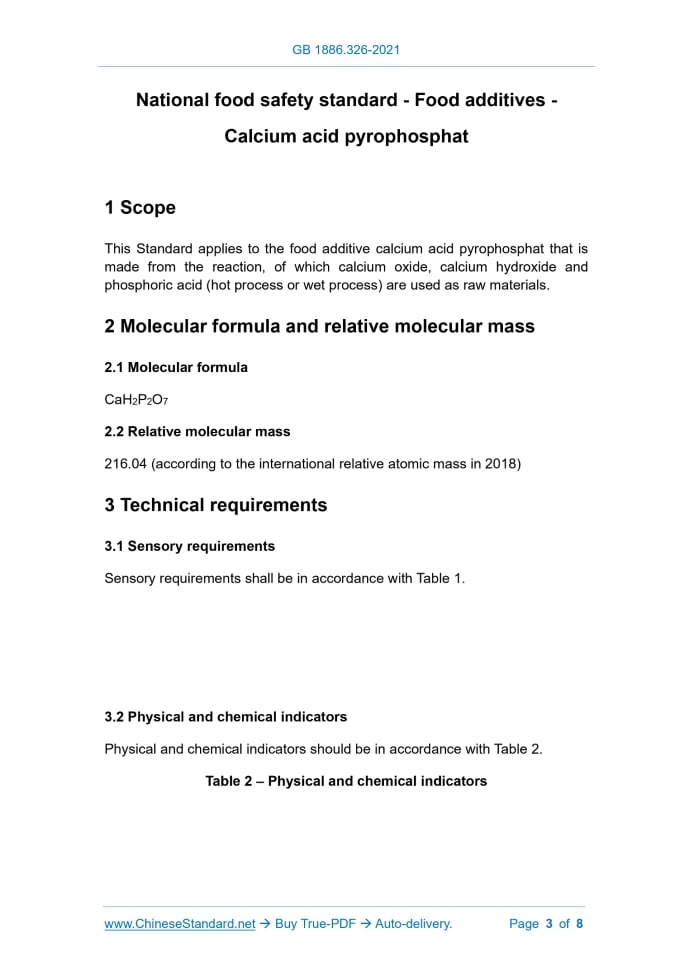
This Standard applies to the food additive calcium acid pyrophosphat that is made from the reaction, of which calcium oxide, calcium hydroxide and phosphoric acid (hot process or wet process) are used as raw materials.2 Molecular formula and relative molecular mass
2.1 Molecular formula CaH2P2O7 2.2 Relative molecular mass 216.04 (according to the international relative atomic mass in 2018)3 Technical requirements
3.1 Sensory requirements Sensory requirements shall be in accordance with Table 1. 3.2 Physical and chemical indicators Physical and chemical indicators should be in accordance with Table 2. Table 2 – Physical and chemical indicatorsAppendix A
Inspection method WARNING: Some reagents used in this test method are toxic or corrosive; the operator shall be careful. If it is splashed on the skin, use water to rinse it immediately. If it is serious, seek medical attention immediately. A.1 General Provisions The reagents and water that are used in this Standard, when no other requirements are specified, refer to analytical reagents and grade-III water which is specified in GB/T 6682. The standard solution, the standard solutions, preparations and products for impurity determination, which are used in the test, are all prepared in accordance with the provisions of GB/T 601, GB/T 602, and GB/T 603, when no other requirements are specified. The solution used in the test, if not indicated which solvent is used, refers to aqueous solution. A.2 Identification test A.2.1 Reagents and materials A.2.1.1 Nitric acid solution: 1+9. A.2.1.2 Quinmolybdenone solution: Prepare according to HG/T 3696.3. A.2.1.3 Ammonium oxalate solution: 33 g/L. A.2.2 Identification method A.2.2.1 Identification of calcium ions Weigh about 0.1 g of the sample; add 20 mL of water; shake well and filter. Add 5 mL of ammonium oxalate solution to the filtrate, to form a white precipitate. A.2.2.2 Identification of pyrophosphate Weigh about 0.1 g of the sample; dissolve it in 100 mL of nitric acid solution to obtain the sample solution; pipette 0.5 mL of the above solution and add into 30 mL of quinmolybdenone solution. Heat the remaining sample solution at 95°C for 10 min; then, take 0.5 mL of the sample solution from it and add into 30 mL of the quinmolybdenone solution. A yellow precipitate is immediately formed in the heated sample solution; no precipitate is formed if it is not heated. A.3 Determination of calcium acid pyrophosphat content water to rinse the beaker and crucible twice. Place the crucible in another beaker; add 100 mL of water and 50 mL of sulfuric acid solution; heat to about 70 °C; use potassium permanganate titration solution to titrate until the solution is pink and does not disappear within 30 s, which is the end of the titration. At the same time, do a blank test. For the blank test, except that no sample is added, the other operations and the type and amount of added reagents (except for the standard titration solution) are the same as the determination test. A.3.5 Result calculation Calculate the mass fraction w1 of the calcium acid pyrophosphat content according to Formula (A.1). Where: c – concentration of the potassium permanganate titration solution, in moles per liter (mol/L); V1 – volume of the potassium permanganate standard titration solution that is consumed in the titration of the sample solution, in milliliters (mL); V2 – volume of the potassium permanganate standard titration solution that is consumed in the titration of the blank solution, in milliliters (mL); M – molar mass of the calcium acid pyrophosphat, in grams per mole (g/mol) [M(1 2ൗ CaH2P2O7) = 108.02]; m – sample mass, in grams (g). 1 000 – volume conversion factor. The test result is based on the arithmetic mean of the parallel determination results. The absolute difference between two independent determination results that are obtained under repeatability conditions is not more than 0.2%. A.4 Determination of loss on ignition A.4.1 Reagents and materials Sulfuric acid A.4.2 Instruments and apparatuses ......Source: Above contents are excerpted from the full-copy PDF -- translated/reviewed by: www.ChineseStandard.net / Wayne Zheng et al.