GB 1886.319-2021 English PDF
Price & Delivery
US$70.00 · In stock · Download in 9 secondsGB 1886.319-2021: National food safety standard - Food additives - Hippophae rhamnoides yellow
Delivery: 9 seconds. True-PDF full-copy in English & invoice will be downloaded + auto-delivered via email. See step-by-step procedure
Status: Valid
| Standard ID | USD | BUY PDF | Delivery | Standard Title (Description) | Status |
| GB 1886.319-2021 | 70 | Add to Cart | Auto, 9 seconds. | National food safety standard - Food additives - Hippophae rhamnoides yellow | Valid |
Click to Preview this PDF
Similar standards
GB 1886.319-2021: National food safety standard - Food additives - Hippophae rhamnoides yellow
---This is an excerpt. Full copy of true-PDF in English version (including equations, symbols, images, flow-chart, tables, and figures etc.), auto-downloaded/delivered in 9 seconds, can be purchased online: https://www.ChineseStandard.net/PDF.aspx/GB1886.319-2021GB NATIONAL STANDARD OF THE PEOPLE’S REPUBLIC OF CHINA National Food Safety Standard – Food Additives – Hippophae Rhamnoides Yellow ISSUED ON: FEBRUARY 22, 2021 IMPLEMENTED ON: AUGUST 22, 2021 Issued by: National Health Commission of the PRC.; State Administration for Market Regulation.
Table of Contents
1 Scope ... 3 2 Technical Requirements ... 3 Appendix A Test Methods ... 5 National Food Safety Standard – Food Additives – Hippophae Rhamnoides Yellow1 Scope
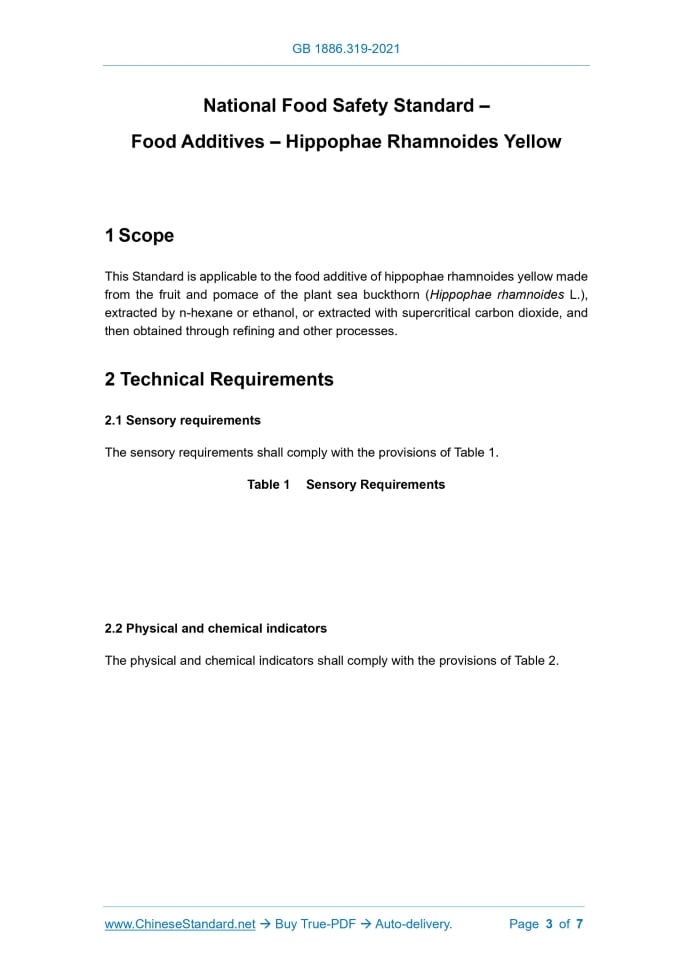
This Standard is applicable to the food additive of hippophae rhamnoides yellow made from the fruit and pomace of the plant sea buckthorn (Hippophae rhamnoides L.), extracted by n-hexane or ethanol, or extracted with supercritical carbon dioxide, and then obtained through refining and other processes.2 Technical Requirements
2.1 Sensory requirements The sensory requirements shall comply with the provisions of Table 1. Table 1 Sensory Requirements 2.2 Physical and chemical indicators The physical and chemical indicators shall comply with the provisions of Table 2.Appendix A
Test Methods A.1 General provisions When there are no other requirements, the reagents and water used in this Standard refer to analytical reagents and Class-III water that complies with the provisions of GB/T 6682. When there are no other requirements, the standard solutions, impurity standard solutions, preparations and products used in the test shall all be prepared in accordance with the provisions of GB/T 601, GB/T 602, and GB/T 603. The solution used in the test refers to the aqueous solution when the solvent is not specified. A.2 Identification test A.2.1 Solubility It is not easily soluble in water; but easily soluble in organic solvents such as n-hexane, petroleum ether, acetone, etc. The solution shall be yellow. A.2.2 Colour reaction A.2.2.1 Reagents and materials A.2.2.1.1 Phosphomolybdic acid solution: Take 5.0g of phosphomolybdic acid; add absolute ethanol to make the constant volume to 100mL; and get it. A.2.2.1.2 Sulfuric acid: 98%. A.2.2.1.3 Bromophenol blue solution: Take 1.0g of bromophenol blue; add absolute ethanol to make the constant volume to 100mL; and get it. A.2.2.1.4 Antimony trichloride solution: a trichloromethane solution saturated with antimony trichloride. A.2.2.2 Measurement procedures Dip the silica gel G thin-layer TLC plate in the he yellow pigment solution. The developing solvent can be 95% ethanol or absolute ethanol. After taking it out, it shall air dry; and the TLC plate shall be yellow. Drop the above-mentioned reagent solution on this thin-layer plate and observe the colour development. Blank test: Take a blank silica gel G thin-layer TLC plate immersed in the same developing solvent; titrate the corresponding colour reagents; and observe the colour development. ......Source: Above contents are excerpted from the full-copy PDF -- translated/reviewed by: www.ChineseStandard.net / Wayne Zheng et al.