Path:
Home >
JJ >
Page14 > JJG 561-2016
Price & Delivery
US$329.00 · In stock · Download in 9 secondsJJG 561-2016: Near-Zone Electric-field Measuring Instruments
Delivery: 9 seconds. True-PDF full-copy in English & invoice will be downloaded + auto-delivered via email. See
step-by-step procedureStatus: Valid
JJG 561: Historical versions
| Std ID | Version | USD | Buy | Deliver [PDF] in | Title (Description) |
| JJG 561-2016 | English | 329 |
Add to Cart
|
3 days [Need to translate]
|
Near-Zone Electric-field Measuring Instruments
|
| JJG 561-1988 | English | 279 |
Add to Cart
|
3 days [Need to translate]
|
Verification regulation of Model RJ-3 Near -Zone Electric -Field Measuring Instruments
|
Click to Preview a similar PDF
Basic data
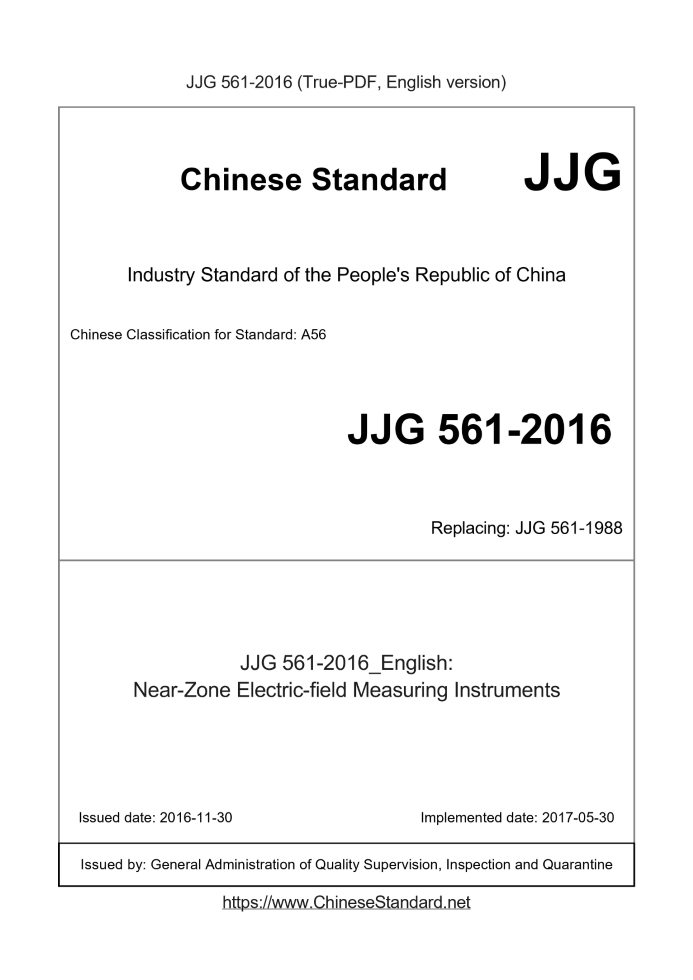
| Standard ID | JJG 561-2016 (JJG561-2016) |
| Description (Translated English) | Near-Zone Electric-field Measuring Instruments |
| Sector / Industry | Metrology & Measurement Industry Standard |
| Classification of Chinese Standard | A56 |
| Word Count Estimation | 14,170 |
| Date of Issue | 2016-11-30 |
| Date of Implementation | 2017-05-30 |
| Older Standard (superseded by this standard) | JJG 561-1988 |
| Regulation (derived from) | State Administration of Quality Supervision, Inspection and Quarantine Notice No.119 of 2016 |
| Issuing agency(ies) | General Administration of Quality Supervision, Inspection and Quarantine |
JJG 561-2016: Near-Zone Electric-field Measuring Instruments
---This is a DRAFT version for illustration, not a final translation. Full copy of true-PDF in English version (including equations, symbols, images, flow-chart, tables, and figures etc.) will be manually/carefully translated upon your order.
Near-Zone Electric-field Measuring Instruments
National Metrological Verification Regulation of the People's Republic of China
Near - field electric field measuring instrument
2016-11-30 release
2017-05-30 implementation
State Administration of Quality Supervision, Inspection and Quarantine issued
Test procedure for near - field electric field measuring instrument
Replacing JJG 561-1988
Coordinate Unit. National Radio Measurement Technology Committee
Drafting unit. China Institute of Metrology
This procedure entrusts the National Radio Measurement Technology Committee to explain
The main drafters of this procedure.
Li Bo (China Institute of Metrology)
Li Dabo (China Institute of Metrology)
Xie Ming (China Institute of Metrology)
table of Contents
Introduction (II)
1 Scope (1)
2 References (1)
3 Overview (1)
4 Measurement performance requirements (1)
5 General technical requirements (1)
6 Metering device control (1)
6.1 Test conditions (1)
6.2 Verification method (3)
6.3 Processing of test results (4)
6.4 Test cycle (4)
Appendix A Verification of the original record format (5)
APPENDIX B INSPECTION CERTIFICATE/QUALIFICATION RESULTS Notice Page Format (Page 2) (7)
APPENDIX C INSPECTION CERTIFICATE/QUALITY RESULTS NO. Verification Result Page Style (Page 3) (8)
Introduction
This procedure is based on JJF1002-2010 "national measurement procedures for the preparation of rules" preparation.
This procedure is based on IEEE1309-2005, "9kHz ~ 40GHz electromagnetic field sensor and probe (except antenna)
Calibration of the IEEE standard "as the basis, JJG 561-1988" near the field of electric field measuring instrument "to amend the
The main reference to the IEEE1309-2005 on the 9kHz ~.200MHz standard field generation method and its uncertainty
Analysis of the relevant content.
Compared with JJG 561-1988, in addition to editorial changes, the procedures of the technical content of the changes are as follows.
The lower limit of the frequency range is extended to 100 kHz;
- the basic range of the original test, other range test and frequency response test merger, in the frequency range
Select a number of frequency points, at each frequency point were detected under the common field strength range of the lower limit (10V/m), the upper limit
(150V/m) and the median (50V/m) of the field strength measurement error.
The previous versions of this order are released as follows.
Near - field electric field measuring instrument - JJG 561-1988.
Test procedure for near - field electric field measuring instrument
1 Scope
This procedure applies to the frequency range of 100kHz ~.200MHz, commonly used field strength range of 10V/m ~ 150V/m
Of the nearest field electric field measuring instrument of the first test, follow-up test and use in the inspection.
2 reference file
This procedure refers to the following documents.
IEEE1309-2005 9kHz ~ 40GHz electromagnetic field sensor and probe (except antenna) calibration
IEEE standard (IEEE Standard for CFibrationofElectromagneticFieldSensorsand
Probes, ExcludingAntennas, from 9 kHz to 40 GHz).
For dated references, only the dated edition applies to this rule; references that are not dated
, The latest version (including all amendments) applies to this procedure.
3 Overview
The near field electric field measuring instrument is used in the medium to measure the RF electric field component, and the measured electric field produces the smallest disturbance
Device. Which comprises the following components. (1) an electric small size sensor (or sensor group) for detecting radio frequency electric field components;
② the RF signal is converted to the proportion of DC signal or slow exchange of AC signal devices; ③ for picking rectification (inspection
Wave) signal with a high impedance characteristic of the resistive transmission line.
4 Measurement performance requirements
Maximum allowable error of field strength measurement. ± 30%.
5 General technical requirements
The equipment to be inspected should have the manufacturer, instrument name, instrument type, factory number and power supply information. Near field electric field
The control buttons, key switches, input and output ports of the measuring instrument should be clearly marked and made of measuring instruments
License mark.
Check the instrument should not interfere with the reading and affect the normal work of mechanical damage, control knobs and buttons should be able to work
For the display can be normal display, a variety of signs should be clear and complete; pointer meter pointer should not be bent, the first table mechanical
Zero can be adjusted freely.
6 Metering device control
6.1 Test conditions
6.1.1 Environmental conditions
a) Ambient temperature. (23 ± 5) ° C;
b) relative humidity. 20% to 80%;
...