JJG 376-2007 PDF English
Price & Delivery
US$150.00 · In stock · Download in 9 secondsJJG 376-2007: Verification Regulation of Electrolytic Conductivity Meters
Delivery: 9 seconds. True-PDF full-copy in English & invoice will be downloaded + auto-delivered via email. See step-by-step procedure
Status: Valid
JJG 376: Historical versions
| Standard ID | USD | BUY PDF | Delivery | Standard Title (Description) | Status |
| JJG 376-2007 | 150 | Add to Cart | Auto, 9 seconds. | Verification Regulation of Electrolytic Conductivity Meters | Valid |
| JJG 376-1985 | 399 | Add to Cart | 3 days | Verification Regulation for Electrolytic Conductance Meter | Obsolete |
Click to Preview this PDF
JJG 376-2007: Verification Regulation of Electrolytic Conductivity Meters
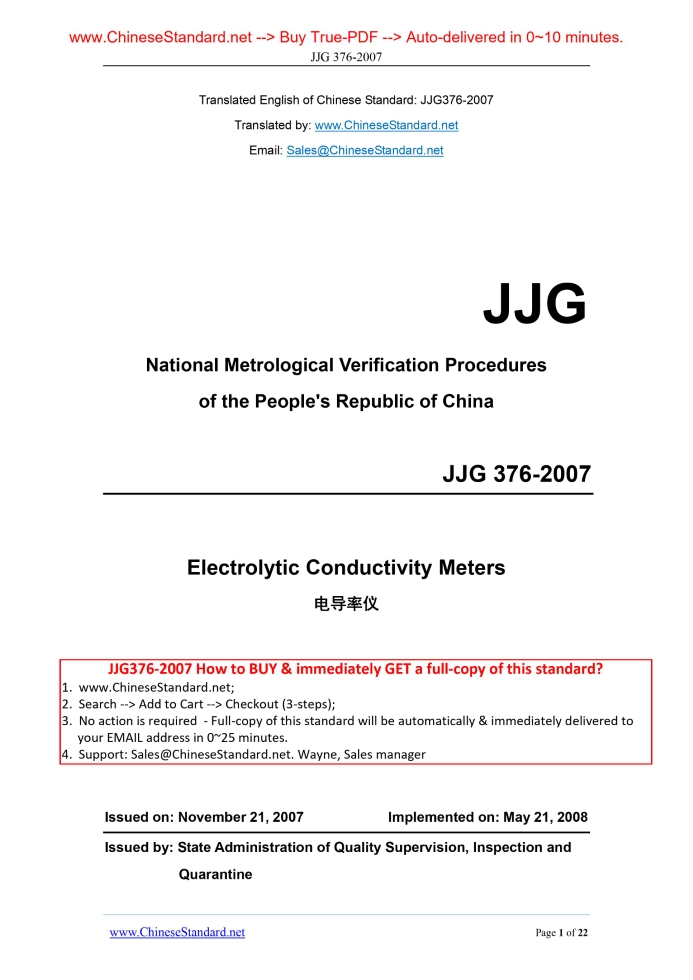
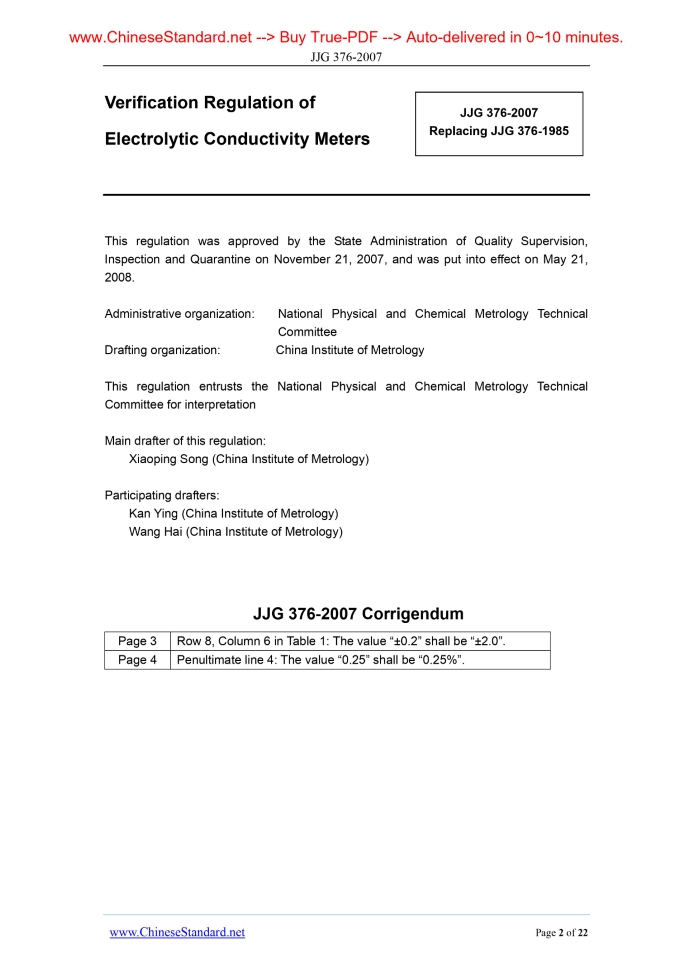
---This is an excerpt. Full copy of true-PDF in English version (including equations, symbols, images, flow-chart, tables, and figures etc.), auto-downloaded/delivered in 9 seconds, can be purchased online: https://www.ChineseStandard.net/PDF.aspx/JJG376-2007JJG National Metrological Verification Procedures of the People's Republic of China Electrolytic Conductivity Meters Issued on. NOVEMBER 21, 2007 Implemented on. MAY 21, 2008 Issued by. State Administration of Quality Supervision, Inspection and Quarantine Verification Regulation of Electrolytic Conductivity Meters This regulation was approved by the State Administration of Quality Supervision, Inspection and Quarantine on November 21, 2007, and was put into effect on May 21, 2008. Administrative organization. National Physical and Chemical Metrology Technical Committee Drafting organization. China Institute of Metrology This regulation entrusts the National Physical and Chemical Metrology Technical Committee for interpretation Main drafter of this regulation. Xiaoping Song (China Institute of Metrology) Participating drafters. Kan Ying (China Institute of Metrology) Wang Hai (China Institute of Metrology) JJG 376-2007 Corrigendum Page 3 Row 8, Column 6 in Table 1.The value “±0.2” shall be “±2.0”. Page 4 Penultimate line 4.The value “0.25” shall be “0.25%”. Replacing JJG 376-1985
Table of Contents
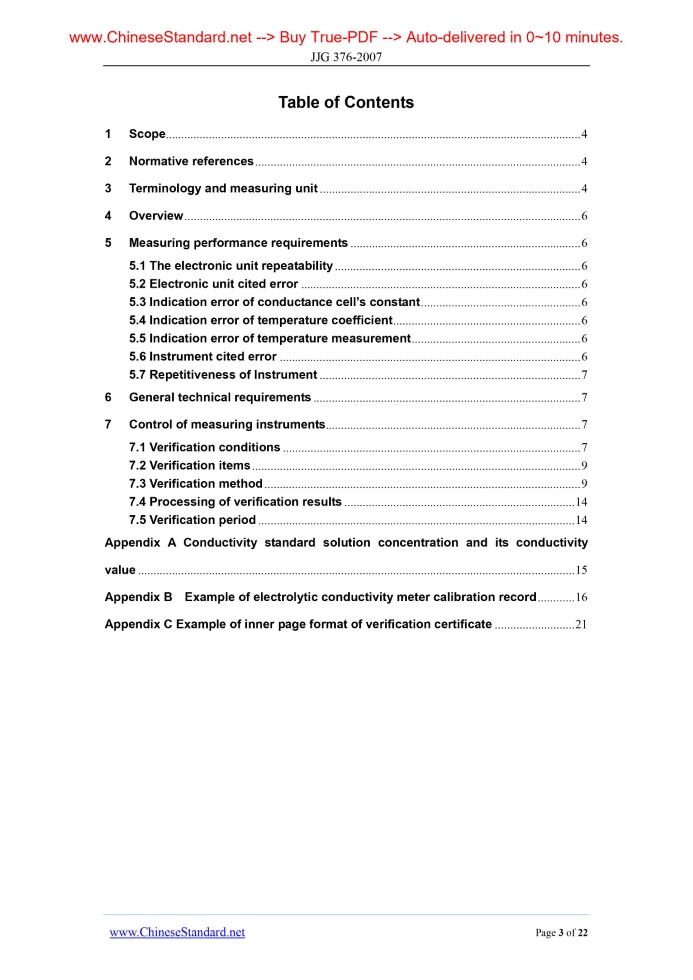
1 Scope... 4 2 Normative references... 4 3 Terminology and measuring unit... 4 4 Overview... 6 5 Measuring performance requirements... 6 5.1 The electronic unit repeatability... 6 5.2 Electronic unit cited error... 6 5.3 Indication error of conductance cell’s constant... 6 5.4 Indication error of temperature coefficient... 6 5.5 Indication error of temperature measurement... 6 5.6 Instrument cited error... 6 5.7 Repetitiveness of Instrument... 7 6 General technical requirements... 7 7 Control of measuring instruments... 7 7.1 Verification conditions... 7 7.2 Verification items... 9 7.3 Verification method... 9 7.4 Processing of verification results... 14 7.5 Verification period... 14 Appendix A Conductivity standard solution concentration and its conductivity value... 15 Appendix B Example of electrolytic conductivity meter calibration record... 16 Appendix C Example of inner page format of verification certificate... 21 Verification Regulation of Electrolytic Conductivity Meters1 Scope
This regulation applies to the first-time verification, subsequent verification, and in-use inspection of electrolytic conductivity meters. Calibration of resistivity meter, salinity meter based on the electrical conductivity measurement principle, and TDS measurement instrument can reference to this regulation.2 Normative references
OIML R68 Edition 1985 Calibration method for conductivity cell BS EN 60746-3.2002 Expression of performance of electrochemical analyzers - Part 3.3 Terminology and measuring unit
3.1 Electrolytic conductance The ratio of current and electric potential difference when ionic charge of conductivity cell moves in the electrolyte solution. 3.3 Cell constant Conductance cell constant is calculated by the formula (3). 3.4 Temperature coefficient The relative change of the conductivity of the electrolyte solution that is caused by temperature change of 1 °C. For strong electrolyte whose electrical conductivity is greater than 1 x 10⁻⁴ S·m-1, the temperature coefficient α can be approximately expressed by Formula (5).4 Overview
Conductivity meter is used to measure the electrolyte solution conductivity. The measuring principle of conductivity meter is based on the relationship [formula (4)] of conductivity, electric conductance, and conductance cell’s constant. Apply alternating electrical signals between electrodes of conductance cell to measure the solution conductivity; obtain the conductivity according to the imputed conductance cell’s constant.5 Measuring performance requirements
5.1 The electronic unit repeatability Verification results shall comply with the provisions of Table 1. 5.2 Electronic unit cited error Verification results shall comply with the provisions of Table 1. 5.3 Indication error of conductance cell’s constant Verification results shall comply with the provisions of Table 1.6 General technical requirements
Instrument appearance shall be bright, clean and flat. Instrument function keys shall be able to work properly. All fasteners shall not be loose. The indication of instrument panel shall be clear and intact. Digital display instrument shall be clear and complete.7 Control of measuring instruments
Control of measuring instruments includes first-time verification, subsequent verification and in-use inspection. 7.1 Verification conditions 7.1.1 Environmental conditions Verification results shall comply with the provisions of Table 2. 7.1.2 Solution conductance simulator It is the standard device for verifying electronic unit’s metrological performance. It is consisted of a set of non-inductive a.c. (alternate current) resistance. Setting of resistance value shall be able to meet the requirements of "verification method". 7.1.3 Conductivity standard solution The relative uncertainty of reference value of standard solution used in verification shall be less than or equal to 0.25 0.25% (k = 2). Potassium chloride solution conductivity standard material may be used. It may also use KCl conductivity solid standard material prepared according to the provisions of the appendix. 7.3.8 Instrument repeatability Repeatedly measure standard solution 1 or standard solution 2 for 6 times. Calculate the ratio of single-measurement standard deviation AND full-range according to Formula (6). It represents the repeatability of instrument measurement results. 7.4 Processing of verification results After verification, the instrument complying with this regulation is deemed as qualified instrument. A verification certificate shall be issued. The certificate shall provide each item’s verification result and the instrument level. The instrument at certain level shall meet the requirements of all metrological performance of that level. If some range can not meet the requirements, it shall indicate the limitation range. If the instrument is not qualified, a notice of verification result shall be issued. 7.5 Verification period The verification period generally shall not be more than a year. JJG 376-2007 JJG National Metrological Verification Procedures of the People's Republic of China Electrolytic Conductivity Meters Issued on. NOVEMBER 21, 2007 Implemented on. MAY 21, 2008 Issued by. State Administration of Quality Supervision, Inspection and Quarantine Verification Regulation of Electrolytic Conductivity Meters This regulation was approved by the State Administration of Quality Supervision, Inspection and Quarantine on November 21, 2007, and was put into effect on May 21, 2008. Administrative organization. National Physical and Chemical Metrology Technical Committee Drafting organization. China Institute of Metrology This regulation entrusts the National Physical and Chemical Metrology Technical Committee for interpretation Main drafter of this regulation. Xiaoping Song (China Institute of Metrology) Participating drafters. Kan Ying (China Institute of Metrology) Wang Hai (China Institute of Metrology) JJG 376-2007 Corrigendum Page 3 Row 8, Column 6 in Table 1.The value “±0.2” shall be “±2.0”. Page 4 Penultimate line 4.The value “0.25” shall be “0.25%”. Replacing JJG 376-1985Table of Contents
1 Scope... 4 2 Normative references... 4 3 Terminology and measuring unit... 4 4 Overview... 6 5 Measuring performance requirements... 6 5.1 The electronic unit repeatability... 6 5.2 Electronic unit cited error... 6 5.3 Indication error of conductance cell’s constant... 6 5.4 Indication error of temperature coefficient... 6 5.5 Indication error of temperature measurement... 6 5.6 Instrument cited error... 6 5.7 Repetitiveness of Instrument... 7 6 General technical requirements... 7 7 Control of measuring instruments... 7 7.1 Verification conditions... 7 7.2 Verification items... 9 7.3 Verification method... 9 7.4 Processing of verification results... 14 7.5 Verification period... 14 Appendix A Conductivity standard solution concentration and its conductivity value... 15 Appendix B Example of electrolytic conductivity meter calibration record... 16 Appendix C Example of inner page format of verification certificate... 21 Verification Regulation of Electrolytic Conductivity Meters1 Scope
This regulation applies to the first-time verification, subsequent verification, and in-use inspection of electrolytic conductivity meters. Calibration of resistivity meter, salinity meter based on the electrical conductivity measurement principle, and TDS measurement instrument can reference to this regulation.2 Normative references
OIML R68 Edition 1985 Calibration method for conductivity cell BS EN 60746-3.2002 Expression of performance of electrochemical analyzers - Part 3.3 Terminology and measuring unit
3.1 Electrolytic conductance The ratio of current and electric potential difference when ionic charge of conductivity cell moves in the electrolyte solution. 3.3 Cell constant Conductance cell constant is calculated by the formula (3). 3.4 Temperature coefficient The relative change of the conductivity of the electrolyte solution that is caused by temperature change of 1 °C. For strong electrolyte whose electrical conductivity is greater than 1 x 10⁻⁴ S·m-1, the temperature coefficient α can be approximately expressed by Formula (5).4 Overview
Conductivity meter is used to measure the electrolyte solution conductivity. The measuring principle of conductivity meter is based on the relationship [formula (4)] of conductivity, electric conductance, and conductance cell’s constant. Apply alternating electrical signals between electrodes of conductance cell to measure the solution conductivity; obtain the conductivity according to the imputed conductance cell’s constant.5 Measuring performance requirements
5.1 The electronic unit repeatability Verification results shall comply with the provisions of Table 1. 5.2 Electronic unit cited error Verification results shall comply with the provisions of Table 1. 5.3 Indication error of conductance cell’s constant Verification results shall comply with the provisions of Table 1.6 General technical requirements
Instrument appearance shall be bright, clean and flat. Instrument function keys shall be able to work properly. All fasteners shall not be loose. The indication of instrument panel shall be clear and intact. Digital display instrument shall be clear and complete.7 Control of measuring instruments
Control of measuring instruments includes first-time verification, subsequent verification and in-use inspection. 7.1 Verification conditions 7.1.1 Environmental conditions Verification results shall comply with the provisions of Table 2. 7.1.2 Solution conductance simulator It is the standard device for verifying electronic unit’s metrological performance. It is consisted of a set of non-inductive a.c. (alternate current) resistance. Setting of resistance value shall be able to meet the requirements of "verification method". 7.1.3 Conductivity standard solution The relative uncertainty of reference value of standard solution used in verification shall be less than or equal to 0.25 0.25% (k = 2). Potassium chloride solution conductivity standard material may be used. It may also use KCl conductivity solid standard material prepared according to the provisions of the appendix. 7.3.8 Instrument repeatability Repeatedly measure standard solution 1 or standard solution 2 for 6 times. Calculate the ratio of single-measurement standard deviation AND full-range according to Formula (6). It represents the repeatability of instrument measurement results. 7.4 Processing of verification results After verification, the instrument complying with this regulation is deemed as qualified instrument. A verification certificate shall be issued. The certificate shall provide each item’s verification result and the instrument level. The instrument at certain level shall meet the requirements of all metrological performance of that level. If some range can not meet the requirements, it shall indicate the limitation range. If the instrument is not qualified, a notice of verification result shall be issued. 7.5 Verification period The verification period generally shall not be more than a year. ......Source: Above contents are excerpted from the full-copy PDF -- translated/reviewed by: www.ChineseStandard.net / Wayne Zheng et al.