JJG 245-2005 PDF English
Price & Delivery
US$620.00 · In stock · Download in 9 secondsJJG 245-2005: Verification Regulation of Illuminance Meter
Delivery: 9 seconds. True-PDF full-copy in English & invoice will be downloaded + auto-delivered via email. See step-by-step procedure
Status: Valid
JJG 245: Historical versions
| Standard ID | USD | BUY PDF | Delivery | Standard Title (Description) | Status |
| JJG 245-2005 | 620 | Add to Cart | Auto, 9 seconds. | Verification Regulation of Illuminance Meter | Valid |
| JJG 245-1991 | 839 | Add to Cart | 6 days | Verification Regulation of Illuminometer | Obsolete |
| JJG 245-1981 | RFQ | ASK | 3 days | (Chinese Industry Standard) | Obsolete |
Click to Preview this PDF
JJG 245-2005: Verification Regulation of Illuminance Meter
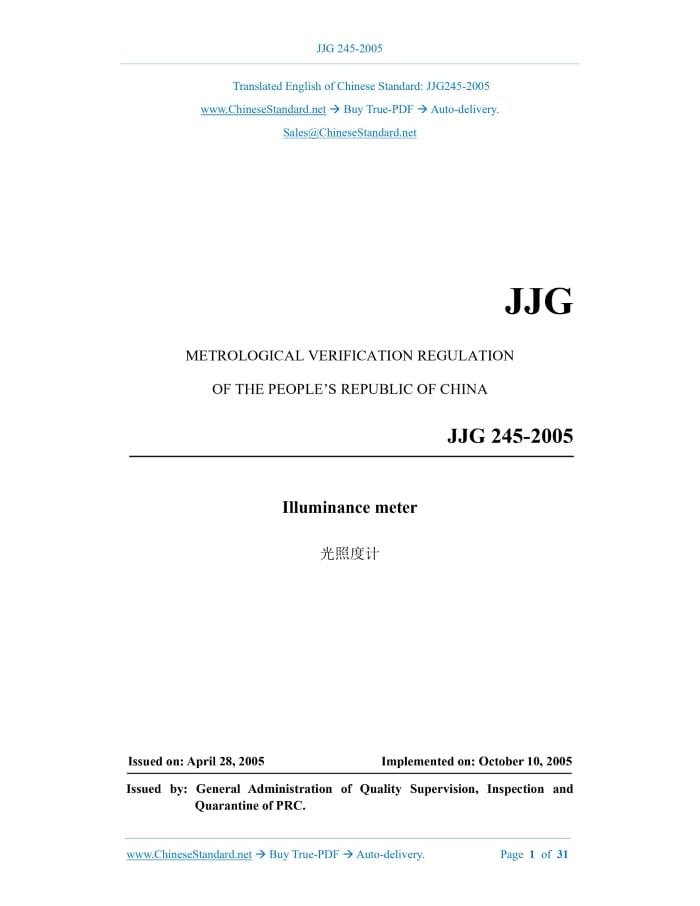
---This is an excerpt. Full copy of true-PDF in English version (including equations, symbols, images, flow-chart, tables, and figures etc.), auto-downloaded/delivered in 9 seconds, can be purchased online: https://www.ChineseStandard.net/PDF.aspx/JJG245-2005JJG METROLOGICAL VERIFICATION REGULATION Illuminance meter Issued on. APRIL 28, 2005 Implemented on. OCTOBER 10, 2005 Issued by. General Administration of Quality Supervision, Inspection and Quarantine of PRC. Verification regulation of illuminance meter This Regulation was approved by the General Administration of Quality Supervision, Inspection and Quarantine of PRC on April 28, 2005.It was implemented from October 28, 2005. Under the jurisdiction of. National Optical Metrology Technical Committee Drafting organization. China Institute of Metrology National Optical Metrology Technical Committee is responsible for the interpretation of this Regulation. Drafters of this Regulation. Jiang Xiaomei (Chinese Institute of Metrology) Gao Zhizhong (China Institute of Metrology) Replacing JJG 245-1991
Table of Contents
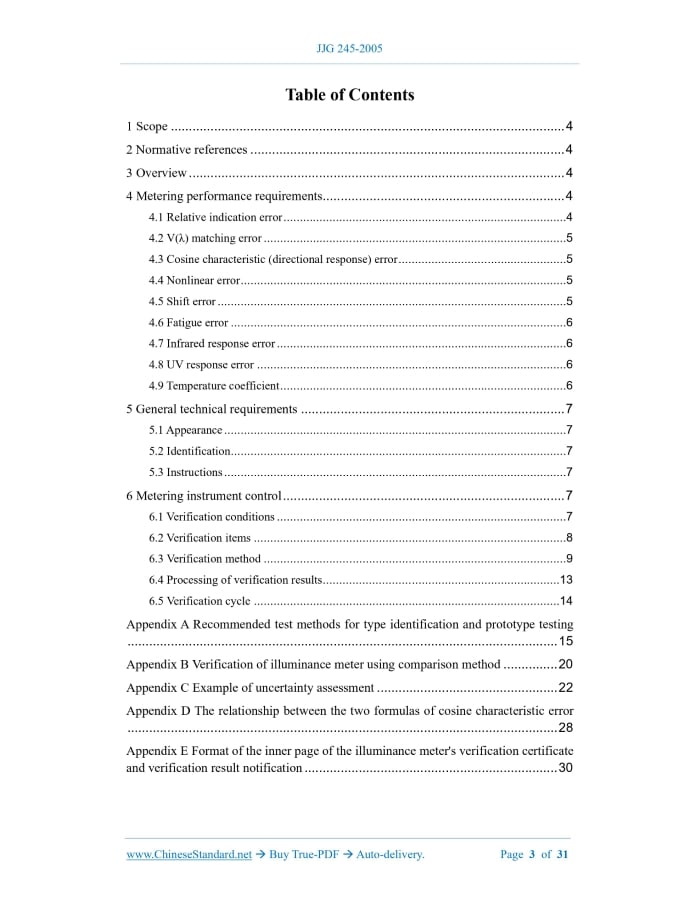
1 Scope... 4 2 Normative references... 4 3 Overview... 4 4 Metering performance requirements... 4 4.1 Relative indication error... 4 4.2 V(λ) matching error... 5 4.3 Cosine characteristic (directional response) error... 5 4.4 Nonlinear error... 5 4.5 Shift error... 5 4.6 Fatigue error... 6 4.7 Infrared response error... 6 4.8 UV response error... 6 4.9 Temperature coefficient... 6 5 General technical requirements... 7 5.1 Appearance... 7 5.2 Identification... 7 5.3 Instructions... 7 6 Metering instrument control... 7 6.1 Verification conditions... 7 6.2 Verification items... 8 6.3 Verification method... 9 6.4 Processing of verification results... 13 6.5 Verification cycle... 14 Appendix A Recommended test methods for type identification and prototype testing ... 15 Appendix B Verification of illuminance meter using comparison method... 20 Appendix C Example of uncertainty assessment... 22 Appendix D The relationship between the two formulas of cosine characteristic error ... 28 Appendix E Format of the inner page of the illuminance meter's verification certificate and verification result notification... 30 Verification regulation of illuminance meter1 Scope
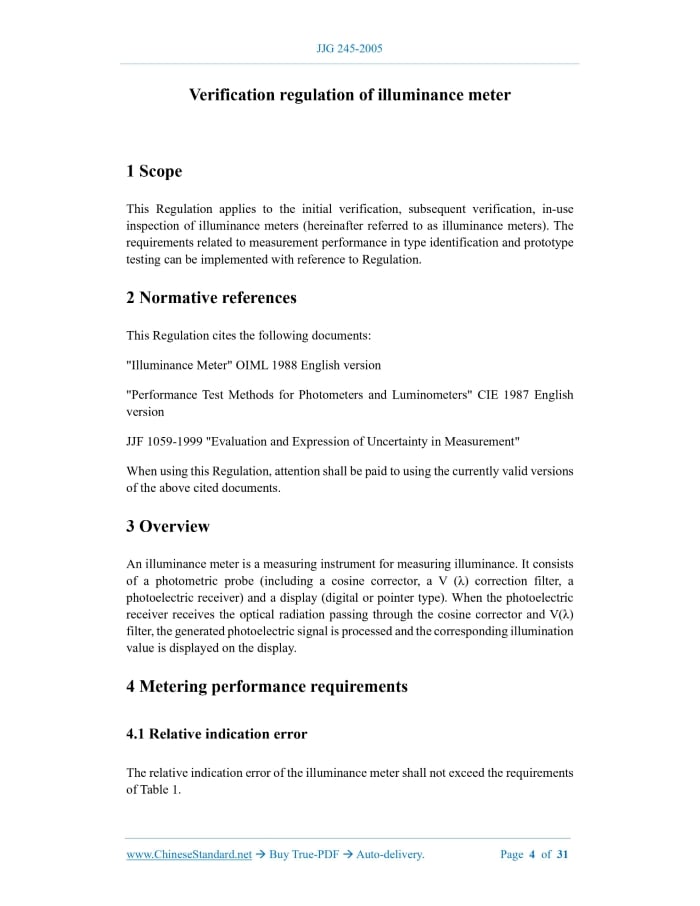
This Regulation applies to the initial verification, subsequent verification, in-use inspection of illuminance meters (hereinafter referred to as illuminance meters). The requirements related to measurement performance in type identification and prototype testing can be implemented with reference to Regulation.2 Normative references
This Regulation cites the following documents. "Illuminance Meter" OIML 1988 English version "Performance Test Methods for Photometers and Luminometers" CIE 1987 English version JJF 1059-1999 "Evaluation and Expression of Uncertainty in Measurement" When using this Regulation, attention shall be paid to using the currently valid versions of the above cited documents.3 Overview
An illuminance meter is a measuring instrument for measuring illuminance. It consists of a photometric probe (including a cosine corrector, a V (λ) correction filter, a photoelectric receiver) and a display (digital or pointer type).4 Metering performance requirements
4.1 Relative indication error The relative indication error of the illuminance meter shall not exceed the requirements of Table 1. 4.2 V(λ) matching error The V(λ) matching error of the illuminance meter shall not exceed the requirements of 4.3 Cosine characteristic (directional response) error The cosine characteristic (directional response) error of the illuminance meter shall not exceed the requirements of Table 3. 4.8 UV response error The UV response error of the illuminance meter shall not exceed the requirements in Table 8. 4.9 Temperature coefficient The temperature coefficient of the illuminance meter shall not exceed the requirements of Table 9.5 General technical requirements
5.1 Appearance The connection lines of the illuminance meter shall be in good contact; the outer surface of the cosine corrector of the photometer probe shall be clean and undamaged, with no spots or other marks. The digital display of the digital illuminance meter shall be clear, with no broken strokes, etc. 5.2 Identification The instrument shall be identified as follows. Name, model, product number, manufacturer, relevant mandatory and descriptive marks.6 Metering instrument control
Metering instrument control includes. initial verification, subsequent verification, in- use inspection. 6.1 Verification conditions 6.1.1 Verification equipment 6.1.1.3 Luminous intensity standard lamp set The luminous intensity standard lamp used to calibrate the illuminance meter shall not be lower than the requirements in Table 11. 6.1.2 Environmental conditions The room where the photometry system is located shall be a dark room; the temperature shall be maintained at (20 ± 5) °C. If the electrical measurement system uses supporting equipment such as a potentiometer and standard batteries, the temperature of the room where it is located shall be maintained at (20 ± 2) °C, the humidity shall be less than 85%RH. 6.2 Verification items The verification items are as shown in Table 12. The recommended test items for type identification and prototype testing include all the contents in Chapter 4.Among them, please refer to Appendix A for the test methods of V (λ) matching error, fatigue error, infrared response error, ultraviolet response error, temperature coefficient. 6.3 Verification method 6.3.3.3 The photometric probe shall cause the response of the light projected onto it to comply with the cosine law. Calculate the error f2(ε, ϕ) caused by the direction of the projected light according to formula (3). 6.3.4 Nonlinear error 6.3.5 Shift error 6.3.5.1 On the photometric measuring device, install the standard lamp and the photometric probe of the illuminance meter in accordance with the requirements for calibrating the illuminance meter. Keep the position of the fixed photometric probe unchanged; move the standard lamp, so that the standard illumination value X (A) reaches 90% of the full scale in the low-range gear A; its displayed value is Y (A). Then change the illuminance meter to the relatively high range B; move the standard lamp so that the standard illuminance value X (B) increases k times compared to X (A). Read the illuminance meter's display value Y (B). 6.3.5.2 Calculate the error f4 caused by the change of measuring range according to formula (6). 6.4 Processing of verification results Carry out verification one by one according to the provisions of 6.2 "Verification items". Record the various data obtained. Calculate the results. If all items meet the requirements of this Regulation, 6.5 Verification cycle The verification cycle generally does not exceed 1 year. JJG METROLOGICAL VERIFICATION REGULATION Illuminance meter Issued on. APRIL 28, 2005 Implemented on. OCTOBER 10, 2005 Issued by. General Administration of Quality Supervision, Inspection and Quarantine of PRC. Verification regulation of illuminance meter This Regulation was approved by the General Administration of Quality Supervision, Inspection and Quarantine of PRC on April 28, 2005.It was implemented from October 28, 2005. Under the jurisdiction of. National Optical Metrology Technical Committee Drafting organization. China Institute of Metrology National Optical Metrology Technical Committee is responsible for the interpretation of this Regulation. Drafters of this Regulation. Jiang Xiaomei (Chinese Institute of Metrology) Gao Zhizhong (China Institute of Metrology) Replacing JJG 245-1991Table of Contents
1 Scope... 4 2 Normative references... 4 3 Overview... 4 4 Metering performance requirements... 4 4.1 Relative indication error... 4 4.2 V(λ) matching error... 5 4.3 Cosine characteristic (directional response) error... 5 4.4 Nonlinear error... 5 4.5 Shift error... 5 4.6 Fatigue error... 6 4.7 Infrared response error... 6 4.8 UV response error... 6 4.9 Temperature coefficient... 6 5 General technical requirements... 7 5.1 Appearance... 7 5.2 Identification... 7 5.3 Instructions... 7 6 Metering instrument control... 7 6.1 Verification conditions... 7 6.2 Verification items... 8 6.3 Verification method... 9 6.4 Processing of verification results... 13 6.5 Verification cycle... 14 Appendix A Recommended test methods for type identification and prototype testing ... 15 Appendix B Verification of illuminance meter using comparison method... 20 Appendix C Example of uncertainty assessment... 22 Appendix D The relationship between the two formulas of cosine characteristic error ... 28 Appendix E Format of the inner page of the illuminance meter's verification certificate and verification result notification... 30 Verification regulation of illuminance meter1 Scope
This Regulation applies to the initial verification, subsequent verification, in-use inspection of illuminance meters (hereinafter referred to as illuminance meters). The requirements related to measurement performance in type identification and prototype testing can be implemented with reference to Regulation.2 Normative references
This Regulation cites the following documents. "Illuminance Meter" OIML 1988 English version "Performance Test Methods for Photometers and Luminometers" CIE 1987 English version JJF 1059-1999 "Evaluation and Expression of Uncertainty in Measurement" When using this Regulation, attention shall be paid to using the currently valid versions of the above cited documents.3 Overview
An illuminance meter is a measuring instrument for measuring illuminance. It consists of a photometric probe (including a cosine corrector, a V (λ) correction filter, a photoelectric receiver) and a display (digital or pointer type).4 Metering performance requirements
4.1 Relative indication error The relative indication error of the illuminance meter shall not exceed the requirements of Table 1. 4.2 V(λ) matching error The V(λ) matching error of the illuminance meter shall not exceed the requirements of 4.3 Cosine characteristic (directional response) error The cosine characteristic (directional response) error of the illuminance meter shall not exceed the requirements of Table 3. 4.8 UV response error The UV response error of the illuminance meter shall not exceed the requirements in Table 8. 4.9 Temperature coefficient The temperature coefficient of the illuminance meter shall not exceed the requirements of Table 9.5 General technical requirements
5.1 Appearance The connection lines of the illuminance meter shall be in good contact; the outer surface of the cosine corrector of the photometer probe shall be clean and undamaged, with no spots or other marks. The digital display of the digital illuminance meter shall be clear, with no broken strokes, etc. 5.2 Identification The instrument shall be identified as follows. Name, model, product number, manufacturer, relevant mandatory and descriptive marks.6 Metering instrument control
Metering instrument control includes. initial verification, subsequent verification, in- use inspection. 6.1 Verification conditions 6.1.1 Verification equipment 6.1.1.3 Luminous intensity standard lamp set The luminous intensity standard lamp used to calibrate the illuminance meter shall not be lower than the requirements in Table 11. 6.1.2 Environmental conditions The room where the photometry system is located shall be a dark room; the temperature shall be maintained at (20 ± 5) °C. If the electrical measurement system uses supporting equipment such as a potentiometer and standard batteries, the temperature of the room where it is located shall be maintained at (20 ± 2) °C, the humidity shall be less than 85%RH. 6.2 Verification items The verification items are as shown in Table 12. The recommended test items for type identification and prototype testing include all the contents in Chapter 4.Among them, please refer to Appendix A for the test methods of V (λ) matching error, fatigue error, infrared response error, ultraviolet response error, temperature coefficient. 6.3 Verification method 6.3.3.3 The photometric probe shall cause the response of the light projected onto it to comply with the cosine law. Calculate the error f2(ε, ϕ) caused by the direction of the projected light according to formula (3). 6.3.4 Nonlinear error 6.3.5 Shift error 6.3.5.1 On the photometric measuring device, install the standard lamp and the photometric probe of the illuminance meter in accordance with the requirements for calibrating the illuminance meter. Keep the position of the fixed photometric probe unchanged; move the standard lamp, so that the standard illumination value X (A) reaches 90% of the full scale in the low-range gear A; its displayed value is Y (A). Then change the illuminance meter to the relatively high range B; move the standard lamp so that the standard illuminance value X (B) increases k times compared to X (A). Read the illuminance meter's display value Y (B). 6.3.5.2 Calculate the error f4 caused by the change of measuring range according to formula (6). 6.4 Processing of verification results Carry out verification one by one according to the provisions of 6.2 "Verification items". Record the various data obtained. Calculate the results. If all items meet the requirements of this Regulation, 6.5 Verification cycle The verification cycle generally does not exceed 1 year. ......Source: Above contents are excerpted from the full-copy PDF -- translated/reviewed by: www.ChineseStandard.net / Wayne Zheng et al.