GB/T 7573-2025 PDF English
Price & Delivery
US$170.00 · In stock · Download in 9 secondsGB/T 7573-2025: Textiles - Determination of pH of aqueous extract
Delivery: 9 seconds. True-PDF full-copy in English & invoice will be downloaded + auto-delivered via email. See step-by-step procedure
Status: Valid
GB/T 7573: Historical versions
| Standard ID | USD | BUY PDF | Delivery | Standard Title (Description) | Status |
| GB/T 7573-2025 | 170 | Add to Cart | Auto, 9 seconds. | Textiles - Determination of pH of aqueous extract | Valid |
| GB/T 7573-2009 | 70 | Add to Cart | Auto, 9 seconds. | Textiles -- Determination of pH of aqueous extract | Valid |
| GB/T 7573-2002 | 239 | Add to Cart | 2 days | Textiles -- Determination of pH of the aqueous extract | Obsolete |
| GB/T 7573-1987 | 199 | Add to Cart | 2 days | Textiles--Determination of PH of the aqueous extract | Obsolete |
Click to Preview this PDF
Similar standards
GB/T 7573-2025: Textiles - Determination of pH of aqueous extract
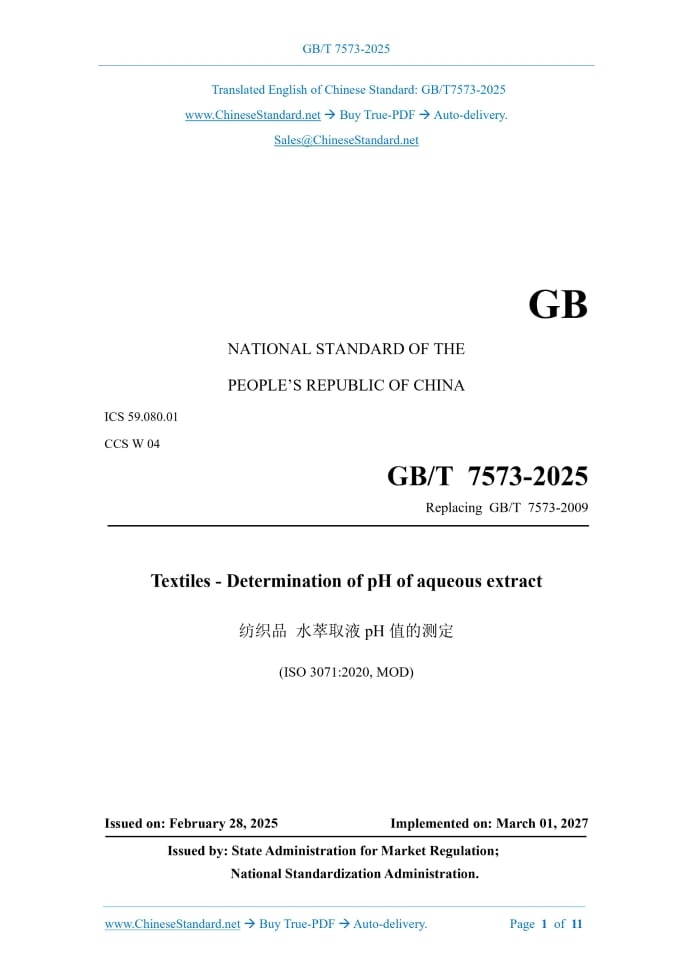
---This is an excerpt. Full copy of true-PDF in English version (including equations, symbols, images, flow-chart, tables, and figures etc.), auto-downloaded/delivered in 9 seconds, can be purchased online: https://www.ChineseStandard.net/PDF.aspx/GBT7573-2025GB NATIONAL STANDARD OF THE PEOPLE’S REPUBLIC OF CHINA ICS 59.080.01 CCS W 04 Replacing GB/T 7573-2009 Textiles - Determination of pH of aqueous extract (ISO 3071.2020, MOD) Issued on. FEBRUARY 28, 2025 Implemented on. MARCH 01, 2027 Issued by. State Administration for Market Regulation; National Standardization Administration.
Table of Contents
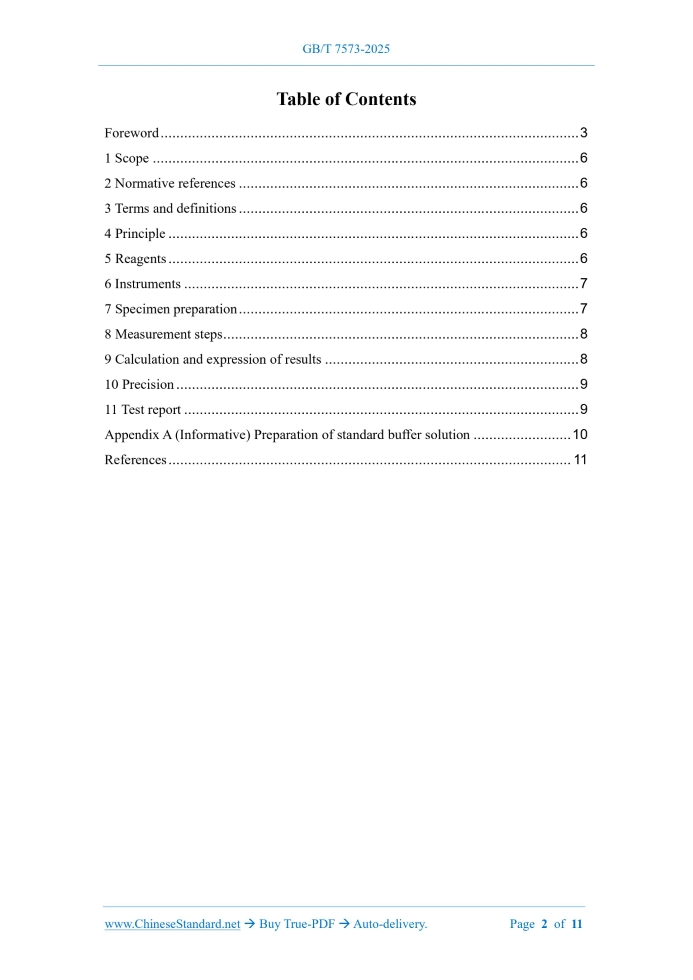
Foreword... 3 1 Scope... 6 2 Normative references... 6 3 Terms and definitions... 6 4 Principle... 6 5 Reagents... 6 6 Instruments... 7 7 Specimen preparation... 7 8 Measurement steps... 8 9 Calculation and expression of results... 8 10 Precision... 9 11 Test report... 9 Appendix A (Informative) Preparation of standard buffer solution... 10 References... 11Foreword
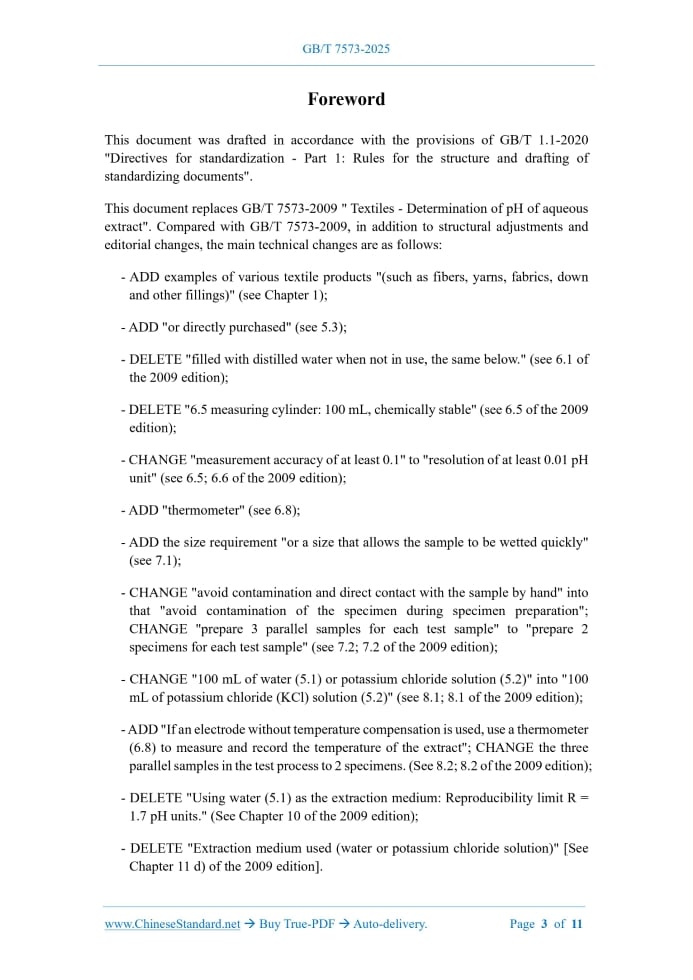
This document was drafted in accordance with the provisions of GB/T 1.1-2020 "Directives for standardization - Part 1.Rules for the structure and drafting of standardizing documents". This document replaces GB/T 7573-2009 " Textiles - Determination of pH of aqueous extract". Compared with GB/T 7573-2009, in addition to structural adjustments and editorial changes, the main technical changes are as follows. - ADD examples of various textile products "(such as fibers, yarns, fabrics, down and other fillings)" (see Chapter 1); - ADD "or directly purchased" (see 5.3); - DELETE "filled with distilled water when not in use, the same below." (see 6.1 of the 2009 edition); - DELETE "6.5 measuring cylinder. 100 mL, chemically stable" (see 6.5 of the 2009 edition); - CHANGE "measurement accuracy of at least 0.1" to "resolution of at least 0.01 pH unit" (see 6.5; 6.6 of the 2009 edition); - ADD "thermometer" (see 6.8); - ADD the size requirement "or a size that allows the sample to be wetted quickly" (see 7.1); - CHANGE "avoid contamination and direct contact with the sample by hand" into that "avoid contamination of the specimen during specimen preparation"; CHANGE "prepare 3 parallel samples for each test sample" to "prepare 2 specimens for each test sample" (see 7.2; 7.2 of the 2009 edition); - CHANGE "100 mL of water (5.1) or potassium chloride solution (5.2)" into "100 mL of potassium chloride (KCl) solution (5.2)" (see 8.1; 8.1 of the 2009 edition); - ADD "If an electrode without temperature compensation is used, use a thermometer (6.8) to measure and record the temperature of the extract"; CHANGE the three parallel samples in the test process to 2 specimens. (See 8.2; 8.2 of the 2009 edition); - DELETE "Using water (5.1) as the extraction medium. Reproducibility limit R = 1.7 pH units." (See Chapter 10 of the 2009 edition); - DELETE "Extraction medium used (water or potassium chloride solution)" [See Chapter 11 d) of the 2009 edition]. This document modifies and adopts ISO 3071.2020 "Textiles - Determination of pH of aqueous extract". The technical differences between this document and ISO 3071.2020 and their reasons are as follows. - ADD the example of "filling materials such as down" to the Scope (see Chapter 1; Chapter 1 of ISO 3071.2020) for easy understanding; - USE the normative reference GB/T 6682 to replace the informative reference ISO 3696 (see 5.1; 5.1 of ISO 3071.2020) for easy understanding; - CHANGE the frequency of the mechanical oscillator from "is suitable" to "at least" (see 6.2; 6.2 of ISO 3071.2020) for easy understanding; - ADD the thermometer (see 6.8) for easy operation; - CHANGE that "The pH meter is calibrated with two buffer solutions at the temperature of the extract" into that "The pH meter is calibrated with two or three buffer solutions at the temperature of the extract" (see 8.2; 8.2 of ISO 3071.2020), for easy operation; - ADD "b) Sample description" to the test report for easier understanding (see Chapter 11). Please note that some of the contents of this document may involve patents. The issuing agency of this document does not assume the responsibility for identifying patents. This document was proposed by the China National Textile and Apparel Council. This document shall be under the jurisdiction of the National Technical Committee for Textile Standardization (SAC/TC 209). Drafting organizations of this document. China Textile Standard Inspection and Certification Co., Ltd., China Textile Standard (Zhejiang) Testing Co., Ltd., Ningbo Peacebird Fashion Apparel Co., Ltd., Zhejiang Meisheng New Materials Co., Ltd., Xiamen Laihe Lace Co., Ltd., Ningbo Textile Instrument Factory, Guangdong Jinfa Maternal and Infant Products Co., Ltd., Fujian Jinjiang Huayu Weaving Co., Ltd., Hangzhou Nomo Testing Technology Co., Ltd., Fujian Yubang Textile Technology Co., Ltd., Fujian Jinjiang Benda Printing and Dyeing Co., Ltd., Fujian Jinjiang Xiesheng Weaving and Dyeing Co., Ltd., Shaoxing Laijie New Materials Technology Co., Ltd., Zhejiang Boshang Textile Co., Ltd., Zhejiang Changshan Textile Co., Ltd., Zhejiang Carolina Textile Co., Ltd. The main drafters of this document. Jing Tingting, Sui Jiaojiao, Ge You, Liu Lin, Wu Yan, Zhai Yi, Hu Junwei, Zhang Xiaofeng, Qian Neng, Lin Xianzhen, Su Chengyu, Wu Xiaohang, Zhang Shuyi, Wei Qingbo, Lin Peng, Zhang Hongliang, Zhang Yi, Yang Xiaohua. The previous versions of this document and the documents it replaces are as follows. - It was first published in 1987 as GB/T 7573-1987.It was first revised in 2002.It was second revised in 2009; - This is the third revision. Textiles - Determination of pH of aqueous extract1 Scope
This document describes the method for determining the pH value of aqueous extracts of textiles. This document is applicable to various textile products (such as fibers, yarns, fabrics, down and other fillings).2 Normative references
The contents of the following documents constitute the essential terms of this document through normative references in the text. Among them, for dated references, only the version corresponding to that date applies to this document; for undated references, the latest version (including all amendments) applies to this document. GB/T 6682 Water for analytical laboratory use - Specification and test methods (GB/T 6682-2008, ISO 3696.1987, MOD)3 Terms and definitions
The following terms and definitions apply to this document. The negative logarithm of the hydrogen ion concentration in the aqueous extract.4 Principle
The pH value of the aqueous extract of the textile is determined at room temperature using a pH meter with a glass electrode.5 Reagents
All reagents are analytically pure. 5.3 Buffer solution, used to calibrate the pH meter before measurement. It can be prepared according to the provisions of Appendix A or purchased directly; the pH value is close to that of the solution to be tested. The pH value of the buffer solution used is preferably around 4, 7, 9.6 Instruments
6.5 pH meter. Equipped with glass electrode, resolution at least 0.01 pH unit. It is better to have a pH meter with temperature compensation. 6.6 Balance. Resolution at least 0.01 g.7 Specimen preparation
7.1 Select representative laboratory samples from the batch of large samples, the number of which shall meet the amount required for all tests. Cut the sample into pieces of about 5 mm × 5 mm, or a size that is convenient for the specimen to be quickly wetted. 7.2 Avoid specimen contamination during specimen preparation. Prepare 2 specimens for each test sample; weigh (2.00 ± 0.05) g of each specimen using a balance (6.6).8 Measurement steps
If an electrode without temperature compensation is used, measure and record the temperature of the extract with a thermometer (6.8). Immerse the electrode in the KCl solution (5.2) used to prepare the extract several times, until the pH indication stabilizes; record the pH value of the KCl solution. Pour part of the first extract into a beaker (6.3); quickly immerse the electrode to a depth of at least 10 mm below the liquid surface; gently stir the solution with a glass rod (6.4), until the pH value is stable (the measured value is not recorded this time).9 Calculation and expression of results
If the difference between two pH measurement values (accurate to 0.1) is greater than 0.2 pH units, take another specimen and retest until two valid measurement values are obtained; calculate their average value; retain one decimal place.10 Precision
9 laboratories jointly tested 7 specimens and obtained the following results after statistical analysis. Using potassium chloride (KCl) solution (5.2) as the extraction medium. Reproducibility limit R = 1.1 pH unit.11 Test report
The test report shall include the following information. ......Source: Above contents are excerpted from the full-copy PDF -- translated/reviewed by: www.ChineseStandard.net / Wayne Zheng et al.