Path:
Home >
GB/T >
Page505 > GB/T 43084.1-2023
Price & Delivery
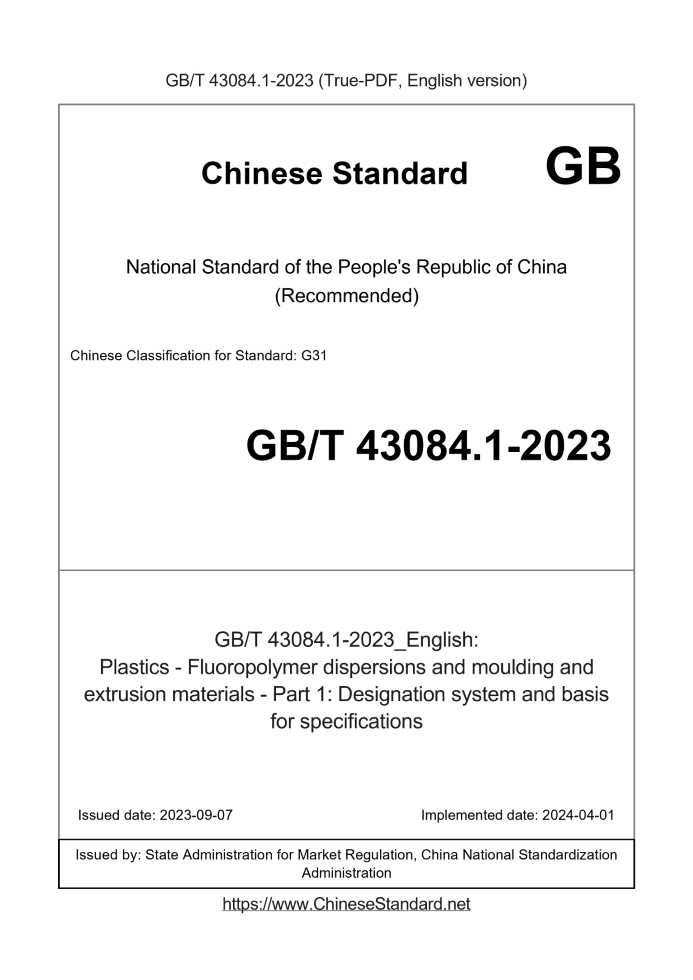
US$419.00 · In stock · Download in 9 secondsGB/T 43084.1-2023: Plastics - Fluoropolymer dispersions and moulding and extrusion materials - Part 1: Designation system and basis for specifications
Delivery: 9 seconds. True-PDF full-copy in English & invoice will be downloaded + auto-delivered via email. See
step-by-step procedureStatus: Valid
| Std ID | Version | USD | Buy | Deliver [PDF] in | Title (Description) |
| GB/T 43084.1-2023 | English | 419 |
Add to Cart
|
4 days [Need to translate]
|
Plastics - Fluoropolymer dispersions and moulding and extrusion materials - Part 1: Designation system and basis for specifications
|
Click to Preview a similar PDF
Basic data
| Standard ID | GB/T 43084.1-2023 (GB/T43084.1-2023) |
| Description (Translated English) | Plastics - Fluoropolymer dispersions and moulding and extrusion materials - Part 1: Designation system and basis for specifications |
| Sector / Industry | National Standard (Recommended) |
| Classification of Chinese Standard | G31 |
| Classification of International Standard | 83.080.20 |
| Word Count Estimation | 22,214 |
| Date of Issue | 2023-09-07 |
| Date of Implementation | 2024-04-01 |
| Issuing agency(ies) | State Administration for Market Regulation, China National Standardization Administration |
GB/T 43084.1-2023: Plastics - Fluoropolymer dispersions and moulding and extrusion materials - Part 1: Designation system and basis for specifications
---This is a DRAFT version for illustration, not a final translation. Full copy of true-PDF in English version (including equations, symbols, images, flow-chart, tables, and figures etc.) will be manually/carefully translated upon your order.
ICS 83.080.20
CCSG31
National Standards of People's Republic of China
Plastic fluoropolymer dispersions, molding and extrusion materials
Part 1.Nomenclature systems and classification basics
(ISO 20568-1.2017,MOD)
Published on 2023-09-07
2024-04-01 Implementation
State Administration for Market Regulation
Released by the National Standardization Administration Committee
Foreword
This document complies with the provisions of GB/T 1.1-2020 "Standardization Work Guidelines Part 1.Structure and Drafting Rules of Standardization Documents"
Drafting.
This document is Part 1 of GB/T 43084 "Plastic Fluoropolymer Dispersions, Molding and Extrusion Materials". GB/T 43084 has been issued.
The following parts have been published.
---Part 1.Nomenclature system and classification basics
---Part 2.Sample preparation and performance determination
This document is modified using ISO 20568-1.2017 "Plastic fluoropolymer dispersions, molding and extrusion materials - Part 1.Nomenclature
Fundamentals of Systems and Classification.
Compared with ISO 20568-1.2017, this document has made the following structural adjustments.
---Added 4.5.1;
---4.5.2 corresponds to 4.5.1 of ISO 20568-1.2017;
---4.5.2.1, 4.5.2.1.1 correspond to 4.5.1.1 of ISO 20568-1.2017;
---4.5.2.1.2~4.5.2.1.4 corresponds to 4.5.1.1.1~4.5.1.1.3 of ISO 20568-1.2017;
---4.5.2.2 corresponds to 4.5.1.2 of ISO 20568-1.2017;
---Added 4.5.2.2.1;
---4.5.2.2.2~4.5.2.2.4 corresponds to 4.5.1.2.1~4.5.1.2.3 of ISO 20568-1.2017;
---4.5.3 corresponds to 4.5.2 of ISO 20568-1.2017;
---4.5.3.1 corresponds to 4.5.2.1 of ISO 20568-1.2017;
---Added 4.5.3.1.1;
---4.5.3.1.2, 4.5.2.1.3 correspond to 4.5.2.1.1, 4.5.2.1.2 of ISO 20568-1.2017;
---4.5.3.2~4.5.3.4 corresponds to 4.5.2.2~4.5.2.4 of ISO 20568-1.2017;
---Added 4.5.3.4.1;
---4.5.3.4.2~4.5.3.4.4 corresponds to 4.5.2.4.1~4.5.2.4.3 of ISO 20568-1.2017.
The technical differences between this document and ISO 20568-1.2017 and their reasons are as follows.
---Replaced ISO 1043-1.2011 (see 4.2) with normatively cited GB/T 1844.1 to adapt to my country's technical conditions, adding
Increase operability;
---Replaced ISO 472.1999 (see Chapter 3) with normatively cited GB/T 2035 to adapt to my country's technical conditions, adding
Operability;
---Replaced ISO 20568-2.2017 (see 4.5.2, 4.5.3) with normatively quoted GB/T 43084.2 to adapt to my country's technology
technical conditions to increase operability;
---Replaced ISO 1133-1.2011 (see 4.5.3.1.3) with normatively quoted GB/T 3682.1 to adapt to my country's technical conditions
parts to increase operability;
---Replaced ISO 11357-2.1999 (see 4.5.3.3) with normatively quoted GB/T 19466.2 to adapt to my country's technology
technical conditions to increase operability;
---Replaced ISO 11357-3.1999 (see 4.5.3.1.2) with normatively quoted GB/T 19466.3 to adapt to my country's technology
conditions to increase operability;
---For naming examples, change the reference of the standard number in the example "ISO 20568-1" to "GB/T 43084" (see Chapter 5), instead of
The naming system of other national standards for plastic resins remains consistent.
Please note that some content in this document may be subject to patents. The publisher of this document assumes no responsibility for identifying patents.
This document is proposed by China Petroleum and Chemical Industry Federation.
This document is under the jurisdiction of the National Plastics Standardization Technical Committee (SAC/TC15).
This document was drafted by. Shanghai Huayi Sanaifu New Materials Co., Ltd., Shandong Dongyue Polymer Materials Co., Ltd., Zhonglan Chenguang Chemical Industry
Research and Design Institute Co., Ltd., Luxi Chemical Group Co., Ltd., Shenzhen Jundingda New Materials Co., Ltd., Ganzhou Lichang New Materials
Material Co., Ltd., Hebei Huami New Material Technology Co., Ltd., Zhejiang Quzhou Jusu Chemical Co., Ltd., Liaocheng Fluor New Material Technology
Co., Ltd., Guangdong Xinhuwei Industrial Investment Co., Ltd., Shandong Huaxia Shenzhou New Materials Co., Ltd., Liaocheng University, Jinhua Yonghe Fluorine Chemical Co., Ltd.
Co., Ltd., Zhejiang Funolin Chemical New Materials Co., Ltd., Zhejiang Juhua Co., Ltd. Fluoropolymer Plant, Fujian Haidefu New Materials Co., Ltd.,
Jiangmen Ruixiang Composite Materials Research Institute Co., Ltd., Qingdao Customs of the People's Republic of China.
The main drafters of this document. Su Qin, Wang Jun, Tang Yong, Bi Jingli, Feng Meng, Feng Xingwen, Li Zangwen, Zhang Heguang, Lin Jinyuan, Zhu Haoyan, Liang Jiajun,
Bi Congcong, Xing Yanping, Wang Minya, Song Lifeng, Shen Qing, Teng Mouyong, Zhang Lu, Sun Peifeng, Meng Qingwen, Chen Zhifeng, Wu Deshan, Gao Jianguo, Wang Lun,
Liu Zhanwei.
Introduction
Most of my country's existing standards related to fluoropolymer dispersions, molding and extrusion materials were released in.1997, and they are all product standards.
However, there is a lack of nomenclature system and basic classification standards for fluoropolymers. Some of the normative reference documents have been revised and changed. To contain
For the healthy development of the fluoropolymer industry, better promotion and application, and domestic and foreign trade and technical exchanges, there is an urgent need to integrate various existing standards among industry enterprises.
industry-implemented naming method, form standardized naming, unify product naming, and formulate fluoropolymer dispersions, molding and
National standard for nomenclature and classification of extrusion materials.
After studying the national and industry standards for plastic-fluoropolymer dispersions, molding and extrusion materials at home and abroad, a comparative analysis was conducted.
ISO 20568.2017, GB/T 43084 aims to standardize the naming, classification and performance determination of fluoropolymer dispersions, molding and extrusion materials
and sample preparation, which is intended to consist of two parts.
---Part 1.Nomenclature system and classification basics. The aim is to introduce a complete nomenclature system for fluoropolymers.
---Part 2.Sample preparation and performance determination. The purpose is to establish a standardized set of standard methods for test preparation and performance measurement.
The two parts complement each other to form a complete standard system of fluoropolymers.
The issuance and implementation of this document can standardize the sample preparation and performance measurement of fluoropolymer dispersions, molding and extrusion materials to meet customer needs.
requirements to better promote trade, exchanges and technical cooperation.
Plastic fluoropolymer dispersions, molding and extrusion materials
Part 1.Nomenclature systems and classification basics
1 Scope
This document establishes the naming rules and classification basis for fluoroplastics.
A systematic approach is used to classify and name different fluoropolymers, mainly based on the unique properties, uses, processing methods,
Main properties, additives, colorants, fillers, reinforced plastics and other information are classified.
Among them, polytetrafluoroethylene (PTFE) is classified into granular PTFE or dispersion-agglomerated PTFE resin for molding and extrusion based on the standard
Quasi relative density (SSG), bulk density, particle size.
The classification of PTFE dispersions is based on solid content, surfactant percentage, and surfactant tolerance level.
Meltable processable resins (CPT, ECTFE, EFEP, ETFE, FEP, PFA, PVDF, PVF, VDF/CTFE, VDF/
The classification of HFP, VDF/T FE, VDF/T FE/HFP) is based on melting temperature and melt mass flow rate.
The classification of PCTFE is based on zero intensity time (ZST).
The classification of TFE/PDD is based on glass transition temperature (Tg).
Melt processable resin dispersion (ETFE, FEP, PFA, PVDF, PVF, VDF/CTFE, DVF/HFP, VDF/T FE,
VDF/T FE/HFP) classification is based on solid content, surfactant content, and surfactant tolerance level.
This nomenclature applies to all fluoropolymers and their mixtures. Suitable for unmodified materials and modified materials, such as colorants, additives
Modified materials such as additives, fillers, reinforcing agents and polymer modifiers.
Materials with the same designation do not necessarily have the same properties. This document is not intended to describe specific uses and/or processing of materials.
Engineering data, performance data or processing condition data required for the method. If necessary, use the test method specified in GB/T 43084.2 to determine
these additional requirements.
2 Normative reference documents
The contents of the following documents constitute essential provisions of this document through normative references in the text. Among them, the dated quotations
For undated referenced documents, only the version corresponding to that date applies to this document; for undated referenced documents, the latest version (including all amendments) applies to
this document.
GB/T 1844.1 Plastic symbols and abbreviations Part 1.Basic polymers and their characteristic properties (GB/T 1844.1-
2022,ISO 1043-1.2011,MOD)
GB/T 2035 Plastic terms and definitions (GB/T 2035-2008, ISO 472.1999, IDT)
GB/T 3682.1 Determination of melt mass flow rate (MFR) and melt volume flow rate (MVR) of plastic thermoplastics
Part 1.Standard method (GB/T 3682.1-2018, ISO 1133-1.2011, MOD)
GB/T 19466.2 Differential Scanning Calorimetry (DSC) for Plastics Part 2.Determination of Glass Transition Temperature
(GB/T 19466.2-2004,ISO 11357-2.1999,IDT)
GB/T 19466.3 Differential Scanning Calorimetry (DSC) for Plastics Part 3.Determination of Melting and Crystallization Temperatures and Enthalpies
(GB/T 19466.3-2004,ISO 11357-3.1999,IDT)
GB/T 43084.2-2023 Plastic fluoropolymer dispersions, molding and extrusion materials Part 2.Sample preparation and properties
Determination (ISO 20568-2.2017, MOD)
...