GB/T 3836.18-2024 PDF English
Price & Delivery
US$725.00 · In stock · Download in 9 secondsGB/T 3836.18-2024: Explosive atmospheres - Part 18: Intrinsically safe electrical systems
Delivery: 9 seconds. True-PDF full-copy in English & invoice will be downloaded + auto-delivered via email. See step-by-step procedure
Status: Valid
GB/T 3836.18: Historical versions
| Standard ID | USD | BUY PDF | Delivery | Standard Title (Description) | Status |
| GB/T 3836.18-2024 | 725 | Add to Cart | Auto, 9 seconds. | Explosive atmospheres - Part 18: Intrinsically safe electrical systems | Valid |
| GB/T 3836.18-2017 | RFQ | ASK | 7 days | Explosive atmospheres -- Part 18: Intrinsically safe electrical systems | Obsolete |
| GB 3836.18-2010 | RFQ | ASK | 5 days | Explosive atmospheres -- Part 18: Intrinsically safe system | Obsolete |
Click to Preview this PDF
Similar standards
GB/T 3836.18-2024: Explosive atmospheres - Part 18: Intrinsically safe electrical systems
---This is an excerpt. Full copy of true-PDF in English version (including equations, symbols, images, flow-chart, tables, and figures etc.), auto-downloaded/delivered in 9 seconds, can be purchased online: https://www.ChineseStandard.net/PDF.aspx/GBT3836.18-2024GB NATIONAL STANDARD OF THE PEOPLE’S REPUBLIC OF CHINA ICS 29.260.20 CCS K 35 Replacing GB/T 3836.18-2017 Explosive atmospheres - Part 18: Intrinsically safe electrical systems (IEC 60079-25:2020, Explosive atmospheres - Part 25: Intrinsically safe electrical systems, MOD) ISSUED ON: MARCH 15, 2024 IMPLEMENTED ON: OCTOBER 01, 2024 Issued by: State Administration for Market Regulation; National Standardization Administration.
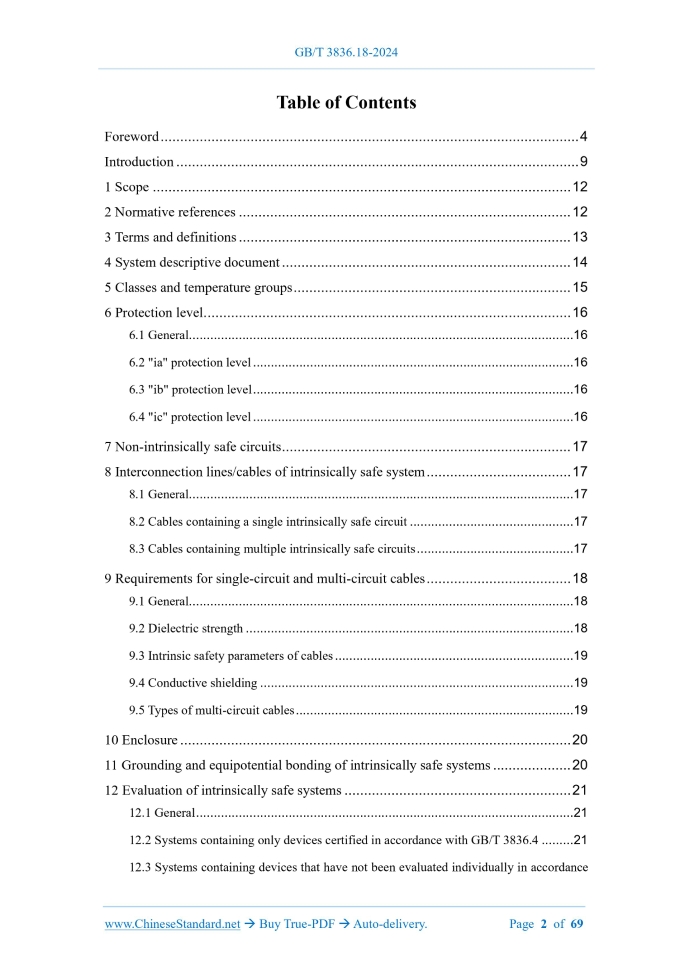
Table of Contents
Foreword ... 4 Introduction ... 9 1 Scope ... 12 2 Normative references ... 12 3 Terms and definitions ... 13 4 System descriptive document ... 14 5 Classes and temperature groups ... 15 6 Protection level ... 16 6.1 General... 16 6.2 "ia" protection level ... 16 6.3 "ib" protection level ... 16 6.4 "ic" protection level ... 16 7 Non-intrinsically safe circuits ... 17 8 Interconnection lines/cables of intrinsically safe system ... 17 8.1 General... 17 8.2 Cables containing a single intrinsically safe circuit ... 17 8.3 Cables containing multiple intrinsically safe circuits ... 17 9 Requirements for single-circuit and multi-circuit cables ... 18 9.1 General... 18 9.2 Dielectric strength ... 18 9.3 Intrinsic safety parameters of cables ... 19 9.4 Conductive shielding ... 19 9.5 Types of multi-circuit cables ... 19 10 Enclosure ... 20 11 Grounding and equipotential bonding of intrinsically safe systems ... 20 12 Evaluation of intrinsically safe systems ... 21 12.1 General ... 21 12.2 Systems containing only devices certified in accordance with GB/T 3836.4 ... 21 12.3 Systems containing devices that have not been evaluated individually in accordanceForeword
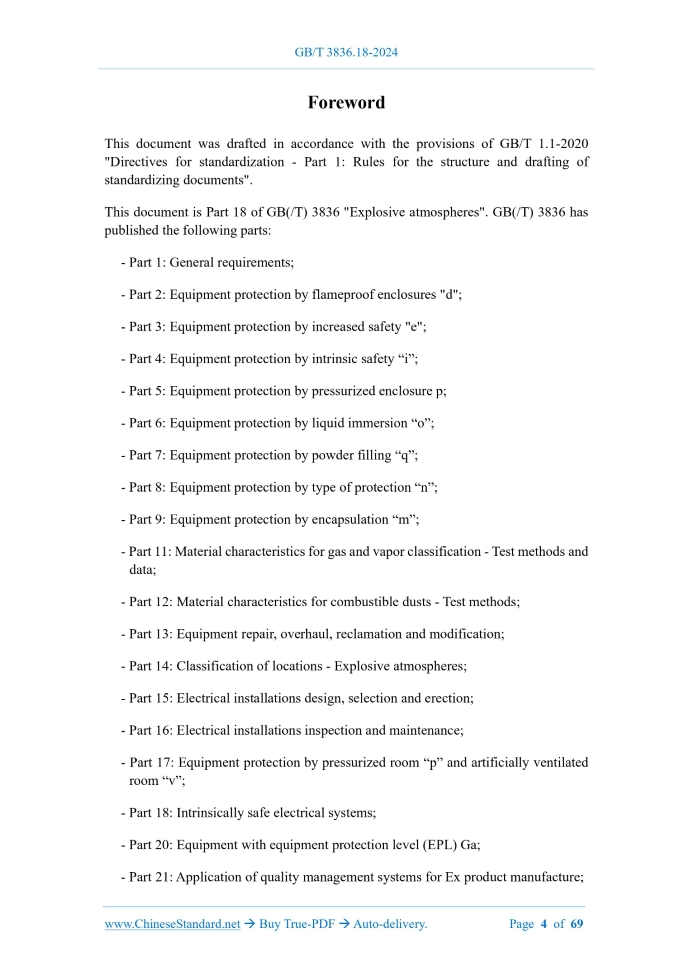
This document was drafted in accordance with the provisions of GB/T 1.1-2020 "Directives for standardization - Part 1: Rules for the structure and drafting of standardizing documents". This document is Part 18 of GB(/T) 3836 "Explosive atmospheres". GB(/T) 3836 has published the following parts: - Part 1: General requirements; - Part 2: Equipment protection by flameproof enclosures "d"; - Part 3: Equipment protection by increased safety "e"; - Part 4: Equipment protection by intrinsic safety “i”; - Part 5: Equipment protection by pressurized enclosure p; - Part 6: Equipment protection by liquid immersion “o”; - Part 7: Equipment protection by powder filling “q”; - Part 8: Equipment protection by type of protection “n”; - Part 9: Equipment protection by encapsulation “m”; - Part 11: Material characteristics for gas and vapor classification - Test methods and data; - Part 12: Material characteristics for combustible dusts - Test methods; - Part 13: Equipment repair, overhaul, reclamation and modification; - Part 14: Classification of locations - Explosive atmospheres; - Part 15: Electrical installations design, selection and erection; - Part 16: Electrical installations inspection and maintenance; - Part 17: Equipment protection by pressurized room “p” and artificially ventilated room “v”; - Part 18: Intrinsically safe electrical systems; - Part 20: Equipment with equipment protection level (EPL) Ga; - Part 21: Application of quality management systems for Ex product manufacture; - Part 22: Protection of equipment and transmission system using optical radiation; - Part 23: Group I, category EPL Ma equipment intended to remain functional in atmospheres endangered by firedamp and/or coal dust; - Part 24: Equipment protection by special protection “s”; - Part 25: Requirements for process sealing between flammable process fluids and electrical systems; - Part 26: Electrostatic hazards - Guidance; - Part 27: Electrostatic hazards - Test; - Part 28: Non-electrical equipment for explosive atmospheres - Basic method and requirements; - Part 29: Non-electrical equipment for explosive atmospheres - Constructional safety “c”, control of ignition source “b”, liquid immersion “k”; - Part 30: Equipment and components in explosive atmospheres in underground mines; - Part 31: Equipment dust ignition protection by enclosure “t”; - Part 32: Intrinsically safe systems with electronically controlled spark duration limitation; - Part 33: Equipment in adverse service conditions; - Part 34: Equipment assemblies; - Part 35: Classification of areas for explosive dust atmospheres; - Part 36: Electrical safety devices for the control of potential ignition sources from Ex Equipment. This document replaces GB/T 3836.18-2017 "Explosive atmospheres - Part 18: Intrinsically safe electrical systems". Compared with GB/T 3836.18-2017, in addition to structural adjustments and editorial changes, the main technical changes are as follows: - CHANGE the content of the system description file (see Chapter 4; Chapter 4 of the 2017 edition); - CHANGE the requirements for categories and temperature groups, including the original Chapter 7 ambient temperature ratings (see Chapter 5; Chapters 5 and 7 of the 2017 edition); Explosive atmospheres - Part 18: Intrinsically safe electrical systems1 Scope
This document specifies special requirements for the design, structure, and assessment of intrinsically safe systems (explosion-proof type "i"). This document applies to intrinsically safe systems that are intended to be used in whole or in part in places where Class I, Class II or Class III Ex equipment is required. Note 1: This document is used for the design and assessment of intrinsically safe systems; its personnel may be the manufacturer, third-party organization, expert consultant or end-user staff. This document supplements and modifies the general requirements of GB/T 3836.1 and the intrinsic safety type of GB/T 3836.4. When the requirements of this document conflict with the requirements of GB/T 3836.1 or GB/T 3836.4, the requirements of this document take precedence. The installation requirements of Class II or Class III intrinsically safe systems, which are designed in accordance with this document, are specified in GB/T 3836.15. Note 2: GB/T 3836.15 currently does not specify the installation requirements for Class I; the installation requirements for Class I are under consideration.2 Normative references
The contents of the following documents constitute essential clauses of this document through normative references in the text. Among them, for dated references, only the version corresponding to that date applies to this document; for undated references, the latest version (including all amendments) applies to this document. GB/T 3836.1 Explosive atmospheres - Part 1: Equipment - General requirements (GB/T 3836.1-2021, IEC 60079-0:2017, MOD) GB/T 3836.4 Explosive atmospheres - Part 4: Equipment protection by intrinsic safety "i" (GB/T 3836.4-2021, IEC 60079-11:2011, MOD) GB/T 3836.15 Explosive atmospheres - Part 15: Electrical installations design, selection and erection (GB/T 3836.15-2017, IEC 60079-14:2007, MOD) GB/T 16657.2 Industrial communication networks - Fieldbus specifications - Part 2: connection to the combined power source: - Maximum external capacitance Co; and - Maximum external inductance Lo; or - Maximum inductance to resistance ratio L/R of the connecting cable. Any test-based verification shall be performed using a spark test device in accordance with GB/T 3836.4, taking into account the safety factor of the combined device. The Ui, Ii, Pi of each device in the system shall be greater than or equal to the Uo, Io, Po determined above, respectively. Note 2: Appendix E illustrates the analysis used in the most common combination of linear resistor-limited output power sources. Alternatively, GB/T 3836.15 provides a simplified analysis for Class II circuits with protection level "ib" where the power source is an associated device. The analysis may also include a spark ignition test in accordance with GB/T 3836.4. 12.5.2 Systems containing linear and non-linear power sources The assessment of a system containing multiple power sources, one or more of which are non-linear, shall be performed by a person with appropriate competence and knowledge in the design and safety of non-linear intrinsically safe power sources. This assessment cannot be based solely on open circuit voltage and short circuit current. Any special conditions related to the system shall be clearly stated in the system descriptive document. If the intrinsically safe system contains multiple power sources, one or more of which are non-linear, the assessment method described in Appendix E does not apply. Appendix F describes how to perform a system analysis for a combination containing a single non-linear power source. Figure 1 illustrates the principle of system analysis. If the power sources have different output voltages, any additional losses in the regulating circuit need to be considered. For non-linear sources, the combined Lo/Ro may be determined by testing the circuit using the spark ignition test in GB/T 3836.4 with several discrete values of Lo and Ro, using values of Ro ranging from nearly short circuit (maximum Io) to nearly open circuit (Io near zero), and establishing a trend that ensures that Lo/Ro passes the spark ignition test. Note 1: Appendix F provides further guidance, including an assessment method that does not require spark ignition testing for systems with no more than one non-linear source. ......Source: Above contents are excerpted from the full-copy PDF -- translated/reviewed by: www.ChineseStandard.net / Wayne Zheng et al.