GB/T 2910.1-2009 PDF English
Price & Delivery
US$85.00 · In stock · Download in 9 secondsGB/T 2910.1-2009: Textiles -- Quantitative chemical analysis -- Part 1: General principles of testing
Delivery: 9 seconds. True-PDF full-copy in English & invoice will be downloaded + auto-delivered via email. See step-by-step procedure
Status: Valid
GB/T 2910.1: Historical versions
| Standard ID | USD | BUY PDF | Delivery | Standard Title (Description) | Status |
| GB/T 2910.1-2009 | 85 | Add to Cart | Auto, 9 seconds. | Textiles -- Quantitative chemical analysis -- Part 1: General principles of testing | Valid |
| GB/T 2910-1997 | 839 | Add to Cart | 6 days | Textile--Binary fibre mixtures--Quantitative chemical analysis | Obsolete |
| GB/T 2910-1982 | RFQ | ASK | 3 days | Method of quantitative chemical analysis of binary fibre mixture | Obsolete |
Click to Preview this PDF
Similar standards
GB/T 2910.1-2009: Textiles -- Quantitative chemical analysis -- Part 1: General principles of testing
---This is an excerpt. Full copy of true-PDF in English version (including equations, symbols, images, flow-chart, tables, and figures etc.), auto-downloaded/delivered in 9 seconds, can be purchased online: https://www.ChineseStandard.net/PDF.aspx/GBT2910.1-2009
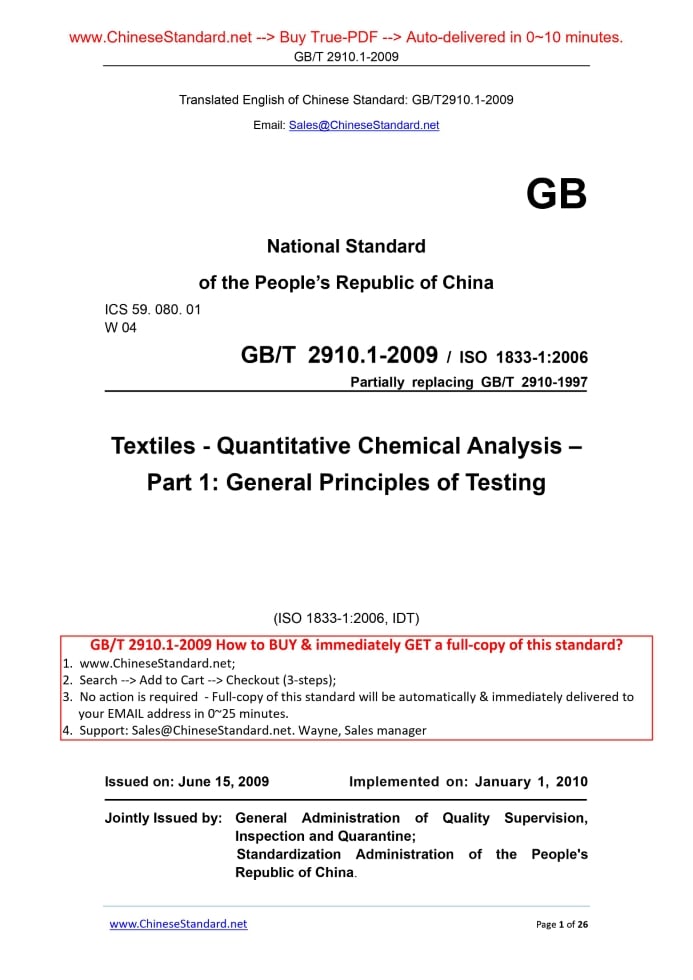
GB National Standard of the People’s Republic of China ICS 59.080.01 W 04 GB/T 2910.1-2009 / ISO 1833-1.2006 Partially replacing GB/T 2910-1997 Textiles - Quantitative Chemical Analysis – Part 1.General Principles of Testing (ISO 1833-1.2006, IDT) Issued on. JUNE 15, 2009 Implemented on. JANUARY 1, 2010 Jointly Issued by. General Administration of Quality Supervision, Inspection and Quarantine; Standardization Administration of the People's Republic of China.
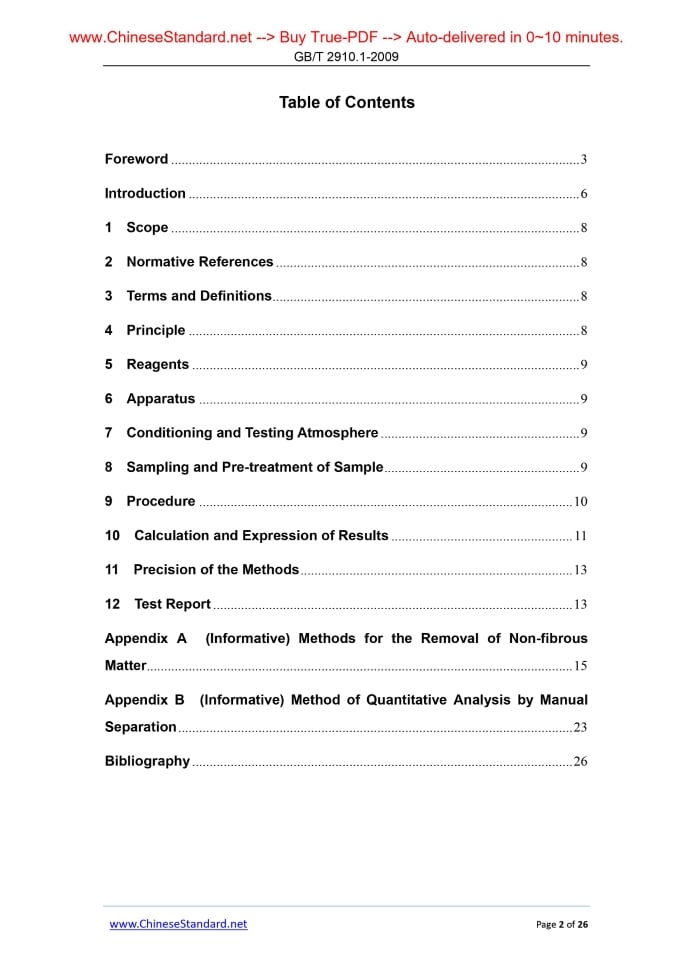
Table of Contents
Foreword... 3 Introduction... 6 1 Scope... 8 2 Normative References... 8 3 Terms and Definitions... 8 4 Principle... 8 5 Reagents... 9 6 Apparatus... 9 7 Conditioning and Testing Atmosphere... 9 8 Sampling and Pre-treatment of Sample... 9 9 Procedure... 10 10 Calculation and Expression of Results... 11 11 Precision of the Methods... 13 12 Test Report... 13 Appendix A (Informative) Methods for the Removal of Non-fibrous Matter... 15 Appendix B (Informative) Method of Quantitative Analysis by Manual Separation... 23 Bibliography... 26Foreword
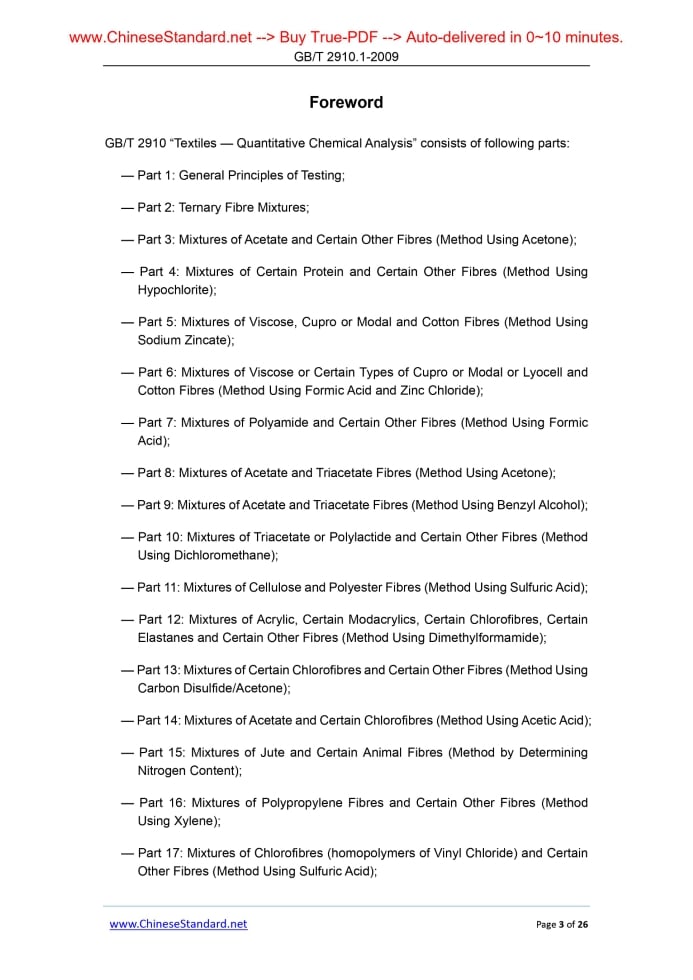
GB/T 2910 “Textiles — Quantitative Chemical Analysis” consists of following parts. — Part 1.General Principles of Testing; — Part 2.Ternary Fibre Mixtures; — Part 3.Mixtures of Acetate and Certain Other Fibres (Method Using Acetone); — Part 4.Mixtures of Certain Protein and Certain Other Fibres (Method Using Hypochlorite); — Part 5.Mixtures of Viscose, Cupro or Modal and Cotton Fibres (Method Using Sodium Zincate); — Part 6.Mixtures of Viscose or Certain Types of Cupro or Modal or Lyocell and Cotton Fibres (Method Using Formic Acid and Zinc Chloride); — Part 7.Mixtures of Polyamide and Certain Other Fibres (Method Using Formic Acid); — Part 8.Mixtures of Acetate and Triacetate Fibres (Method Using Acetone); — Part 9.Mixtures of Acetate and Triacetate Fibres (Method Using Benzyl Alcohol); — Part 10.Mixtures of Triacetate or Polylactide and Certain Other Fibres (Method Using Dichloromethane); — Part 11.Mixtures of Cellulose and Polyester Fibres (Method Using Sulfuric Acid); — Part 12.Mixtures of Acrylic, Certain Modacrylics, Certain Chlorofibres, Certain Elastanes and Certain Other Fibres (Method Using Dimethylformamide); — Part 13.Mixtures of Certain Chlorofibres and Certain Other Fibres (Method Using Carbon Disulfide/Acetone); — Part 14.Mixtures of Acetate and Certain Chlorofibres (Method Using Acetic Acid); — Part 15.Mixtures of Jute and Certain Animal Fibres (Method by Determining Nitrogen Content); — Part 16.Mixtures of Polypropylene Fibres and Certain Other Fibres (Method Using Xylene); — Part 17.Mixtures of Chlorofibres (homopolymers of Vinyl Chloride) and Certain Other Fibres (Method Using Sulfuric Acid); — Part 18.Mixtures of Silk and Wool or Hair (Method Using Sulfuric Acid); — Part 19.Mixtures of Cellulose Fibres and Asbestos (Method by Heating); — Part 20.Mixtures of Elastane and Certain Other Fibres (Method Using Dimethylacetamide); — Part 21.Mixtures of Chlorofibres, Certain Modacrylics, Certain Elastanes, Acetates, Triacetates and Certain Other Fibres (Method Using Cyclohexanone); — Part 22.Mixtures of Viscose or Certain Types of Cupro or Modal or Lyocell and Flax Fibres (Method Using Formic Acid and Zinc Chlorate); — Part 23.Mixtures of Polyethylene and Polypropylene (Method Using Cyclohexanone) — Part 24.Mixtures of Polyester and Some Other Fibres (Method Using Phenol and Tetrachloroethane); — Part 101.Mixtures of Soybean Protein Composite Fibre and Certain Other Fibers. This Part is Part 1 of GB/T 2910. GB/T 2910-1997 is replaed by following standards. GB/T 2910.1, GB/T 2910.3, GB/T 2910.4, GB/T 2910.6, GB/T 2910.7, GB/T 2910.8, GB/T 2910.9, GB/T 2910.10, GB/T 2910.11, GB/T 2910.12, GB/T 2910.13, GB/T 2910.14, GB/T 2910.15, GB/T 2910.16, GB/T 2910.17, GB/T 2910.18, GB/T 2910.19, and GB/T 2910.22. This Part is identical to ISO 1833-1.2006 "Textiles — Quantitative Chemical Analysis - Part 1.General Principles of Testing". Compared with ISO 1833-1.2006, this Part has the following editorial changes. — The international standards in "Normative References" were replaced by the corresponding Chinese standards; — Foreword of the international standard was deleted. This Part replaces Chapter 4 of GB/T 2910-1997 "Textile — Binary Fibre Mixtures — Quantitative Chemical Analysis". The main differences between this Part and Chapter 4 of GB/T 2910-1997 are as follows. — The term and definition of "non-fibrous matter" was added (see Chapter 3); — "Conditioning and Testing Atmosphere" was added (see Chapter 7); — The chapter of "Test Results" was cancelled, which is incorporated into Introduction; — Original Appendix A "Tables for the Convention Moisture Regains of Textiles" was deleted; and Appendix A "Methods for the Removal of Non-fibrous Matter" was added; — Appendix B was added. Appendix A and Appendix B of this Part are informative. This Part was proposed by China National Textile and Apparel Council. This Part shall under the jurisdiction of Subcommittee 1 on Basic Standard of National Technical Committee 209 on Textiles of Standardization Administration of China (SAC/TC 209/SC 6). Chief drafting organizations of this Part. China National Textiles Quality Supervision Testing Center, and Standardization Research Institute of Textile Industry. Chief drafting staff of this Part. Yan Chunhong. Historical editions of GB/T 2910 are as follows. — GB/T 2910-1982; — GB/T 2910-1997.1 Scope
This Part of GB/T 2910 specifies a common method for the quantitative chemical analysis of various binary mixtures of fibres.2 Normative References
The following normative documents contain provisions which, through reference in this text, constitute provisions of this Part of GB/T 2910.For dated references, subsequent amendments or revisions of these publications do not apply.3 Terms and Definitions
For the purposes of this Part of GB/T 2910, the following terms and definitions apply. Processing aids such as lubricants and sizes (but excluding jute-batching oils), and naturally occurring non-fibrous substances.4 Principle
After the identification of the components of a mixture, one component is removed, usually by selective solution, the insoluble residue is weighed, and the proportions of soluble component are calculated from the loss in mass.5 Reagents
Use only reagents of recognized analytical grade.6 Apparatus
The crucible shall be provided with either a ground glass stopper or a watch-glass cover. Soxhlet extraction apparatus, of sufficient size to give a volume, in milliliters, equal to 20 times the mass, in grams, of the specimen, or any other apparatus giving identical results.7 Conditioning and Testing Atmosphere
Because dry masses are determined, it is unnecessary to condition the specimen. The analysis is carried out under ordinary room conditions.8 Sampling and Pre-treatment of Sample
Extract the air-dry sample in a Soxhlet apparatus with light petroleum for 1 h at a minimum rate of six cycles per hour. Allow the light petroleum to evaporate from the sample. Soak the specimen in cold water for 1 h, and then in water at (65 ± 5)°C for a further 1 h.9 Procedure
Conduct all drying operations for not less than 4 h and not more than 16 h at (105 ± 3)°C in a ventilated oven with the oven door closed throughout. Note. The specimen should be dried until constant mass is achieved. Conduct all cooling operations until complete cooling is attained, and in any case for not less than 2 h with the desiccator beside the balance.10 Calculation and Expression of Results
Express the mass of the insoluble component as a percentage of the total mass of fibre in the mixture. ......Source: Above contents are excerpted from the full-copy PDF -- translated/reviewed by: www.ChineseStandard.net / Wayne Zheng et al.