GB/T 2523-2022 PDF English
Price & Delivery
US$260.00 · In stock · Download in 9 secondsGB/T 2523-2022: Measuring method of surface roughness, peak count and waviness for cold-rolled metal sheet and strip
Delivery: 9 seconds. True-PDF full-copy in English & invoice will be downloaded + auto-delivered via email. See step-by-step procedure
Status: Valid
GB/T 2523: Historical versions
| Standard ID | USD | BUY PDF | Delivery | Standard Title (Description) | Status |
| GB/T 2523-2022 | 260 | Add to Cart | Auto, 9 seconds. | Measuring method of surface roughness, peak count and waviness for cold-rolled metal sheet and strip | Valid |
| GB/T 2523-2008 | 165 | Add to Cart | Auto, 9 seconds. | Measuring method of surface roughness and peak count for cold-rolled metal sheet (strip) | Obsolete |
| GB/T 2523-1990 | 359 | Add to Cart | 3 days | Cold rolled sheet (strip)--Measuring method for surface roughness | Obsolete |
Click to Preview this PDF
GB/T 2523-2022: Measuring method of surface roughness, peak count and waviness for cold-rolled metal sheet and strip
---This is an excerpt. Full copy of true-PDF in English version (including equations, symbols, images, flow-chart, tables, and figures etc.), auto-downloaded/delivered in 9 seconds, can be purchased online: https://www.ChineseStandard.net/PDF.aspx/GBT2523-2022
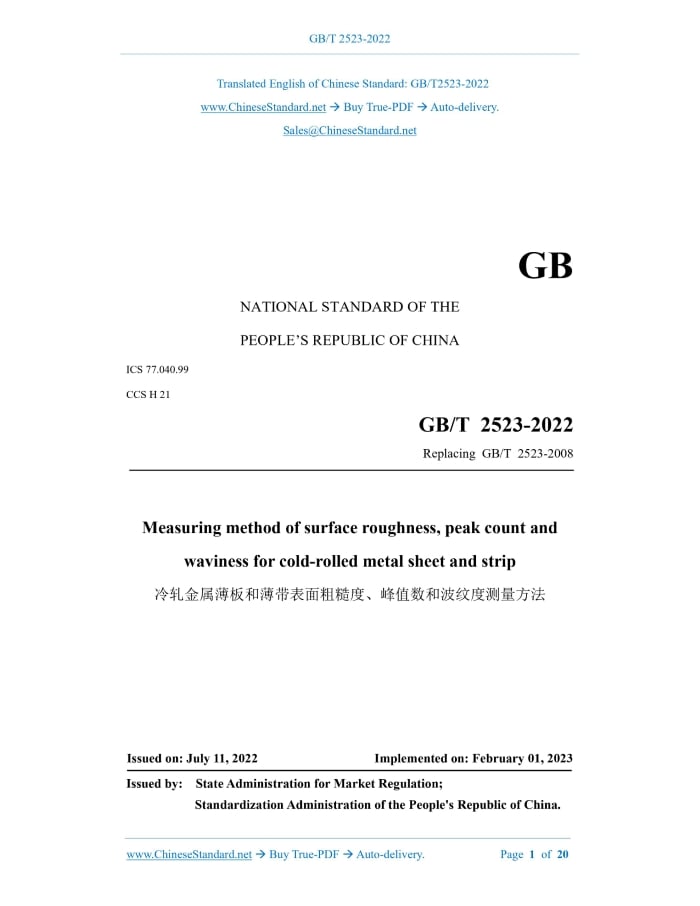
GB NATIONAL STANDARD OF THE PEOPLE’S REPUBLIC OF CHINA ICS 77.040.99 CCS H 21 Replacing GB/T 2523-2008 Measuring method of surface roughness, peak count and waviness for cold-rolled metal sheet and strip Issued on. JULY 11, 2022 Implemented on. FEBRUARY 01, 2023 Issued by. State Administration for Market Regulation; Standardization Administration of the People's Republic of China.
Table of Contents
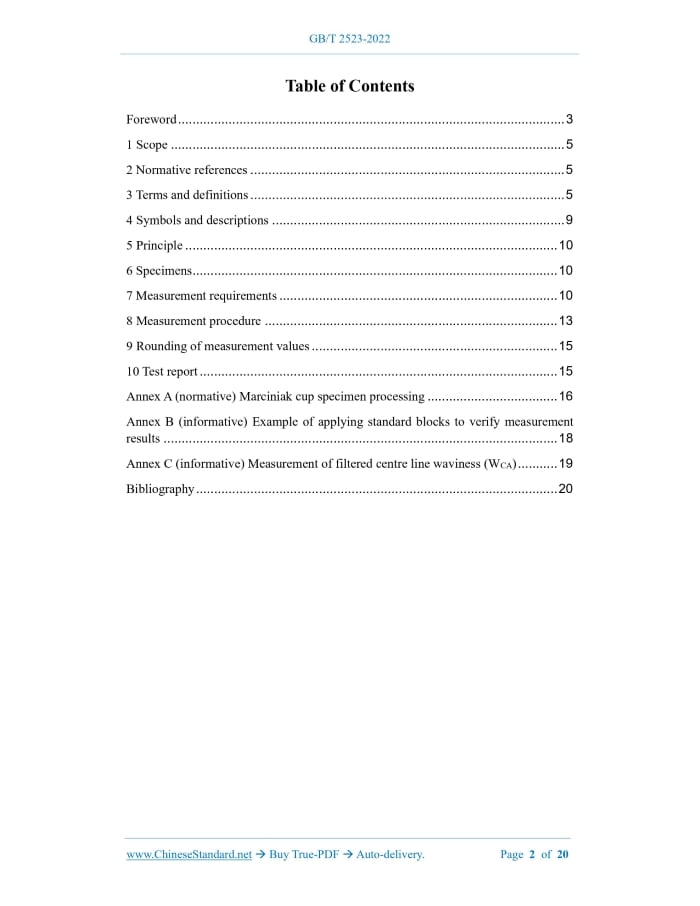
Foreword... 3 1 Scope... 5 2 Normative references... 5 3 Terms and definitions... 5 4 Symbols and descriptions... 9 5 Principle... 10 6 Specimens... 10 7 Measurement requirements... 10 8 Measurement procedure... 13 9 Rounding of measurement values... 15 10 Test report... 15 Annex A (normative) Marciniak cup specimen processing... 16 Annex B (informative) Example of applying standard blocks to verify measurement results... 18 Annex C (informative) Measurement of filtered centre line waviness (WCA)... 19 Bibliography... 201 Scope
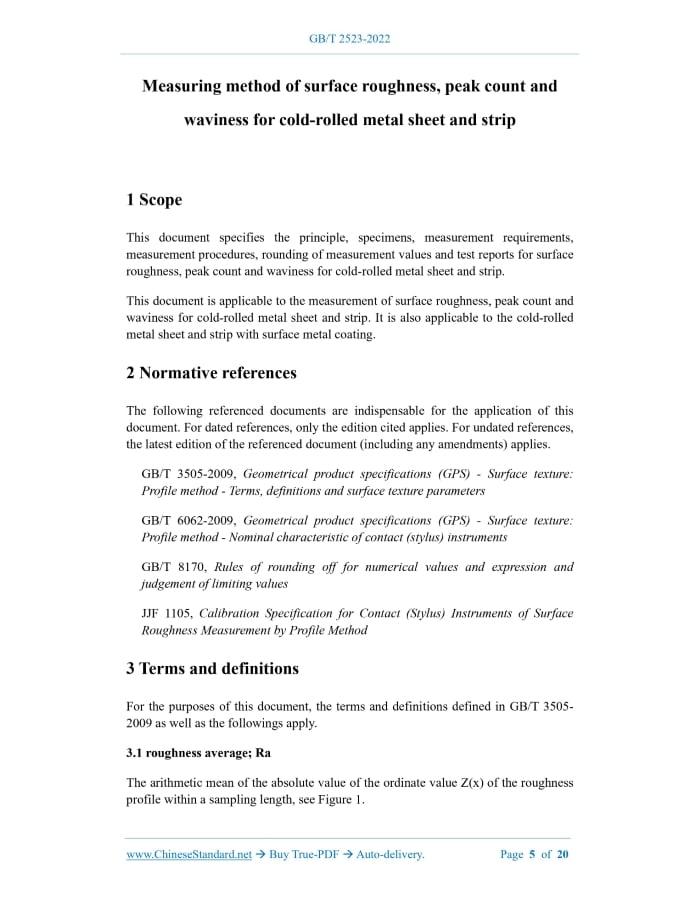
This document specifies the principle, specimens, measurement requirements, measurement procedures, rounding of measurement values and test reports for surface roughness, peak count and waviness for cold-rolled metal sheet and strip. This document is applicable to the measurement of surface roughness, peak count and waviness for cold-rolled metal sheet and strip. It is also applicable to the cold-rolled metal sheet and strip with surface metal coating.2 Normative references
The following referenced documents are indispensable for the application of this document. For dated references, only the edition cited applies. For undated references, the latest edition of the referenced document (including any amendments) applies. GB/T 3505-2009, Geometrical product specifications (GPS) - Surface texture. Profile method - Terms, definitions and surface texture parameters GB/T 6062-2009, Geometrical product specifications (GPS) - Surface texture. Profile method - Nominal characteristic of contact (stylus) instruments GB/T 8170, Rules of rounding off for numerical values and expression and judgement of limiting values JJF 1105, Calibration Specification for Contact (Stylus) Instruments of Surface Roughness Measurement by Profile Method3 Terms and definitions
For the purposes of this document, the terms and definitions defined in GB/T 3505- 2009 as well as the followings apply. 3.1 roughness average; Ra The arithmetic mean of the absolute value of the ordinate value Z(x) of the roughness profile within a sampling length, see Figure 1. 3.3 peak count level The vertical distance between the upper and lower boundary lines equidistant from the profile midline. 3.4 peak In the profile, a pair of adjacent peaks and valleys beyond the peak count level boundary line. 3.5 peak count; RPc (or PPI) In the profile, the number of peaks per unit length.4 Symbols and descriptions
The symbols and corresponding descriptions used in this document are shown in Table 1.5 Principle
Place a diamond stylus with a certain angle and tip radius vertically on the surface of the specimen with the specified contact force. Move in a straight line at a specified rate. The stylus moves vertically with the profile of the specimen surface.6 Specimens
6.1 The sampling location shall be in accordance with the relevant product standards or agreements. 6.2 For Ra, Rz, Rz1 max, RPc (or PPI), Wa and specimens that do not need to be punched into Marciniak cups to measure Wa0.8 and Wsa1-5, it is recommended to use a square (or circle) with a side length (or diameter) of 100mm. 6.3 When punching into Marciniak cups to measure Wa0.8 and Wsa1-5, the side length of the sample blank shall be at least 220mm×220mm. 6.4 Sample blanks and specimens shall be flat, free from scratches. The surface of the specimen shall be free from rust spots, stains and other surface defects. 6.5 Scrub the measurement area of the specimen with acetone or alcohol before measurement. Immediately measure.7 Measurement requirements
7.1 Instruments 7.1.1 The roughness instrument shall be calibrated in accordance with the requirements of JJF 1105. 7.1.4 See Table 3 for information on the tip radius (rtip) and tolerances of the stylus. The maximum measuring force of the stylus shall not exceed the value shown in Table 3. 7.1.5 When measuring Ra, Rz, Rz1 max and RPc (or PPI), if not otherwise specified, the stylus with a nominal tip angle of 60° shall be used. 7.1.6 When measuring Wa, Wa0.8 and Wsa1-5, it is recommended to use a stylus with a nominal tip angle of 90° and a radius (rtip) of 5μm. Other styluses with smaller tip angles and radiuses (rtip) may also be used. 7.2 Measurement conditions 7.2.1 Filtering Filtering selection is based on the following. 7.2.2 Roughness and peak count 7.2.3 Waviness The cut-off wavelength, sampling length, assessment length and travel length for measuring the waviness of cold-rolled metal sheet and strip shall comply with the technical characteristic values given in Table 7. 7.2.4 Stylus movement rate During measurement, the movement rate of the stylus shall not be greater than 1mm·s- 1.8 Measurement procedure
8.1 The measurement shall be carried out at a temperature of (20 ± 10)°C, otherwise it shall be noted in the test report. 8.2 The instrument shall be checked with a standard block before measurement. The relative error of the Ra measurement value shall not exceed ±5%. 8.3 The measuring table shall be stable. Measurements shall be carried out in a dry, vibration-free and non-corrosive atmosphere. 8.4 When measuring Ra, Rz, Rz1 max, RPc (or PPI), place the specimen flat on the measuring table. The measuring surface and the stylus travel direction shall be in accordance with the relevant product standards or agreements. 8.6 See Annex C for the measurement of filtered centre line waviness (WCA).9 Rounding of measurement values
The value of the measurement result shall be rounded up in accordance with the provisions of the relevant product standard or agreement. If not specified, the rounding shall be carried out according to the following requirements. The method of rounding is in accordance with GB/T 8170.10 Test report
If applicable, the test report shall include at least the following.Annex A
(normative) Marciniak cup specimen processing A.1 Specimen processing equipment Use sheet forming test equipment. A schematic cross-sectional view of the Marciniak die and test specimen is shown in Figure A.1. A.2 Specimen processing Place a sample blank with a side length of at least 220mm×220mm on the sheet forming test equipment.Annex B
(informative) Example of applying standard blocks to verify measurement results B.1 This appendix gives examples of verifying Ra and RPc (or PPI) measurements. B.2 About the Ra standard block used in this example, its surface has a triangular wave profile. The waveform angle is 150°. ......Source: Above contents are excerpted from the full-copy PDF -- translated/reviewed by: www.ChineseStandard.net / Wayne Zheng et al.