GB/T 223.68-1997 PDF English
Price & Delivery
US$70.00 · In stock · Download in 9 secondsGB/T 223.68-1997: Methods for chemical analysis of iron, steel and alloy - The potassium iodate titration method after combustion in the pipe furnace for the determination of sulfur content
Delivery: 9 seconds. True-PDF full-copy in English & invoice will be downloaded + auto-delivered via email. See step-by-step procedure
GB/T 223.68: Historical versions
| Standard ID | USD | BUY PDF | Delivery | Standard Title (Description) | Status |
| GB/T 223.68-1997 | 70 | Add to Cart | Auto, 9 seconds. | Methods for chemical analysis of iron, steel and alloy - The potassium iodate titration method after combustion in the pipe furnace for the determination of sulfur content | |
| GB/T 223.68-1989 | RFQ | ASK | 3 days | Methods for chemical analysis of iron, steel and alloy--The combustion potassium iodate volumetric method for the determination of sulfur content | Obsolete |
Click to Preview this PDF
Similar standards
GB/T 223.68-1997: Methods for chemical analysis of iron, steel and alloy - The potassium iodate titration method after combustion in the pipe furnace for the determination of sulfur content
---This is an excerpt. Full copy of true-PDF in English version (including equations, symbols, images, flow-chart, tables, and figures etc.), auto-downloaded/delivered in 9 seconds, can be purchased online: https://www.ChineseStandard.net/PDF.aspx/GBT223.68-1997
GB NATIONAL STANDARD OF THE PEOPLE’S REPUBLIC OF CHINA ICS 77.080 H 11 Replacing GB/T 223.68-1997 Methods for Chemical Analysis of Iron, Steel and Alloy The Potassium Iodate Titration Method after Combustion in the Pipe Furnace for the Determination of Sulfur Content Issued on: MARCH 17, 1997 Implemented on: SEPTEMBER 1, 1997 Issued by. State Bureau of Technical Supervision of the People’s Republic of China
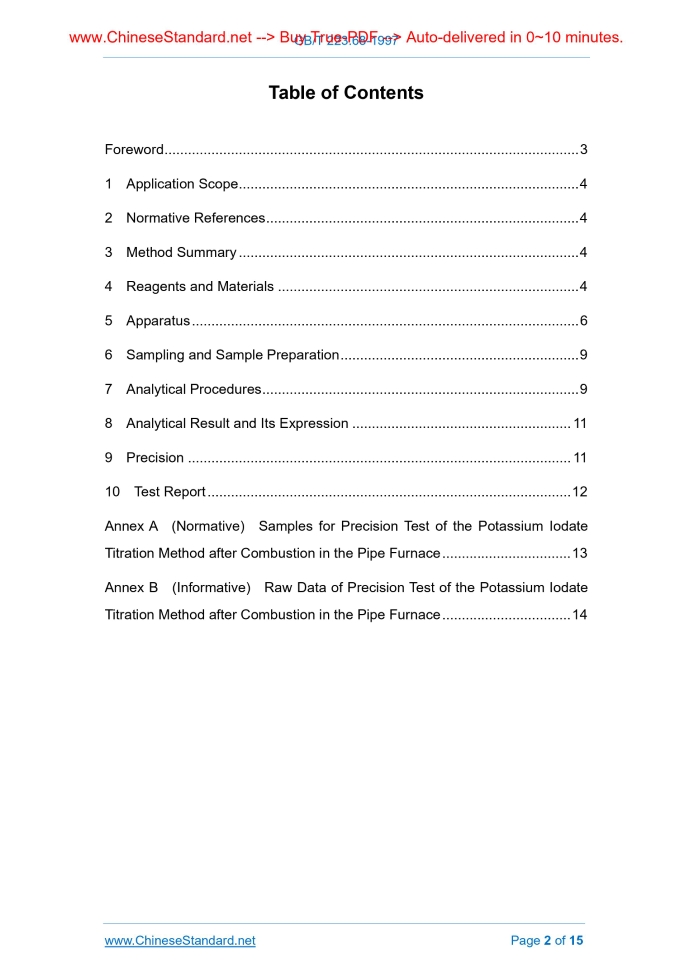
Table of Contents
Foreword ... 3 1 Application Scope ... 4 2 Normative References ... 4 3 Method Summary ... 4 4 Reagents and Materials ... 4 5 Apparatus ... 6 6 Sampling and Sample Preparation ... 9 7 Analytical Procedures ... 9 8 Analytical Result and Its Expression ... 11 9 Precision ... 11 10 Test Report ... 12 Annex A (Normative) Samples for Precision Test of the Potassium Iodate Titration Method after Combustion in the Pipe Furnace ... 13 Annex B (Informative) Raw Data of Precision Test of the Potassium Iodate Titration Method after Combustion in the Pipe Furnace ... 14Foreword
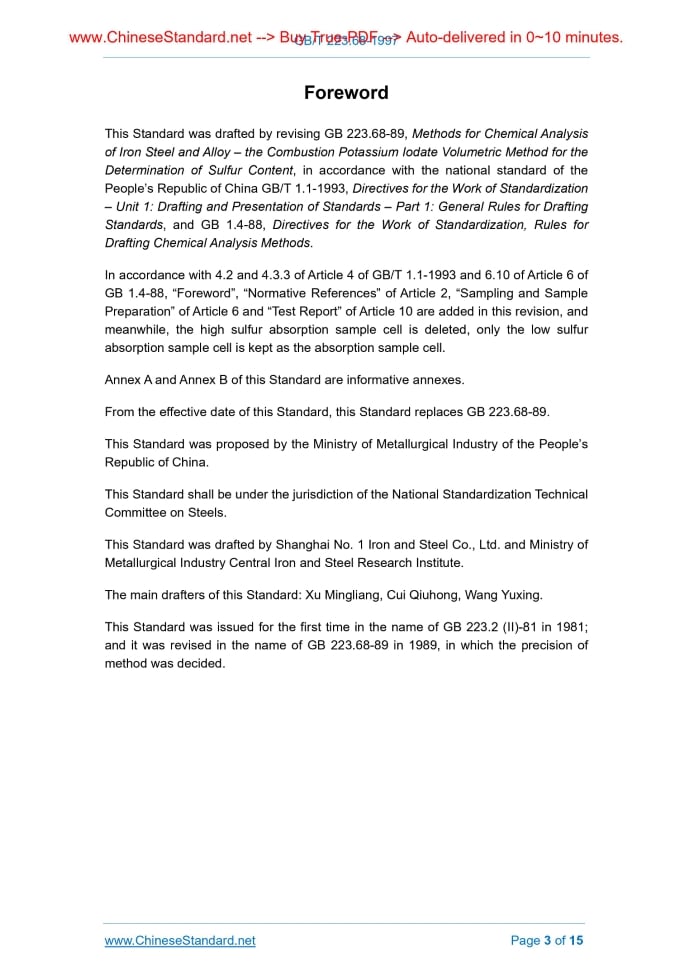
This Standard was drafted by revising GB 223.68-89, Methods for Chemical Analysis of Iron Steel and Alloy – the Combustion Potassium Iodate Volumetric Method for the Determination of Sulfur Content, in accordance with the national standard of the People’s Republic of China GB/T 1.1-1993, Directives for the Work of Standardization – Unit 1. Drafting and Presentation of Standards – Part 1. General Rules for Drafting Standards, and GB 1.4-88, Directives for the Work of Standardization, Rules for Drafting Chemical Analysis Methods. In accordance with 4.2 and 4.3.3 of Article 4 of GB/T 1.1-1993 and 6.10 of Article 6 of GB 1.4-88, “Foreword”, “Normative References” of Article 2, “Sampling and Sample Preparation” of Article 6 and “Test Report” of Article 10 are added in this revision, and meanwhile, the high sulfur absorption sample cell is deleted, only the low sulfur absorption sample cell is kept as the absorption sample cell. Annex A and Annex B of this Standard are informative annexes. From the effective date of this Standard, this Standard replaces GB 223.68-89. This Standard was proposed by the Ministry of Metallurgical Industry of the People’s Republic of China. This Standard shall be under the jurisdiction of the National Standardization Technical Committee on Steels. This Standard was drafted by Shanghai No. 1 Iron and Steel Co., Ltd. and Ministry of Metallurgical Industry Central Iron and Steel Research Institute. The main drafters of this Standard. Xu Mingliang, Cui Qiuhong, Wang Yuxing. This Standard was issued for the first time in the name of GB 223.2 (II)-81 in 1981; and it was revised in the name of GB 223.68-89 in 1989, in which the precision of method was decided. Methods for Chemical Analysis of Iron, Steel and Alloy The Potassium Iodate Titration Method after Combustion in the Pipe Furnace for the Determination of Sulfur Content1 Application Scope
This Standard specifies the potassium iodate titration method after combustion in the pipe furnace for the determination of sulfur content. This Standard applies to the determination of sulfur content of 0.003 0% (m/m) ~ 0.20% (m/m) in iron, steel, high temperature alloy and precision alloy.2 Normative References
The provisions in following documents become the provisions of this Standard through reference in this Standard. All editions shown are effective when this Standard is issued. All standards will be revised, however, parties who reach an agreement based on this Standard are encouraged to study if the latest versions of the following standards are applicable. GB 222-84, Method of Sampling Steel for Determination of Chemical Composition and Permissible Variations for Product Analysis GB 6379-86, Precision of Test Methods – Determination of Repeatability and Reproducibility for a Standard Test Method by Interlaboratory Tests3 Method Summary
Test sample and combustion-supporting agent burn in a pipe furnace at high temperature (1 250°C ~ 1 350°C) by pumping in oxygen; sulfur is fully oxidized into sulfur dioxide; and then use acidic starch solution to absorb and use potassium iodate standard solution for titration. Calculate the content of sulfur in accordance with the volume of potassium iodate consumed.4 Reagents and Materials
4.1 Oxygen of purity not lower than 99.5% (m/m). If the content of organic impurities in oxygen is suspected, add one oxidation catalyst [copper oxide (II) or platinum] pipe heated to the temperature over 450°C for treatment before the purification equipment (5.1). 4.2 Solvents which are applicable to wash the grease or dirt on the surface of samples, such as acetone. 4.3 Anhydrous calcium chloride (solid). 4.4 Potassium iodide (solid). 4.5 Soda asbestos. 4.6 Sulphuric acid (ρ 1.84 g/ml). 4.7 Hydrochloric acid (ρ 1.19 g/ml). 4.8 Potassium hydroxide (100 g/l). 4.9 Cosolvent. 4.9.1 Iron powder. 4.9.2 Vanadium pentoxide. Place in a furnace of high temperature 600°C to burn for 2 h ~ 3 h in advance, and place in a ground-glass stoppered flask as standby after cooling. 4.9.3 Stannic oxide. Screen out stannic oxide of grain size 0.125 mm to place in a big porcelain boat, pump in oxygen to burn in a pipe furnace for 2 min at 1 300°C, and place in a ground-glass stoppered flask as standby after cooling. 4.10 Starch absorption liquid. Weigh 10 g of soluble starch (sweet potato starch), use a small amount of water to make into it into a paste, add 500 ml of boiling water, stir, heat to boiling before taking down, add 500 ml of water and 2 drops of hydrochloric acid (ρ 1.19 g/ml) before stirring up and allowing to stand, take 25 ml of supernatant liquid for use, add 15 ml of hydrochloric acid (ρ 1.19 g/ml) and use water to dilute to 1 000 ml before mixing up. 4.11 Potassium iodate standard solution 4.11.1 Potassium iodate standard solution [c(16 KIO3) = 0.01 mol/l] Weigh 0.356 0 g (accurate to ± 0.1 mg) of potassium iodate (standard reagent) to dissolve in water, add 1 ml of potassium hydroxide solution (100 g/l), transfer to a 1 000-ml volumetric flask, and use water to dilute to the scale before mixing up. 4.11.2 Potassium iodate standard solution [c(16 KIO3) = 0.001 mol/l] Transfer 100 ml of potassium iodate (4.11.1) to a 1 000-ml volumetric flask, add 1 g of potassium iodide (4.4) to dissolve it, and use water to dilute to the scale before mixing up. 4.11.3 Potassium iodate standard solution [c(16 KIO3) = 0.000 25 mol/l] Transfer 25.00 ml of potassium iodate (4.11.1) to a 1 000-ml volumetric flask, add 1 g of potassium iodide (4.4) to dissolve it, and use water to dilute to the scale before mixing up. 4.11.4 Standardization of potassium iodate standard solution. Weigh three standard samples of similar steel grade and similar content as that of test samples, and handle with them as specified in 7.3 ~ 7.6. The maximum difference between the millilitres of potassium iodate standard solution consumed by three standard samples shall not exceed 0.20 ml, so their mean value may be taken. The titre value of sulphur by potassium iodate standard solution in accordance with Formula (1). where, T—the titre of sulphur by potassium iodate standard solution, g/ml; S—the content of sulphur in a standard sample, % (m/m); V—the mean volume of potassium iodate standard solution consumed for titrating the standard sample, ml; V0—the mean volume of potassium iodate standard solution consumed for titrating the blank test solution, in ml; m—the mass of test sample, in g. NOTE The standard sample shall be a national primary standard substance. 4.12 Glass wool5 Apparatus
Except the following specifications, only common laboratory apparatus are used (see Figure 1). 1 - oxygen flask 2 - partial pressure meter (equipped with flow meter and cushion valve) 3 - surge flask 4 - gas-washing bottle 5 - drying tower 6 - pipe furnace 7 - temperature controller 8 - porcelain tube 9 - porcelain boat with porcelain cover 10 - spherical drying tube 11 - absorption sample cell 12 - burette (25 ml) 13 - fluorescent lamp (8 W) Figure 1 – Apparatus 5.1 Oxygen purification equipment 5.1.1 Surge flask (see 3 in Figure 1). 5.1.2 Gas-washing bottle (see 4 in Figure 1). containing sulphuric acid (ρ 1.84 g/ml) whose quantity is about one third of the volume of gas-washing bottle. 5.1.3 Drying tower (see 5 in Figure 1). containing soda asbestos (soda lime) as the upper layer, anhydrous calcium chloride as the lower layer and glass wool as the partition (4.12) and containing glass wool on the top and at the bottom (4.12). 5.2 Pipe furnace (see 6 in Figure 1) Equipped with thermocouples and automatic temperature control. The high- temperature heating equipment may also be high-freque... ......Source: Above contents are excerpted from the full-copy PDF -- translated/reviewed by: www.ChineseStandard.net / Wayne Zheng et al.