GB/T 20380.4-2006 PDF English
Price & Delivery
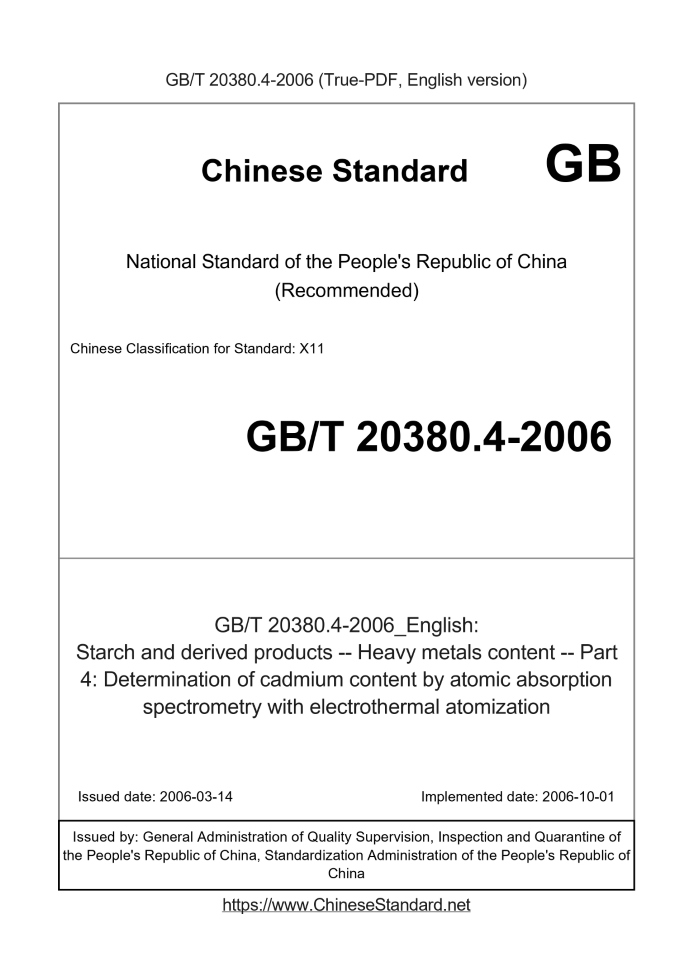
US$154.00 · In stock · Download in 9 secondsGB/T 20380.4-2006: Starch and derived products -- Heavy metals content -- Part 4: Determination of cadmium content by atomic absorption spectrometry with electrothermal atomization
Delivery: 9 seconds. True-PDF full-copy in English & invoice will be downloaded + auto-delivered via email. See step-by-step procedure
Status: Valid
| Std ID | Version | USD | Buy | Deliver [PDF] in | Title (Description) |
| GB/T 20380.4-2006 | English | 154 | Add to Cart | 3 days [Need to translate] | Starch and derived products -- Heavy metals content -- Part 4: Determination of cadmium content by atomic absorption spectrometry with electrothermal atomization |
Click to Preview a similar PDF
Basic data
| Standard ID | GB/T 20380.4-2006 (GB/T20380.4-2006) |
| Description (Translated English) | Starch and derived products -- Heavy metals content -- Part 4: Determination of cadmium content by atomic absorption spectrometry with electrothermal atomization |
| Sector / Industry | National Standard (Recommended) |
| Classification of Chinese Standard | X11 |
| Classification of International Standard | 67.180.20 |
| Word Count Estimation | 8,891 |
| Date of Issue | 2006-03-14 |
| Date of Implementation | 2006-10-01 |
| Adopted Standard | ISO 11212-4-1997, IDT |
| Regulation (derived from) | China National Standard Approval Announcement 2006 No.8 (Total No.95) |
| Issuing agency(ies) | General Administration of Quality Supervision, Inspection and Quarantine of the People's Republic of China, Standardization Administration of the People's Republic of China |
| Summary | This standard specifies the determination of starch and its derivatives electrothermal atomic absorption spectrometry, byproduct cadmium approach. Process parameters electrothermal atomic absorption spectrometry involved far more than the flame atomic absorption spectrometry. It is not possible to provide an integrated approach to ensure that the various instruments can have satisfactory results. Therefore, every analyst should be based on common or specific guidance to optimize their use of the instrument conditions. |