GB/T 17592-2024 PDF English
Price & Delivery
US$505.00 · In stock · Download in 9 secondsGB/T 17592-2024: Textiles - Determination of the banned azo colourants
Delivery: 9 seconds. True-PDF full-copy in English & invoice will be downloaded + auto-delivered via email. See step-by-step procedure
Status: Valid
GB/T 17592: Historical versions
| Standard ID | USD | BUY PDF | Delivery | Standard Title (Description) | Status |
| GB/T 17592-2024 | 505 | Add to Cart | Auto, 9 seconds. | Textiles - Determination of the banned azo colourants | Valid |
| GB/T 17592-2011 | 85 | Add to Cart | Auto, 9 seconds. | Textiles -- Determination of the banned azo colorant | Valid |
| GB/T 17592-2006 | 70 | Add to Cart | Auto, 9 seconds. | Determination of banned azo dyes in textiles | Obsolete |
| GB/T 17592.1-1998 | 319 | Add to Cart | 3 days | Textiles--Test method of the use of banned azo colourants--Gas chromatography/mass spectrography method | Obsolete |
Click to Preview this PDF
Similar standards
GB/T 17592-2024: Textiles - Determination of the banned azo colourants
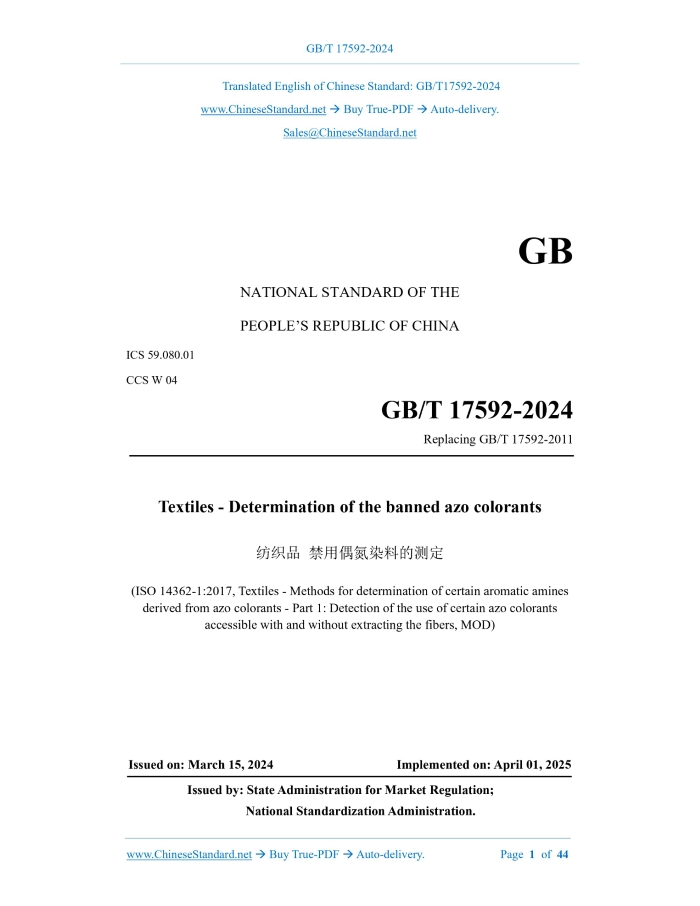
---This is an excerpt. Full copy of true-PDF in English version (including equations, symbols, images, flow-chart, tables, and figures etc.), auto-downloaded/delivered in 9 seconds, can be purchased online: https://www.ChineseStandard.net/PDF.aspx/GBT17592-2024GB NATIONAL STANDARD OF THE PEOPLE’S REPUBLIC OF CHINA ICS 59.080.01 CCS W 04 Replacing GB/T 17592-2011 Textiles - Determination of the banned azo colorants (ISO 14362-1.2017, Textiles - Methods for determination of certain aromatic amines derived from azo colorants - Part 1.Detection of the use of certain azo colorants accessible with and without extracting the fibers, MOD) Issued on. MARCH 15, 2024 Implemented on. APRIL 01, 2025 Issued by. State Administration for Market Regulation; National Standardization Administration.
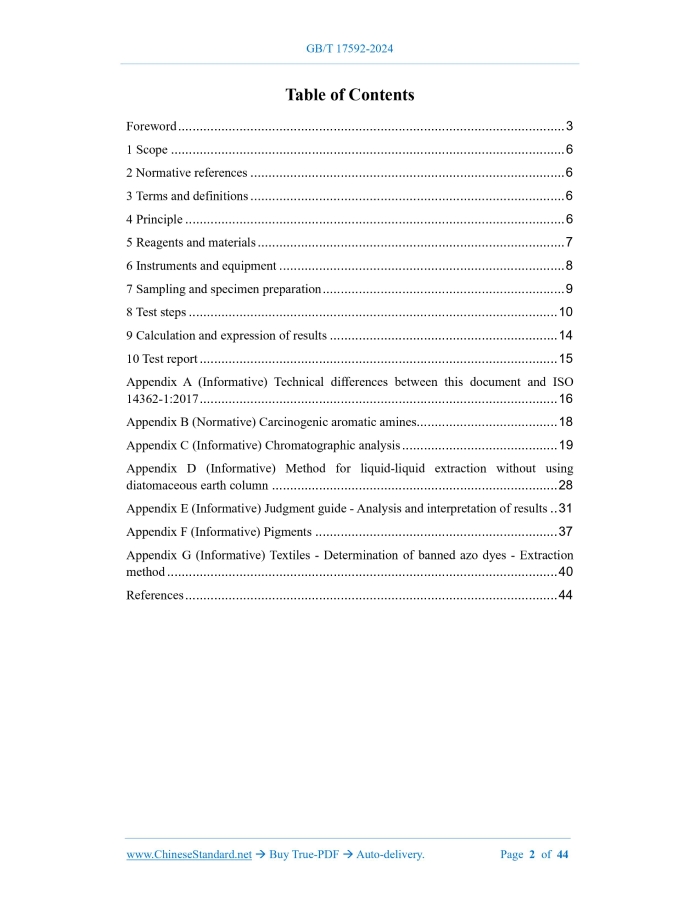
Table of Contents
Foreword... 3 1 Scope... 6 2 Normative references... 6 3 Terms and definitions... 6 4 Principle... 6 5 Reagents and materials... 7 6 Instruments and equipment... 8 7 Sampling and specimen preparation... 9 8 Test steps... 10 9 Calculation and expression of results... 14 10 Test report... 15 Appendix A (Informative) Technical differences between this document and ISO 14362-1.2017... 16 Appendix B (Normative) Carcinogenic aromatic amines... 18 Appendix C (Informative) Chromatographic analysis... 19 Appendix D (Informative) Method for liquid-liquid extraction without using diatomaceous earth column... 28 Appendix E (Informative) Judgment guide - Analysis and interpretation of results.. 31 Appendix F (Informative) Pigments... 37 Appendix G (Informative) Textiles - Determination of banned azo dyes - Extraction method... 40 References... 44Foreword
This document was drafted in accordance with the provisions of GB/T 1.1-2020 "Directives for standardization - Part 1.Rules for the structure and drafting of standardizing documents". This document replaces GB/T 17592-2011 "Textiles - Determination of the banned azo colorant". Compared with GB/T 17592-2011, in addition to structural adjustments and editorial changes, the main technical changes are as follows. - ADD the reagents such as acetonitrile, tert-butyl methyl ether, aromatic amine quantitative standard working solution, sodium hydroxide aqueous solution, benzidine-d8; SPECIFY the validity period of sodium dithionite aqueous solution; CHANGE the concentrations of aromatic amine standard stock solution, aromatic amine standard working solution, internal standard solution; DELETE ether (see Chapter 5; Chapter 4 of the 2011 edition); - ADD the pipettes, analytical balances, pH meters; ADD the mass selective detectors (MS) and polytetrafluoroethylene filters to high performance liquid chromatographs; ADJUST the size of glass or polypropylene columns (see Chapter 6; Chapter 5 of the 2011 edition); - ADD the "Sampling and preparation of specimen", clarifying the requirements for sampling by components and colors (see Chapter 7); - CHANGE the amount of citrate-sodium hydroxide buffer solution added and the cooling time (see 8.1; 6.1 of the 2011 edition); - CHANGE the separation and concentration steps, extraction reagents, volume- fixing reagents of aromatic amines; ADD the storage requirements of the sample solution after volume fixation (see 8.2; 6.2 of the 2011 edition); - ADD the requirements for the qualitative analysis of aniline and 1,4- phenylenediamine (see 8.3.2); - DELELTE the specific steps of gas chromatography/mass spectrometry qualitative and quantitative analysis; MOVE the chromatographic analysis conditions to Appendix C (see Appendix C; 6.3 and 6.4 of the 2011 edition); - ADD the "Quantitative equipment and other sources related to false positive results" (see 8.3.3); - ADD the "verification", specifying the minimum recovery rate requirements of aromatic amines (see 8.4); - CHANGE the "result calculation and expression" (see Chapter 9; Chapter 7 of the 2011 edition); - ADJUST the original Appendix A to Appendix B. This document modifies and adopts ISO 14362-1.2017 "Textiles - Methods for determination of certain aromatic amines derived from azo colorants - Part 1.Detection of the use of certain azo colorants accessible with and without extracting the fibers". Compared with ISO 14362-1.2017, this document has made the following structural adjustments. - Chapter 4 corresponds to Chapter 5 of ISO 14362-1.2017; - Chapter 5 corresponds to Chapter 7 of ISO 14362-1.2017, of which 5.1 corresponds to 7.11 of ISO 14362-1.2017 and 5.2 ~ 5.10 correspond to 7.1 ~ 7.10 of ISO 14362- 1.2017; - Chapter 6 corresponds to Chapter 8 of ISO 14362-1.2017, of which 6.1 ~ 6.7 correspond to 8.3 ~ 8.8 of ISO 14362-1.2017, meanwhile 6.8 and 6.9 are added; - Chapter 7 corresponds to Chapter 9 of ISO 14362-1.2017, of which 7.1 ~ 7.2 correspond to 9.1 ~ 9.2 of ISO 14362-1.2017, 7.3 corresponds to 9.6 of ISO 14362- 1.2017; - Chapter 8 corresponds to Chapter 10 of ISO 14362-1.2017, of which 8.1 ~ 8.4 correspond to 10.3 ~ 10.6 of ISO 14362-1.2017; - Chapter 9 corresponds to Chapter 11 of ISO 14362-1.2017; Chapter 10 corresponds to Chapter 12 of ISO 14362-1.2017; - Appendices C ~ F correspond to Appendix A, Appendix E, Appendix C, Appendix G of ISO 14362-1.2017, respectively; Appendix A and Appendix G are added. This document has technical differences, as compared with ISO 14362-1.2017, which are marked with a vertical single line (|) in the outer margin of the clauses involved. A list of these technical differences and their reasons is shown in Appendix A. This document also made the following editorial changes. - CHANGE the standard name to "Textiles - Determination of the banned azo colorants"; - MOVE the content of Chapter 4 of the international standard to Appendix B of this document; - DELETE the informative Appendix B "Reliability of the method" from the international standard. Please note that some of the content of this document may involve patents. The issuing agency of this document does not assume the responsibility for identifying patents. This document was proposed by the China National Textile and Apparel Council. This document shall be under the jurisdiction of the National Technical Committee for Textile Standardization (SAC/TC 209). Drafting organizations of this document. Textile Industry Standardization Research Institute, Shanghai Textile Science Research Institute Co., Ltd. The main drafters of this document. Chen Xiaocheng, Ren Hang, Liu Jinyun, Zhang Hui, Xu Lu, Zheng Yuying, Jing Tingting, Chen Yun, Zhu Ying, Zhang Xiaoyan. This standard replaces the standard previously issued as follows. - It was first published in 1998 as GB/T 17592.1 ~ 17592.3-1998; - It was first revised in 2006 as GB/T 17592-2006; - It was second revised in 2011 as GB/T 17592-2011; - This is the third revision. Textiles - Determination of the banned azo colorants Warning - Personnel using this document shall have practical experience in formal laboratory work. This document does not address all possible safety issues. Users are responsible for taking appropriate safety and health measures and ensuring that the conditions specified in relevant national laws and regulations are met.1 Scope
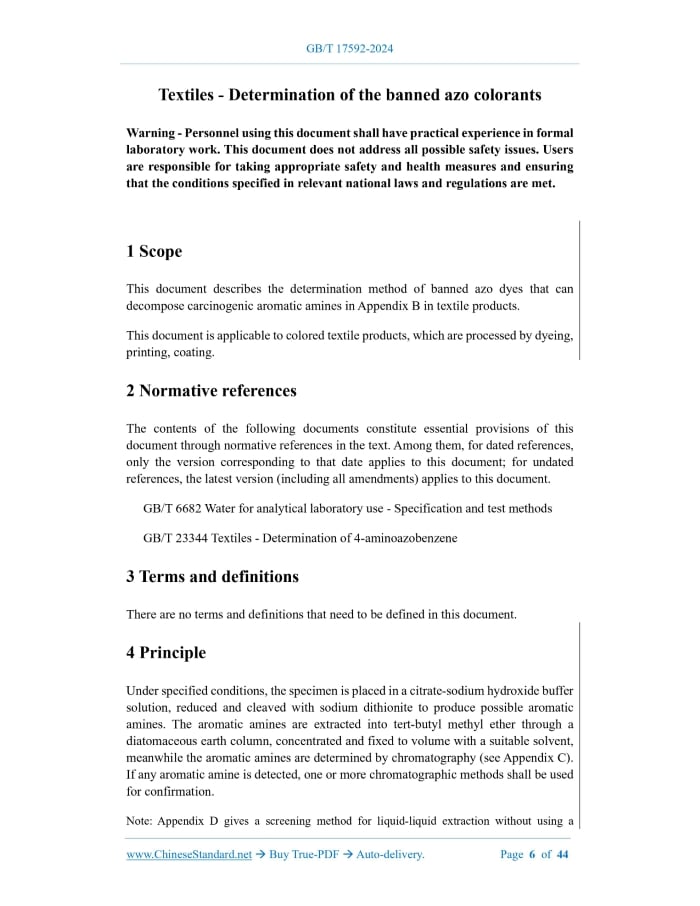
This document describes the determination method of banned azo dyes that can decompose carcinogenic aromatic amines in Appendix B in textile products.2 Normative references
The contents of the following documents constitute essential provisions of this document through normative references in the text. Among them, for dated references, only the version corresponding to that date applies to this document; for undated references, the latest version (including all amendments) applies to this document. GB/T 6682 Water for analytical laboratory use - Specification and test methods GB/T 23344 Textiles - Determination of 4-aminoazobenzene3 Terms and definitions
There are no terms and definitions that need to be defined in this document.4 Principle
Under specified conditions, the specimen is placed in a citrate-sodium hydroxide buffer solution, reduced and cleaved with sodium dithionite to produce possible aromatic amines.5 Reagents and materials
Unless otherwise specified, all reagents used are analytically pure. Use the internal standard solution (see 5.9.4) to prepare a solution which has a mass concentration of 0.5 mg/mL. Benzidine-d8 is a suitable indicator of late-eluting aromatic amines in the gas chromatogram (see 8.3).6 Instruments and equipment
Vacuum rotary evaporator. It is equipped with vacuum control and water bath. Other evaporation devices can also be used, such as nitrogen blower equipped with water bath and nitrogen flow control.7 Sampling and specimen preparation
If the sample is a semi-finished product (such as yarn, fabric, etc.), cut the specimen directly. If any aromatic amine in the mixed color determination result is 5 mg/kg ~ 20 mg/kg, each color shall be measured separately, because the measured value of the single color specimen may exceed 20 mg/kg.8 Test steps
Concentrate the tert-butyl methyl ether eluent to nearly 1 mL (do not evaporate to dryness) in a vacuum rotary evaporator (see 6.4), at no more than 50 °C. If other solvents need to be replaced, use a low-flow inert gas to slowly blow until nearly dry.9 Calculation and expression of results
The content w of aromatic amine in the specimen is calculated according to formula (3), in milligrams per kilogram (mg/kg). The results of this method are expressed as the measured values of various aromatic amines; the calculated results are expressed to the single digit. The limit of quantification of this method is 5 mg/kg.10 Test report
The test report shall include the following. ......Source: Above contents are excerpted from the full-copy PDF -- translated/reviewed by: www.ChineseStandard.net / Wayne Zheng et al.