GB/T 15825.5-2008 PDF English
Price & Delivery
US$170.00 · In stock · Download in 9 secondsGB/T 15825.5-2008: Sheet metal formability and test methods - Part 5: Bending test
Delivery: 9 seconds. True-PDF full-copy in English & invoice will be downloaded + auto-delivered via email. See step-by-step procedure
Status: Valid
GB/T 15825.5: Historical versions
| Standard ID | USD | BUY PDF | Delivery | Standard Title (Description) | Status |
| GB/T 15825.5-2008 | 170 | Add to Cart | Auto, 9 seconds. | Sheet metal formability and test methods - Part 5: Bending test | Valid |
| GB/T 15825.5-1995 | 239 | Add to Cart | 2 days | Sheet metal formability and test methods--Bending test | Obsolete |
Click to Preview this PDF
Similar standards
GB/T 15825.5-2008: Sheet metal formability and test methods - Part 5: Bending test
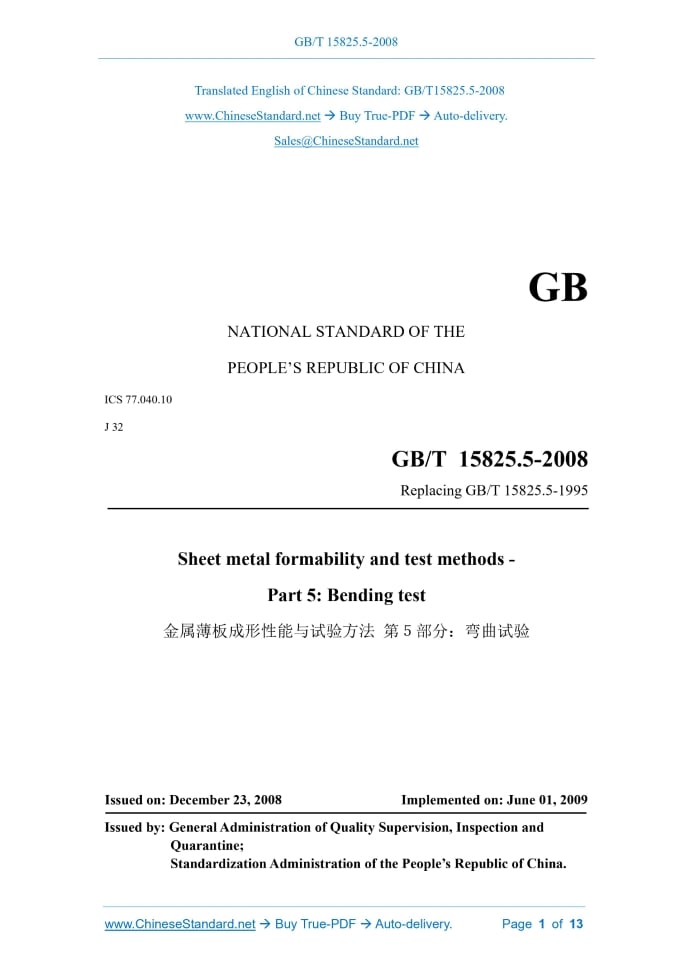
---This is an excerpt. Full copy of true-PDF in English version (including equations, symbols, images, flow-chart, tables, and figures etc.), auto-downloaded/delivered in 9 seconds, can be purchased online: https://www.ChineseStandard.net/PDF.aspx/GBT15825.5-2008NATIONAL STANDARD OF THE PEOPLE’S REPUBLIC OF CHINA ICS 77.040.10 J 32 Replacing GB/T 15825.5-1995 Sheet metal formability and test methods - Part 5.Bending test Issued on. DECEMBER 23, 2008 Implemented on. JUNE 01, 2009 Issued by. General Administration of Quality Supervision, Inspection and Quarantine; Standardization Administration of the People’s Republic of China.
Table of Contents
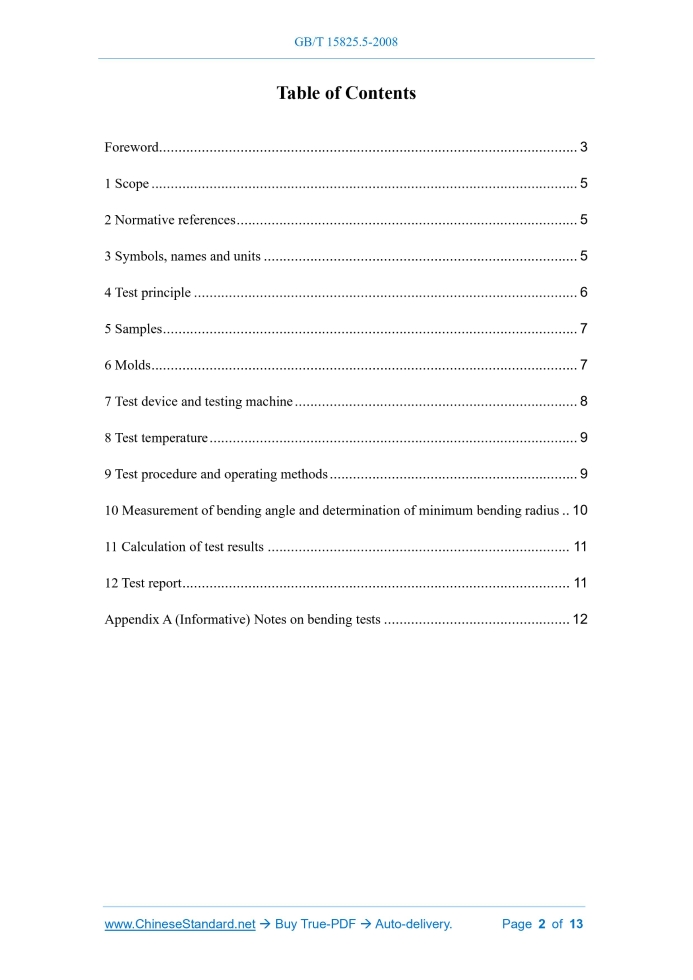
Foreword... 3 1 Scope... 5 2 Normative references... 5 3 Symbols, names and units... 5 4 Test principle... 6 5 Samples... 7 6 Molds... 7 7 Test device and testing machine... 8 8 Test temperature... 9 9 Test procedure and operating methods... 9 10 Measurement of bending angle and determination of minimum bending radius.. 10 11 Calculation of test results... 11 12 Test report... 11 Appendix A (Informative) Notes on bending tests... 12Foreword
GB/T 15825 Sheet metal formability and test methods is divided into 8 parts. -- Part 1.Formability and indexes; -- Part 2.General test rules; -- Part 3.Drawing and drawing load test; -- Part 4.Method of hole expanding test; -- Part 5.Bending test; -- Part 6.Conical cup test; -- Part 7.Earing test; -- Part 8.Guidelines for the determination of forming-limit diagrams. This Part is Part 5 of GB/T 15825. This Part replaces GB/T 15825.5-1995 Sheet metal formability and test methods - Bending test. Compared with GB/T 15825.5-1995, the main changes in this Part are as follows. -- Add “Foreword”; -- Add introductory text to “2 Normative references”; -- Modify the names in Figure 1 and Figure 2; -- Add the names to Table 2; -- Change 7.1.1 ~ 7.1.6 to column items a) ~ f); -- Add the content of 7.2.1 to the hanging line of 7.2, and modify the statement of the hanging line; -- Change 7.2.2, 7.2.3, 7.2.4, 7.2.5 to column items a) ~ d) respectively; -- Add “8 Test temperature”; -- Remove 9.5, and push the subsequent clause numbers forward in sequence; -- Remove the “Note” below Table 3; -- Change the title of Appendix A to “Notes on bending tests”; -- Modify the content of Appendix A.1; -- Modify the name of Figure A.2; -- In addition to the above revisions, editorial revisions have also been made to some text, figure title formats and column item numbers of the original standard. Appendix A of this Part is an informative appendix. This Part was proposed by China Machinery Industry Federation. This Standard shall be under the jurisdiction of National Technical Committee for Standardization of Forging. Drafting organizations of this Part. Wuhan University of Technology, Zhengzhou University, Dongfeng Die & Stamping Technologies Co., Ltd. Chief drafting staffs of this Part. Jiang Kuihua, Cao Hongshen, Hua Lin, Li Jianhua, Huang Shangyu, Mao Huajie. The previous released editions of this Part are as follows. -- GB/T 15825.5-1995. Sheet metal formability and test methods - Part 5.Bending test1 Scope
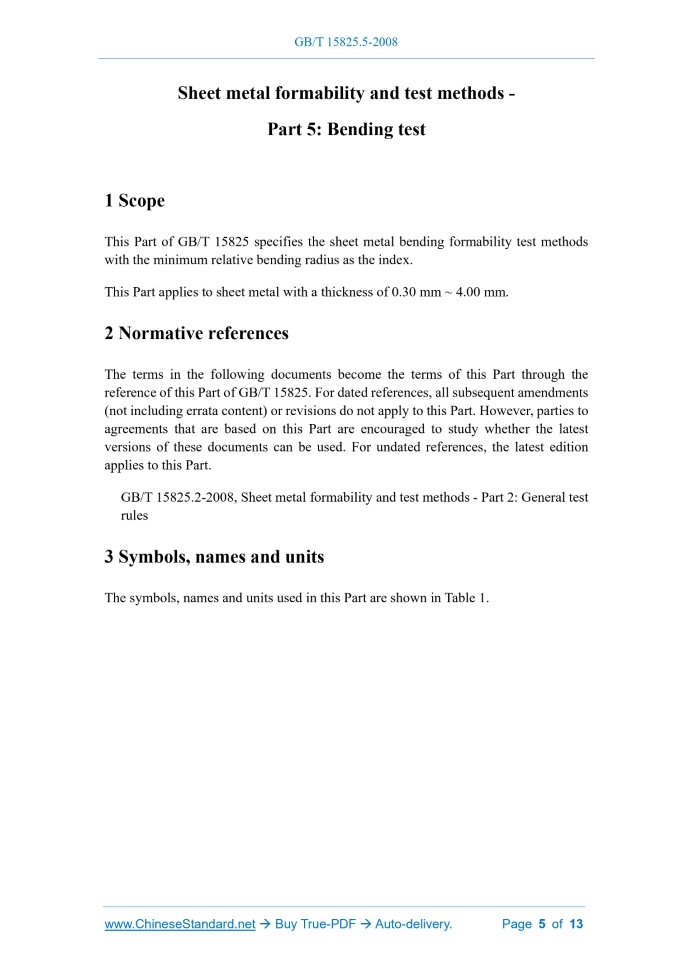
This Part of GB/T 15825 specifies the sheet metal bending formability test methods with the minimum relative bending radius as the index. This Part applies to sheet metal with a thickness of 0.30 mm ~ 4.00 mm.2 Normative references
The terms in the following documents become the terms of this Part through the reference of this Part of GB/T 15825.For dated references, all subsequent amendments (not including errata content) or revisions do not apply to this Part. However, parties to agreements that are based on this Part are encouraged to study whether the latest versions of these documents can be used. For undated references, the latest edition applies to this Part. GB/T 15825.2-2008, Sheet metal formability and test methods - Part 2.General test rules3 Symbols, names and units
The symbols, names and units used in this Part are shown in Table 1.4 Test principle
In this test, a series of punches with different bottom arc radii (or cushion-type dies with different thicknesses) are used to shape the sample according to the specified bending angle (Figure 1, Figure 2).5 Samples
5.1 Strip samples are used in this test. The width shall be greater than 10 times the basic sheet thickness, but shall not be less than 20 mm; the length shall enable the bending into a “V” shape or a “U” shape. 5.2 Strip samples with a width of 50 mm ± 0.5 mm and a length of 150 mm ± 2.0 mm are recommended. 5.3 The length direction of the sample shall be perpendicular to the rolling direction (sampling angle θ = 90°). If there are special requirements, the sampling angle can be changed to other values, which, however, shall be indicated in the test report.6 Molds
6.1 Molds shall be prepared according to the provisions of Chapter 4 in GB/T 15825.2- 2008. 6.2 The width of punch, cushion-type die and die shall be larger than the width of the sample. 6.4 For the punch bottom arc radius Rp (Figure 1), each interval of 0.1 mm, in principle, is regarded as a level of specification; the manufacturing tolerance range is ±0.01 mm. In order to reduce the test workload, it is recommended to use the punch specifications listed in Table 2. 6.5 For the cushion-type die thickness used for 180° bending [Figure 2a)], in principle, every interval of 0.2 mm is regarded as a level of specification; the manufacturing tolerance range is ±0.01 mm.7 Test device and testing machine
7.1 Test device Prepare the test device according to the provisions in 5.1 of GB/T 15825.2-2008; it is required to meet the following technical conditions. 7.2 Testing machine According to 5.2 of GB/T 15825.2-2008, equipment such as material testing machine or hydraulic press can be used, by referring to the following technical conditions.8 Test temperature
Usually, the test can be carried out in an ambient environment of 10 °C ~ 35 °C, and if necessary, the temperature environment can also be set to 23 °C ± 5 °C.9 Test procedure and operating methods
9.1 Before the test, clean, inspect and lubricate the mold, test device and testing machine according to 4.2, 5.1.2, 5.2.2 and 5.2.3 of GB/T 15825.2-2008. 9.2 Before each test, use L-AN100 oil for total loss system to lubricate the die mouth fillet area. 9.3 Adjust the die opening and lock it after adjustment. 9.5 When the compression bending test method in Figure 1 is used, if the punch or cushion-type die of the smallest specifications still cannot cause cracks or significant depressions on the outer surface of the deformation area of the sample, change the bending angle of the sample OR perform the 180° fold bending as shown in Figure 2b) for the sample, which, however, shall be stated in the test report. 9.6 If the punch stiffness allows, the sample can be directly bent at 180° using the compression bending test method shown in Figure 1, and the die opening can be determined according to Formula (2). 9.7 When the compression bending test method cannot be used for 180° bending, the sample shall be bent to a certain angle, and then moved to between the upper and lower pressing plates for 180° bending (Figure 2). 9.8 Carry out more than 3 effective repeated tests on the front and back sides of the same material, respectively. 10 Measurement of bending angle and determination of minimum bending radius 10.1 Measure the bending angle under loading conditions, and the allowable measurement error is ±1°. 10.2 When the test device or the testing machine is not provided with a bending angle display device, use the sample plate to measure the bending angle during the test loading process, or convert the bending angle into the punch stroke for test control. 10.3 During the compression bending test or the 180° bending test with a cushion-type die, determine the minimum bending radius Rmin according to Formula (3).11 Calculation of test results
11.1 Calculate the minimum relative bending radius Rmin/t, and keep one decimal place for the calculation result.12 Test report
12.1 The format of the test report is designed separately. 12.2 The test report shall include the following main contents. ......Source: Above contents are excerpted from the full-copy PDF -- translated/reviewed by: www.ChineseStandard.net / Wayne Zheng et al.