GB/T 1510-2016 PDF English
Price & Delivery
US$170.00 · In stock · Download in 9 secondsGB/T 1510-2016: Manganese ores - Determination of aluminium content - EDTA titrimetric method
Delivery: 9 seconds. True-PDF full-copy in English & invoice will be downloaded + auto-delivered via email. See step-by-step procedure
Status: Valid
GB/T 1510: Historical versions
| Standard ID | USD | BUY PDF | Delivery | Standard Title (Description) | Status |
| GB/T 1510-2016 | 170 | Add to Cart | Auto, 9 seconds. | Manganese ores - Determination of aluminium content - EDTA titrimetric method | Valid |
| GB/T 1510-2006 | 279 | Add to Cart | 3 days | Manganese ores -- Determination of aluminium content -- EDTA titrimetric method | Obsolete |
| GB/T 1510-1979 | 199 | Add to Cart | 2 days | Method for determination of aluminium trioxide content in manganese ores | Obsolete |
Click to Preview this PDF
GB/T 1510-2016: Manganese ores - Determination of aluminium content - EDTA titrimetric method
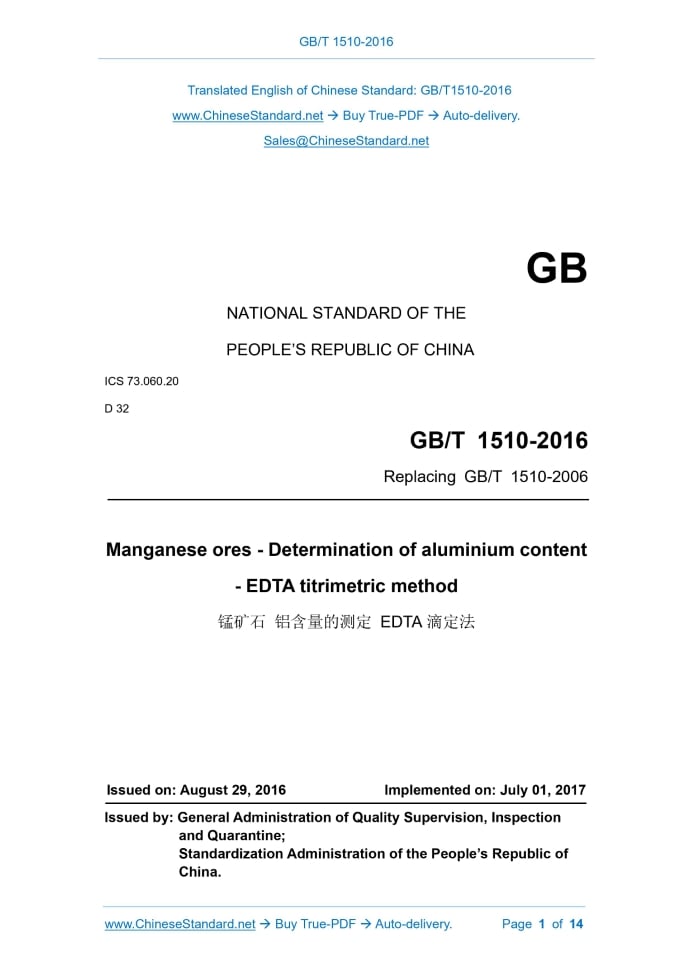
---This is an excerpt. Full copy of true-PDF in English version (including equations, symbols, images, flow-chart, tables, and figures etc.), auto-downloaded/delivered in 9 seconds, can be purchased online: https://www.ChineseStandard.net/PDF.aspx/GBT1510-2016GB NATIONAL STANDARD OF THE PEOPLE’S REPUBLIC OF CHINA ICS 73.060.20 D 32 Replacing GB/T 1510-2006 Manganese ores - Determination of aluminium content - EDTA titrimetric method ISSUED ON: AUGUST 29, 2016 IMPLEMENTED ON: JULY 01, 2017 Issued by: General Administration of Quality Supervision, Inspection and Quarantine; Standardization Administration of the People’s Republic of China.
Table of Contents
Foreword ... 3 1 Scope ... 5 2 Normative references ... 5 3 Principle ... 5 4 Reagents and materials ... 6 5 Instruments ... 8 6 Sampling ... 8 7 Analysis steps ... 8 8 Calculation of analysis results ... 10 9 Test report ... 13 Appendix A (Normative) Sample analysis value acceptance procedure flow chart ... 14 Manganese ores - Determination of aluminium content - EDTA titrimetric method WARNING – The personnel who uses this Standard shall have hands-on experience in formal laboratory work. This Standard does not address all possible security issues. It is the responsibility of the user to take appropriate safety and health measures and to ensure compliance with the conditions which are set by the relevant national regulations.1 Scope
This Standard specifies the determination of aluminium content in manganese ores by EDTA titrimetric method. This Standard applies to the determination of aluminium content in manganese ores and manganese concentrates; the determination range (mass fraction): 0.10% ~ 12.50%.2 Normative references
The following referenced documents are indispensable for the application of this document. For dated references, only the edition cited applies. For undated references, the latest edition of the referenced document (including any amendments) applies. GB/T 2011, Method of sampling and sample preparation of manganese ores in bulk GB/T 6682, Water for analytical laboratory use - Specification and test methods GB/T 8170, Rules of rounding off for numerical values & expression and judgment of limiting values GB/T 14949.8, Manganese ores - Determination of hygroscopic moisture content - Gravimetric method3 Principle
For the sample, use hydrochloric acid-nitric acid to decompose, and use sulfuric acid-hydrofluoric acid to evaporates silicon. After precipitation and separation by hexamethylenetetramine, use hydrochloric acid to dissolve the aluminium hydroxide precipitate; use sodium carbonate-boric acid to melt the residue. After separation by strong base, divide the filtrate into the slightly acidic solution; then, add excess EDTA. When the pH value is 5 ~ 5.5, use xylenol orange as indicator; use zinc standard titration solution to titrate excess EDTA; use fluoride ion to replace the EDTA with aluminium; then, use zinc standard titration solution to titrate. According to the consumption of zinc standard titration solution, calculate the aluminium content.4 Reagents and materials
In the analysis process, only use approved analytical reagents and water of grade 3 and above in accordance with GB/T 6682. 4.1 Mixed solvent: the mass ratio of sodium carbonate and boric acid is 2:1; grind and mix well. 4.2 Nitric acid, ρ = 1.42 g/mL. 4.3 Hydrochloric acid, ρ = 1.19 g/mL. 4.4 Hydrochloric acid, 1+1. 4.5 Hydrochloric acid, 1+2. 4.6 Hydrochloric acid, 1+5. 4.7 Hydrochloric acid, 2+98. 4.8 Sulfuric acid: 1+1. 4.9 Hydrofluoric acid, ρ = 1.17 g/mL. 4.10 Hydrogen peroxide, mass fraction of 30%. 4.11 Ammonia water, 1+1. 4.12 Hydrochloric acid-hexamethylenetetramine solution (pH = 5 ~ 5.5): Weigh 40 g of hexamethylenetetramine and dissolve it in water; add 20 mL of hydrochloric acid (1+1); use water to dilute to 100 mL; mix well. 4.13 Hexamethylenetetramine solution, 5 g/L. 4.14 Sodium hydroxide solution, 500 g/L: Weigh 500 g of sodium hydroxide; use water to dissolve and dilute to 1 L; store in a plastic bottle. 4.15 Sodium fluoride saturated solution: Store in a plastic bottle. 7.4 Determination 7.4.1 Preparation of sample solutions 7.4.1.1 Put the sample (see 7.2) in a 400 mL beaker; add 20 mL of hydrochloric acid (see 4.3); heat the solution until there is no obvious reaction,; then, add 5 mL of nitric acid (see 4.2). Continue to heat to dissolve until nearly dry; remove and cool slightly; add 20 mL of hydrochloric acid (see 4.4) and 100 mL of water; heat to dissolve the salts. Remove it; use medium-speed filter paper to filter while it is still hot; use hot water to wash the filter paper 10 ~ 15 times. Keep the filtrate as main liquid A. 7.4.1.2 Transfer the filter paper and residue into a platinum dish or platinum crucible; dry and carbonize at low temperature; put it into a high temperature furnace at about 550 °C for ashing; then, burn it in a high temperature furnace at 850 °C for 10 minutes; remove it for cooling. Add 2 mL of sulfuric acid (see 4.8); add 3 mL ~ 5 mL of hydrofluoric acid (see 4.9) dropwise; after heating to evaporate the silicon, heat it on an electric hot plate until the sulfuric acid emits smoke; remove it. Slightly cool; blow a small amount of water around the platinum dish; then, heat until the sulfuric acid smokes and is almost dry. Remove it; add 10 mL of hydrochloric acid (see 4.4); heat to dissolve the salts; combine the test solution with the main solution A. 7.4.2 Separation of hexamethylenetetramine 7.4.2.1 Adjust the volume of the solution (see 7.4.1.2) to about 100 mL ~ 150 mL; boil and remove. Use ammonia water (see 4.11) to neutralize until a precipitation occurs; then, use hydrochloric acid (see 4.4) to adjust until the precipitate just dissolves; add 5 ~ 10 drops in excess. Add 20 mL of hydrochloric acid-hexamethylenetetramine solution (see 4.12); heat to slightly boil and keep at a temperature (80 °C ~ 90 °C) for 15 min ~ 20 min. Remove and cool slightly; use a medium-speed filter paper to filter (in two funnels when there are a lot of precipitations of hydroxide of iron and aluminium); use hot hexamethylenetetramine solution (see 4.13) to wash the beaker and precipitate 5 ~ 8 times respectively. Use 30 mL of hot hydrochloric acid (see 4.5) to dissolve the precipitate in the original beaker; use hot hydrochloric acid (see 4.7) to wash the filter paper until it is no longer yellow; then, use hot water to wash the filter paper for 10 ~ 15 times. Keep the solution as the main liquid B for strong base separation. 7.4.2.2 Transfer the filter paper and residue into a platinum dish or platinum crucible; put it into a high temperature furnace at about 550 °C for ashing; then, burn it in a high temperature furnace at 850 °C for 10 minutes; remove it for cooling. Add 3 g of mixed solvent (see 4.1); put it in a high temperature furnace of 950 °C for 10 min; take it out and cool it slightly; add hydrochloric acid (see 4.4) dropwise; heat until the frit is separated from the platinum crucible; pour it into the main liquid B and combine them. 7.4.3 Strong base separation Heat and evaporate the solution (see 7.4.2.2) to a volume of about 80 mL ~ 120 mL; add 10 mL of sodium hydroxide solution (see 4.14); use ammonia water (see 4.11) to neutralize until a precipitation occurs; then, use hydrochloric acid (see 4.4) to adjust until the precipitate dissolves, and exceed for 10 mL; boil for 1 min ~ 2 min. Remove it and cool it down; add 40 mL of sodium hydroxide solution (see 4.14) at one time under constant stirring; add 8 ~ 10 drops of hydrogen peroxide (see 4.10) dropwise; boil for 3 min ~ 5 min. Remove and cool to room temperature; transfer to a 250 mL volumetric flask; use water to dilute to the mark; mix well. Use a double-layer medium-speed filter paper for dry filtration. Discard the initial filtrate. 7.4.4 Acidity adjustment and titration Pipette the above filtrate (see 7.4.3) accurately according to Table 2 into a 500 mL conical flask; add 2 drops of phenolphthalein indicator solution (see 4.19); use hydrochloric acid (see 4.4) to adjust it to red; shake while adding; continue to add hydrochloric acid (see 4.4) until the red color disappears and the solution is clear (a large amount of hydrochloric acid is used in this process) and exceed for 5 mL of hydrochloric acid (see 4.6); add EDTA solution (see 4.17) with an excess of 5 mL ~ 10 mL over the theoretical calculation value (see 4.17); the pH value of the solution, at this moment, is about 2; then, add 25 mL of hydrochloric acid-hexamethylenetetramine solution (see 4.12); heat and boil for 3 min ~ 5 min. Remove and cool to room temperature. Add 4 drops of xylenol orange indicator solution (see 4.20); use zinc standard titration solution (see 4.18.1) to titrate to red as the end point (do not record the consumption of zinc standard titration solution). Add 25 mL of saturated sodium fluoride solution (see 4.15); boil for 2 min ~ 3 min. Remove it; cool to room temperature; add 1 drop ~ 2 drops of xylenol orange indicator solution (see 4.20); use zinc standard titration solution (see 4.18.1) to titrate again to red as the end point.8 Calculation of analysis results
8.1 Calculation of aluminium content Calculate the aluminium content (mass fraction) in the sample according to Formula (2); express its value in %. ......Source: Above contents are excerpted from the full-copy PDF -- translated/reviewed by: www.ChineseStandard.net / Wayne Zheng et al.