GB/T 11345-2023 PDF English
Price & Delivery
US$380.00 · In stock · Download in 9 secondsGB/T 11345-2023: Non-destructive testing of welds - Ultrasonic testing - Techniques, testing levels, and assessment
Delivery: 9 seconds. True-PDF full-copy in English & invoice will be downloaded + auto-delivered via email. See step-by-step procedure
Status: Valid
GB/T 11345: Historical versions
| Standard ID | USD | BUY PDF | Delivery | Standard Title (Description) | Status |
| GB/T 11345-2023 | 380 | Add to Cart | Auto, 9 seconds. | Non-destructive testing of welds - Ultrasonic testing - Techniques, testing levels, and assessment | Valid |
| GB/T 11345-2013 | 135 | Add to Cart | Auto, 9 seconds. | Non-destructive testing of welds -- Ultrasonic testing -- Techniques, testing levels, and assessment | Obsolete |
| GB/T 11345-1989 | RFQ | ASK | 6 days | Method for manual ultrasonic testing and classification of testing results for ferritic steel welds | Obsolete |
Click to Preview this PDF
Similar standards
GB/T 11345-2023: Non-destructive testing of welds - Ultrasonic testing - Techniques, testing levels, and assessment
---This is an excerpt. Full copy of true-PDF in English version (including equations, symbols, images, flow-chart, tables, and figures etc.), auto-downloaded/delivered in 9 seconds, can be purchased online: https://www.ChineseStandard.net/PDF.aspx/GBT11345-2023
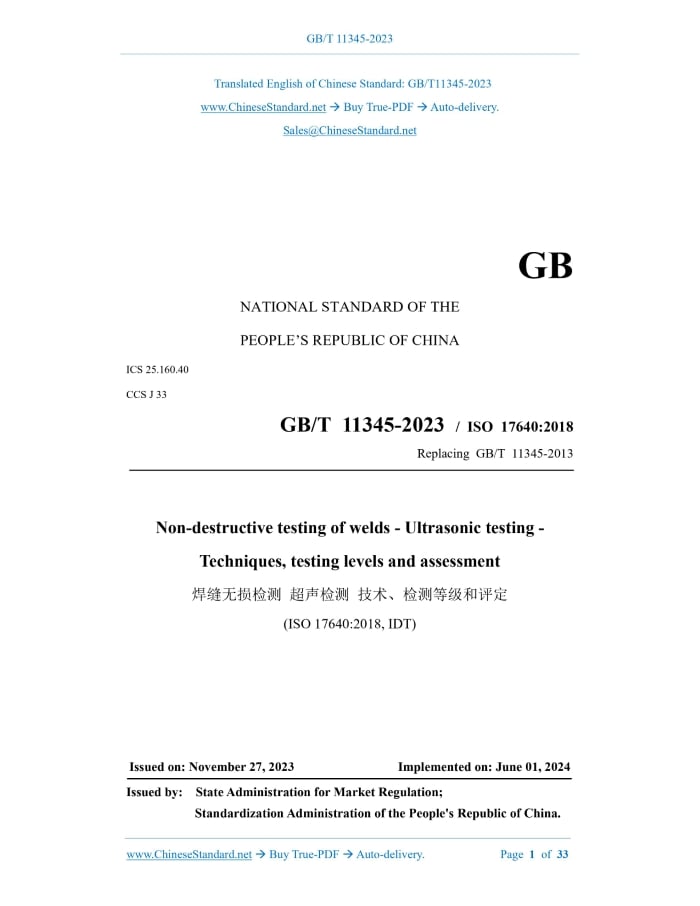
GB NATIONAL STANDARD OF THE PEOPLE’S REPUBLIC OF CHINA ICS 25.160.40 CCS J 33 GB/T 11345-2023 / ISO 17640.2018 Replacing GB/T 11345-2013 Non-destructive testing of welds - Ultrasonic testing - Techniques, testing levels and assessment (ISO 17640.2018, IDT) Issued on. NOVEMBER 27, 2023 Implemented on. JUNE 01, 2024 Issued by. State Administration for Market Regulation; Standardization Administration of the People's Republic of China.
Table of Contents
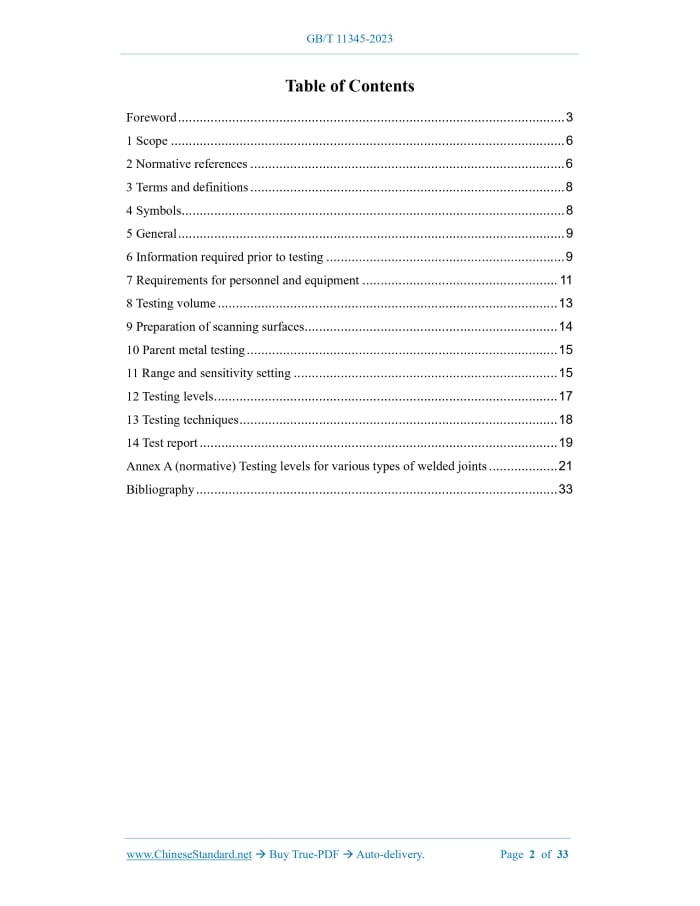
Foreword... 3 1 Scope... 6 2 Normative references... 6 3 Terms and definitions... 8 4 Symbols... 8 5 General... 9 6 Information required prior to testing... 9 7 Requirements for personnel and equipment... 11 8 Testing volume... 13 9 Preparation of scanning surfaces... 14 10 Parent metal testing... 15 11 Scope and sensitivity setting... 15 12 Testing levels... 17 13 Testing techniques... 18 14 Test report... 19 Annex A (normative) Testing levels for various types of welded joints... 21 Bibliography... 33Foreword
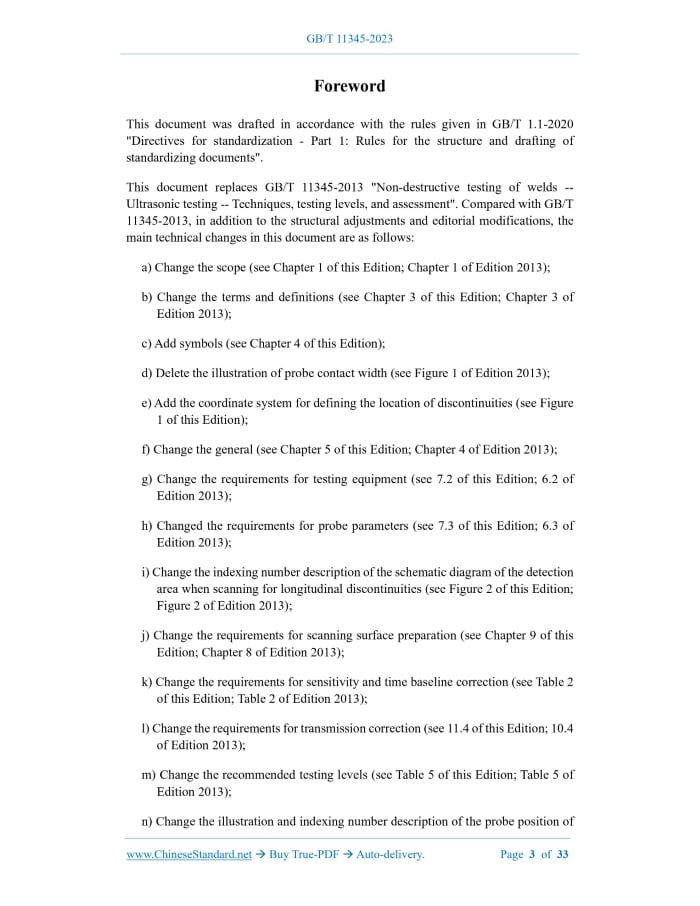
This document was drafted in accordance with the rules given in GB/T 1.1-2020 "Directives for standardization - Part 1.Rules for the structure and drafting of standardizing documents". This document replaces GB/T 11345-2013 "Non-destructive testing of welds -- Ultrasonic testing -- Techniques, testing levels, and assessment". Compared with GB/T 11345-2013, in addition to the structural adjustments and editorial modifications, the main technical changes in this document are as follows. a) Change the scope (see Chapter 1 of this Edition; Chapter 1 of Edition 2013); b) Change the terms and definitions (see Chapter 3 of this Edition; Chapter 3 of Edition 2013); c) Add symbols (see Chapter 4 of this Edition); d) Delete the illustration of probe contact width (see Figure 1 of Edition 2013); e) Add the coordinate system for defining the location of discontinuities (see Figure 1 of this Edition); f) Change the general (see Chapter 5 of this Edition; Chapter 4 of Edition 2013); g) Change the requirements for testing equipment (see 7.2 of this Edition; 6.2 of Edition 2013); h) Changed the requirements for probe parameters (see 7.3 of this Edition; 6.3 of Edition 2013); i) Change the indexing number description of the schematic diagram of the detection area when scanning for longitudinal discontinuities (see Figure 2 of this Edition; Figure 2 of Edition 2013); j) Change the requirements for scanning surface preparation (see Chapter 9 of this Edition; Chapter 8 of Edition 2013); k) Change the requirements for sensitivity and time baseline correction (see Table 2 of this Edition; Table 2 of Edition 2013); l) Change the requirements for transmission correction (see 11.4 of this Edition; 10.4 of Edition 2013); m) Change the recommended testing levels (see Table 5 of this Edition; Table 5 of Edition 2013); n) Change the illustration and indexing number description of the probe position of the butt joint (see Figure A.1 of this Edition; Figure A.1 of Edition 2013); o) Add an illustration of the probe positions for a set-through nozzle joint (see Figure A.3 of this Edition; Figure A.3 of Edition 2013); p) Delete the appendix on tandem scanning (see Annex B of Edition 2013); q) Delete the appendix on calculation of the actual refraction angle of curved workpieces (see Annex D of Edition 2013); r) Delete the appendix on time baseline and sensitivity settings (see Annex E of Edition 2013); s) Delete the appendix for transmission corrections (see Annex F of Edition 2013). This document identically adopts ISO 17640.2018 "Non-destructive testing of welds - Ultrasonic testing - Techniques, testing levels, and assessment". This document made the following minimum editorial modification. - Add notes (see Chapter 5, 6.1 and 11.3 of this Edition). Attention is drawn to the possibility that some of the elements of this document may be the subject of patent rights. The issuing authority shall not be held responsible for identifying any or all such patent rights. This document was proposed by China Machinery Industry Federation. This document shall be under the jurisdiction of National Technical Committee on Welding of Standardization Administration of China (SAC/TC 55). The drafting organizations of this document. Shanghai Materials Research Institute, China Special Equipment Inspection Institute, Fushun Special Equipment Supervision and Inspection Institute, Zhejiang Special Equipment Science Research Institute, Jiangsu Fangtian Electric Power Technology Co., Ltd., Fujian Jianyan Engineering Inspection Co., Ltd., Shandong Ruixiang Mold Co., Ltd., Shanghai Survey and Design Institute Co., Ltd., Wuhan Zhongke Innovation Technology Co., Ltd., Guangdong Jianyuan Inspection Technology Co., Ltd., Iintik Technology (Shanghai) Co., Ltd., Chongqing Shuntai Tower Manufacturing Co., Ltd., Chengdu Special Equipment Inspection Inspection Research Institute, Railway Research Institute (Shenzhen) Inspection Engineering Co., Ltd., Harbin Welding Research Institute Co., Ltd., Dongying Huachen Petroleum Equipment Co., Ltd., and Shenzhen Jingheng Engineering Inspection Co., Ltd. Main drafters of this document. Jiang Jiansheng, Zheng Hui, Zhang Yifeng, Huang Wenda, Pan Zhixin, Liu Xiangmin, Wei Zhongrui, Zhu Jian, Che Youming, Lin Guanghui, Lou Ruilong, Zhang Rui, Zhang Wenjie, Ma Junpeng, Wang Bin, Huang Yin, Gui Linlin, Tang Jie, Chen Hao, Fu Hao, Xu Leihui, Ding Jie, Liu Zhibo, Wu Xiaoqing, Wei Wei, Su Jinhua, Wang Jin, Chen Jian. This document was first issued in 1989.The first revision was in 2013.This is the second revision. Non-destructive testing of welds - Ultrasonic testing - Techniques, testing levels and assessment1 Scope
This document specifies techniques for the manual ultrasonic testing of fusion-welded joints in metallic materials of thickness not less than 8 mm which exhibit low ultrasonic attenuation (especially that due to scatter) at object temperatures from 0°C to 60°C. It is primarily intended for use on full penetration welded joints where both the welded and the parent material are ferritic.2 Normative references
The following referenced documents are indispensable for the application of this document. For dated references, only the edition cited applies. For undated references, the latest edition of the referenced document (including any amendments) applies. ISO 5577, Non-destructive testing - Ultrasonic testing - Vocabulary NOTE. GB/T 12604.1-2020, Non-destructive testing -- Terminology -- Ultrasonic testing (ISO 5577.2017, MOD)3 Terms and definitions
For the purposes of this document, the terms and definitions defined in ISO 5577 and ISO 17635apply.4 Symbols
The symbols in Table 1 apply.5 General
The purpose of this document is to describe general techniques of ultrasonic weld testing, using standard criteria, for the most commonly used welded joints at object temperatures in the range 0°C to 60°C. The specific requirements of this document cover the test equipment, preparation, performance of testing, and reporting. The parameters specified, in particular those for the probes, are compatible with the requirements of ISO 11666 and ISO 23279.6 Information required prior to testing
The definitions and requirements in this document normally satisfy the need for a written test procedure. Where this is not the case, or where the techniques described in this document are not applicable to the welded joint to be tested, additional written test procedures shall be used, if required by specification.7 Requirements for personnel and equipment
Any equipment used for testing in conjunction with this document shall comply with the requirements of ISO 22232 (all parts). The transducer size shall be chosen according to the ultrasonic path to be used and the frequency. The coupling media shall be in accordance with ISO 16810.The coupling medium used for range and sensitivity setting and for the test shall be the same.8 Testing volume
The testing volume (see Figure 2) is defined as the zone which includes weld and parent material and the width of the heat-affected zone on each side of the weld or at least 10 mm if the width of the heat-affected zone is not known.9 Preparation of scanning surfaces
Scanning surfaces shall be wide enough to permit the testing volume (see Figure 2) to be fully covered. Alternatively, the width of the scanning surfaces may be smaller if equivalent coverage of the testing volume can be achieved by scanning from both the upper and the lower surface of the joint. ......Source: Above contents are excerpted from the full-copy PDF -- translated/reviewed by: www.ChineseStandard.net / Wayne Zheng et al.