Path:
Home >
GB/T >
Page58 > GB/T 10360-2008
Price & Delivery
US$254.00 · In stock · Download in 9 secondsGB/T 10360-2008: Oilseed residues -- Sampling
Delivery: 9 seconds. True-PDF full-copy in English & invoice will be downloaded + auto-delivered via email. See
step-by-step procedureStatus: Valid
GB/T 10360: Historical versions
| Std ID | Version | USD | Buy | Deliver [PDF] in | Title (Description) |
| GB/T 10360-2008 | English | 254 |
Add to Cart
|
3 days [Need to translate]
|
Oilseed residues -- Sampling
|
| GB/T 10360-1989 | English | 439 |
Add to Cart
|
4 days [Need to translate]
|
Oilseed residues--Sampling
|
Click to Preview a similar PDF
Basic data
| Standard ID | GB/T 10360-2008 (GB/T10360-2008) |
| Description (Translated English) | Oilseed residues -- Sampling |
| Sector / Industry | National Standard (Recommended) |
| Classification of Chinese Standard | X14 |
| Classification of International Standard | 67.200.20 |
| Word Count Estimation | 13,129 |
| Date of Issue | 2008-11-04 |
| Date of Implementation | 2009-02-01 |
| Older Standard (superseded by this standard) | GB/T 10360-1989 |
| Adopted Standard | ISO 5500-1986, IDT |
| Regulation (derived from) | National Standard Approval Announcement 2008 No.18 (Total No.131) |
| Issuing agency(ies) | General Administration of Quality Supervision, Inspection and Quarantine of the People's Republic of China, Standardization Administration of the People's Republic of China |
| Summary | This standard specifies the oilseed is for sampling methods. This standard applies to all of the oil cake for sampling, regardless of its form is a powder, dough or cake pieces. Appendix C provides a special kind of oil cake for sampling methods, including some form of non- uniform distribution of matter, such as mycotoxins, castor shell, poisonous seeds. |
GB/T 10360-2008: Oilseed residues -- Sampling
---This is a DRAFT version for illustration, not a final translation. Full copy of true-PDF in English version (including equations, symbols, images, flow-chart, tables, and figures etc.) will be manually/carefully translated upon your order.
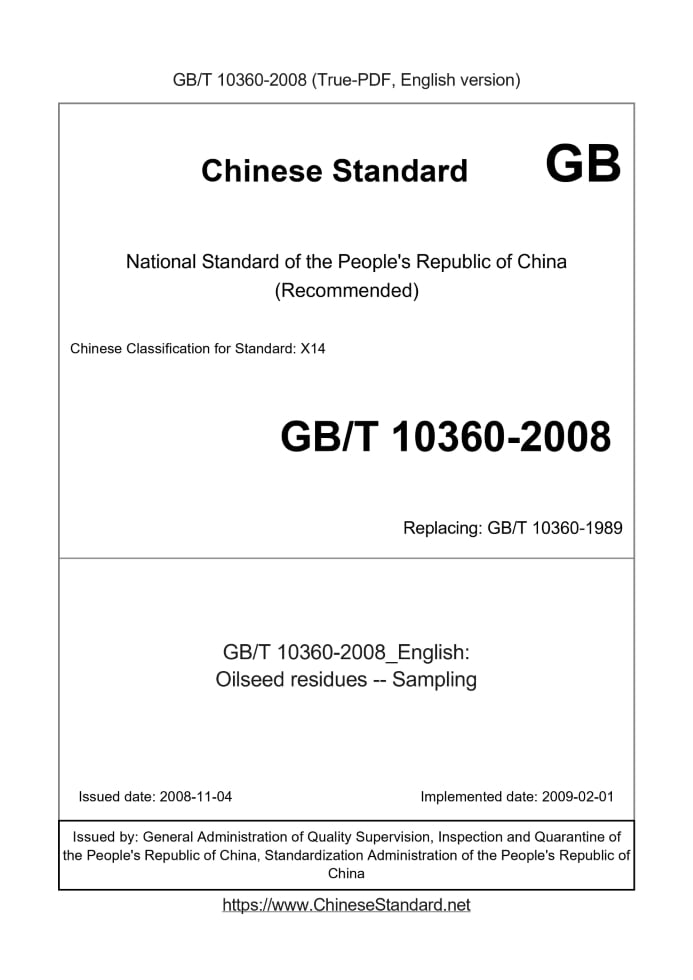
Oilseed residues. Sampling
ICS 67.200.20
X14
National Standards of People's Republic of China
GB/T 10360-2008/ISO 5500. 1986
Replacing GB/T 10360-1989
For sampling oilseed residues
(ISO 5500. 1986, IDT)
Posted 2008-11-04
2009-02-01 implementation
Administration of Quality Supervision, Inspection and Quarantine of People's Republic of China
Standardization Administration of China released
Foreword
This standard is identical with ISO 5500. 1986 "for sampling oilseed residues" (in English).
For ease of use, the standard ISO 5500. 1986 includes the following editorial changes.
--- Delete foreword international standards;
--- The "this International Standard" by "this standard";
--- With a decimal point "." Instead of the original text as a decimal point "."
The date of promulgation of this standard instead of GB/T 10360-1989.
The standard of Appendices B and C are normative appendices, Appendix A is an information appendix.
The standard proposed by the National Food Authority.
This standard by the National Standardization Technical Committee OILS.
This standard was drafted. National Food Authority Standard Quality Center, the Hubei Provincial Cereals, Oils and food quality monitoring stations.
The main drafters of this standard. Tang Ruiming, bear Ning, Nishan Shan, Liu Jian.
GB/T 10360-2008/ISO 5500. 1986
For sampling oilseed residues
1 Scope
This standard specifies the method for sampling of oilseed residues.
This standard applies to all of the oilseed for sampling, irrespective of their form is a powder, or cake dough block.
Appendix C provides for a special kind of oil cake for sampling method. Comprising certain substances in a non-uniform distribution, such as mycotoxins, ricin
Seed shells, poisonous seeds.
2 Terms and definitions
The following terms and definitions apply to this standard.
2.1
According to the contract or the amount of a shipping or transport protocol received oilseed, and may include one or more inspection lot or a batch inspection
A plurality of portions of the inspection lot.
2.2
Goods from the same batch and have the quality of a number of oil cake, it is to test the unit in an amount of not more than 500t.
2.3
From a single inspection lot for sampling point skewer take a small amount of oil cake samples. Stick in the subject from a series of samples in different parts of the inspection lot, the mix
After closing, a representative of the inspection lot.
2.4
Test sample taken from the same batch inspection, the combined and mixed to obtain a certain amount of oil cake samples.
2.5
The original sample divided by continuous sampling and reduced hours to get the number of oilseed similar to laboratory sample, representative of the original sample characteristics.
2.6
Obtained from an average sample for analysis or other oilseed kind of detection. The quality of the sample should be representative of the inspection lot.
3 General
3.1 Samples should be fully representative of the inspection lot taken. Each batch of goods to be accurately divided into several test batches, each batch of test is generally not more than
500t. Taken from each inspection lot stick in a series of test sample, and sufficiently mixed to the original sample. After several minutes of each original sample thus obtained test
kind. The specimen shall have the inspection lot quality representation.
3.2 for sampling should ensure that all tools clean, dry, odor-free, for sampling instruments and the materials of oilseed pollution. For sampling should ensure that
Stick sample tools for sampling, sample containers to avoid external contamination, such as rain, dust and the like. Before loading the sample should be removed adhered to for sampling tool
The appearance of the debris.
3.3 for sampling operations should be as short as possible time to avoid changes in the sample composition. If a stage for sampling or for sampling takes a long time,
Sample or intermediate sample application airtight container preservation. Samples of volatile hydrocarbons requires determination, should try to avoid evaporation losses, should not be used
Plastic containers.
GB/T 10360-2008/ISO 5500. 1986
...