GB 7657-2020 PDF English
Price & Delivery
US$95.00 · In stock · Download in 9 secondsGB 7657-2020: National food safety standard - Food additive - Glucono-delta-lactone
Delivery: 9 seconds. True-PDF full-copy in English & invoice will be downloaded + auto-delivered via email. See step-by-step procedure
Status: Valid
GB 7657: Historical versions
| Standard ID | USD | BUY PDF | Delivery | Standard Title (Description) | Status |
| GB 7657-2020 | 95 | Add to Cart | Auto, 9 seconds. | National food safety standard - Food additive - Glucono-delta-lactone | Valid |
| GB 7657-2005 | 279 | Add to Cart | 3 days | Food additive -- Glucono delta-lactone | Obsolete |
| GB 7657-1987 | 199 | Add to Cart | 2 days | Food additive--Glucono-delta-lactone | Obsolete |
Click to Preview this PDF
Similar standards
GB 7657-2020: National food safety standard - Food additive - Glucono-delta-lactone
---This is an excerpt. Full copy of true-PDF in English version (including equations, symbols, images, flow-chart, tables, and figures etc.), auto-downloaded/delivered in 9 seconds, can be purchased online: https://www.ChineseStandard.net/PDF.aspx/GB7657-2020GB NATIONAL STANDARD OF THE PEOPLE’S REPUBLIC OF CHINA National Food Safety Standard - Food additive - Glucono delta-lactone ISSUED ON: SEPTEMBER 11, 2020 IMPLEMENTED ON: MARCH 11, 2021 Issued by: National Health Commission of the People's Republic of China; State Administration for Market Regulation.
Table of Contents
Foreword ... 3 1 Scope ... 4 2 Molecular formula, structural formula and relative molecular mass ... 4 3 Technical requirements ... 4 Appendix A Inspection method ... 6 National Food Safety Standard - Food additive - Glucono delta-lactone1 Scope
This Standard applies to the food additive glucono delta-lactone, which is made from the reaction of D-calcium gluconate with sulfuric acid, or from sodium gluconate, as the raw material, through dissolution, cation exchange desodiumization, concentration, crystallization, centrifugation, and drying.2 Molecular formula, structural formula and relative
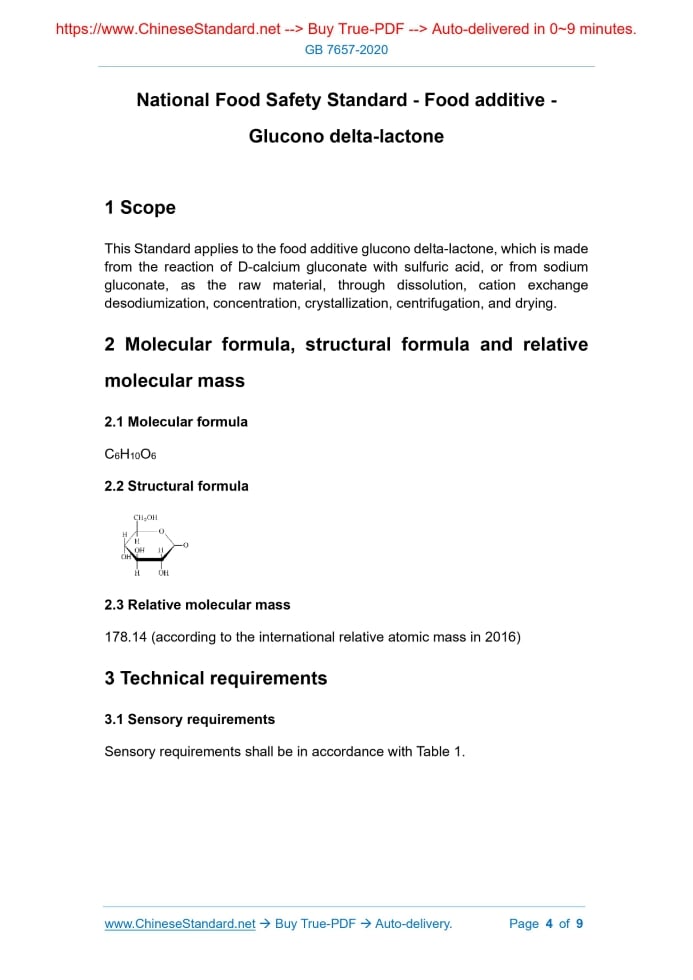
molecular mass 2.1 Molecular formula C6H10O6 2.2 Structural formula 2.3 Relative molecular mass 178.14 (according to the international relative atomic mass in 2016)3 Technical requirements
3.1 Sensory requirements Sensory requirements shall be in accordance with Table 1.Appendix A
Inspection method A.1 Safety instructions Some of the reagents that are used in the test method of this Standard are toxic or corrosive, so be careful while using and operate in accordance with relevant regulations. If it is splashed on the skin, use water to rinse it immediately. If it is serious, seek medical attention immediately. When volatile acids are used, it must be carried out in a fume hood. A.2 General Provisions Unless otherwise specified in this Standard, the purity of the used reagents shall be analytical reagents; the used standard titration solutions, the standard solutions for the determination of impurities, the preparations and products shall be prepared in accordance with the provisions of GB/T 601, GB/T 602 and GB/T 603; the test water shall meet the requirements of grade-3 water that is specified by GB/T 6682. The solution which is used in the test, if not indicated, refers to aqueous solution. A.3 Identification test A.3.1 Color reaction A.3.1.1 Reagents and materials Ferric chloride solution: 50 g/L. Weigh 8.33 g of ferric trichloride (FeCl3·6H2O); dissolve it in the hydrochloric acid solution (1+9); use the hydrochloric acid solution (1+9) to dilute to 100 mL. A.3.1.2 Analysis steps Weigh about 0.1 g of sample; dissolve it in 5 mL of water; add 1 drop of ferric chloride solution; the solution shall be dark yellow. A.3.2 Melting point Perform the measurement according to the instrument method of GB/T 617; the melting point is 150 °C ~ 154 °C. A.4 Determination of GLucono delta-lactone (C6H10O6) content A.4.1 Reagents and materials A.4.1.1 Sodium hydroxide standard titration solution: c(NaOH) = 0.1 mol/L. A.5.1 Reagents and materials A.5.1.1 Fehling's solution. A.5.1.2 Glucose (C6H12O6) standard solution: 1.0 mg/mL. Weigh 0.100 g of anhydrous glucose, accurate to 0.000 2 g; dissolve in water; transfer quantitatively to a 100 mL volumetric flask; dilute to the mark. A.5.2 Analysis steps Weigh 1 g of sample, accurate to 0.01 g; use water to dissolve it and dilute to 25 mL; take 5 mL of sample solution; add 2 mL of Fehling's solution; boil for 1 min. Take 1.00 mL of glucose (C6H12O6) standard solution; dilute it to 5 mL; from “add 2 mL of Fehling's solution”, process the same as the sample. The red precipitate that is generated by the sample solution shall not be more than the red precipitate of the standard solution. A.6 Determination of sulfate (in SO4) A.6.1 Reagents and materials A.6.1.1 Hydrochloric acid solution: 1+10. A.6.1.2 Barium chloride solution: 100 g/L. A.6.1.3 Sulfate (SO4) standard solution: 0.1 mg/mL. A.6.2 Analysis steps Weigh 0.2 g of sample, accurate to 0.01 g; dissolve it in 15 mL of water; add 1 mL of hydrochloric acid solution (filter if necessary); add 2 mL of barium chloride solution; dilute to 50 mL; shake well; place for 10 min. Take 0.60 mL of sulfate (SO4) standard solution; add 15 mL of water; from “add 1 mL of hydrochloric acid solution”, process the same as the sample. The turbidity of the sample solution shall not be deeper than the turbidity of the standard solution. A.7 Determination of chloride (in Cl) A.7.1 Reagents and materials A.7.1.1 Nitric acid solution: Weigh 25 g of nitric acid and place it in 75 g of water. A.7.1.2 Silver nitrate solution: 17 g/L. A.7.1.3 Chloride (Cl) standard solution: 0.1 mg/mL. A.7.2 Analysis steps ......Source: Above contents are excerpted from the full-copy PDF -- translated/reviewed by: www.ChineseStandard.net / Wayne Zheng et al.