Path:
Home >
GB >
Page21 > GB 1886.234-2016
Price & Delivery
US$439.00 · In stock · Download in 9 secondsGB 1886.234-2016: Food additive -- Xylitol
Delivery: 9 seconds. True-PDF full-copy in English & invoice will be downloaded + auto-delivered via email. See
step-by-step procedureStatus: Valid
| Std ID | Version | USD | Buy | Deliver [PDF] in | Title (Description) |
| GB 1886.234-2016 | English | 439 |
Add to Cart
|
4 days [Need to translate]
|
Food additive -- Xylitol
|
Click to Preview a similar PDF
Basic data
| Standard ID | GB 1886.234-2016 (GB1886.234-2016) |
| Description (Translated English) | Food additive -- Xylitol |
| Sector / Industry | National Standard |
| Classification of Chinese Standard | X41 |
| Word Count Estimation | 22,290 |
| Date of Issue | 2016-08-31 |
| Date of Implementation | 2017-01-01 |
| Older Standard (superseded by this standard) | GB 13509-2005 |
| Regulation (derived from) | Announcement of the State Administration of Public Health and Family Planning 2016 No.11 |
| Issuing agency(ies) | National Health and Family Planning Commission of the People's Republic of China, State Food and Drug Administration |
GB 1886.234-2016: Food additive -- Xylitol
---This is a DRAFT version for illustration, not a final translation. Full copy of true-PDF in English version (including equations, symbols, images, flow-chart, tables, and figures etc.) will be manually/carefully translated upon your order.
(Food safety national standard - Food additive - Xylitol)
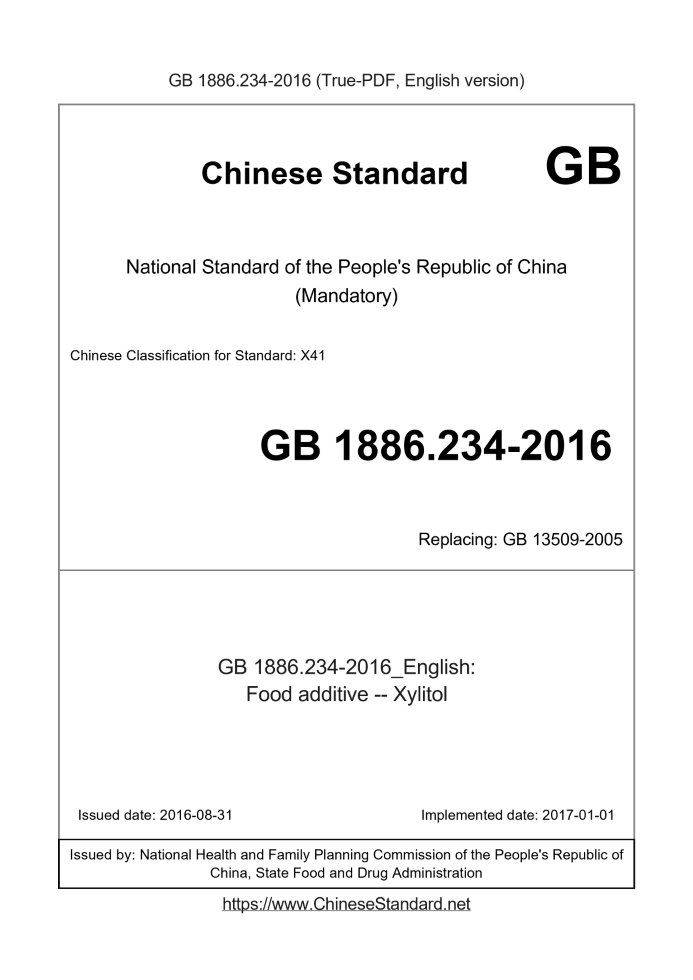
National Standards of People's Republic of China
National Food Safety Standard
Xylitol Food Additive
Issued on.2016-08-31
2017-01-01 implementation
People's Republic of China
National Health and Family Planning Commission released
Foreword
This standard replaces GB 13509-2005 "Food Additives Xylitol."
This standard compared with GB 13509-2005, the main changes are as follows.
--- Standard name was changed to "national food safety standards for food additives Xylitol";
--- Modify the scope;
--- Modify the identification test;
--- Modify the content of xylitol and other polyols detection methods;
--- Modified residue on ignition, other polyols and Nickel indicators;
--- Remove the physical and chemical indicators of heavy metals in the melting point and indicators;
--- Modified sugar (glucose) in the detection method.
National Food Safety Standard
Xylitol Food Additive
1 Scope
This standard applies to corn cobs, bagasse and wood as raw materials by hydrolysis, purification made xylose, food made by the hydrogenation process again
Additives xylitol, xylose, or directly as raw material by hydrogenation process into food additives xylitol.
2 molecular formula, relative molecular mass and structural formula
Formula 2.1
C5H12O5
2.2 formula
2.3 relative molecular mass
152.15 (according to 2013 international relative atomic mass)
3 Technical requirements
3.1 Sensory requirements
Sensory requirements shall comply with the requirements of Table 1.
Table 1 Sensory requirements
Project requires test methods
Color White
State crystal or crystalline powder
Take appropriate sample is placed in a clean, dry white porcelain dish, under natural light, observe its color and
status
3.2 Physical and Chemical Indicators
Physical and chemical indicators should be consistent with the provisions of Table 2.
Table 2. Physical and chemical indicators
Item Index Test Method
Xylitol content (dry basis), w /% 98.5 ~ 101.0 Appendix A A.3
Loss on drying, w /% ≤ 0.50 GB 5009.3 a vacuum drying method
Residue on ignition, w /% ≤ 0.10 Appendix A A.4
Reducing sugar (glucose), w /% ≤ 0.20 Appendix A A.5
Other polyols, w /% ≤ 1.0 Appendix A A.3
Nickel (Ni)/(mg/kg) ≤ 1.0 GB 5009.138
Lead (Pb)/(mg/kg) ≤ 1.0 GB 5009.12
Total arsenic (As)/(mg/kg) ≤ 3.0 GB 5009.11
He said a sample of about 1g.
Appendix A
Testing method
A.1 General Provisions
This standard reagents and water in the absence of other specified requirements, refer to the three water analytical reagent and GB 6682 regulations. As used standard
Quasi-titration solution, impurity measurement standard solution, preparations and products, did not indicate when the other requirements, according to GB/T 601, GB/T 602,
GB/T 603 provisions prepared. This solution was used in the test does not indicate what is formulated with solvent, it refers to an aqueous solution.
A.2 Identification Test
A.2.1 solubility
Easily soluble in water, slightly soluble in ethanol.
A.2.2 melting point
According to GB/T 617-2006 4.2 instrumental method were measured. A melting point in the range of 92.0 ℃ ~ 96.0 ℃.
A.2.3 infrared absorption spectrum
The sample spectra with standard spectra of potassium bromide dispersion of xylitol (see Figure B.1) compare the two should be basically the same.
A.3 Determination of the content of xylitol and other polyols
A.3.1 Gas Chromatography
A.3.1.1 Method summary
After acetylation of a sample, by gas chromatography (with flame ionization detector) measurement and control standards, based on retention time qualitative, within
Standard method.
A.3.1.2 Reagents and materials
A.3.1.2.1 ethanol.
A.3.1.2.2 pyridine.
A.3.1.2.3 acetic anhydride.
A.3.1.2.4 xylitol standards.
A.3.1.2.5 mannitol standard.
A.3.1.2.6 dulcitol standards.
A.3.1.2.7 L- arabinitol standards.
A.3.1.2.8 sorbitol standards.
A.3.1.2.9 erythritol standard (internal standard).
A.3.1.3 instruments and equipment
A.3.1.3.1 gas chromatograph with flame ionization detector.
A.3.1.3.2 balance.
A.3.1.3.3 water bath.
A.3.1.3.4 oven.
A.3.1.4 reference chromatographic conditions
A.3.1.4.1 Column. (14% - cyanopropyl phenyl) - dimethylpolysiloxane capillary column, 30m × 0.25mm × 0.25μm. Or equivalent
Column.
A.3.1.4.2 temperature program. Initial temperature 170 ℃, 10min maintained; at a rate of 1 ℃/min raised to 180 ℃, 10min maintained; then to
Rate of 30 ℃/min was raised to 240 ℃, maintained 5min.
A.3.1.4.3 Inlet temperature. 240 ℃.
A.3.1.4.4 detector temperature. 250 ℃.
A.3.1.4.5 Carrier gas. nitrogen.
A.3.1.4.6 carrier gas flow rate. 2.0mL/min.
A.3.1.4.7 Hydrogen. 50mL/min.
A.3.1.4.8 Air. 50mL/min.
A.3.1.4.9 Split ratio. 100.
A.3.1.4.10 Injection volume. 1.0μL.
A.3.1.5 analysis step
Preparation A.3.1.5.1 internal standard solution
Weigh erythritol standard (internal standard) 500mg, accurate to 0.0001g, dissolved in water, into 25mL volumetric flask, dilute to
Volume, and mix.
A.3.1.5.2 Preparation of standard solution
Each weighed 25mg of mannitol, dulcitol, L- arabitol and xylitol sorbitol and 4.9g standard, accurate to
0.0001g, dissolved in water, were transferred to 100mL volumetric flask, dilute to volume, and mix. The resulting solution was to draw 1mL 100mL
Round-bottomed flask, 1.0mL internal standard solution, at 60 ℃ water bath rotary evaporated, then add ethanol 1mL, shake to dissolve, in
60 ℃ water bath rotary evaporated to dryness. 1mL of pyridine was added to dissolve the residue, acetic anhydride is added 1mL, cover tightly, vortexed 30s,
70 ℃ oven placed 30min remove and let cool.
A.3.1.5.3 preparation of the sample solution
Take about 5g of sample, accurately weighed, accurate to 0.0001g, dissolved in water, transferred to 100mL volumetric flask, dilute to volume, mix
uniform. The resulting solution was to draw 1mL 100mL round bottom flask, 1.0mL internal standard solution, at 60 ℃ water bath rotary evaporated, plus
Anhydrous ethanol 1mL, shake to dissolve at 60 ℃ water bath rotary evaporated to dryness. 1mL of pyridine was added to dissolve the residue, acetic anhydride
1mL, cover tightly, vortex mixing 30s, 70 ℃ oven placed 30min remove and let cool.
A.3.1.5.4 Determination
In reference chromatographic conditions, inject the standard solution and a sample solution. Retention time with reference to the components and chromatogram figure
Figure B.2.
A.3.1.6 Calculation Results
Mass content of xylitol or other polyols Wi scores, according to formula (A.1) calculation, as other polyols L- arabitol, galactose
Alcohol, mannitol and sorbitol content combined.
wi =
ms × Ru
mu × Rs ×
100% (A.1)
Where.
Ms --- Quality standard solution of xylitol or other polyols, in milligrams (mg);
Mu --- sample mass reduction after drying, in milligrams (mg);
Ru --- sample xylitol or other polyols and erythritol derivative response value ratio;
Rs --- standard solution of xylitol or other polyols and erythritol derivative response ratio.
The results parallel arithmetic mean of the measurement results shall prevail. Two independent determination of xylitol obtained under repeatability conditions results
The absolute difference is not more than 2% of the arithmetic mean of the two independent determination results of other polyols absolute difference of not more than 0.1%.
A.3.2 liquid chromatography
A.3.2.1 Method summary
Samples dissolved in water, liquid chromatography, quantified by external standard.
A.3.2.2 Reagents and materials
A.3.2.2.1 Water. a water.
A.3.2.2.2 acetonitrile. chromatography.
A.3.2.2.3 xylitol standards.
A.3.2.2.4 L- arabinitol standards.
A.3.2.2.5 sorbitol standards.
A.3.2.2.6 dulcitol standards.
A.3.2.2.7 mannitol standard.
A.3.2.3 instruments and equipment
High performance liquid chromatography with a differential detector.
A.3.2.4 reference chromatographic conditions
A.3.2.4.1 column. polystyrene divinylbenzene resin filler analytical column, 300mm × 7.8mm. Or an equivalent column.
A.3.2.4.2 mobile phase. acetonitrile - water (3565).
A.3.2.4.3 flow rate. 0.6mL/min.
A.3.2.4.4 column temperature. 75 ℃.
A.3.2.4.5 testing room temperature. 45 ℃.
A.3.2.4.6 Injection volume. 20μL.
A.3.2.5 analysis step
A.3.2.5.1 Preparation of standard solution
Weigh accurately mannitol standards, L- arabinitol standards, sorbitol standards, galactose and xylose alcohol standard each 0.1g
Alcohol standard 2.5g, accurate to 0.0001g, water volume to 100mL volumetric flask. Then Pipette 2.0mL, 4.0mL, 6.0mL,
The standard solution 8.0mL to 10mL volumetric flask, water volume, the preparation containing xylitol 5.0mg/mL, 10.0mg/mL,
15.0mg/mL, 20.0mg/mL, 25.0mg/mL and mannitol, L- arabitol, sorbitol, dulcitol 0.2mg/mL,
0.4mg/mL, 0.6mg/mL, 0.8mg/mL, 1.0mg/mL of mixed standard solution series.
A.3.2.5.2 Preparation of sample solution
Take a sample of approximately 2g dry weight loss after accurate weighing, accurate to 0.0001g, water volume to 100mL volumetric flask.
A.3.2.5.3 Determination
In reference chromatographic conditions were injected into the series of standard solution, sample solution was measured by external standard method with a series of standard solution for calibration
table. Retention time with reference to the components and chromatogram shown in Figure B.3.
A.3.2.6 Calculation Results
Mass content of xylitol or other polyols Wi scores, according to equation (A.2) calculation, as other polyols L- arabitol, galactose
Alcohol, mannitol and sorbitol content combined.
wi =
mi × Asi
m × Ai ×
100% (A.2)
Where.
mi --- standard solution in a mass of component i in grams (g);
Asi --- sample measured response value of a component i;
M --- sample mass reduction after drying, in grams (g);
Measured response of a component i Ai --- standard solution.
The results parallel arithmetic mean of the measurement results shall prevail. Two independent determination of xylitol obtained under repeatability conditions results
The absolute difference is not more than 2% of the arithmetic mean of the two independent determination results of other polyols absolute difference of not more than 0.1%.
A.4 Determination of residue on ignition
A.4.1 Analysis step
Accurately weighed sample 2g, accurate to 0.0001g, has put constant quality crucible or platinum dish, add about 0.5mL of sulfuric acid wetting
Sample on the electric heating carbonization, and then transferred to a high temperature furnace at 600 ℃ ± 25 ℃ burning to completely gray, and then weighed to quality
Constant.
A.4.2 Calculation Results
Burning residue mass fraction w2, according to equation (A.3) Calculated.
w2 =
m1-m2
m × 100%
(A.3)
Where.
The residue was added to the crucible M1 --- mass in grams (G);
m2 --- empty crucible mass in grams (g);
m --- sample mass, in grams (g).
The results parallel arithmetic mean of the measurement results shall prevail. Twice under the same condition of independent determination results obtained absolute difference
Not more than 0.02%.
A.5 reducing sugar (glucose) Determination
A.5.1 Method summary
Bennett reducing sugars in the sample reagent divalent copper ion reacts with the red cuprous oxide, cuprous oxide when iodine is oxidized, and
Into divalent copper ions, the excess iodine with sodium thiosulfate, oxidation reaction consumption to calculate the iodine content of reducing sugar.
A.5.2 Reagents and materials
A.5.2.1 hydrochloric acid solution. c (HCl) = 1mol/L.
A.5.2.2 iodine standard solution. c (
2I2
) = 0.04mol/L. Said 7.2g of potassium iodide and iodine 5.0762g dubbed 1000mL solution, save
In a brown bottle (to be placed after 24h shake use).
A.5.2.3 sodium thiosulfate standard titration solution. c (Na2S2O3) = 0.04mol/L. The exact amount of 400mL calibrated 0.1mol/L
Sodium thiosulfate standard solution dubbed 1000mL.
A.5.2.4 acetic acid solution. Measure 48mL glacial acetic acid, diluted to 1000mL.
A.5.2.5 starch indicator solution. 10g/L.
A.5.2.6 Bennett reagents.
Solution A. 16g in 150mL of water was added copper sulfate (CuSO4 · 5H2O), stirred and dissolved;
Solution B. 150g in 650mL water was added successively trisodium citrate, 130g of anhydrous sodium carbonate, 10g of sodium hydrogencarbonate, and heated
Dissolve;
The two solutions A and B mixing cooled, diluted with water to 1000mL filtered, placed after 24h used.
A.5.3 Analysis step
Accurately weighed sample 5g, accurate to 0.001g, placed in 250mL conical flask, Bennett reagent 20mL, add a few grains of glass beads,
Heating and controlling the temperature exactly inside 4min ± 0.25min boil and continue to boil rapidly cooled with tap water after 3min. In the first conical flask
Was added 50mL of water, 50mL acetic acid was coupled, accurate pipette iodine standard solution was added 20mL, hydrochloric acid solution was added 25mL, full
Shaking the red precipitate is completely dissolved, the excess iodine back titration with sodium thiosulfate standard titration solution, towards the end (by the dark brown pale green)
, Add about 5 drops of starch indicator for the end and continue titration until the color turned light blue as the end point. While doing the blank test.
A.5.4 Calculation Results
Sugar mass fraction w3, according to equation (A.4) Calculated.
w3 =
(V0-V1) × c × 0.112
0.04 × m
(A.4)
Where.
V0 --- blank test consumption of sodium thiosulfate standard titration solution volume in milliliters (mL);
V1 --- sample consumption of sodium thiosulfate standard titration solution volume in milliliters (mL);
c --- the actual concentration of sodium thiosulfate standard titration solution, expressed in moles per liter (mol/L);
0.112 --- 0.04 (
2I2
) Mol/L of iodine standard solution (glucose) 1mL equivalent glucose 0.112g;
0.04 --- concentration of iodine standard solution, unit mole per liter (mol/L);
M --- the quality of the sample, in grams (g).
The results parallel arithmetic mean of the measurement results shall prevail. Twice under the same condition of independent determination results obtained absolute difference
Not more than 0.01%.
Appendix B
Xylitol standard infrared spectrum with xylitol and other polyols measured chromatogram
B.1 xylitol standard infrared spectrum
Xylitol standard infrared spectrum is shown in Figure B.1.
Figure B.1 xylitol infrared spectrum
B.2 xylitol and other polyols by gas chromatogram
Xylitol and other polyols by gas chromatography shown in Figure B.2.
Explanation.
1 --- erythritol;
2 --- L- arabinitol;
3 --- Xylitol;
4 --- galactitol;
5 --- mannitol;
6 --- sorbitol.
7 --- reference retention time of each component. erythritol 3.6min, L- arabitol 10.6min, xylitol 13.5min, dulcitol 23.7min, mannitol
Sugar alcohols 25.2min, sorbitol 26.4min.
Figure B.2 xylitol and other polyols standard gas chromatogram
B.3 Determination of xylitol and other polyols liquid chromatograph
Xylitol and other polyols measured by liquid chromatography is shown in Figure B.3.
Explanation.
1 --- L- arabinitol;
2 --- mannitol;
3 --- Xylitol;
4 --- galactitol;
5 --- sorbitol;
6 --- reference retention time of the components. L- arabitol 28.0min, mannitol 31.0min, xylitol 35.3min, dulcitol 39.8min, Mountain
Sorbitol 41.7min.
Figure B.3 xylitol and other polyols standard liquid chromatogram
...