FZ/T 81008-2021 PDF English
Price & Delivery
US$245.00 · In stock · Download in 9 secondsFZ/T 81008-2021: Jackets
Delivery: 9 seconds. True-PDF full-copy in English & invoice will be downloaded + auto-delivered via email. See step-by-step procedure
Status: Valid
FZ/T 81008: Historical versions
| Standard ID | USD | BUY PDF | Delivery | Standard Title (Description) | Status |
| FZ/T 81008-2021 | 245 | Add to Cart | Auto, 9 seconds. | Jackets | Valid |
| FZ/T 81008-2011 | 719 | Add to Cart | 3 days | Jackets | Obsolete |
| FZ/T 81008-2004 | 799 | Add to Cart | 5 days | Jackets | Obsolete |
| FZ/T 81008-1994 | 279 | Add to Cart | 3 days | Jackets | Obsolete |
Click to Preview this PDF
Similar standards
FZ/T 81008-2021: Jackets
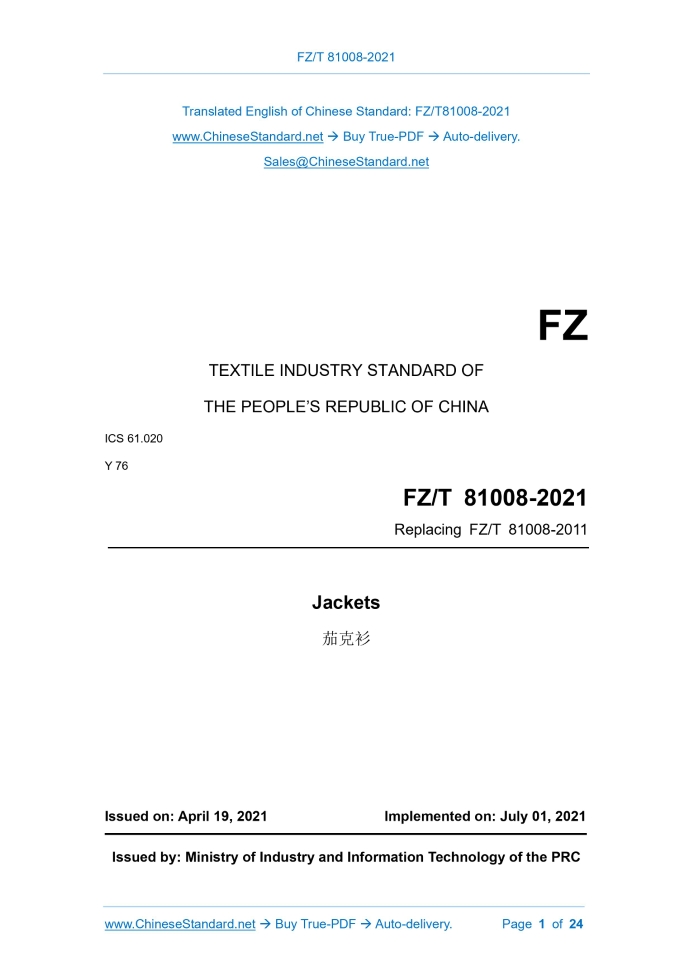
---This is an excerpt. Full copy of true-PDF in English version (including equations, symbols, images, flow-chart, tables, and figures etc.), auto-downloaded/delivered in 9 seconds, can be purchased online: https://www.ChineseStandard.net/PDF.aspx/FZT81008-2021FZ TEXTILE INDUSTRY STANDARD OF THE PEOPLE’S REPUBLIC OF CHINA ICS 61.020 Y 76 Replacing FZ/T 81008-2011 Jackets Issued on. APRIL 19, 2021 Implemented on. JULY 01, 2021 Issued by. Ministry of Industry and Information Technology of the PRC
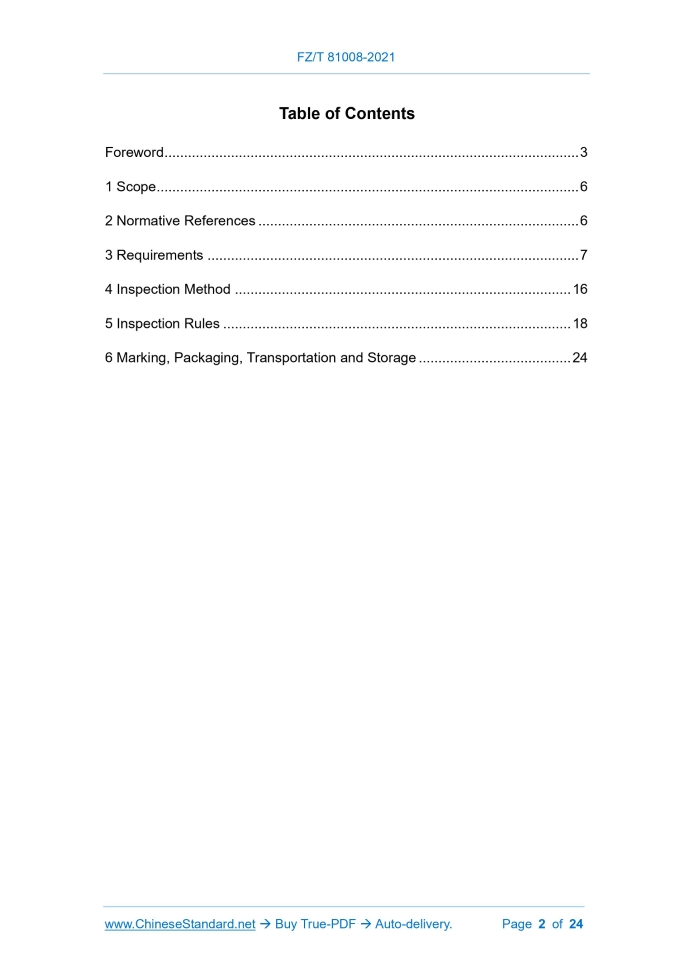
Table of Contents
Foreword... 3 1 Scope... 6 2 Normative References... 6 3 Requirements... 7 4 Inspection Method... 16 5 Inspection Rules... 18 6 Marking, Packaging, Transportation and Storage... 241 Scope
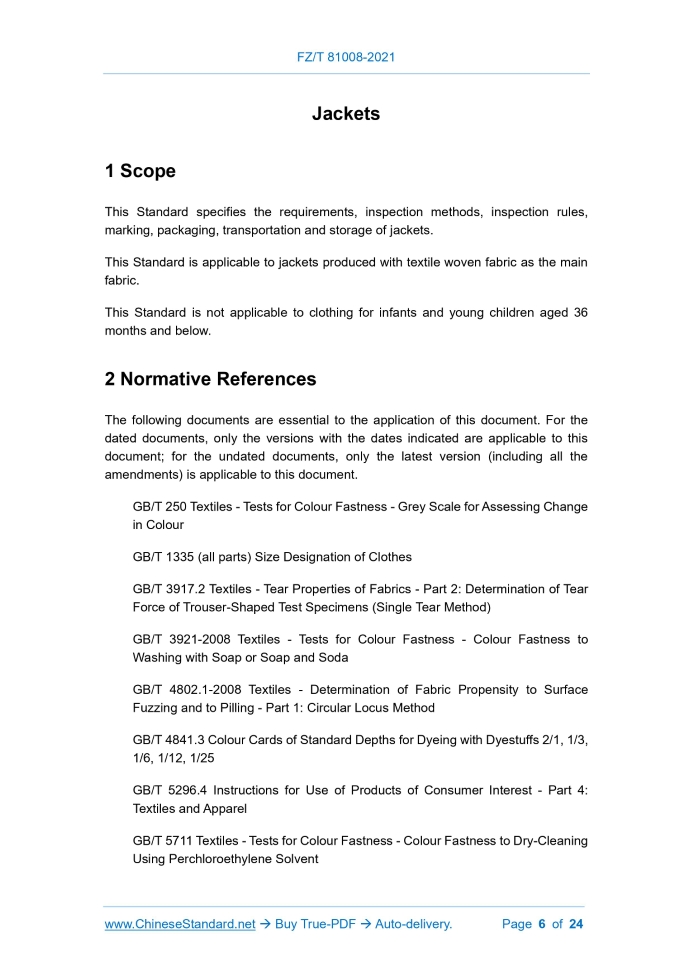
This Standard specifies the requirements, inspection methods, inspection rules, marking, packaging, transportation and storage of jackets. This Standard is applicable to jackets produced with textile woven fabric as the main fabric. This Standard is not applicable to clothing for infants and young children aged 36 months and below.2 Normative References
The following documents are essential to the application of this document. For the dated documents, only the versions with the dates indicated are applicable to this document; for the undated documents, only the latest version (including all the amendments) is applicable to this document. GB/T 250 Textiles - Tests for Colour Fastness - Grey Scale for Assessing Change in Colour GB/T 1335 (all parts) Size Designation of Clothes GB/T 3917.2 Textiles - Tear Properties of Fabrics - Part 2.Determination of Tear Force of Trouser-Shaped Test Specimens (Single Tear Method) GB/T 3921-2008 Textiles - Tests for Colour Fastness - Colour Fastness to Washing with Soap or Soap and Soda GB/T 4802.1-2008 Textiles - Determination of Fabric Propensity to Surface Fuzzing and to Pilling - Part 1.Circular Locus Method GB/T 4841.3 Colour Cards of Standard Depths for Dyeing with Dyestuffs 2/1, 1/3, 1/6, 1/12, 1/253 Requirements
3.1 Instructions for use The instructions for use are in accordance with the provisions of GB/T 5296.4 and GB 31701. 3.2 Size designation 3.3 Raw materials 3.3.1 Fabric According to the relevant textile fabric standards, select fabrics that meet the quality requirements of this Standard. 3.3.2 Lining Use lining that is suitable for the used fabric and meets the quality requirements of this Standard. 3.3.3 Auxiliary materials 3.3.3.1 Interlining, shoulder pads, decorative lace, pocket cloth Use interlinings, shoulder pads, decorative lace, pocket cloth suitable for the performance and colour of the used fabrics and linings, and their quality shall meet the requirements of this Standard. 3.3.3.2 Sutures, cords, elastic bands Use sutures, cords, and elastic bands that are suitable for the performances of the used fabrics, linings, and auxiliary materials (except for decorative threads and decorative ribbons).4 Inspection Method
4.1 Inspection tools 4.1.1 Steel tape or ruler, the graduation value is 1mm. 4.2 Specification determination The measurement method of the main part specifications is in accordance with the provisions of GB/T 31907; and the allowable deviation of the specifications is in accordance with the provisions of Table 4. 4.3 Appearance determination 4.3.1 The appearance inspection generally adopts lighting; the illuminance is no less than 600lx; and northern sky light can also be used if possible. 4.3.4 The stitch density is measured at 3cm on the finished sewing stitches (except for thick and thin parts). 4.3.5 The degree of warp and weft yarn skew is measured according to the provisions of GB/T 14801, and the result is calculated according to Formula (1). 4.4.6 The colour fastness to transfer in joints shall be tested in accordance with Method A specified in GB/T 31127-2014. 4.4.7 Pilling is tested according to the provisions of GB/T 4802.1-2008 (among them, sanded fabrics, wool-like fabrics, and worsted fabrics are in accordance with Method E; loose-structured worsted fabrics and woollen fabrics are in accordance with Method F; and the rest are in accordance with Method D). 4.4.8 The tearing strength shall be tested in accordance with the provisions of GB/T 3917.2. 4.4.9 The peeling strength of the adhesive lining shall be tested in accordance with the provisions of FZ/T 80007.1. 4.4.13 For the test items that do not mention the sampling location, specimens can be selected from the finished product according to the test needs.5 Inspection Rules
5.1 Inspection classification 5.1.1 Finished product inspection is divided into exit-factory inspection and type inspection. The timing of the type inspection is based on the actual conditions of the manufacturer or the contractual agreement. It is generally carried out when the production is transferred, resumed after stopping, and the raw materials or processes have major changes. 5.2 Appearance quality grade and defect classification rules 5.2.1 Appearance quality classification The quality level of finished products is based on the existence and severity of defects. The single product in the sample is classified by the number of defects and its severity; and the batch grade is classified by the number of grades of the single products in the sample. 5.2.2 Classification of appearance defects A single product that does not meet the technical requirements specified in this Standard constitutes a defect. 5.4 Judgment rules 5.4.1 Appearance judgment of a single piece (sample) Superior products. the number of serious defects = 0, the number of major defects = 0, the number of minor defects ≤ 4. 5.4.2 Determination of batch grade Superior product batch. The number of superior products in the appearance inspection sample is ≥90%, the number of Class-I products and qualified products is ≤10%, and no unqualified products are included. All physical and chemical property tests have met the requirements of superior products index. 5.4.3 Qualification judgment If the number of batches judged in the random inspection complies with the provisions of corresponding level in 5.4.2, it shall be judged to be a qualified batch. Otherwise, the batch of products is judged to be unqualified. 5.4.4 Re-inspection provisions When the number of batches judged in the random inspection does not meet the requirements of this Standard or the delivery parties have objections to the inspection results, a second random inspection can be carried out, and the number of random inspections shall be doubled. Take the re-inspection result as the final judgment result.6 Marking, Packaging, Transportation and Storage
The marking, packaging, transportation and storage of the finished products shall be implemented in accordance with FZ/T 80002. FZ/T 81008-2021 FZ TEXTILE INDUSTRY STANDARD OF THE PEOPLE’S REPUBLIC OF CHINA ICS 61.020 Y 76 Replacing FZ/T 81008-2011 Jackets Issued on. APRIL 19, 2021 Implemented on. JULY 01, 2021 Issued by. Ministry of Industry and Information Technology of the PRCTable of Contents
Foreword... 3 1 Scope... 6 2 Normative References... 6 3 Requirements... 7 4 Inspection Method... 16 5 Inspection Rules... 18 6 Marking, Packaging, Transportation and Storage... 241 Scope
This Standard specifies the requirements, inspection methods, inspection rules, marking, packaging, transportation and storage of jackets. This Standard is applicable to jackets produced with textile woven fabric as the main fabric. This Standard is not applicable to clothing for infants and young children aged 36 months and below.2 Normative References
The following documents are essential to the application of this document. For the dated documents, only the versions with the dates indicated are applicable to this document; for the undated documents, only the latest version (including all the amendments) is applicable to this document. GB/T 250 Textiles - Tests for Colour Fastness - Grey Scale for Assessing Change in Colour GB/T 1335 (all parts) Size Designation of Clothes GB/T 3917.2 Textiles - Tear Properties of Fabrics - Part 2.Determination of Tear Force of Trouser-Shaped Test Specimens (Single Tear Method) GB/T 3921-2008 Textiles - Tests for Colour Fastness - Colour Fastness to Washing with Soap or Soap and Soda GB/T 4802.1-2008 Textiles - Determination of Fabric Propensity to Surface Fuzzing and to Pilling - Part 1.Circular Locus Method GB/T 4841.3 Colour Cards of Standard Depths for Dyeing with Dyestuffs 2/1, 1/3, 1/6, 1/12, 1/253 Requirements
3.1 Instructions for use The instructions for use are in accordance with the provisions of GB/T 5296.4 and GB 31701. 3.2 Size designation 3.3 Raw materials 3.3.1 Fabric According to the relevant textile fabric standards, select fabrics that meet the quality requirements of this Standard. 3.3.2 Lining Use lining that is suitable for the used fabric and meets the quality requirements of this Standard. 3.3.3 Auxiliary materials 3.3.3.1 Interlining, shoulder pads, decorative lace, pocket cloth Use interlinings, shoulder pads, decorative lace, pocket cloth suitable for the performance and colour of the used fabrics and linings, and their quality shall meet the requirements of this Standard. 3.3.3.2 Sutures, cords, elastic bands Use sutures, cords, and elastic bands that are suitable for the performances of the used fabrics, linings, and auxiliary materials (except for decorative threads and decorative ribbons).4 Inspection Method
4.1 Inspection tools 4.1.1 Steel tape or ruler, the graduation value is 1mm. 4.2 Specification determination The measurement method of the main part specifications is in accordance with the provisions of GB/T 31907; and the allowable deviation of the specifications is in accordance with the provisions of Table 4. 4.3 Appearance determination 4.3.1 The appearance inspection generally adopts lighting; the illuminance is no less than 600lx; and northern sky light can also be used if possible. 4.3.4 The stitch density is measured at 3cm on the finished sewing stitches (except for thick and thin parts). 4.3.5 The degree of warp and weft yarn skew is measured according to the provisions of GB/T 14801, and the result is calculated according to Formula (1). 4.4.6 The colour fastness to transfer in joints shall be tested in accordance with Method A specified in GB/T 31127-2014. 4.4.7 Pilling is tested according to the provisions of GB/T 4802.1-2008 (among them, sanded fabrics, wool-like fabrics, and worsted fabrics are in accordance with Method E; loose-structured worsted fabrics and woollen fabrics are in accordance with Method F; and the rest are in accordance with Method D). 4.4.8 The tearing strength shall be tested in accordance with the provisions of GB/T 3917.2. 4.4.9 The peeling strength of the adhesive lining shall be tested in accordance with the provisions of FZ/T 80007.1. 4.4.13 For the test items that do not mention the sampling location, specimens can be selected from the finished product according to the test needs.5 Inspection Rules
5.1 Inspection classification 5.1.1 Finished product inspection is divided into exit-factory inspection and type inspection. The timing of the type inspection is based on the actual conditions of the manufacturer or the contractual agreement. It is generally carried out when the production is transferred, resumed after stopping, and the raw materials or processes have major changes. 5.2 Appearance quality grade and defect classification rules 5.2.1 Appearance quality classification The quality level of finished products is based on the existence and severity of defects. The single product in the sample is classified by the number of defects and its severity; and the batch grade is classified by the number of grades of the single products in the sample. 5.2.2 Classification of appearance defects A single product that does not meet the technical requirements specified in this Standard constitutes a defect. 5.4 Judgment rules 5.4.1 Appearance judgment of a single piece (sample) Superior products. the number of serious defects = 0, the number of major defects = 0, the number of minor defects ≤ 4. 5.4.2 Determination of batch grade Superior product batch. The number of superior products in the appearance inspection sample is ≥90%, the number of Class-I products and qualified products is ≤10%, and no unqualified products are included. All physical and chemical property tests have met the requirements of superior products index. 5.4.3 Qualification judgment If the number of batches judged in the random inspection complies with the provisions of corresponding level in 5.4.2, it shall be judged to be a qualified batch. Otherwise, the batch of products is judged to be unqualified. 5.4.4 Re-inspection provisions When the number of batches judged in the random inspection does not meet the requirements of this Standard or the delivery parties have objections to the inspection results, a second random inspection can be carried out, and the number of random inspections shall be doubled. Take the re-inspection result as the final judgment result.6 Marking, Packaging, Transportation and Storage
The marking, packaging, transportation and storage of the finished products shall be implemented in accordance with FZ/T 80002. ......Source: Above contents are excerpted from the full-copy PDF -- translated/reviewed by: www.ChineseStandard.net / Wayne Zheng et al.