Path:
Home >
MISC >
Page348 > WS/T 574-2018
Price & Delivery
US$179.00 · In stock · Download in 9 secondsWS/T 574-2018: Purified reagent water in the clinical laboratory
Delivery: 9 seconds. True-PDF full-copy in English & invoice will be downloaded + auto-delivered via email. See
step-by-step procedureStatus: Valid
| Std ID | Version | USD | Buy | Deliver [PDF] in | Title (Description) |
| WS/T 574-2018 | English | 179 |
Add to Cart
|
3 days [Need to translate]
|
Purified reagent water in the clinical laboratory
|
Click to Preview a similar PDF
Basic data
| Standard ID | WS/T 574-2018 (WS/T574-2018) |
| Description (Translated English) | Purified reagent water in the clinical laboratory |
| Sector / Industry | Health Industry Standard (Recommended) |
| Classification of Chinese Standard | C50 |
| Word Count Estimation | 7,783 |
| Date of Issue | 2018-04-27 |
| Date of Implementation | 2018-11-01 |
| Regulation (derived from) | State-Health-Communication (2018) 7 |
| Issuing agency(ies) | National Health Commission |
WS/T 574-2018: Purified reagent water in the clinical laboratory
---This is a DRAFT version for illustration, not a final translation. Full copy of true-PDF in English version (including equations, symbols, images, flow-chart, tables, and figures etc.) will be manually/carefully translated upon your order.
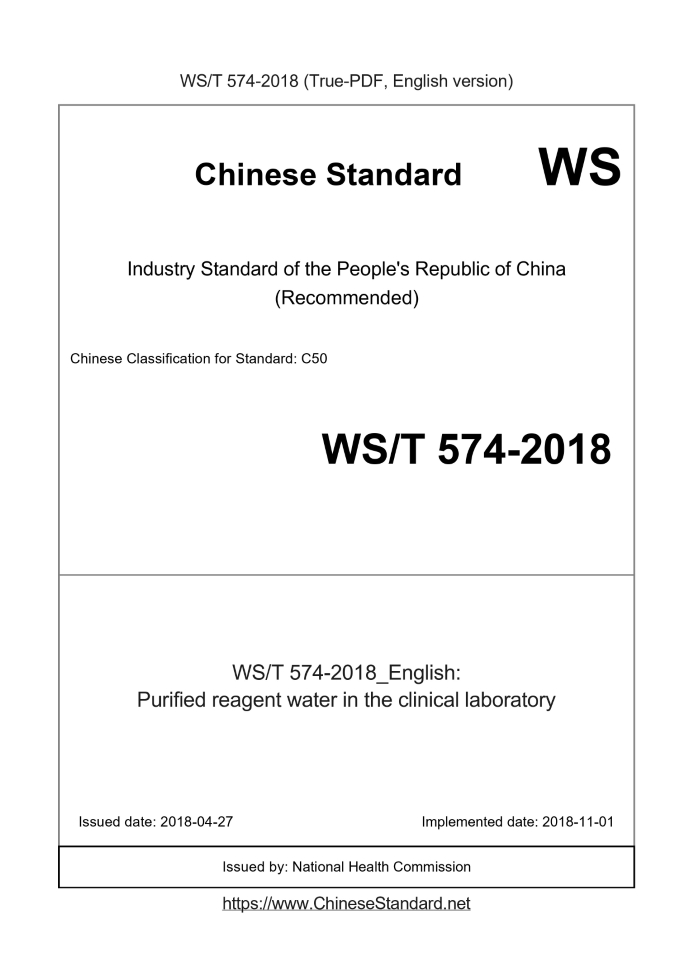
Purified reagent water in the clinical laboratory
ICS 11.020
C50
WS
People's Republic of China Health Industry Standard
Purified water for clinical laboratory reagents
Published on.2018 - 04 - 27
2018 - 11 - 01 implementation
National Health Council of the People's Republic of China
Foreword
This standard was drafted in accordance with the rules given in GB/T 1.1-2009.
This standard was drafted. Beijing Hospital, Peking Union Medical College Hospital of Chinese Academy of Medical Sciences, Beijing Tongren Hospital affiliated to Capital Medical University, China
Tongji Hospital affiliated to Tongji Medical College, University of Science and Technology.
The main drafters of this standard. Zhang Chuanbao, Zhao Haijian, Ma Wei, Yan Ying, Ge Menglei, Zhao Wei, Qiu Ling, Liu Xiangyu, Sun Zizhen, Guan Qing.
Purified water for clinical laboratory reagents
1 Scope
This standard specifies the requirements, confirmation, test methods and monitoring frequency of purified water for clinical laboratory reagents.
This standard is applicable to purified water used in clinical laboratory general experimental reagent preparation, calibration products and reconstitution of quality control products.
This standard does not apply to purified water for special experiments. Special clinical laboratory water should refer to relevant standards and specific requirements.
2 Normative references
The following documents are indispensable for the application of this document. For dated references, only the dated version applies to this document.
For undated references, the latest edition (including all amendments) is appropriate for this document.
GB/T 11446.4 Test method for electronic grade water resistivity
GB/T 11446.8 Test method for total organic carbon in electronic grade water
GB/T 11446.9 Instrumental test method for electronic grade water particles
GB/T 11446.10 Filter-culture test method for total number of electronic water bacteria
3 Terms and definitions
The following terms and definitions apply to this document.
3.1
Purified water
Pure water
Water without impurities. In clinical laboratories, purified water (pure water) refers to pure water equipment by reverse osmosis, distillation, ion exchange, etc.
The prepared deionized water has a conductivity of usually < 10 μS/cm (25 ° C), that is, a resistivity of >0.1 MΩ·cm (25 ° C).
3.2
Resistivity resistivity
The resistance value measured between two opposite faces of a 1 cm3 (positive cube) aqueous solution at a specified temperature (usually 25 ° C). Usually with symbols
ρ is expressed in Ω·cm (25 ° C).
3.3
Conductivity conductivity
The physical quantity, electrical conductivity and electrical resistivity that characterize the electrical conductivity of an object are reciprocal. The common unit of conductivity is mS/m or μS/cm.
3.4
Total organic carbon (TOC)
The total amount of carbon present in the form of various organic substances in water, including organic matter that is easily oxidized by general strong oxidants and needs to be oxidized by special methods.
Organic matter.
3.5
Particulate matter
In addition to gas, a substance that is non-liquid dispersed in water and forms a heterogeneous mixture.
3.6
Purified reagent water
Pure water for reagent preparation, calibrator and reconstitution of quality control products for general laboratory experiments.
4 Requirement for purified water for reagents
4.1 Resistivity
The resistivity should be ≥10 MΩ·cm (25 ° C), or the conductivity ≤0.1 μS/cm (25 ° C).
4.2 TOC
TOC< 500 ng/g (ppb).
4.3 Total number of microorganisms
The total number of microorganisms is < 10 CFU/mL.
4.4 Number of particles
The number of particles having a diameter of 0.22 μm or more is < 1 (undetectable).
5 Requirements for purified water for special reagents
For most of the special reagents with purified water, if there are no relevant standards and specific requirements, you can refer to the following requirements.
a) resistivity ≥ 18 MΩ · cm (25 ° C);
b) TOC < 10 ng/g (ppb);
c) the total number of microorganisms < 10 CFU/mL;
d) The number of particles having a diameter of 0.22 μm or more is < 1 (undetectable).
6 Reagent confirmation with purified water
For pure water that meets the requirements, the laboratory also needs to confirm that it is suitable for the specific experimental method. The following methods are available for reference.
Confirm one or more.
- Test the water sample as a blank sample. the response should be obtained, such as no response signal, zero result, etc.
- Preparation of test reagents or culture medium. determination of fixed value samples (reference materials, method calibrators, previously analyzed patient samples, etc.)
The results are in line with expectations.
-- Formulation of quality control products (where applicable), the results are comparable to the quality control results of the identified reagents used in water. After sure
Recognized reagent water includes.
a) different batches of pure water that have been confirmed;
b) confirmed pure water prepared prior to disinfection of the pure water system stored under appropriate conditions;
c) Purified pure water from other suppliers or other pure water systems.
-- Review the laboratory quality control records, and the quality control results meet the clinical needs.
7 Test methods and monitoring frequency
7.1 Sensory testing
The visual inspection should be colorless, transparent, clear liquid, and the nose should be odorless. Need to be tested every day.
7.2 Conductivity/resistivity
Determine according to GB/T 11446.4. Testing is required for each experiment and can be performed online or offline. Conductivity meter needs regular school
The calibration frequency should be no less than once a year.
7.3 Total organic carbon
The measurement is carried out according to the national standard GB/T 11446.8; the subcontracting laboratory can be commissioned for testing once a year.
7.4 Total number of bacteria
The measurement was carried out in accordance with GB/T 11446.10. Subcontracting laboratories can be commissioned for testing once a month.
7.5 Number of particles
Determine according to GB/T 11446.9. Subcontracting laboratories can be commissioned for testing, once a quarter.
references
[1] CLSI Preparation and Testing of Reagent Water in the Clinical Laboratory; Approved Guidline-Fourth
Edition.
[2] GB/T 6682 analytical laboratory water specifications and test methods
[3] GB/T 11446-2013 electronic grade water
[4] YY/T 1244-2014 Purified water for in vitro diagnostic reagents
...