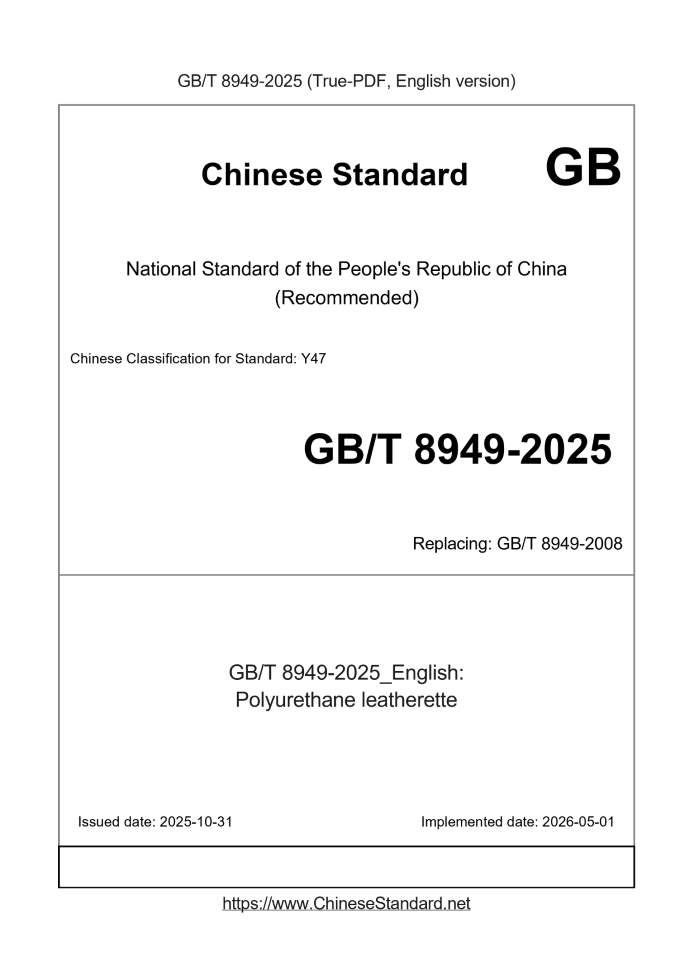
GB/T 8949: Historical versions
| Standard ID | USD | BUY PDF | Lead-Days | Standard Title (Description) | Status |
| GB/T 8949-2025 | RFQ |
ASK
|
3 days
|
Polyurethane leatherette
| |
| GB/T 8949-2008 | 160 |
Add to Cart
|
Auto, < 3 mins
|
Polyurethane dry-processing artificial leather
| Valid |
| GB/T 8949-1995 | 359 |
Add to Cart
|
3 days
|
Polyurethane dry-processing artificial leather
| Obsolete |
| GB 8949-1988 | RFQ |
ASK
|
3 days
|
Polyurethane artificial leather
| Obsolete |
Basic data
Standard ID: GB/T 8949-2025 (GB/T8949-2025)
Description (Translated English): Polyurethane leatherette
Sector / Industry: National Standard (Recommended)
Classification of Chinese Standard: Y47
Classification of International Standard: 59.080.40
Date of Issue: 2025-10-31
Date of Implementation: 2026-05-01
Older Standard (superseded by this standard): GB/T 8949-2008
GB/T 8949-2008: Polyurethane dry-processing artificial leather
---This is a DRAFT version for illustration, not a final translation. Full copy of true-PDF in English version (including equations, symbols, images, flow-chart, tables, and figures etc.) will be manually/carefully translated upon your order.
Polyurethane dry-processing artificial leather
ICS 59.080.40
Y47
National Standards of People's Republic of China
Replace GB/T 8949-1995
Polyurethane dry artificial leather
Released on.2008-08-19
2009-05-01 implementation
General Administration of Quality Supervision, Inspection and Quarantine of the People's Republic of China
Issued by China National Standardization Administration
Foreword
This standard replaces GB/T 8949-1995 "Synthetic leather for shoe uppers".
Compared with GB/T 8949-1995, the main changes of this standard are.
---The product classification of this standard is changed from the original standard into A, B, and C according to the purpose of the original standard, to A and B according to the bucky classification;
---In 4.1.3, the length of each roll and its limit deviation are generally 50m/roll from the original standard length, and the limit deviation is +0.1m.
The length of the change is determined through negotiation between the supplier and the buyer, and the length cannot be a negative deviation;
--- This standard 4.1.4 determines different indicators according to the length of each roll;
---This standard cancels product quality classification;
--- This standard is divided into general physical and mechanical properties (4.3.1) and negotiated physical and mechanical properties (4.3.2) according to the importance of physical and mechanical properties to products;
--- This standard 5.2 is changed from the original standard to a sample of more than 0.65m cut along the longitudinal direction of the product to be cut 0.8m along the longitudinal direction of the product;
---This standard increases the requirements for rub resistance, bursting strength, yellowing resistance, and low temperature folding resistance.
This standard will replace GB/T 8949-1995 from the date of implementation.
This standard was proposed by the China National Light Industry Council.
This standard is under the jurisdiction of the National Plastic Products Standardization Technical Committee.
This standard was drafted by Wuxi Shuangxiang Microfiber Materials Co., Ltd., Foshan Plastics Group Co., Ltd. Shuanglong Branch, Zhejiang Hexin
Industrial Group Co., Ltd. participated in the drafting.
The main drafters of this standard. Gu Yuting, Tian Weikun, Zou Huizhong, Jin Mei, Zou Yonghua.
The previous editions replaced by this standard are as follows.
---GB/T 8949-1988, GB/T 8949-1995.
Polyurethane dry artificial leather
1 scope
This standard specifies the product classification, requirements, test methods, inspection rules and signs, packaging, transportation, and storage of polyurethane dry-process artificial leather.
This standard is applicable to artificial leather manufactured by dry polyurethane coating process with knitted fabric base and woven fabric base as the base.
2 Normative references
The clauses in the following documents become clauses of this standard after being quoted in this standard. For dated reference documents, all subsequent amendments
(Excluding errata content) or revised editions are not applicable to this standard. However, all parties who have reached an agreement based on this standard are encouraged to study
Is the latest version of these files available? For undated references, the latest version is applicable to this standard.
GB/T 250-2008 Textile color fastness test evaluation gray sample card for discoloration
GB/T 1040.1-2006 Determination of tensile properties of plastics Part 1.General
GB/T 1040.3-2006 Determination of tensile properties of plastics Part 3.Test conditions for films and sheets
GB/T 1539-2007 Determination of Burst Resistance of Paperboard
GB/T 2828.1-2003 Sampling inspection procedures by attributes Part 1.Sampling plan for batch-by-batch inspection searched by acceptance quality limit (AQL)
GB/T 2918-1998 Standard environment for condition adjustment and testing of plastic samples
GB/T 3920-2008 Textile Color Fastness Test Color Fastness to Rubbing
GB 7565-1987 Textile color fastness test Cotton and viscose standard lining fabric specifications
QB/T 2714-2005 Leather Physical and Mechanical Test Determination of Folding Fastness
HG/T 2-162-1965 Plastic film low temperature elongation test method
HG/T 3689-2001 Footwear yellowing resistance test method
3 Product Classification
Products are classified by cloth, see Table 1.
5.3 Thickness
5.3.1 Instruments
The dial gauge thickness gauge shall meet the following requirements.
a) Measuring force. 0.8N~1.5N;
b) Probe diameter. 7mm~10mm;
c) Graduation value. 0.01mm.
5.3.2 Test procedure
Use a dial gauge thickness gauge to measure the left, center, and right 3 points along the width of the product. The measurement result is expressed as an arithmetic average, accurate to
0.01mm.
5.4 Width
Use a steel tape measure or meter with an accuracy of 1mm to measure 3 locations along the length at will, and take the minimum result to be accurate to 1mm.
5.5 Length
Measure with a suitable measuring tool or instrument, and the result is accurate to 1cm.
5.6 Appearance
Visual inspection under natural light.
5.7 Tensile load and elongation at break
The tensile testing machine should meet the requirements of 5.1.2 to 5.1.5 in GB/T 1040.3-2006, and the test procedures and results shall be in accordance with GB/T 1040.3-
Chapter 9 of.2006 stipulates that the distance between the sample markings is 100mm, and the test speed is.200mm/min ± 10mm/min.
5.8 Tear load
Cut 75mm at the center line of the specimen width parallel to the length direction, and clamp the cut ends in opposite directions to meet the 5.7 regulations.
On a fixed tensile testing machine fixture, test at a speed of.200mm/min±10mm/min, record the maximum tearing load of the sample,
The test results are expressed as the arithmetic average of three samples in each of the warp and weft directions, with an accuracy of 0.1N.
5.9 Stripping load
5.9.1 Instruments
5.9.1.1 The tensile testing machine should meet the requirements of GB/T 1040.3.
5.9.1.2 Constant temperature oven with blast device.
5.9.2 Test procedure
Take 3 samples, paste the coating and the same leather coating together with an appropriate amount of adhesive glue (the sample must be firmly bonded), and then put the bonded test
Place the sample at 135°C±5°C for 2 hours at a constant temperature, then peel off the laminated sample by hand, separate the coating of the sample from the base cloth to 50mm, and then
Clamp the separated ends on the clamps of the tensile testing machine and peel them at a speed of.200 mm/min. Record the maximum load of the sample peeling.
5.9.3 Test results
5.9.3.1 Take the arithmetic average of each group of samples, accurate to 1N;
5.9.3.2 If the coating of the sample is completely broken, the maximum reading shall be the peeling load of the sample;
5.9.3.3 The coating and base fabric of the sample cannot be peeled off by hand, and the peeling load of the sample is qualified. If a set of samples cannot be peeled off, the test result is qualified.
5.10 Surface color fastness
According to the regulations of GB/T 3920-2008, the standard lining fabric for friction should meet the regulations of GB/T 7565-1987.
The test results are evaluated according to GB/T 250-2008.
5.11 Anti-blocking
5.11.1 Apparatus
Constant temperature oven with blast device.
5.11.2 Test procedure
Take 6 samples, a total of 3 sets of coating and coating pairs. Clamp the three groups of samples in two glass clips of 60mm×60mm×3mm,
And press a 10N load on the clip, put it into a constant temperature oven with a blast device at a temperature of (80±2) ℃, and keep it constant for 3 hours
Take out the sample, place it at room temperature for 30 minutes, and then uncover the aligned sample by hand.
5.11.3 Test results
The test result is judged according to the following method.
Level 5.Can be peeled off gently.
Level 4.Peel off slightly harder.
Level 3.Peel off with a certain amount of force, and the surface is not damaged.
Level 2.Peeling under gravity with incomplete peeling.
Level 1.Cannot be peeled off.
Take the lowest value of the three sets of samples as the test result.
5.12 Folding fastness
According to the provisions of QB/T 2714-2005.
5.13 Cold resistance
Carry out according to HG/T 2-162, the test temperature is -10℃. In the test results, if one of the three samples is broken, the cold resistance is unqualified.
5.14 Rub resistance
5.14.1 Test equipment
Scott type rubbing tester.
5.14.2 Test procedure
The two sample cloth surfaces in the same direction are overlapped with each other, and then they are placed in the grips of the rubbing tester with a grip interval of 30mm. Shrink gradually
The distance between the clamps is small, so that the cloth surfaces of the two specimens are lightly contacted and then the load is applied, and the distance is reduced until the load is 1kg. At frequency
120 times/min, under the condition of 50mm stroke, reciprocate 1000 times, observe whether there are cracks, damages or separation of the cloth base and the coating on the surface of the artificial leather
And other phenomena. If there is a sample with the above phenomenon, the rubbing resistance of the sample is judged to be unqualified.
5.15 Bursting strength
5.15.1 Test equipment
The Mulun burst strength testing machine should meet the requirements of GB/T 1539-2007.
5.15.2 Test procedure
Place the coating surface of the sample facing down, clamp it with a ring clamp, and evenly press it until the sample is broken. The burst strength is expressed by the pressure when the sample is burst,
The test result is the arithmetic mean of 3 samples, accurate to 0.1MPa.
5.16 Yellowing resistance
5.16.1 Test device
The test device should meet the requirements of 4.1 in HG/T 3689-2001.
5.16.2 Test method
The test is carried out in accordance with the provisions of the 7.1A method in HG/T 3689-2001, where the irradiation time is 24h.
5.16.3 Test results
Determine the test result in accordance with the provisions of Chapter 8 in HG/T 3689-2001.
6 Inspection rules
6.1 Batch
The products shall be checked and accepted in batches. Products with the same raw material, same specification and same process shall be one batch, and the quantity of each batch shall not exceed 15,000m.
e) Trademark;
f) Inspector code;
g) Marks such as pressure-proof and moisture-proof;
h) Purpose;
i) Precautions for use;
j) Shelf life or storage period.
8.Packaging, transportation and storage
8.1 Packaging
The product is generally rolled into a neat round roll with a core, and packed with plastic film or wrapping paper.
8.2 Transportation
During the transportation of the product, load and unload with care, do not press heavily, do not sun or rain, and keep the package intact.
8.3 Storage
The product should be stored in a clean, dry, ventilated warehouse with a suitable temperature, avoid extrusion, sun protection, and away from heat sources. The product storage period is no more than 18 months from the date of production.
......
Tips & Frequently Asked Questions:
Question 1: How long will the true-PDF of GB/T 8949-2025_English be delivered?
Answer: Upon your order, we will start to translate GB/T 8949-2025_English as soon as possible, and keep you informed of the progress. The lead time is typically 1 ~ 3 working days. The lengthier the document the longer the lead time.
Question 2: Can I share the purchased PDF of GB/T 8949-2025_English with my colleagues?
Answer: Yes. The purchased PDF of GB/T 8949-2025_English will be deemed to be sold to your employer/organization who actually pays for it, including your colleagues and your employer's intranet.
Question 3: Does the price include tax/VAT?
Answer: Yes. Our tax invoice, downloaded/delivered in 9 seconds, includes all tax/VAT and complies with 100+ countries' tax regulations (tax exempted in 100+ countries) -- See Avoidance of Double Taxation Agreements (DTAs):
List of DTAs signed between Singapore and 100+ countriesQuestion 4: Do you accept my currency other than USD?
Answer: Yes. If you need your currency to be printed on the invoice, please write an email to Sales@ChineseStandard.net. In 2 working-hours, we will create a special link for you to pay in any currencies. Otherwise, follow the normal steps: Add to Cart -- Checkout -- Select your currency to pay.
Question 5: Should I purchase the latest version GB/T 8949-2025?
Answer: Yes. Unless special scenarios such as technical constraints or academic study, you should always prioritize to purchase the latest version GB/T 8949-2025 even if the enforcement date is in future. Complying with the latest version means that, by default, it also complies with all the earlier versions, technically.