GB/T 7736-2008 PDF English
GB/T 7736: Historical versions
| Standard ID | USD | BUY PDF | Delivery | Standard Title (Description) | Status |
| GB/T 7736-2008 | 70 | Add to Cart | Auto, 9 seconds. | Ultrasonic inspecting method for macro-structure and imperfection of steel | Valid |
| GB/T 7736-2001 | 399 | Add to Cart | 3 days | Ultrasonic inspecting method for macro-structure and imperfection of steel | Obsolete |
| GB/T 7736-1987 | 359 | Add to Cart | 3 days | Ultrasonic inspecting method for macro-structure and imperfection of steel | Obsolete |
GB/T 7736-2008: Ultrasonic inspecting method for macro-structure and imperfection of steel
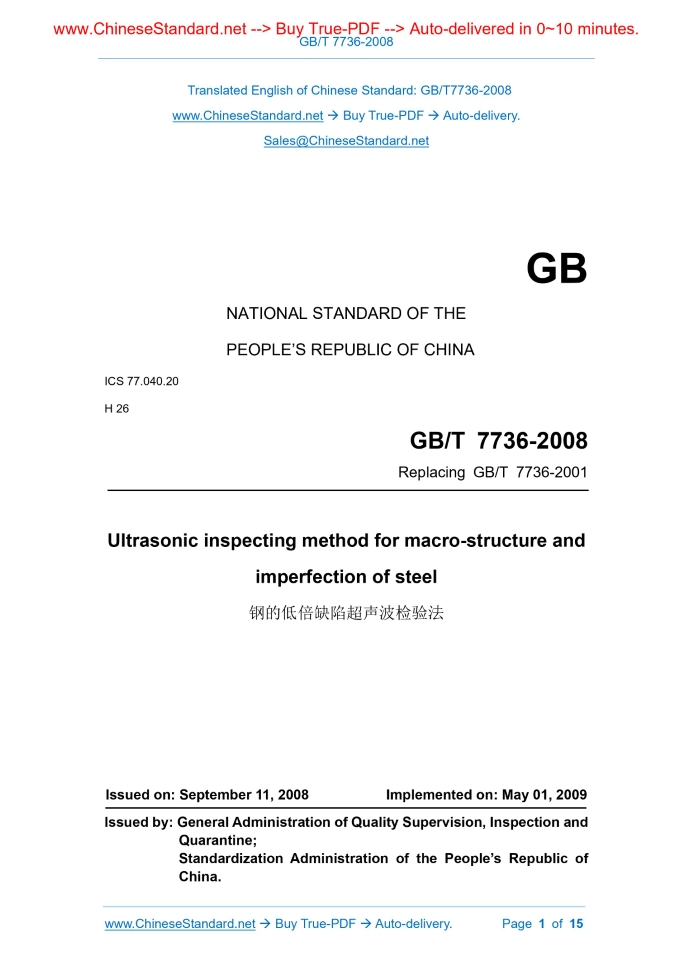
---This is an excerpt. Full copy of true-PDF in English version (including equations, symbols, images, flow-chart, tables, and figures etc.), auto-downloaded/delivered in 9 seconds, can be purchased online: https://www.ChineseStandard.net/PDF.aspx/GBT7736-2008NATIONAL STANDARD OF THE PEOPLE’S REPUBLIC OF CHINA ICS 77.040.20 H 26 Replacing GB/T 7736-2001 Ultrasonic inspecting method for macro-structure and imperfection of steel ISSUED ON: SEPTEMBER 11, 2008 IMPLEMENTED ON: MAY 01, 2009 Issued by: General Administration of Quality Supervision, Inspection and Quarantine; Standardization Administration of the People’s Republic of China.
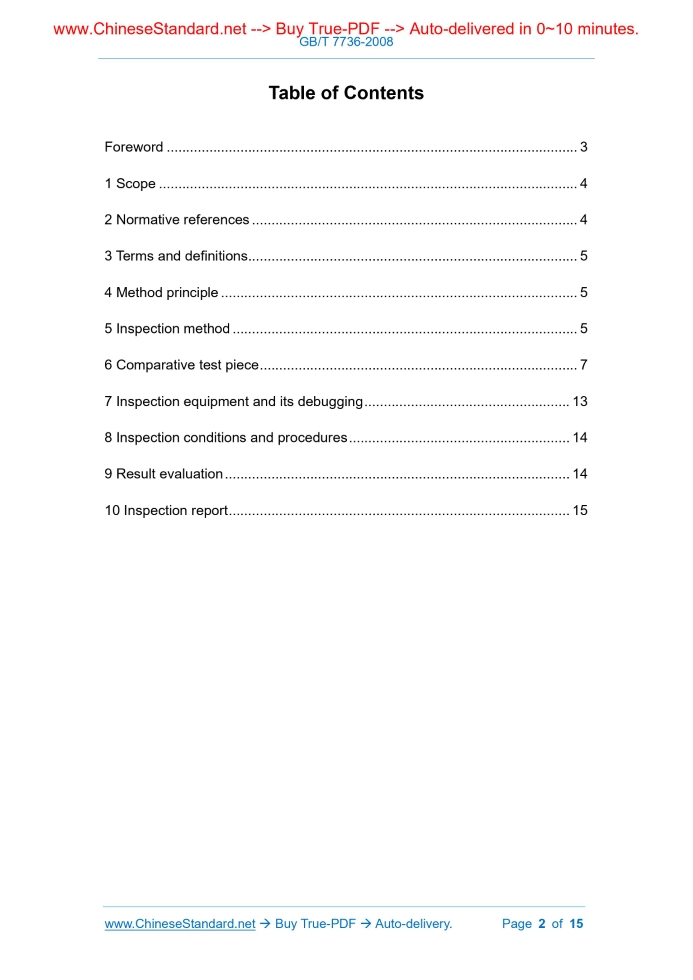
Table of Contents
Foreword ... 3 1 Scope ... 4 2 Normative references ... 4 3 Terms and definitions ... 5 4 Method principle ... 5 5 Inspection method ... 5 6 Comparative test piece ... 7 7 Inspection equipment and its debugging ... 13 8 Inspection conditions and procedures ... 14 9 Result evaluation ... 14 10 Inspection report ... 15 Ultrasonic inspecting method for macro-structure and imperfection of steel1 Scope
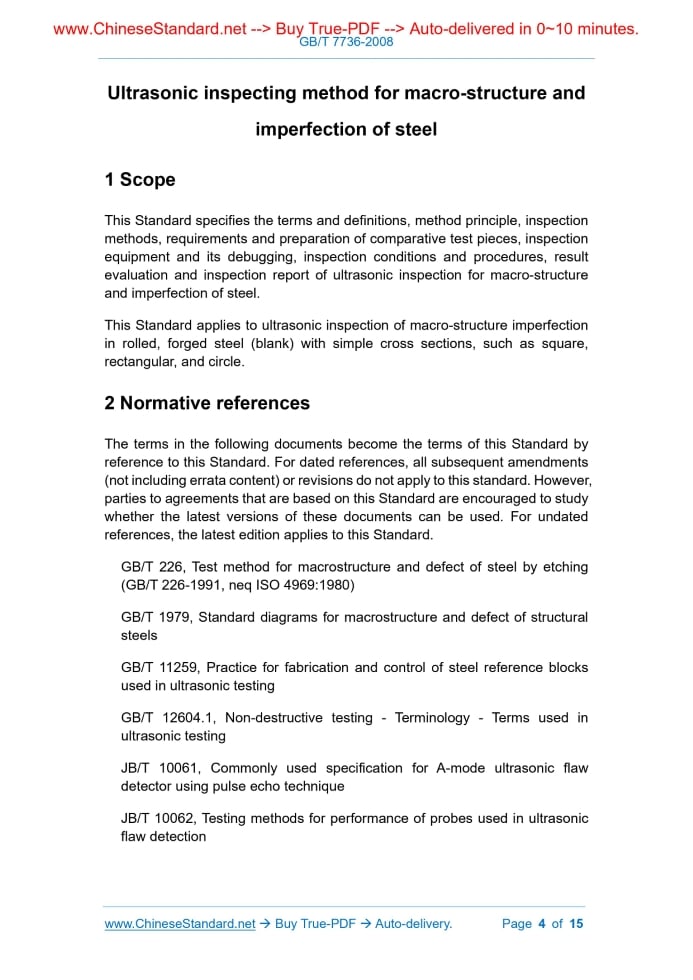
This Standard specifies the terms and definitions, method principle, inspection methods, requirements and preparation of comparative test pieces, inspection equipment and its debugging, inspection conditions and procedures, result evaluation and inspection report of ultrasonic inspection for macro-structure and imperfection of steel. This Standard applies to ultrasonic inspection of macro-structure imperfection in rolled, forged steel (blank) with simple cross sections, such as square, rectangular, and circle.2 Normative references
The terms in the following documents become the terms of this Standard by reference to this Standard. For dated references, all subsequent amendments (not including errata content) or revisions do not apply to this standard. However, parties to agreements that are based on this Standard are encouraged to study whether the latest versions of these documents can be used. For undated references, the latest edition applies to this Standard. GB/T 226, Test method for macrostructure and defect of steel by etching (GB/T 226-1991, neq ISO 4969:1980) GB/T 1979, Standard diagrams for macrostructure and defect of structural steels GB/T 11259, Practice for fabrication and control of steel reference blocks used in ultrasonic testing GB/T 12604.1, Non-destructive testing - Terminology - Terms used in ultrasonic testing JB/T 10061, Commonly used specification for A-mode ultrasonic flaw detector using pulse echo technique JB/T 10062, Testing methods for performance of probes used in ultrasonic flaw detection3 Terms and definitions
Terms and definitions determined by GB/T 12604.1 are applicable to this Standard. 4 Method principle 4.1 General principle Use the ultrasonic echo method; use the principle that echo occurs at different acoustic impedance interfaces during the propagation of ultrasonic waves in steel for flaw detection. 4.2 Small signal overlay The ultrasonic flaw detection method is a display of the flaw status within a certain volume range. Although the size of a single flaw is smaller than the specified limit of detection, the overlay of signals from many small flaw groups makes detection of the flaw group possible. 4.3 Structure echo The acoustic impedance changes which are caused by chemical composition segregation and inhomogeneity of structure in macro-structure can still obtain a sufficiently large echo signal in ultrasonic detection. This phenomenon of ultrasonic echo that is caused by macro-structure is called structure echo. 4.4 Flaw equivalent Adopt equivalent calibration of short horizontal hole artificial flaw and big flat- bottomed hole artificial flaws, or use big flat-bottomed equivalent calculation. 5 Inspection method Use longitudinal or horizontal waves to perform ultrasonic inspection along the peripheral surface of the steel (blank). The contact method or immersion method can be used. A coupling medium of good coupling effect and harmless to the human body and the steel surface shall be selected. 5.1 Contact method Use a single-straight probe to scan the workpiece in the far field; use a double- crystal probe to scan the workpiece in the near field. It shall be ensured that the entire workpiece scan coverage is good. It is recommended that when the diameter or side length of the to-be-inspected steel (blank) is not more than 207 Inspection equipment and its debugging
7.1 Inspection equipment 7.1.1 The inspection equipment can be distinguished by the immersion method and the contact method. It is mainly composed of ultrasonic flaw detectors, probes, comparative samples, mechanical transmission devices and water tanks. Its comprehensive sensitivity shall reliably detect the artificial flaws which are specified in this Standard. 7.1.2 The flaw detector is a device that uses echo technique; the probe is a straight probe or a double-crystal probe; its electrical performance, combined performance and test method shall comply with the relevant provisions of JB/T 10061 and JB/T 10062. 7.1.3 In principle, the contact method flaw detection can choose straight probes or double-crystal probes of different frequencies and specifications according to the product specifications and requirements. 7.1.4 The immersion method can choose water-immersion probe or focus probe according to product specifications. 7.2 Equipment debugging 7.2.1 Each time when the flaw detection equipment is re-used or the specifications are replaced, the specified comparative test piece shall be used for static and dynamic debugging. 7.2.2 The static debugging mainly adjusts the artificial flaw wave amplitude, the alarm gate position and amplitude; when setting the alarm sensitivity, it shall be debugged according to the minimum amplitude of the flaw. If the equivalent calculation method is used, first adjust the initial sensitivity of the instrument, that is, adjust the first bottom echo height to 50% to 80% of the full scale of the phosphor screen in the intact part of the tested sample, as the reference of the evaluated echo signal. Then, according to the requirements of the tested sample, calculate the gain value that is needed to be increased according to Formula (2), to meet the debugging requirements of the specified sensitivity; then, perform the inspection. 7.2.3 The dynamic debugging mainly adjusts the appropriate scanning speed to ensure good reproducibility of the manual flaw detection limit. 7.2.4 The scanning speed of the manual operation of the contact method shall not be greater than 3 m/min. ......Source: Above contents are excerpted from the full-copy PDF -- translated/reviewed by: www.ChineseStandard.net / Wayne Zheng et al.