GB/T 4079-2025 English PDF
Price & Delivery
US$335.00 · In stock · Download in 9 secondsGB/T 4079-2025: Test procedures for amplifiers and charge-sensitive preamplifiers used with detectors of ionizing radiation
Delivery: 9 seconds. True-PDF full-copy in English & invoice will be downloaded + auto-delivered via email. See step-by-step procedure
Status: Valid
GB/T 4079: Historical versions
| Standard ID | USD | BUY PDF | Delivery | Standard Title (Description) | Status |
| GB/T 4079-2025 | 335 | Add to Cart | Auto, 9 seconds. | Test procedures for amplifiers and charge-sensitive preamplifiers used with detectors of ionizing radiation | Valid |
| GB/T 4079-1994 | 739 | Add to Cart | 4 days | Test procedures for amplifiers and charge-sensitive preamplifiers used with detectors of ionizing radiation | Obsolete |
| GB 4079-1983 | 479 | Add to Cart | 4 days | Test procedures for amplifiers and preamplifiers for semiconductor detectors for ionizing radiation | Obsolete |
Click to Preview this PDF
Similar standards
GB/T 4079-2025: Test procedures for amplifiers and charge-sensitive preamplifiers used withdetectors of ionizing radiation
---This is an excerpt. Full copy of true-PDF in English version (including equations, symbols, images, flow-chart, tables, and figures etc.), auto-downloaded/delivered in 9 seconds, can be purchased online: https://www.ChineseStandard.net/PDF.aspx/GBT4079-2025
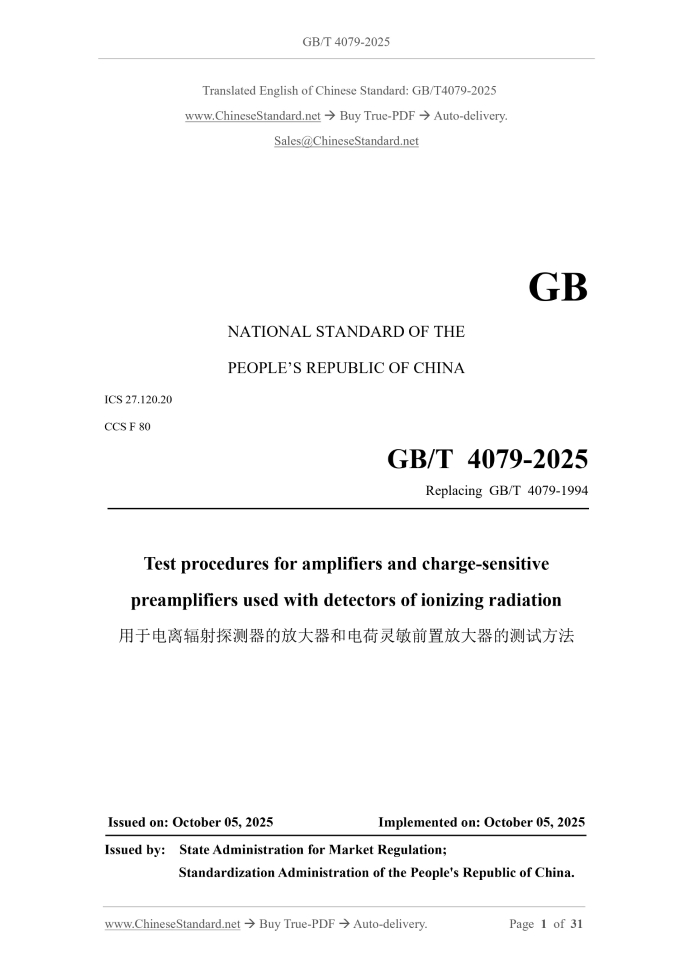
GB NATIONAL STANDARD OF THE PEOPLE’S REPUBLIC OF CHINA ICS 27.120.20 CCS F 80 Replacing GB/T 4079-1994 Test procedures for amplifiers and charge-sensitive preamplifiers used with detectors of ionizing radiation Issued on: OCTOBER 05, 2025 Implemented on: OCTOBER 05, 2025 Issued by. State Administration for Market Regulation; Standardization Administration of the People's Republic of China.
Table of Contents
Foreword... 3 1 Scope... 5 2 Normative references... 5 3 Terms and definitions... 5 4 Symbols... 9 5 Test conditions... 10 6 Test methods for the main parameters of the main amplifier... 13 7 Test methods for key parameters of the preamplifier... 23 Bibliography... 31 Test procedures for amplifiers and charge-sensitive preamplifiers used with detectors of ionizing radiation1 Scope
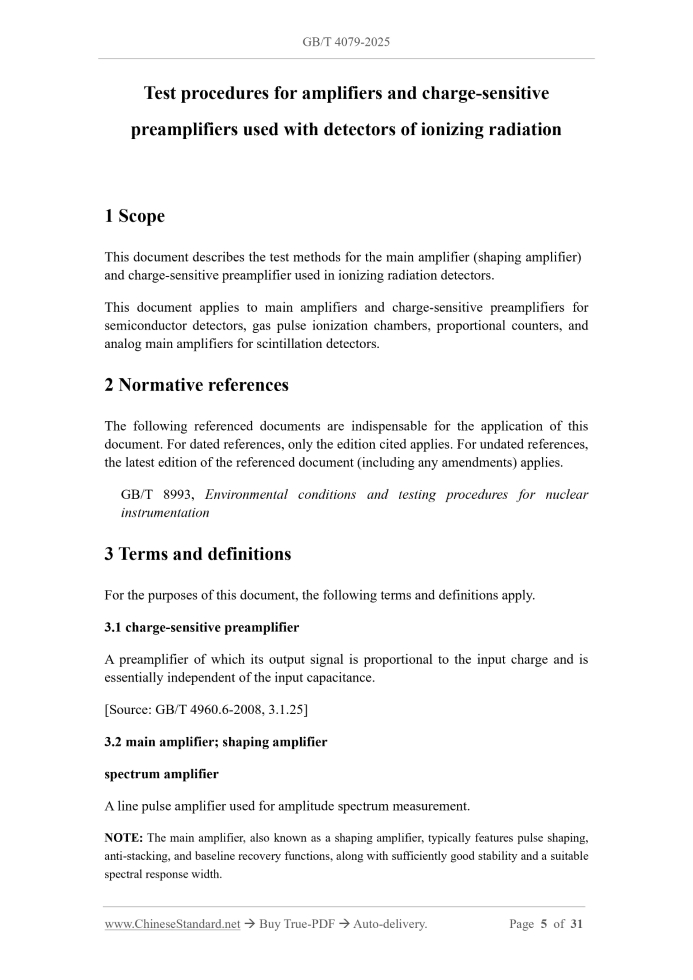
This document describes the test methods for the main amplifier (shaping amplifier) and charge-sensitive preamplifier used in ionizing radiation detectors. This document applies to main amplifiers and charge-sensitive preamplifiers for semiconductor detectors, gas pulse ionization chambers, proportional counters, and analog main amplifiers for scintillation detectors.2 Normative references
The following referenced documents are indispensable for the application of this document. For dated references, only the edition cited applies. For undated references, the latest edition of the referenced document (including any amendments) applies. GB/T 8993, Environmental conditions and testing procedures for nuclear instrumentation3 Terms and definitions
For the purposes of this document, the following terms and definitions apply. 3.1 charge-sensitive preamplifier A preamplifier of which its output signal is proportional to the input charge and is essentially independent of the input capacitance. [Source. GB/T 4960.6-2008, 3.1.25] 3.2 main amplifier; shaping amplifier spectrum amplifier A line pulse amplifier used for amplitude spectrum measurement. NOTE. The main amplifier, also known as a shaping amplifier, typically features pulse shaping, anti-stacking, and baseline recovery functions, along with sufficiently good stability and a suitable spectral response width. amplitude. (2) The deviation of the linear relationship between the number of channels and the pulse amplitude is divided by the maximum number of channels of the multichannel pulse amplitude analyzer. NOTE. It is expressed as a percentage. 3.19 differential nonlinearity (of measuring assembly) (1) The maximum deviation of the slope of the output and input relationship curve from the slope of the reference line. (2) Fluctuations in the uniformity of individual channel width in a multichannel analyzer. NOTE. It is expressed as a percentage. [Source. GB/T 4960.6-2008, 3.2.41, modified] 3.20 bipolar pulse A raised pulse on each side of the baseline. 3.21 baseline The average level. NOTE. In the case of non-overlapping pulses, the pulse deviates from this level and then returns to this level. 3.22 baseline restorer; BLR The line that quickly restores the baseline to its previous level after the amplifier outputs a pulse (or a series of pulses). 3.23 offset The DC voltage deviates from the specified voltage (or current) level. NOTE. Unless otherwise stated, this level is the baseline. 3.24 energy resolution (of a radiation spectrometer) The smallest difference in energy between two particles that a radiation spectrometer can distinguish. NOTE. Energy resolution is typically represented by a factor. This factor is the full width at half maximum (energy) of the peak in the monoenergetic particle distribution curve divided by the energy at the peak position. [Source. GB/T 4960.6-2008, 3.2.26] 3.25 resolving time The minimum time interval between two consecutive pulses that can still be distinguished. [Source. GB/T 4960.6-2008, 3.2.20] 3.26 terminating resistor A resistor connected across the output of an amplifier or signal generator. NOTE. The purpose of terminating resistors is to eliminate signal reflections at these terminals. 3.27 characteristic impedance The internal resistance (impedance) of a network (such as a coaxial cable or an attenuator). NOTE. When a resistor with the same impedance is used for termination, signal reflection can be avoided and the output signal is halved. 3.28 walk Changes in pulse height in the amplifier cause changes in the zero-crossing time. 3.29 full width at half maximum; FWHM On a distribution curve formed by a single peak, the distance between the x-coordinates of two points on the curve at half the peak value. [Source. GB/T 4960.6-2008, 3.2.27]4 Symbols
The following symbols apply to this document. t0.01.the minimum time interval between two consecutive, distinguishable pulses. t1/2.the time interval between two points in a unipolar pulse waveform where the amplitude is half the peak amplitude, in microseconds (μs). tp1.the time to peak of a bipolar pulse measured from 1% of the peak height of the first half-cycle to its peak center, in microseconds (μs). tp2.the time to peak of a bipolar pulse measured from 1% of the peak height of the first half-cycle to the peak center of the second peak, in microseconds (μs). tx0.the transit time of a bipolar pulse, in microseconds (μs).5 Test conditions
5.1 Test environment conditions The reference and standard test conditions for calibration and testing of the equipment under varying influence conditions covered in this document shall comply with the requirements of GB/T 8993. 5.2 Test schematic The test schematic for general amplifier parameters is shown in Figure 1.The terminating resistor R0 for both the pulse generator and the amplifier is typically 50 Ω. The cable selection shall match the impedance of R0. 5.3 Test equipment requirements 5.3.1 Pulse generator 5.3.1.1 Basic requirements for pulse generators The pulse generator has a maximum output amplitude Up greater than or equal to 10 V. The amplitude of the output pulse can be adjusted in minimum intervals of 10 mV. Unless otherwise specified, Up equals 10 V. Different Up values or adjustment methods shall only affect certain details of the measurement and shall not affect the overall measurement method. The pulse generator shall have at least two outputs. one direct output and one attenuated output. Each output shall have its own termination resistor and the same internal resistance r0 (r0 is 0.5 Ω or less). There shall also be an output for triggering oscilloscope scanning. The pulse generator can operate at the power supply frequency or other frequencies. Operating at other frequencies can be used to detect AC hum interference in the system. 5.3.1.2 Verify the pulse generator of the preamplifier A pulse generator with a flat-top pulse rise time (tr) less than or equal to 1 ns is generally used. Alternatively, a mercury relay tail pulse generator with a tr less than or equal to 5 ns can be used for all tests except for verifying the exponential decay performance of a charge-sensitive preamplifier. Generally, the pulse generator's tr (trajectory value) shall match the detector's tr. When verifying preamplifiers connected to semiconductor and gas detectors, because the detector's collection time varies, the pulse generator's tr shall not exceed 1/3 of the shortest tr of the detector or preamplifier system. When verifying preamplifiers connected to scintillation detectors, the pulse generator's tr shall be less than the preamplifier's tr. If the scintillation detector's tr is greater than the preamplifier's tr, the pulse generator shall be readjusted to match the scintillation detector's tr. The fall time of the pulse generator is faster than that of the preamplifier. 5.3.1.3 Verify the pulse generator of the main amplifier When verifying overload or pole-zero cancellation, a tail pulse shall be used. For other tests, a rectangular pulse generator can be used, or a tail pulse generator can also be used. The tail pulse can be obtained from a flat-topped pulse by simply adding a capacitor between the pulse generator and the attenuator. 5.3.2 Attenuator The attenuator can be part of the pulse generator or externally connected. Connected to the output of the pulse generator, each attenuator setting shall be matched to the coarse gain adjustment of the main amplifier. The accuracy and stability of the attenuator depend on the stability and accuracy of the connected resistors. The error caused by switching each setting on shall not exceed 1% of the output signal for that setting. 5.3.3 Capacitor box Figure 1 shows the circuit diagram of the capacitor box. The capacitor box contains a test capacitor Cc and a set of parallel capacitors Ct switched by a switch. The test ......Source: Above contents are excerpted from the full-copy PDF -- translated/reviewed by: www.ChineseStandard.net / Wayne Zheng et al.