GB/T 31289-2025 English PDF
Price & Delivery
US$215.00 · In stock · Download in 9 secondsGB/T 31289-2025: Portland cement used for ocean project
Delivery: 9 seconds. True-PDF full-copy in English & invoice will be downloaded + auto-delivered via email. See step-by-step procedure
Status: Valid
GB/T 31289: Historical versions
| Standard ID | USD | BUY PDF | Delivery | Standard Title (Description) | Status |
| GB/T 31289-2025 | 215 | Add to Cart | Auto, 9 seconds. | Portland cement used for ocean project | Valid |
| GB/T 31289-2014 | 209 | Add to Cart | 3 days | Portland cement used for ocean project | Valid |
Click to Preview this PDF
Similar standards
GB/T 31289-2025: Portland cement used for ocean project
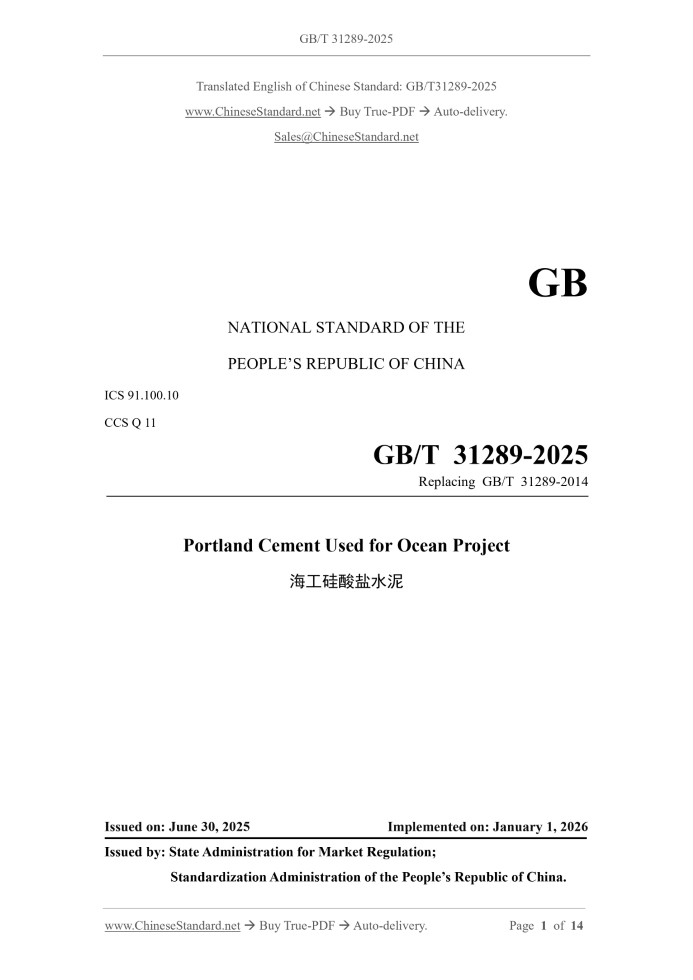
---This is an excerpt. Full copy of true-PDF in English version (including equations, symbols, images, flow-chart, tables, and figures etc.), auto-downloaded/delivered in 9 seconds, can be purchased online: https://www.ChineseStandard.net/PDF.aspx/GBT31289-2025GB NATIONAL STANDARD OF THE PEOPLE’S REPUBLIC OF CHINA ICS 91.100.10 CCS Q 11 Replacing GB/T 31289-2014 Portland Cement Used for Ocean Project 海工硅酸盐水泥 Issued on: JUNE 30, 2025 Implemented on: JANUARY 1, 2026 Issued by. State Administration for Market Regulation; Standardization Administration of the People’s Republic of China.
Table of Contents
Foreword... 3 1 Scope... 6 2 Normative References... 6 3 Terms and Definitions... 7 4 Classification and Codes... 7 5 Composition and Materials... 7 6 Strength Grades... 8 7 Technical Requirements... 8 8 Test Methods... 10 9 Inspection Rules... 10 10 Packaging, Marking, Transportation and Storage... 13 Appendix A (informative) Precautions for Using Portland Cement Used for Ocean Project... 14Foreword
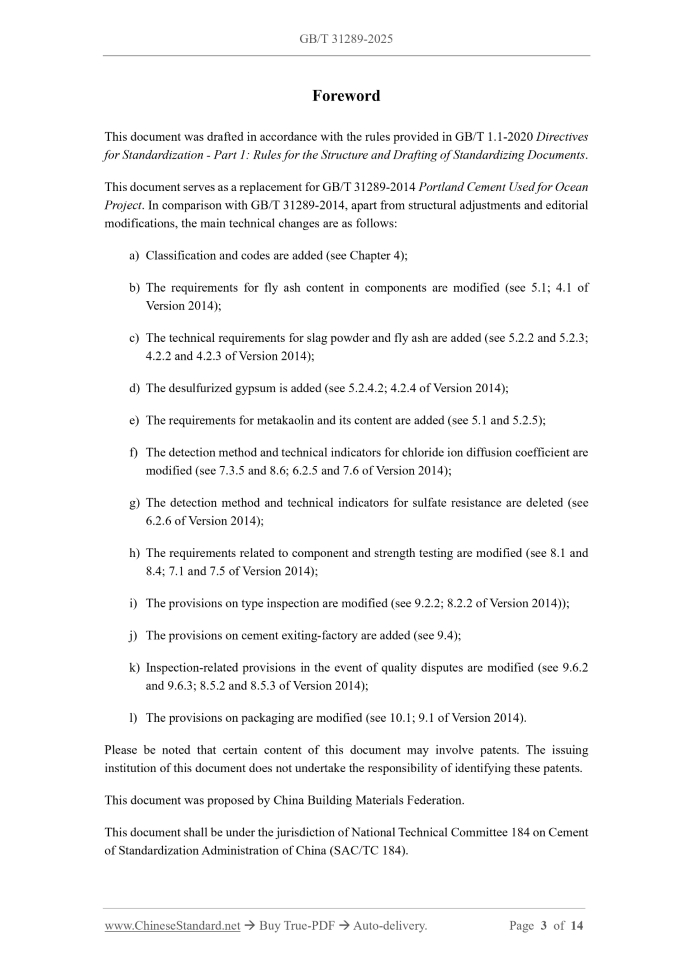
This document was drafted in accordance with the rules provided in GB/T 1.1-2020 Directives for Standardization - Part 1.Rules for the Structure and Drafting of Standardizing Documents. This document serves as a replacement for GB/T 31289-2014 Portland Cement Used for Ocean Project. In comparison with GB/T 31289-2014, apart from structural adjustments and editorial modifications, the main technical changes are as follows. a) Classification and codes are added (see Chapter 4); b) The requirements for fly ash content in components are modified (see 5.1; 4.1 of Version 2014); c) The technical requirements for slag powder and fly ash are added (see 5.2.2 and 5.2.3; 4.2.2 and 4.2.3 of Version 2014); d) The desulfurized gypsum is added (see 5.2.4.2; 4.2.4 of Version 2014); e) The requirements for metakaolin and its content are added (see 5.1 and 5.2.5); f) The detection method and technical indicators for chloride ion diffusion coefficient are modified (see 7.3.5 and 8.6; 6.2.5 and 7.6 of Version 2014); g) The detection method and technical indicators for sulfate resistance are deleted (see 6.2.6 of Version 2014); h) The requirements related to component and strength testing are modified (see 8.1 and 8.4; 7.1 and 7.5 of Version 2014); i) The provisions on type inspection are modified (see 9.2.2; 8.2.2 of Version 2014)); j) The provisions on cement exiting-factory are added (see 9.4); k) Inspection-related provisions in the event of quality disputes are modified (see 9.6.2 and 9.6.3; 8.5.2 and 8.5.3 of Version 2014); l) The provisions on packaging are modified (see 10.1; 9.1 of Version 2014). Please be noted that certain content of this document may involve patents. The issuing institution of this document does not undertake the responsibility of identifying these patents. This document was proposed by China Building Materials Federation. This document shall be under the jurisdiction of National Technical Committee 184 on Cement of Standardization Administration of China (SAC/TC 184). Portland Cement Used for Ocean Project1 Scope
This document specifies the classification and codes, composition and materials, strength grades, technical requirements, test methods, inspection rules, as well as packaging, marking, transportation, and storage of Portland cement used for ocean project. This document applies to Portland cement used for ocean project.2 Normative References
The contents of the following documents constitute indispensable clauses of this document through the normative references in the text. In terms of references with a specified date, only versions with a specified date are applicable to this document. In terms of references without a specified date, the latest version (including all the modifications) is applicable to this document. GB/T 176 Methods for Chemical Analysis of Cement GB/T 203 Granulated Blast furnace Slag Used for Cement Production GB/T 1345 The Test Sieving Method for Fineness of Cement GB/T 1346 Test Methods for Water Requirement of Standard Consistency, Setting Time and Soundness of the Porland Cement GB/T 1596 Fly Ash Used for Cement and Concrete GB/T 2419 Test Method for Fluidity of Cement Mortar GB/T 5483 Natural Gypsum GB/T 9774 Sacks for Packing Cement GB/T 12573 Sampling Method for Cement GB/T 12960 Quantitative Determination of Constituents of Cement GB/T 17671 Test Method of Cement Mortar Strength (ISO method) GB/T 18046 Ground Granulated Blast Furnace Slag Used for Cement, Mortar and Concrete GB/T 18736 Mineral Admixtures for High Strength and High Performance Concrete GB/T 21372 Portland Cement Clinker GB/T 26748 Cement Grinding Aids GB/T 37785 Flue Gas Desulfurization Gypsum GB/T 38140 Test Method for Determining Capability of Cement Exposed to Seawater GB/T 39701 Limit and Test Method of Ammonium Ion Content in Fly Ash GB/T 42272 The Method for Determining the Chloride Diffusion Coefficient for Cement Mortar3 Terms and Definitions
The following terms and definitions are applicable to this document. 3.1 Portland cement used for ocean project A hydraulic cementing material with relatively strong resistance to seawater erosion, made by grinding silicate cement clinker and appropriate amounts of gypsum, slag powder/blast furnace slag, fly ash, silica fume, etc. NOTE. it is abbreviated as cement for ocean project, code OP.4 Classification and Codes
Based on different resistances to chloride ion penetration and seawater erosion, cement for ocean project is divided into two categories. ordinary type and high erosion-resistant type. The ordinary type is code OPO, and the high erosion-resistant type is code OPH.5 Composition and Materials
5.1 Composition The composition of cement for ocean project shall conform to the provisions in Table 1. 5.2 Materials 5.2.1 Clinker Comply with the relevant requirements of Grade 52.5 general Portland cement clinker in GB/T 21372. 5.2.2 Slag powder / slag Slag powder shall comply with the provisions of GB/T 18046, and slag shall comply with the provisions of GB/T 203. 5.2.3 Fly ash Comply with the requirements of Grade II or above in GB/T 1596, and the loss on ignition (mass fraction) shall not exceed 5.0%. The ammonium ion content in fly ash shall comply with the provisions of GB/T 39701. 5.2.4 Gypsum 5.2.4.1 Natural gypsum Gypsum or mixed gypsum that complies with Grade II (inclusive) or above of Class G or M in GB/T 5483, and the content (mass fraction) of anhydrite in mixed gypsum should not exceed 50%. 5.2.4.2 Desulfurized gypsum Comply with the provisions of GB/T 37785. 5.2.5 Silica fume and metakaolin Comply with the provisions of GB/T 18736. 5.2.6 Cement grinding aids During cement grinding, grinding aids conforming to the provisions of GB/T 26748 can be used, and their addition amount shall not exceed 0.5% of the cement mass.6 Strength Grades
Cement for ocean project is classified into three strength grades. 32.5L, 32.5 and 42.5.7 Technical Requirements
7.1 Chemical Composition The chemical composition of cement for ocean project shall conform to the provisions of Table 2. ......Source: Above contents are excerpted from the full-copy PDF -- translated/reviewed by: www.ChineseStandard.net / Wayne Zheng et al.