GB/T 20975.25-2020 English PDF
Price & Delivery
US$230.00 · In stock · Download in 9 secondsGB/T 20975.25-2020: Methods for chemical analysis of aluminium and aluminium alloys - Part 25: Determination of elements content--Inductively coupled plasma atomic emission spectrometric method
Delivery: 9 seconds. True-PDF full-copy in English & invoice will be downloaded + auto-delivered via email. See step-by-step procedure
Status: Valid
GB/T 20975.25: Historical versions
| Standard ID | USD | BUY PDF | Delivery | Standard Title (Description) | Status |
| GB/T 20975.25-2020 | 230 | Add to Cart | Auto, 9 seconds. | Methods for chemical analysis of aluminium and aluminium alloys - Part 25: Determination of elements content--Inductively coupled plasma atomic emission spectrometric method | Valid |
| GB/T 20975.25-2008 | 439 | Add to Cart | 3 days | Methods for chemical analysis of aluminium and aluminium alloys -- Part 25: Inductively coupled plasma atomic emission spectrometric method | Obsolete |
Click to Preview this PDF
Similar standards
GB/T 20975.25-2020: Methods for chemical analysis of aluminium and aluminium alloys - Part 25: Determination of elements content--Inductively coupled plasma atomic emission spectrometric method
---This is an excerpt. Full copy of true-PDF in English version (including equations, symbols, images, flow-chart, tables, and figures etc.), auto-downloaded/delivered in 9 seconds, can be purchased online: https://www.ChineseStandard.net/PDF.aspx/GBT20975.25-2020
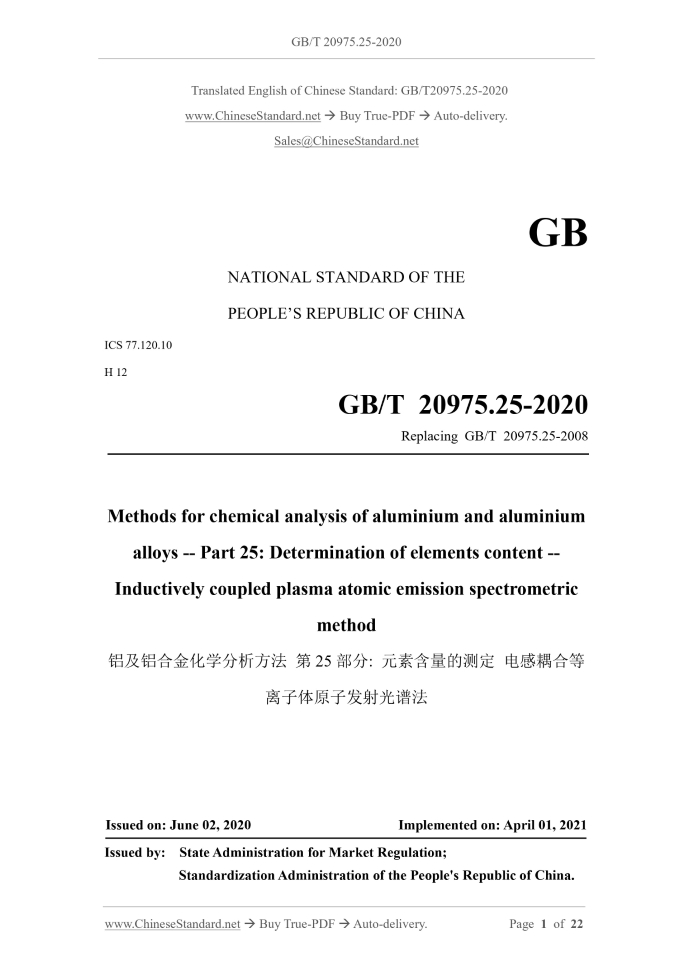
GB NATIONAL STANDARD OF THE PEOPLE’S REPUBLIC OF CHINA ICS 77.120.10 H 12 Replacing GB/T 20975.25-2008 Methods for chemical analysis of aluminium and aluminium alloys -- Part 25.Determination of elements content -- Inductively coupled plasma atomic emission spectrometric method Issued on: JUNE 02, 2020 Implemented on: APRIL 01, 2021 Issued by. State Administration for Market Regulation; Standardization Administration of the People's Republic of China.
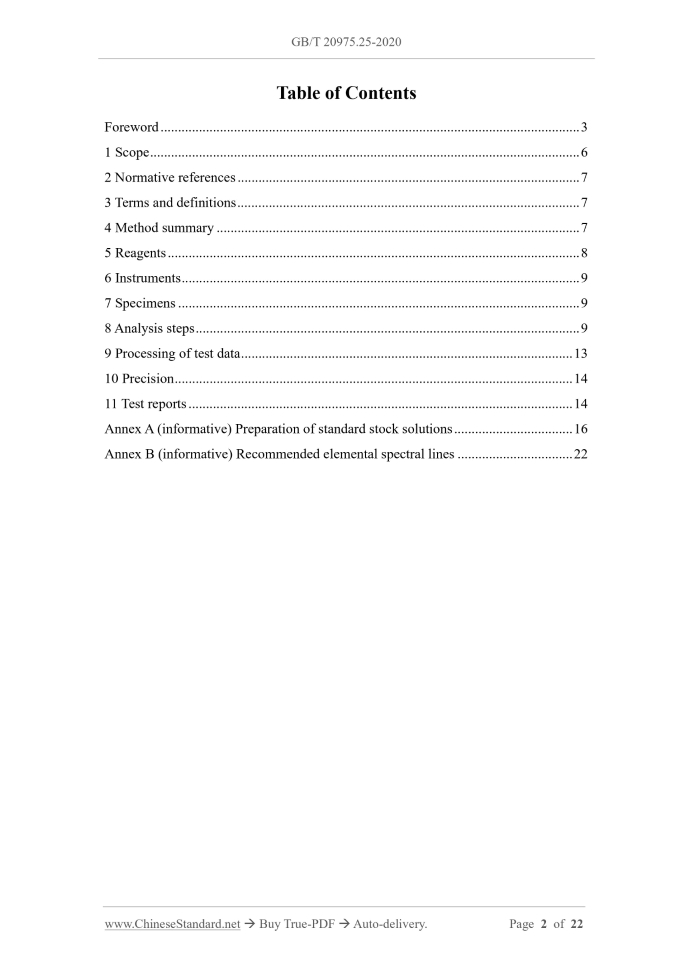
Table of Contents
Foreword... 3 1 Scope... 6 2 Normative references... 7 3 Terms and definitions... 7 4 Method summary... 7 5 Reagents... 8 6 Instruments... 9 7 Specimens... 9 8 Analysis steps... 9 9 Processing of test data... 13 10 Precision... 14 11 Test reports... 14 Annex A (informative) Preparation of standard stock solutions... 16 Annex B (informative) Recommended elemental spectral lines... 22 Methods for chemical analysis of aluminium and aluminium alloys -- Part 25.Determination of elements content -- Inductively coupled plasma atomic emission spectrometric method WARNING -- Personnel using this Part shall have formal laboratory work experience. This Part does not address all potential safety issues. Users are responsible for taking appropriate safety and health precautions and ensuring compliance with relevant national regulations.1 Scope
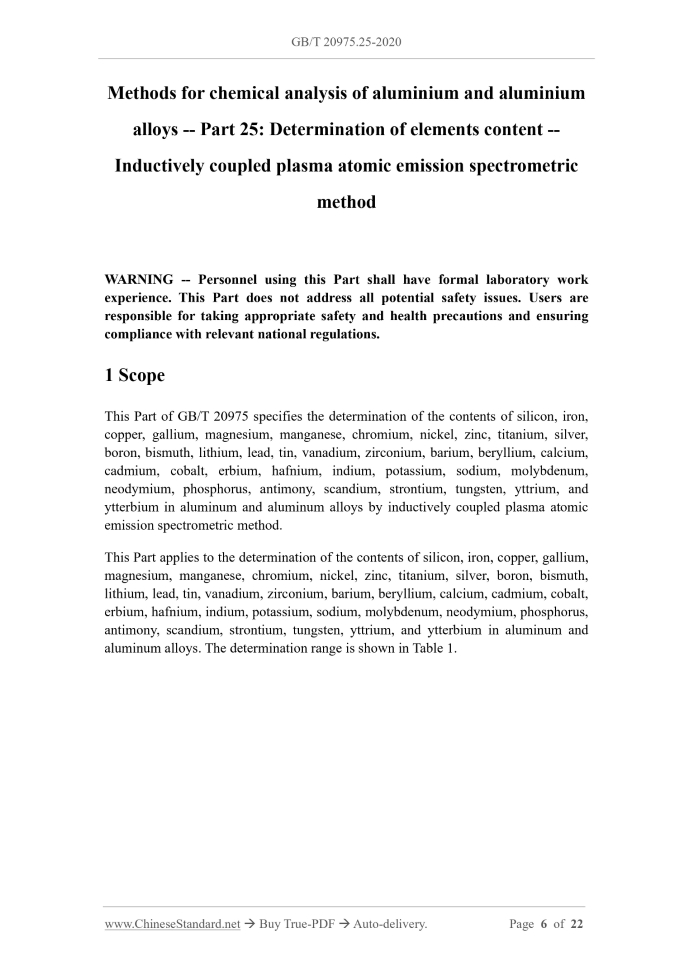
This Part of GB/T 20975 specifies the determination of the contents of silicon, iron, copper, gallium, magnesium, manganese, chromium, nickel, zinc, titanium, silver, boron, bismuth, lithium, lead, tin, vanadium, zirconium, barium, beryllium, calcium, cadmium, cobalt, erbium, hafnium, indium, potassium, sodium, molybdenum, neodymium, phosphorus, antimony, scandium, strontium, tungsten, yttrium, and ytterbium in aluminum and aluminum alloys by inductively coupled plasma atomic emission spectrometric method. This Part applies to the determination of the contents of silicon, iron, copper, gallium, magnesium, manganese, chromium, nickel, zinc, titanium, silver, boron, bismuth, lithium, lead, tin, vanadium, zirconium, barium, beryllium, calcium, cadmium, cobalt, erbium, hafnium, indium, potassium, sodium, molybdenum, neodymium, phosphorus, antimony, scandium, strontium, tungsten, yttrium, and ytterbium in aluminum and aluminum alloys. The determination range is shown in Table 1.2 Normative references
The following referenced documents are indispensable for the application of this document. For dated references, only the edition cited applies. For undated references, the latest edition of the referenced document (including any amendments) applies. GB/T 8005.2, Terms of aluminium and aluminium alloys -- Part 2.Chemical analysis GB/T 8170-2008, Specifications of amusement rides battery car category3 Terms and definitions
For the purposes of this document, the terms and definitions defined in GB/T 8005.2 apply.4 Method summary
Depending on the type of alloy and the content of elements, the following method is used to dissolve the specimen. - Specimens decomposed by hydrochloric acid and hydrogen peroxide; - Specimens decomposed by a mixture of hydrochloric acid and nitric acid; - Specimens decomposed by sodium hydroxide solution and hydrogen peroxide; - Specimens decomposed by a mixture of hydrochloric acid and nitric acid, and hydrofluoric acid. After specimen decomposition, inductively coupled plasma atomic emission spectrometry (ICP-AES) is used for determination. The matrix matching method is used to correct for the influence of the matrix on the determination.5 Reagents
Unless otherwise specified, only reagents confirmed to be analytically pure and laboratory Grade II water are used in the analysis. 5.1 Pure aluminum (wAl ≥ 99.999%). 5.2 Hydrogen peroxide (ρ =1.10 g/mL). 5.3 Hydrochloric acid (ρ =1.19 g/mL), guaranteed reagent. 5.4 Nitric acid (ρ =1.42 g/mL), guaranteed reagent. 5.5 Hydrofluoric acid (ρ =1.14 g/mL), guaranteed reagent. 5.6 Perchloric acid (ρ =1.76 g/mL), guaranteed reagent. 5.7 Hydrochloric acid (1+1). 5.8 Nitric acid (1+1). 5.9 Mixed acid. mix 3 portions of hydrochloric acid (5.7) and 1 portion of nitric acid (5.8). 5.10 Sodium hydroxide solution (400 g/L). 5.11 Aluminum-based solution (20 mg/mL). Weigh 20.00 g of pure aluminum (5.1) into a 1000 mL beaker. Cover with a watch glass. Add hydrochloric acid (5.7) in portions, totaling 600 mL. After the vigorous reaction stops, heat slowly until completely dissolved. Then add a few drops of hydrogen peroxide (5.2). Boil for several minutes. Cool. Transfer the solution to a 1000 mL volumetric flask. Dilute to the mark with water. Shake well. 5.12 Standard stock solutions for each analytical element. preferably prepared using certified national standard solutions; or see Annex A. 5.13 Standard solution. a) Principles for preparing multi-element standard solutions. Elements that chemically interfere with each other, produce precipitation, or cause spectral interference shall be prepared in groups. b) Dilute the standard stock solution (5.12) to 100 μg/mL. Maintain the same acidity as the standard stock solution (dilute before use). c) Dilute the standard stock solution (5.12) to 10 μg/mL. Maintain the same acidity as the standard stock solution (dilute before use).6 Instruments
Inductively coupled plasma atomic emission spectrometer. The instrument shall meet the following conditions. - The spectrometer has vacuum or gas-expelling functions to ensure stable test signals for elements at wavelengths below 200 nm. - The instrument's resolution is less than 0.005 nm (at 200 nm).7 Specimens
Process the sample into fragments with a thickness of no more than 1 mm.8 Analysis steps
8.1 Test material According to the sample dissolution method adopted, weigh the corresponding mass (m0) of the specimen (Chapter 7) according to Table 2 or Table 3, accurate to 0.0001 g. not allow the filter paper to burn). Then ignite at 800℃ for 5 min. Cool. Add 5 mL of hydrofluoric acid (5.5). Add nitric acid (5.8) dropwise until the solution is clear. Add 1 mL of perchloric acid (5.6). Heat to evaporate to dryness. Cool. Dissolve the residue with 5 mL of hydrochloric acid (5.7). Combine this test solution with the original filtrate. Dilute to the mark. Mix well. If necessary, dilute the test solution according to the working curve range. 8.4.2 Dissolution method II 8.4.2.1 This dissolution method is applicable to the determination of the contents of iron, copper, magnesium, manganese, gallium, titanium, vanadium, indium, tin, lead, bismuth, antimony, chromium, zinc, nickel, cadmium, beryllium, boron, strontium, calcium, silver, barium, cobalt, lithium, molybdenum, neodymium, yttrium, ytterbium, and scandium in aluminum and aluminum alloys. 8.4.2.2 Place the test material (8.1) weighed according to Table 2 into a 250 mL beaker. Add 25 mL of mixed acid (5.9). After the vigorous reaction stops, heat at a low temperature until the test material is completely dissolved. Cool to room temperature. 8.4.2.3 When the silicon mass fraction is greater than 0.5%, if there is insoluble residue, filter the test solution into a volumetric flask of the corresponding volume in Table 2. Wash the residue. Place the residue along with the filter paper in a platinum crucible. Ash (do not allow the filter paper to burn). Then ignite at 800℃ for 5 min. Cool. Add 5 mL of hydrofluoric acid (5.5). Add nitric acid (5.8) dropwise until the solution is clear. Add 1 mL of perchloric acid (5.6). Heat to evaporate to dryness. Cool. Dissolve the residue with 5 mL of hydrochloric acid (5.7). Combine this test solution with the original filtrate. Dilute to the mark. Mix well. If necessary, dilute the test solution according to the working curve range. 8.4.3 Dissolution method III 8.4.3.1 This dissolution method is applicable to the determination of silicon, iron, copper, magnesium, manganese, titanium, boron, vanadium, chromium, zinc, nickel, zirconium, strontium, tin, antimony, lead, calcium, tungsten, ytterbium, erbium, neodymium, and scandium in aluminum and aluminum alloys. 8.4.3.2 Place the test material (8.1) weighed according to Table 3 into a 400 mL polytetrafluoroethylene beaker. Add a small amount of water. Add 6 mL of sodium hydroxide solution (5.10). After the vigorous reaction stops, decompose by heating at a low temperature. Add an appropriate amount of hydrogen peroxide (5.2). Heat slowly until the test material is completely dissolved. Evaporate the solution to a slurry. Cool slightly. Add about 30 mL of water. Heat slowly until completely dissolved. 8.4.3.3 Dilute the solution (8.4.3.1) with water to approximately 100 mL. While stirring, add 25 mL of nitric acid (5.8) and 25 mL of hydrochloric acid (5.7). Heat at a low temperature until completely dissolved (if a brown precipitate of manganese dioxide forms, add anhydrous sodium sulfite solution). Cool. Transfer the solution to a 250 mL ......Source: Above contents are excerpted from the full-copy PDF -- translated/reviewed by: www.ChineseStandard.net / Wayne Zheng et al.