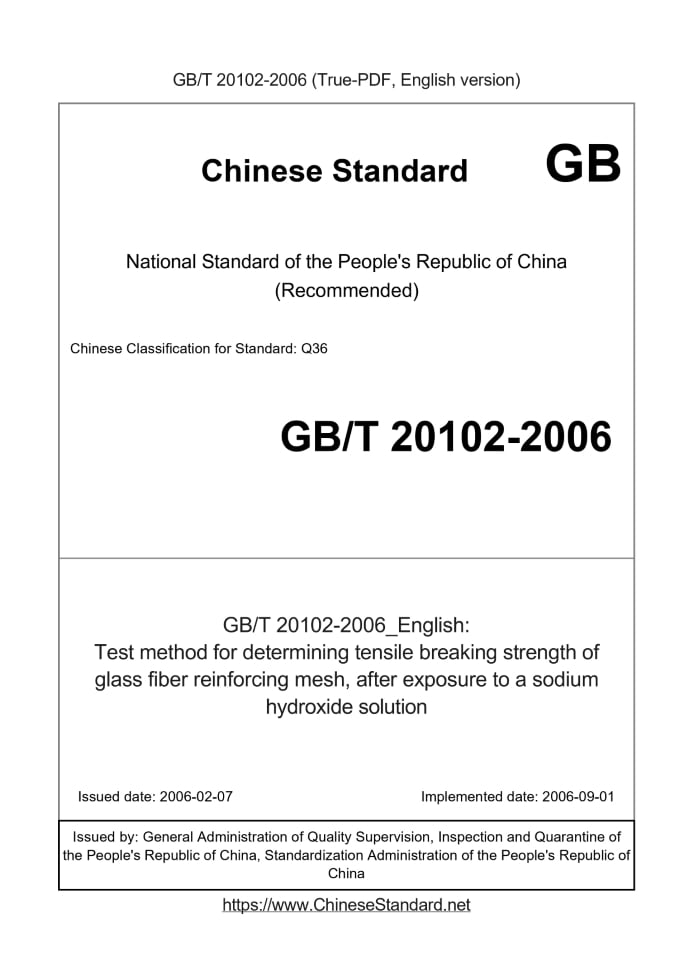
GB/T 20102-2006 PDF English
Price & Delivery
US$114.00 · In stock · Download in 9 secondsGB/T 20102-2006: Test method for determining tensile breaking strength of glass fiber reinforcing mesh, after exposure to a sodium hydroxide solution
Delivery: 9 seconds. True-PDF full-copy in English & invoice will be downloaded + auto-delivered via email. See step-by-step procedure
Status: Valid
| Std ID | Version | USD | Buy | Deliver [PDF] in | Title (Description) |
| GB/T 20102-2006 | English | 114 | Add to Cart | 3 days [Need to translate] | Test method for determining tensile breaking strength of glass fiber reinforcing mesh, after exposure to a sodium hydroxide solution |
Click to Preview a similar PDF
Basic data
| Standard ID | GB/T 20102-2006 (GB/T20102-2006) |
| Description (Translated English) | Test method for determining tensile breaking strength of glass fiber reinforcing mesh, after exposure to a sodium hydroxide solution |
| Sector / Industry | National Standard (Recommended) |
| Classification of Chinese Standard | Q36 |
| Classification of International Standard | 59.100.10 |
| Word Count Estimation | 6,679 |
| Date of Issue | 2006-02-07 |
| Date of Implementation | 2006-09-01 |
| Quoted Standard | GB/T 7689.5-2001 |
| Adopted Standard | ASTM E2098-2000, IDT |
| Regulation (derived from) | China National Standard Approval Announcement 2006 No.3 (Total No.90) |
| Issuing agency(ies) | General Administration of Quality Supervision, Inspection and Quarantine of the People's Republic of China, Standardization Administration of the People's Republic of China |
| Summary | This standard specifies the fiberglass mesh with alkali solution after soaking tensile breaking strength of the measurement method. This method is applicable to polymer-based exterior insulation and finish systems (hereinafter referred to as EIFS) used fiberglass mesh, the system contains Portland cement as a component. Alkali resistance can break glass fiber mesh on the strength per unit width, said alkali solution can also be used after soaking and soaking before breaking strength expressed as a percentage. This standard does not purport to all involved with product safety issues. Standard responsibility of the user to establish appropriate safety and health standards, and prior to use to determine whether the restrictions applicable to certain regulatory items. |