US$399.00 · In stock
Delivery: <= 3 days. True-PDF full-copy in English will be manually translated and delivered via email.
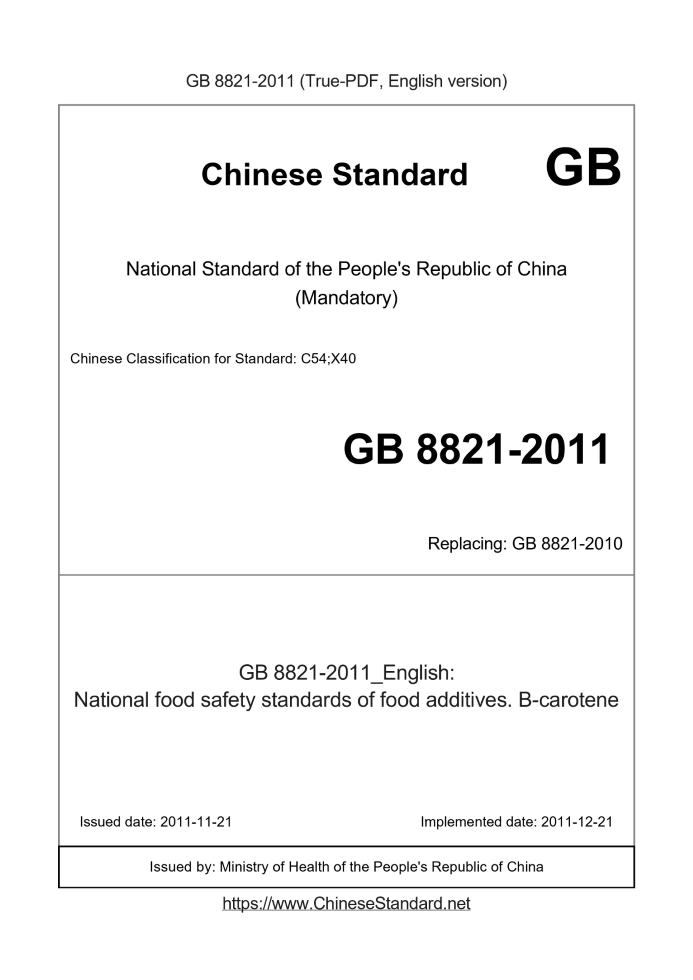
GB 8821-2011: National food safety standards of food additives. Β-carotene
Status: Obsolete
GB 8821: Historical versions
| Standard ID | USD | BUY PDF | Lead-Days | Standard Title (Description) | Status |
| GB 8821-2011 | 399 |
Add to Cart
|
3 days
|
National food safety standards of food additives. Β-carotene
| Obsolete |
| GB 8821-2010 | 399 |
Add to Cart
|
3 days
|
National food safety standards of food additives β-carotene
| Obsolete |
| GB 8821-1988 | 279 |
Add to Cart
|
3 days
|
National Food Safety Standard. Food additive--beta-carotene
| Obsolete |
Basic data
Standard ID: GB 8821-2011 (GB8821-2011)
Description (Translated English): National food safety standards of food additives. ��-carotene
Sector / Industry: National Standard
Classification of Chinese Standard: C54;X40
Classification of International Standard: 67.220.20
Word Count Estimation: 10,142
Date of Issue: 2011-11-21
Date of Implementation: 2011-12-21
Older Standard (superseded by this standard): GB 8821-2010
Regulation (derived from): The Ministry of Health in 2011 Notice No. 26
Issuing agency(ies): Ministry of Health of the People's Republic of China
Summary: This Chinese standard applies to vitamin A acetate as the starting material for chemical synthesis of food additives ��- carotene.
GB 8821-2011: National food safety standards of food additives. Β-carotene
---This is a DRAFT version for illustration, not a final translation. Full copy of true-PDF in English version (including equations, symbols, images, flow-chart, tables, and figures etc.) will be manually/carefully translated upon your order.
National food safety standards of food additives. Β-carotene
National Standards of People's Republic of China
National Food Safety Standard
Food Additives β- carotene
Issued on. 2011-11-21
2011-12-21 implementation
People's Republic of China Ministry of Health issued
Foreword
This standard replaces GB 8821-2010 "national food safety standards for food additives β- carotene."
This standard compared with GB 8821-2010, the main changes are as follows.
- Modify the contents A.10 "Determination of melting point" of.
This standard replaces the standards previously issued as follows.
--GB 8821-1988;
--GB 8821-2010.
National Food Safety Standard
Food Additives β- carotene
1 Scope
This standard applies to vitamin A acetate as a starting material for chemical synthesis of food additives β- carrot
Su.
2 chemical name, molecular formula, molecular mass and structural formula
2.1 Chemical Name
All-trans-1,1 '- (3,7,12,16- tetramethyl -1,3,5,7,9,11,13,15,17- octadecenoic nonaene -1,18- diyl) bis [2,6,6-trimethoxyphenyl
Cyclohexene]
Formula 2.2
C40H56
2.3 formula
2.4 relative molecular mass
536.88 (according to 2007 international relative atomic mass)
3 Technical requirements
3.1 Sensory requirements. comply with Table 1.
Table 1 Sensory requirements
Project requires test methods
Purple or red color proper amount of sample is placed in a clean, dry white porcelain dish, under natural light, observe its color
And texture, smell the smell. Odour odorless
Organization state crystal or crystalline powder
3.2 Physical indicators. to comply with Table 2.
Table 2. Physical and chemical indicators
Item Index Test Method
β- carotene (dry basis), w /% 96.0 ~ 101.0 Appendix A A.4
Residue on ignition, w /% ≤ 0.2 A.5 in Appendix A
Clarity test by test A.8 in Appendix A
Loss on drying, w /% ≤ 0.2 A.9 in Appendix A
Melting point ℃ 176 ~ 182 Appendix A A.10
TABLE 2 (cont.)
Item Index Test Method
Heavy metals (Pb)/(mg/kg) ≤ 5 A.6 in Appendix A
Arsenic (As)/(mg/kg) ≤ 2 Appendix A A.7
Appendix A
Testing method
A.1 Safety Tips
Reagents The standard test methods used for toxic or corrosive, according to the relevant provisions of the operation, the operation need to be careful.
If splashed on the skin should immediately wash with water, severe cases should be treated immediately. When using a volatile acid, to be carried out in a fume hood.
A.2 General Provisions
The reagents used in this standard, unless otherwise noted, only in the analysis confirmed analytically pure reagents and GB/T 6682-2008 in Regulation
Given three water.
Standard Solution, Test Method for preparation and products required, did not indicate when the other requirements, according to GB/T 603's provisions prepared
Preparation.
A.3 Identification Test
A.3.1 principle of the method
β- carotene is a conjugated double bond compound, there are three peaks in the UV absorption spectrum (455 nm, 483 nm, 340 nm),
With A455nm/A340nm and ratio A455nm/A483nm to control the cis isomer of β- carotene and class β- carotene.
A.3.2 Reagents and materials
A.3.2.1 cyclohexane.
A.3.2.2 chloroform.
A.3.3 Instruments and Equipment
A.3.3.1 UV spectrophotometer.
A.3.3.2 quartz cell (1 cm).
A.3.4 Analysis step
A.3.4.1 Preparation of sample solution
Solution A. Take about 50 mg laboratory samples, accurate to 0.000 1 g, brown set 100 mL volumetric flask, add chloroform 10
mL, dissolved immediately diluted to the mark with cyclohexane, shake. The precise amount of whichever is 5.0 mL, 100 mL brown volumetric flask set, with
Cyclohexane diluted to the mark, shake, that was.
Solution B. Take 5.0 mL solution A, setting 50 mL brown volumetric flask, dilute with cyclohexane to the mark, shake, that was.
A.3.4.2 Determination of ultraviolet absorbance
Take the solution B at a wavelength of 455 nm ± 1 nm, 483 nm ± 1 nm was measured at an absorbance (A), the ratio A455nm/A483nm should be
1.14 ~ 1.18.
Take the solution B at a wavelength of 455 nm ± 1 nm, the solution A were measured absorbance (A) at a wavelength of 340 nm ± 1 nm office, A455nm/A340nm
Ratio of not less than 1.5.
Determination A.4 β- carotene
A.4.1 principle of the method
β- carotene is a conjugated double bond compound, the maximum absorption at a wavelength of 455 nm at the sample solution was measured absorbance at that wavelength
Degrees to percentage absorption coefficient (1 mE) calculates a quality score.
A.4.2 Reagents and materials
A.4.2.1 cyclohexane.
A.4.2.2 chloroform.
A.4.3 Instruments and Equipment
With A.3.3.
A.4.4 Analysis step
Take A.3.4.1 in solution B, cyclohexane as blank, measure the absorbance (A) at a wavelength of 455 nm ± 1 nm office.
A.4.5 Calculation Results
Β- carotene absorption calculated according to the value of the laboratory sample mass fraction 1w, expressed in%, according to formula (A.1) Calculation
(A.1)
Where.
A - Laboratory sample solution absorbance value;
- Quality Numerical laboratory sample in grams (g);
20000 - the total volume of the diluted laboratory sample in milliliters (mL of);
2500 --β- percentage carotene absorption coefficient (1 mE);
Numerical 2w --A.9 measured the loss on drying,%.
A.5 Determination of residue on ignition
A.5.1 principle of the method
Sample by adding sulfuric acid sulphate after ignition of the left, with the weight method.
A.5.2 Analysis step
It weighs about 2.0 g laboratory samples, accurate to 0.000 1 g, placed in a burned to constant weight porcelain crucible at 550 ℃ ± 50 ℃, with
Small fire slowly heated to completely carbonized, after cooling, add 1.0 mL sulfuric moist, low-temperature heating to sulfuric acid vapor divisible shifted into high temperature
Furnace to burning at 550 ℃ ± 50 ℃ constant weight.
A.5.3 Calculation Results
Residue on ignition β- carotene mass fraction 3w and its value is expressed in%, according to formula (A.2) Calculated.
(A.2)
Where.
1m - the value of the total mass of the crucible and residue, in grams (g);
2m - Numerical crucible mass in grams (g);
- The quality of the laboratory sample value in units of grams (g).
A.6 Determination of Heavy Metals
20000 100%
(1) 2500100
mw
= × ×
× - × ×
3100%
mm
= ×
A.6.1 principle of the method
Samples of metal impurities in the acidic (pH3.5) conditions with hydrogen sulfide or sodium sulfide test solution color. Sample lead standard solution with the same method
Determination, in order to check its limits.
A.6.2 Reagents and materials
A.6.2.1 nitrate.
A.6.2.2 sulfuric acid.
A.6.2.3 hydrochloric acid.
A.6.2.4 glycerol.
A.6.2.5 ammonium acetate.
A.6.2.6 lead nitrate.
A.6.2.7 thioacetamide.
A.6.2.8 ammonia solution. 400 → 1000.
A.6.2.9 sodium hydroxide solution. c (NaOH) = 1 mol/L.
A.6.2.10 hydrochloric acid solution. c (HCl) = 2 mol/L.
A.6.2.11 hydrochloric acid solution. c (HCl) = 7 mol/L.
A.6.2.12 ammonia solution. c (NH3 · H2O) = 5 mol/L.
A.6.2.13 phenolphthalein indicator solution. 10 g/L ethanol solution.
A.6.2.14 acetate buffer (pH3.5). Take 25 g of ammonium acetate, 25 mL water was added after dissolved, and 7 mol L hydrochloric acid/38 mL,
PH was adjusted to accurately 3.5 of 5 (pH meter) with 2 mol/L aqueous ammonia solution or hydrochloric acid solution, dilute with water to 100 mL.
A.6.2.15 thioacetamide test solution. Weigh about 4 g thioacetamide, to the nearest 0.01 g, add water to dissolve into a 100 mL, set the refrigerator
Saved. Immediately prior to taking a mixture of 5.0 mL (from the 15 mL 1 mol/L sodium hydroxide solution, 5.0 mL of water and 20 mL glycerol), plus
Above 1.0 mL of thioacetamide solution was heated on a water bath to cool 20s used immediately.
A.6.2.16 lead standard solution. Weigh about 0.160 g of lead nitrate, accurate to 0.000 2 g, placed in 1000 mL volumetric flask, add 5 mL Glass
After acid and 50 mL of water to dissolve, dilute to the mark, shake, as the stock solution. Before use, pipette 10 mL ± 0.02 mL stock solution,
Placed 100 mL volumetric flask, diluted with water to the mark, shake, that was (per 1 mL equivalent to 10 μg of Pb). And storage configuration used
Glassware shall lead.
A.6.3 Analysis step
Press the "People's Republic of China Pharmacopoeia" 2005 edition of Appendix VIII H Determination of Heavy Metals in the second test method, as follows.
Take A.5 residue left over, add 0.5 mL of nitric acid, evaporated to oxide vapor divisible after, let cool, add 2 mL of hydrochloric acid, water bath
After evaporation to dryness plus 15 mL of water, dropping ammonia solution to phenolphthalein instructions VIS neutral, plus 2 mL acetate buffer (pH3.5), micro heat
After dissolution, displacing Nessler colorimetric tube A tube, diluted with water to 25 mL; Another reagent formulation of the test solution, and placing porcelain dish to dryness, the
Add 2 mL acetate buffer (pH3.5) and 15 mL of water, heat gently to dissolve, displacing Nessler colorimetric tube acetate tube, add 1.0 mL of lead standard
Solution, then diluted with water to 25 mL; and then were added thioacetamide test solution in B two each 2 mL, shake, place 2min, with
White paper on the home, from the top down perspective, color and acetic Tube Comparison A tube display, shall not be deeper.
A.7 Determination of Arsenic salt
A.7.1 principle of the method
In strongly acidic solution, the sample can be reduced to metallic zinc arsenic into arsine arsine regenerate brown and mercuric bromide paper role
Color compound. Comparative sample with arsenic standard solution using the same method of treating the resulting brown compound, in order to check the sample arsenic salt restriction
degree.
A.7.2 Analysis step
Weigh 5.0 g ± 0.01 g laboratory samples weighed 10 mL ± 0.05 mL limit of arsenic standard solution (per 1 mL solution corresponds to 1 μg
Arsenic), respectively, after pressing GB/T 5009.76-2003 first dry ashing method 5.2.2 Treatment of samples, according to the second law Gutzeit assay samples. test
Like Gutzeit No deeper than the standard Gutzeit.
A.8 Clarity test
A.8.1 Reagents and materials
A.8.1.1 chloroform.
A.8.1.2 methenamine solution. 100 g/L.
A.8.1.3 turbidity standard stock solution. Weigh dried at 105 ℃ to constant weight of 1.00 g hydrazine sulfate, to the nearest 0.001 g, set 100 mL capacity
Bottle, add water to dissolve, if necessary, can be warmed in a water bath 40 ℃ dissolved, and diluted with water to the mark, shake, place 4h ~
6h; of this solution with an equal volume hexamine solution (100 g/L) mixing, shake, standing in the dark at 25 ℃ 24h, that is, too. The liquid home
Cool place away from light, can be used within two months, Shake well before use.
A.8.1.4 turbidity standard stock solution. Take 15.0 mL stock solution turbidity standard, set in 1000 mL volumetric flask, diluted with water to the mark, shake,
Check amount, set 1 cm absorption cell, according to the UV - visible spectrophotometry (People's Republic of China Pharmacopoeia 2005 edition of Appendix IV A),
At a wavelength of 550 nm is measured, the absorbance should be within the range of 0.12 to 0.15. The solution should be within 48h use Shake well before use.
A.8.1.5 0.5 Number turbidity standard. Take 2.5 mL stock solution turbidity standard, set in 100 mL volumetric flask, diluted with water to the mark, shake,
That is, too.
A.8.2 Analysis step
Press the "People's Republic of China Pharmacopoeia" 2005 edition two Appendix Ⅸ B clarity test method. Weigh 1.0 g ± 0.01 g Lab
Sample, add 100 mL of chloroform was dissolved, compared with the same volume of chloroform or No. 0.5 turbidity standard solution, if significant turbidity can not be compared
No. 0.5 turbidity standard solution deeper.
A.9 Determination of loss on drying
A.9.1 Analysis step
Weigh approximately 1 g laboratory samples, accurate to 0.000 1 g, with phosphorus pentoxide as a desiccant, dried under reduced pressure has been placed at 40 ℃ (pressure
Force should be) to constant weight flat weighing bottle, dried under reduced pressure at 40 ℃ 4h at 20 mmHg or less, into the dryer to cool to room temperature,
Weighed.
A.9.2 Calculation Results
β- carotene drying loss mass fraction 2w and its value is expressed in%, according to formula (A.3) Calculated.
(A.3)
Where.
3m - the total mass of the laboratory sample values before drying and weighing bottles in grams (g);
4m - After drying the total mass of the sample and weighing bottle laboratory values, expressed in grams (g);
- Quality Numerical laboratory sample in grams (g).
2 100%
mm
= ×
Determination of the melting point A.10
Press the "People's Republic of China Pharmacopoeia" 2005 edition two Appendix VI C melting point of the first assay method. Here's how.
Take laboratory sample amount, reduced to powder, with phosphorus pentoxide as a desiccant, placed flat weighing bottle, at 40 ℃ reduced pressure (pressure
Force shall be 2666 Pa or less) after drying 4h, cooled to room temperature and placed in a dryer, the check amount, set by capillary melting point measurement (referred to
Capillary hard glass is made from neutral, more than 9 cm long, inner diameter of 0.9 mm ~ 1.1 mm, wall thickness of 0.10 mm ~ 0.15 mm,
End fusion seal; when the thermometer is immersed in transmission fluid temperature (silicone oil or liquid paraffin) at 6 cm above the tube length should be increased, the exposed
Level 3 cm above), tap the wall or by means of a suitable length of a clean glass tube, placed vertically on the surface of the dish or other suitable rigid material
On the body, from the capillary into the free fall catchy, repeated several times, the powder tightly assembled capillary melting terminated. Load test
The sample chamber height is 3 mm. Another thermometer (sub-dip type, with 0.5 ℃ scale, the melting point was determined by reference correction) into Sheng
Mounted transmission fluid temperature of the container so that the bottom portion of the bottom of the thermometer mercury ball away from the container more than 2.5 cm (with a heated vessel, temperature
Total mercury ball on the surface of the heater from the 2.5 cm or more); adding transmission fluid temperature so that the heat transmission fluid temperature level after the appropriate points in the thermometer dip lines
Place. When the transfer capillary temperature was heated until the temperature rises to a lower melting point than the predetermined lower limit of about 10 ℃, it will be equipped with laboratory sample immersion
Transmission fluid temperature, attached to the thermometer (available rubber band or a capillary tube clamp), shall be so suitable capillary contents of mercury in the thermometer ball
Central; heating was continued to adjust the heating rate rising 1.0 ℃ ~ 1.5 ℃ per minute, stirring constantly so that when heated to be transmission fluid temperature to maintain the temperature
Uniform, recording laboratory samples at the time of the initial melting temperature to melt the whole of repeated measured three times and averaged.
"Incipient melting" means the test starting temperature partial liquefaction significant droplets in the capillary.
"Full penetration" test temperature when all means for liquefaction.
The determination of melting and decomposition of the test, the method as described above, but adjust the ramps let rise 2.5 ℃ ~ 3.0 ℃ per minute; the test
Start partial liquefaction product (or start generation of bubble) as the temperature of incipient melting temperature; the test temperature solid phase disappears when all the liquefied
As a whole melting temperature. In case of solid phase disappears obvious, should be based on the decomposition temperature of the test substance began to swell rises as a whole melting temperature.
Some drugs can not distinguish its initial melting, melting the whole time, mutations can occur when the temperature as the melting point.
......
Tips & Frequently Asked Questions:
Question 1: How long will the true-PDF of GB 8821-2011_English be delivered?
Answer: Upon your order, we will start to translate GB 8821-2011_English as soon as possible, and keep you informed of the progress. The lead time is typically 1 ~ 3 working days. The lengthier the document the longer the lead time.
Question 2: Can I share the purchased PDF of GB 8821-2011_English with my colleagues?
Answer: Yes. The purchased PDF of GB 8821-2011_English will be deemed to be sold to your employer/organization who actually pays for it, including your colleagues and your employer's intranet.
Question 3: Does the price include tax/VAT?
Answer: Yes. Our tax invoice, downloaded/delivered in 9 seconds, includes all tax/VAT and complies with 100+ countries' tax regulations (tax exempted in 100+ countries) -- See Avoidance of Double Taxation Agreements (DTAs):
List of DTAs signed between Singapore and 100+ countriesQuestion 4: Do you accept my currency other than USD?
Answer: Yes. If you need your currency to be printed on the invoice, please write an email to Sales@ChineseStandard.net. In 2 working-hours, we will create a special link for you to pay in any currencies. Otherwise, follow the normal steps: Add to Cart -- Checkout -- Select your currency to pay.
Question 5: Should I purchase the latest version GB 8821-2011?
Answer: Yes. Unless special scenarios such as technical constraints or academic study, you should always prioritize to purchase the latest version GB 8821-2011 even if the enforcement date is in future. Complying with the latest version means that, by default, it also complies with all the earlier versions, technically.