US$559.00 · In stock
Delivery: <= 5 days. True-PDF full-copy in English will be manually translated and delivered via email.
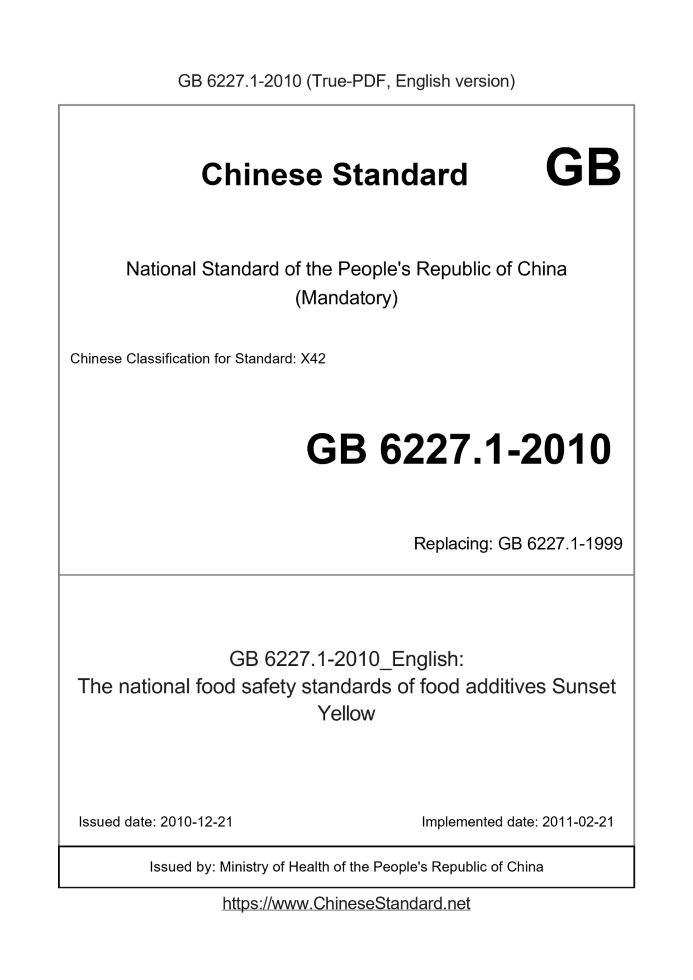
GB 6227.1-2010: The national food safety standards of food additives Sunset Yellow
Status: Valid
GB 6227.1: Historical versions
| Standard ID | USD | BUY PDF | Lead-Days | Standard Title (Description) | Status |
| GB 6227.1-2010 | 559 |
Add to Cart
|
5 days
|
The national food safety standards of food additives Sunset Yellow
| Valid |
| GB 6227.1-1999 | 559 |
Add to Cart
|
4 days
|
Food additive--Sunset yellow
| Obsolete |
| GB 6227.1-1995 | RFQ |
ASK
|
3 days
|
Food additive. Sunset yellow
| Obsolete |
| GB 6227-1986 | 319 |
Add to Cart
|
3 days
|
Food additive--Sunset yellow
| Obsolete |
Basic data
Standard ID: GB 6227.1-2010 (GB6227.1-2010)
Description (Translated English): The national food safety standards of food additives Sunset Yellow
Sector / Industry: National Standard
Classification of Chinese Standard: X42
Classification of International Standard: 67.220.20
Word Count Estimation: 24,256
Date of Issue: 2010-12-21
Date of Implementation: 2011-02-21
Older Standard (superseded by this standard): GB 6227.1-1999
Regulation (derived from): Ministry of Health Bulletin No. 19 of 2010
Issuing agency(ies): Ministry of Health of the People's Republic of China
Summary: This Chinese standard applies to the right amino acid diazotization after Schaeffer salt coupling obtained sunset yellow food additives.
GB 6227.1-2010: The national food safety standards of food additives Sunset Yellow
---This is a DRAFT version for illustration, not a final translation. Full copy of true-PDF in English version (including equations, symbols, images, flow-chart, tables, and figures etc.) will be manually/carefully translated upon your order.
The national food safety standards of food additives Sunset Yellow
National Food Safety Standard
Sunset Yellow Food Additives
Issued on. 2010-12-21
2011-02-21 implementation
National Standards of People's Republic of China
People's Republic of China Ministry of Health issued
Foreword
This standard replaces GB 6227.1-1999 "sunset yellow food additive."
This standard compared with GB 6227.1-1999, the main changes are as follows.
- Added safety tips;
- Canceled ≥60.0% quality specifications, will modify the index ≥85.0% ≥87.0%;
- Modify the discrimination test methods;
- Colorimetric method allows parallel determination by the difference of 2.0% revised to 1.0%;
- Loss on drying, chloride and sulfate aggregates by the ≤15.0% revised to ≤13.0%, and revised the detection method;
- Added amino benzene sulfonate, 2-naphthol-6, sodium 6,6'-oxybis (2-naphthalene sulfonic acid) disodium 4,4 '- (diazonium imino
Yl) two acid disodium salt intermediates and 1-phenylazo-2-naphthol indicators and detection methods unreacted;
- Added unsulfonated primary aromatic amine (aniline meter) indicators and detection methods;
- Arsenic (As) is modified by chemical detection methods limit law atomic absorption spectrometry;
- Cancel the heavy metals (Pb) quality specifications;
- Increase the lead (Pb) indicator and detection methods;
- An increase of mercury (Hg) indicators and detection methods.
The Standard Appendix A, Appendix B and Appendix C are normative appendices, Appendix D is an informative annex.
This standard replaces the standards previously issued as follows.
--GB 6227.1-1986, GB 6227.1-1999.
National Food Safety Standard
Sunset Yellow Food Additives
1 Scope
This standard applies to the after-amino acid diazotization and coupling Xue Fr salt prepared food additive sunset yellow.
2 Normative references
The standard file referenced in the application of this standard is essential. For dated references, only the edition date of the note
Apply to this standard. For undated references, the latest edition (including any amendments) applies to this standard.
3 chemical name, structural formula, molecular formula and relative molecular mass
3.1 Chemical Name
6-hydroxy-5 - [(4-phenyl sulfonic acid group) azo] -2-naphthalenesulfonic acid disodium salt
3.2 Structure.
Formula 3.3
C16H10N2Na2O7S2
3.4 relative molecular mass
452.37 (according to 2007 international relative atomic mass)
4. Technical Requirements
4.1 Sensory requirements. comply with Table 1.
Table 1 Sensory requirements
Project requires test methods
By visual assessment of the orange-red color under natural light.
State organization powders or granules
4.2 Physical indicators. to comply with Table 2.
Table 2. Physical and chemical indicators
Item Index Test Method
Sunset yellow, w /% ≥ 87.0 Appendix A A.4
Loss on drying, chloride (based on NaCl) and sulfate (NaSO4 in dollars) of the total, w /% ≤ 13.0 Appendix A A.5
Water-insoluble, w /% ≤ 0.20 A.6 in Appendix A
Amino benzene sulfonate, w /% ≤ 0.20 Appendix A A.7
-6- Sodium 2-naphthol, w /% 0.30 Appendix A A.8
6,6'-oxybis (2-naphthalene sulfonic acid) disodium, w /% ≤ 1.0 A.9 in Appendix A
4,4 '- (diazo imino) two acid disodium salt, w /% ≤ 0.10 A.10 Appendix A
1-phenyl-azo-2-naphthol/(mg/kg) ≤ 10.0 A.11 Appendix A
Unsulfonated primary aromatic amine (aniline meter) /% ≤ 0.01 Appendix A A.12
Deputy dye, w /% ≤ 4.0 Appendix A A.13
Arsenic (AS)/(mg/kg) ≤ 1.0 Appendix A A.14
Lead (PA)/(mg/kg) ≤ 10.0 A.15 Appendix A
Mercury (Hg)/(mg/kg) ≤ 1.0 A.16 Appendix A
Appendix A
(Normative)
Testing method
A.1 Safety Tips
Reagents The standard test methods used for toxic or corrosive, according to the relevant provisions of the operation, the operation need to be careful. If splash
On the skin should immediately wash with water, severe cases should be treated immediately. When using a volatile acid, to be carried out in a fume hood.
A.2 General Provisions
This standard reagents and water, did not indicate when the other requirements, refer to the three water analytical reagent and GB/T 6682-2008 requirements.
Standard test solution required impurity standard solution, preparations and products at the time did not indicate other provisions, according to GB/T 601, GB/T 602,
GB/T 603 regulations formulated and calibration.
A.3 Identification Test
A.3.1 Reagents and materials
A.3.1.1 sulfuric acid.
A.3.1.2 ammonium acetate solution. 1.5g/L.
A.3.2 Instruments and Equipment
A.3.2.1 Spectrophotometer.
A.3.2.2 cuvette. 10mm.
A.3.3 Identification method
It should meet the following conditions.
A.3.3.1 Weigh about 0.1g sample (accurate to 0.01g), was dissolved in 100mL of water, which was a clear orange solution.
A.3.3.2 Weigh about 0.1g sample (accurate to 0.01g), after adding 10mL sulfuric acid was orange-red, take this solution 2 drops to 3 drops added 5mL
The water was orange.
A.3.3.3 Weigh about 0.1g sample (accurate to 0.01g), was dissolved in 100mL ammonium acetate solution of this solution 1mL, plus acetic acid
With an ammonium solution to 100mL, wavelength of maximum absorption of the solution was 482 nm ± 2nm.
A.4 Determination of sunset yellow
A.4.1 Titanium trichloride titration (Arbitration Act)
A.4.1.1 Method summary
In acidic medium, sunset yellow azo group is reductive decomposition of titanium trichloride, titanium trichloride consumption according to standard titration solution, calculated
Its content.
A.4.1.2 Reagents and materials
A.4.1.2.1 sodium bitartrate;
A.4.1.2.2 titanium trichloride standard titration solution. c (TiCl3) = 0.1mol/L (now with the existing, method of preparation see Appendix B);
A.4.1.2.3 cylinders loaded carbon dioxide.
A.4.1.3 instruments and equipment
A-- conical flask (a 500 mL);
B-- Brown burette (50mL);
C-- under glass bottle package black paper (2000mL);
D-- containing 100g/L solution of ammonium carbonate and 100g/L ferrous sulfate solution container of an equivalent mixture (5000mL);
E-- piston;
F-- bottles;
G-- washing bottle filled with water.
Figure A.1 apparatus of FIG titanium trichloride titration
A.4.1.4 analysis step
Weigh about 0.5g sample (accurate to 0.0001g), placed in 500mL Erlenmeyer flask was dissolved in 50mL boiling water and cooled to room temperature,
After adding 15g of sodium hydrogen tartrate and 150mL boiling water, dissolved by shaking, according to Figure A.1 instrument installed at the level of carbon dioxide introduced into the same time,
Boiled, with titanium trichloride standard titration solution titration end point so that the inherent color disappeared.
A.4.1.5 Calculation Results
Sunset yellow mass fraction 1w its value is expressed in%, according to formula (A.1) Calculated.
0) 4 /) (1000/(
1 × = m
MVcw (A.1)
Where.
c - accurate titanium trichloride standard titration solution concentration value in units of moles per liter (mol/L);
V - accurate value of the sample consumed titration of titanium trichloride standard titration solution volume in milliliters (mL);
M - molar mass sunset yellow values in grams per mole (g/mol) [M (C16H10N2Na2O7S2) = 452.37];
m1 - mass value of the sample in grams (g).
The results represent a decimal.
The absolute difference between the parallel determination results is not more than 1.0% (mass fraction), the arithmetic mean value as a measurement result.
A.4.2 Colorimetric method
A.4.2.1 Method summary
The samples with known content of sunset yellow standards were dissolved in water, diluted to volume, the maximum absorption wavelength ammonium acetate solution,
Absorbance values were measured to calculate its content.
A.4.2.2 Reagents and materials
A.4.2.2.1 ammonium acetate solution. 1.5g/L;
A.4.2.2.2 sunset yellow standard. ≥87.0% (mass fraction, measured according to A.4.1).
A.4.2.3 instruments and equipment
A.4.2.3.1 spectrophotometer;
A.4.2.3.2 cuvette. 10mm.
Sample preparation A.4.2.4 sunset yellow solution
Weigh about 0.25g sunset yellow standard (accurate to 0.0001g), was dissolved in an appropriate amount of water, transferred to 1000mL volumetric flask, diluted with water
To the mark. Draw 10mL, transferred to 500mL volumetric flask, add ammonium acetate solution was diluted to the mark, shake well and set aside.
A.4.2.5 sunset yellow preparation of the sample solution
A.4.2.4 weighing and methods of operation with standard solution preparation.
A.4.2.6 analysis step
The standard solution and sunset yellow sunset yellow sample solution were placed in 10mm cuvettes, with the maximum absorption wavelength with a spectrophotometer
The absorbance was measured by their value, with ammonium acetate solution as reference solution.
A.4.2.7 Calculation Results
Sunset yellow mass fraction 1w its value is expressed in%, according to formula (A.2) Calculated.
1 wmA
Amw × = (A.2)
Where.
A - absorbance values sunset yellow sample solution;
Quality value m0-- sunset yellow standard, in units of grams (g);
A0-- sunset yellow standard sample absorbance value of the solution;
Sample quality m-- value in units of grams (g);
w0-- sunset yellow standard mass fraction%.
The results represent a decimal.
The absolute difference between the parallel determination results is not more than 1.0% (mass fraction), the arithmetic mean value as a measurement result.
A.5 Determination of loss on drying, chloride (based on NaCl) and sulfate (Na2S04 in dollars) of the total
A.5.1 Determination of loss on drying
A.5.1.1 analysis step
Weigh about 2g sample (accurate to 0.001g), has been placed in the weighing bottle at 135 ℃ ± 2 ℃ oven temperature is constant at 135 ℃ ± 2 ℃
Thermostatic oven drying to constant weight.
A.5.1.2 Calculation Results
Loss on drying content in mass fraction 2w and its value is expressed in%, according to formula (A.3) Calculated.
2 × - = m
mmw (A.3)
Where.
Numerical m2-- sample before drying mass in grams (g);
m3-- sample dried to a constant value of mass in grams (g).
The results represent a decimal.
The absolute difference between the parallel determination results is not more than 0.2% (mass fraction), the arithmetic mean value as a measurement result.
A.5.2 chloride (as NaCl) Determination
A.5.2.1 Reagents and materials
A.5.2.1.1 nitrobenzene;
A.5.2.1.2 activated carbon; 767 needle;
A.5.2.1.3 nitric acid solution. 11;
A.5.2.1.4 silver nitrate solution. c (AgNO3) = 0.1mol/L;
A.5.2.1.5 ammonium ferric sulfate solution
Preparation method. Weigh about 14g of ammonium ferric sulfate, dissolved in 100mL of water, filter, add 10mL of nitric acid, stored in a brown bottle;
A.5.2.1.6 ammonium thiocyanate standard titration solution. c (NH4CNS) = 0.1mol/L.
A.5.2.2 preparation of the sample solution
Weigh about 2g sample (accurate to 0.001g), was dissolved in 150mL of water, add about 15g of activated carbon, a moderate boil 2 min ~ 3min, added
1mL solution of nitric acid, constantly rocking evenly placed 30min (during shaking from time to time). Filtered through a dry filter paper. Such as colored filtrate is combined with 5g
Activated carbon, occasionally shaking place 1h, then dried filter paper (such as color still replace the activated carbon Repeat until the filtrate colorless). Each time
10mL washed activated charcoal three times, combined filtrate move 200mL volumetric flask, add water to the mark. For chloride and sulfate content
Determination.
A.5.2.3 analysis step
Pipette 50mL sample solution, placed in 500mL conical flask, add 2mL nitric acid solution and 10mL silver nitrate solution (chloride content for a long time
To add more) and 5mL nitrobenzene, shake vigorously to condense silver chloride was added 1mL solution of ammonium ferric sulfate, ammonium thiocyanate standard titration solution
Titrate the excess silver nitrate to the end and keep 1min, at the same time in the same way to make a blank test.
A.5.2.4 Calculation Results
Chloride (as NaCl) mass fraction 3w and its value is expressed in%, according to formula (A.4) Calculated.
) 200/50 (
] 1000 /) [(
3 × - = m
MVVcw (A.4)
Where.
c1 - accurate ammonium thiocyanate standard titration solution concentration value in units of moles per liter (mol/L);
V1 - accurate value of consumption of titration blank solution of ammonium thiocyanate standard titration solution volume in milliliters (mL);
V0 - accurate value of the sample solution was titrated with ammonium thiocyanate standard titration solution consumed volume in milliliters (mL);
M1 - the value of the molar mass of sodium chloride, in units of grams per mole (g/mol) [M1 (NaCl) = 58.4];
Mass values m4-- sample in grams (g).
The results represent a decimal.
Parallel determination results of absolute difference is not more than 0.3% (mass fraction), the arithmetic mean value as a measurement result.
A.5.3 Sulfate (Na2S04 meter) measurement
A.5.3.1 Reagents and materials
A.5.3.1.1 sodium hydroxide solution. 2g/L.
A.5.3.1.2 hydrochloric acid solution. 11999.
A.5.3.1.3 barium chloride standard titration solution. c (1/2BaCl2) = 0.l mol/L (preparation see Appendix B).
A.5.3.1.4 phenolphthalein indicator solution. 10g/L.
A.5.3.1.5 Rose sodium indicator solution. Weigh 0.lg red roses, sodium dissolved in 10mL of water (using now).
A.5.3.2 analysis step
Draw 25mL sample solution (A.5.2.2), placed in 250mL conical flask, add 1 drop of phenolphthalein indicator solution, a solution of sodium hydroxide solution was pink
Red, then a solution of hydrochloric acid solution to the pink color disappeared, shake, shaking constantly dissolved barium chloride standard titration solution titration to Mei
Rose red indicator solution of sodium for outward indicator solution, and the reaction liquid indicator solution on filter paper presents the intersection of rose red spots and kept 2min does not fade as
end.
At the same time in the same manner as a blank test.
A.5.3.3 Calculation Results
Sulfate (Na2SO4 meter) mass fraction 4w and its value is expressed in%, according to formula (A.5) Calculated.
) 200/25 (
) 2 /] (1000 /) [(
4 × - = m
MVVcw (A.5)
Where.
c2 - accurate barium chloride standard titration solution concentration value in units of moles per liter (mol/L);
The exact value of the sample solution V2-- titration consumption of barium chloride standard titration solution volume in milliliters (mL);
Accurate value of V3-- titrate blank solution consumed barium chloride standard titration solution volume in milliliters (mL);
M2 - the value of the molar mass of sodium sulfate, units of grams per mole (g/mol) [M2 (Na2SO4) = 142.04];
m4 - mass of the sample value in units of grams (g).
The results represent a decimal.
The absolute difference between the parallel determination results is not more than 0.2% (mass fraction), the arithmetic mean value as a measurement result.
Results A.5.4 Loss on drying, chloride (based on NaCl) and sulfate (Na2SO4 in dollars) the total amount of calculation
Total loss on drying and chloride (based on NaCl) and sulfate (Na2SO4 to count) to the mass fraction 5w and its value is expressed in%, according to public
Formula (A.6) Calculated.
4325 wwww = (A.6)
Where.
2w - drying loss mass fraction%;
3w - chloride (as NaCl) mass fraction%;
4w - Sulfate (Na2SO4 meter) mass fraction%.
The results represent a decimal.
A.6 Determination of insoluble matter
A.6.1 Instruments and Equipment
A.6.1.1 sand core glass crucible. G4, a pore size of 5μm ~ 15μm;
A.6.1.2 oven thermostat.
A.6.2 Analysis step
Weigh about 3g sample (accurate to 0.001g), placed in 500mL beaker, add 50 ℃ ~ 60 ℃ hot water 250mL, dissolved with
Already at 135 ℃ ± 2 ℃ drying to constant of G4 sintered glass crucible filtration, and thoroughly washed with hot water to wash colorless liquid, heated at 135 ℃ ± 2 ℃
Oven drying to constant weight.
A.6.3 Calculation Results
Water insoluble mass fraction 6w and its value is expressed in%, according to formula (A.7) calculated as follows.
6 × = m
mw (A.7)
Where.
m6 - Numerical dried water insoluble mass in grams (g);
m5 - the value of the sample mass, in grams (g).
The results represent two decimal.
The absolute difference between parallel determination results is not more than 0.05% (mass fraction), the arithmetic mean value as a measurement result.
A.7 determination of amino benzene sulfonate
A.7.1 Method summary
By reverse-phase liquid chromatography and quantified by external standard method, the calculation of the mass fraction of amino benzene sulfonate.
A.7.2 Reagents and materials
A.7.2.1 methanol.
A.7.2.2 amino benzene sulfonate.
A.7.2.3 ammonium acetate solution. 2g/L.
A.7.3 Instruments and Equipment
A.7.3.1 HPLC. infusion pump - flow range of 0.1 mL/min ~ 5.0mL/min, the flow rate in this range stability
± 1%; detector - multi-wavelength UV spectrophotometric detector or equivalent in performance to UV spectrophotometric detector.
A.7.3.2 Column. length 150mm, an inner diameter of 4.6mm stainless steel column, stationary phase C18, particle size 5μm.
A.7.3.3 chromatography workstation or integrator.
A.7.3.4 ultrasonic generator.
A.7.3.5 loop. 20μL.
A.7.3.6 micro syringe. 20μL ~ 100μL.
A.7.4 Chromatography conditions
A.7.4.1 detection wavelength. 254nm;
A.7.4.2 Column temperature. 40 ℃;
A.7.4.3 Mobile phase. A, a solution of ammonium acetate; B, methanol;
Concentration gradient. 40min linear gradient from A (95) than B (5) to A (50) than B (50);
A.7.4.4 Flow. 1mL/min.
A.7.4.5 Injection volume. 20μL.
According to the different instruments, choose the best analytical conditions corresponding flow after shaking degassed by ultrasonic generator.
Preparation of the sample solution A.7.5
Weigh about 0.1g sample (accurate to 0.0001g), add a solution of ammonium acetate dissolved, diluted to 100mL, this is the sample solution.
A.7.6 preparation of standard solution
Weigh about 0.01g (accurate to 0.0001g) was placed in a vacuum drier 24h after amino benzene sulfonate, ammonium acetate solution
Dissolved, diluted to 100mL. Draw 10mL above solution, add ammonium acetate solution was diluted to 100mL, and then Pipette 2.5mL, 2.0mL,
1.0mL of this solution, and then ammonium acetate solution was diluted to volume to 100mL, as a series of standard solution.
A.7.7 Analysis step
In the chromatographic conditions specified in A.7.4, respectively draw a sample solution and each series of standard solution is injected using a micro syringe and given full
The amount of ring chromatographic detection until the last component of the outflow is completed, the results processing. Determination series of standard solution of amino benzene sulfonate
Peak area of the standard curve plotted. Determination of the sample solution for amino benzene sulfonate peak area, calculated according to a standard curve sulfanilic
Sodium content. Chromatogram in Appendix D.
A.8 2--naphthol-6 Determination of Sodium
A.8.1 Method summary
By reverse-phase liquid chromatography and quantified by external standard method to calculate the 2-naphthol -6- sodium content.
A.8.2 Reagents and materials
A.8.2.1 2- sulfonate-naphthol-6;
A.8.2.2 rest with A.7.2.
A.8.3 Instruments and Equipment
With A.7.3.
Preparation of the sample solution A.8.4
With A.7.5.
A.8.5 preparation of standard solution
Weigh about 0.01g (accurate to 0.0001g) was placed 2-naphthol -6- sodium vacuum drier 24h after ammonium acetate solution
It was dissolved and diluted to volume to 100mL. Draw 10mL above solution, add ammonium acetate solution is diluted to volume to 100mL. Pipette ......
Tips & Frequently Asked Questions:
Question 1: How long will the true-PDF of GB 6227.1-2010_English be delivered?
Answer: Upon your order, we will start to translate GB 6227.1-2010_English as soon as possible, and keep you informed of the progress. The lead time is typically 3 ~ 5 working days. The lengthier the document the longer the lead time.
Question 2: Can I share the purchased PDF of GB 6227.1-2010_English with my colleagues?
Answer: Yes. The purchased PDF of GB 6227.1-2010_English will be deemed to be sold to your employer/organization who actually pays for it, including your colleagues and your employer's intranet.
Question 3: Does the price include tax/VAT?
Answer: Yes. Our tax invoice, downloaded/delivered in 9 seconds, includes all tax/VAT and complies with 100+ countries' tax regulations (tax exempted in 100+ countries) -- See Avoidance of Double Taxation Agreements (DTAs):
List of DTAs signed between Singapore and 100+ countriesQuestion 4: Do you accept my currency other than USD?
Answer: Yes. If you need your currency to be printed on the invoice, please write an email to Sales@ChineseStandard.net. In 2 working-hours, we will create a special link for you to pay in any currencies. Otherwise, follow the normal steps: Add to Cart -- Checkout -- Select your currency to pay.
Question 5: Should I purchase the latest version GB 6227.1-2010?
Answer: Yes. Unless special scenarios such as technical constraints or academic study, you should always prioritize to purchase the latest version GB 6227.1-2010 even if the enforcement date is in future. Complying with the latest version means that, by default, it also complies with all the earlier versions, technically.